
Designed by Journalists, but Is It for Readers? Rethinking AI Disclosures and Transparency in News
Source: arXiv:2606.11116 · Published 2026-06-09 · By Pooja Prajod
TL;DR
This position paper addresses the challenge newsrooms face in disclosing generative AI involvement in news articles in ways that maintain or build reader trust. Current industry approaches mostly rely on either brief one-line labels or lengthy detailed disclosures specifying AI use, human oversight, editorial accountability, and error reporting channels. However, an empirical study with 34 readers found a 'transparency dilemma' whereby detailed disclosures paradoxically lowered trust, while brief labels avoided trust loss but created cognitive effort gaps when readers sought to understand the AI's role. Readers do desire transparency but want agency in engaging with the information rather than being forced to consume standardized disclosures. The paper proposes user-centered disclosure designs offering detail-on-demand, proportional AI usage visualization, outlet-level disclosure summaries, and explicit "no AI" usage labels. The author argues this disconnect between journalism practice and reader needs is fundamentally a design problem for HCI researchers and practitioners to solve, not simply an ethics or compliance checkbox.
Key findings
- A controlled experiment with 34 news readers showed that detailed AI disclosures reduce reader trust compared to brief one-line disclosures (transparency dilemma).
- One-line AI labels avoid trust loss but produce an information gap that causes readers to scan the text for AI involvement cues, increasing cognitive effort.
- Detailed disclosures risk acting as dark patterns by prompting readers to ignore or scroll past them, creating illusion of transparency.
- 71% of participants stated AI disclosure in news should be regulated by governments, despite the EU AI Act exempting text with human editorial oversight.
- Readers proposed disclosure designs centered on agency: detail-on-demand info buttons, proportional AI contribution visualizations, outlet-level disclosure statements, and clear 'no AI used' labels.
- Individual info elements like highlighting human involvement were valued, but the overall detailed disclosure package decreased trust.
- Current AI transparency practices in journalism do not align with actual user trust-building needs.
- The paper's suggested disclosure mockups provide practical alternatives that avoid the transparency dilemma.
Threat model
The paper implicitly considers readers as the primary users impacted by disclosure design and news outlets/publishers as parties responsible for providing disclosures. The adversarial model concerns potential loss of reader trust or manipulation via AI disclosure practices, including risks of dark patterns where outlets comply formally but reduce practical transparency. Malicious actors or bots are not the focus; rather, the model centers on how disclosures influence genuine human readers' trust and cognitive load.
Methodology — deep read
The core empirical basis comes from a controlled experiment with 34 news readers, referenced as [12] in the paper, which investigated how different AI disclosure approaches affect reader trust. The participants read news articles with either brief one-line AI use labels or detailed AI disclosures including descriptions of human oversight and editorial accountability. Their trust levels were measured, revealing that detailed disclosures reduced trust, demonstrating the transparency dilemma. Interview and survey data complemented this, capturing participants' perceptions of AI disclosures and preferred designs. Readers reported expending cognitive effort scanning articles when only brief AI labels were given, indicating an information gap.
Based on these results, readers were engaged to propose new disclosure designs emphasizing user agency — the ability to choose when and how much AI-related transparency to engage with. These designs were visualized as mockups depicting: a highlight-for-glancing approach, info-button for detail on demand, outlet-level aggregate disclosures, proportional AI involvement visualizations, trust stamp badges, and “no AI used” labels.
No details on exact experimental parameters like data splits or hardware are provided, as the study is user-focused rather than algorithmic. The evaluation metrics are primarily subjective trust ratings and qualitative feedback. The paper synthesizes prior work in AI journalism disclosure (citing multiple recent studies) to frame the problem and leverage findings. There is no numerical model training or architectural component, as this is a position/design-focused HCI work.
Overall, the methodology combines controlled human-subject experiments on disclosure trust effects with participatory design sessions eliciting user-generated disclosure concepts, analyzed qualitatively. The results highlight a disconnect between journalistic transparency intentions and reader trust outcomes under existing disclosure models.
Technical innovations
- Identification of the 'transparency dilemma' in AI disclosures for news: more detailed disclosure reduces rather than increases trust.
- Introduction of user-centered disclosure designs that prioritize reader agency, such as detail-on-demand info buttons and proportional AI-ratio visualizations.
- Proposal of outlet-level AI disclosure statements to reduce repetitive label fatigue and improve organizational transparency.
- Reframing transparency not just as warnings but also positive trust signals via explicit 'no AI used' labels and visual trust stamps.
Baselines vs proposed
- Detailed AI disclosure (existing practice): trust decreased vs brief one-line labels: trust stable or no loss
- No disclosure baseline: trust higher than detailed disclosure; brief label disclosures avoid trust loss compared to no disclosure
Figures from the paper
Figures are reproduced from the source paper for academic discussion. Original copyright: the paper authors. See arXiv:2606.11116.
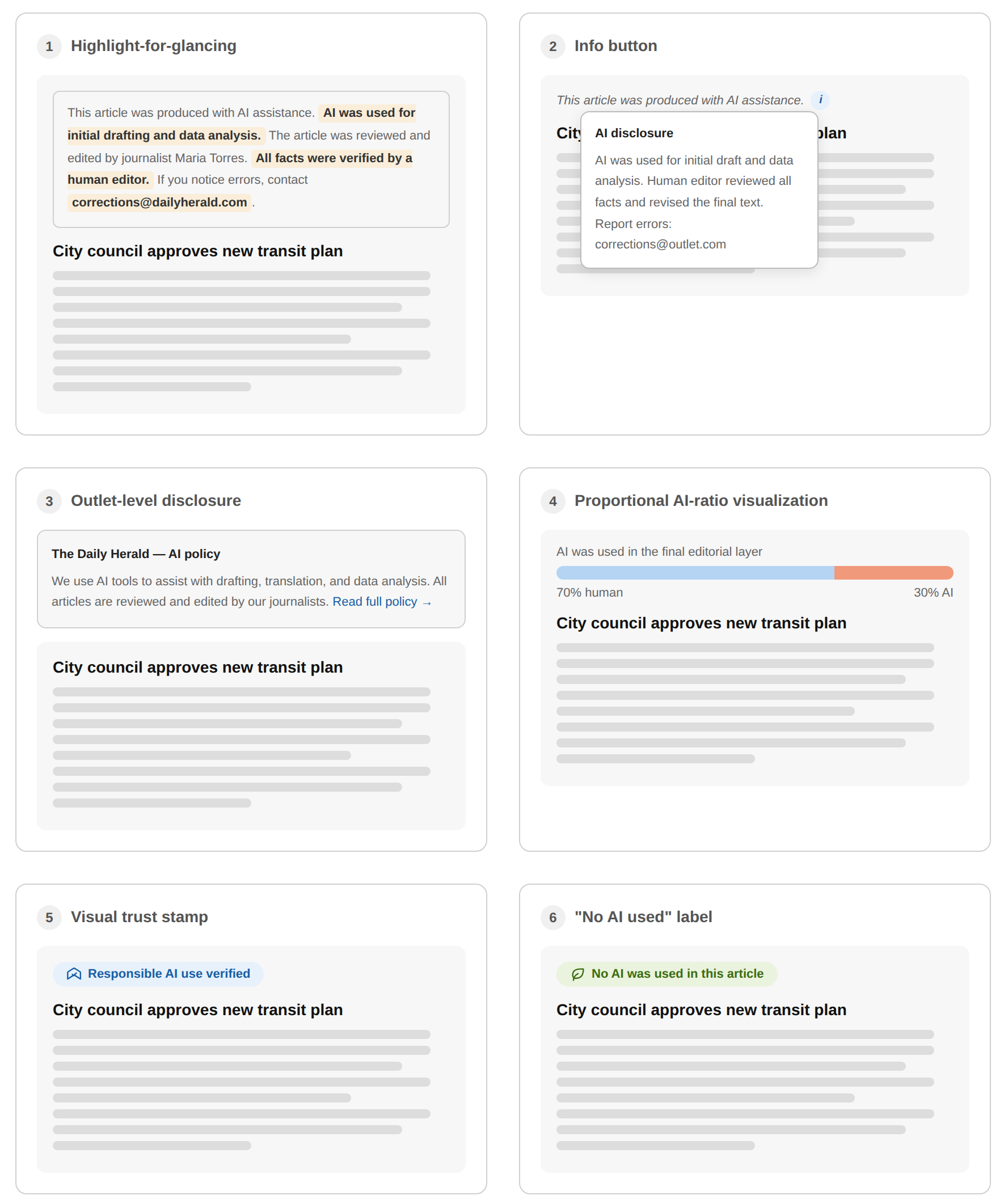
Fig 1: Mockups of six disclosure designs suggested by participants in [12]. Info icon, highlight-for-glancing, and outlet-level
Limitations
- Small user study sample size of 34 participants limits generalizability.
- Trust effects measured only in short-term controlled experiment, not real-world longitudinal settings.
- No adversarial evaluation or testing of malicious manipulation of disclosures.
- Study focuses on English-language news readers, generalizability to other cultures/languages unclear.
- Does not quantitatively validate proposed disclosure designs, only presents them as concepts/mockups.
- No direct measurement of behavior or engagement beyond self-reported trust and cognitive effort.
Open questions / follow-ons
- How do detailed and interactive disclosures perform in larger, more diverse populations and real-world settings?
- Can progressive disclosure interfaces measurably improve reader trust and reduce information gaps during extended news consumption?
- What regulatory frameworks can best mandate both mandatory disclosure and user-centric design approaches?
- How do disclosure effects vary across different news topics, formats, and audience familiarity with AI?
Why it matters for bot defense
While focused on journalism, this paper offers important lessons for bot-defense and CAPTCHA practitioners on the design of AI transparency disclosures. It cautions that overly detailed or compliance-driven transparency measures risk backfiring by eroding user trust or encouraging superficial interaction (dark patterns). Instead, transparency interfaces should grant users control and agency over how much and when to engage with AI usage information. In bot-defense contexts, this implies carefully balancing between mandatory notices or challenge explanations and minimizing cognitive load or user fatigue. The proposed interactive and proportional visualizations could inspire more user-friendly, trust-preserving interfaces for disclosing or explaining AI-driven decisions such as CAPTCHA challenges, automated bot detections, or fraud alerts. Additionally, the insight that users value explicit "no AI" signals suggests value in clearly communicating when AI is not involved, avoiding ambiguity. Overall, bot-defense systems must consider not just compliance with transparency policies but human factors to avoid eroding user trust or encouraging dismissive behavior toward disclosures.
Cite
@article{arxiv2606_11116,
  title={ Designed by Journalists, but Is It for Readers? Rethinking AI Disclosures and Transparency in News },
  author={ Pooja Prajod },
  journal={arXiv preprint arXiv:2606.11116},
  year={ 2026 },
  url={https://arxiv.org/abs/2606.11116}
}