
Inflationary interpretation of the gravitational-wave signal in the European Pulsar Timing Array DR2 with constraints
Source: arXiv:2606.09810 · Published 2026-06-08 · By Philippe Turgeon, Chiara Caprini, Anton Chudaykin, Martin Kunz, Delphine Perrodin, Ismael Cognard et al.
TL;DR
Analyzing the second EPTA data release's new timing measurements for 25 millisecond pulsars over 10.3 years, the authors identify two regimes in reheating temperature: a low Trh (<1 GeV) regime with very steep tensor spectral index (nt ~4) and a high Trh (>1 GeV) regime with flatter nt (~2). Without external constraints, the data allow wide parameter ranges, but imposing BLVK bounds eliminates the low-Trh steep-nt solution and favors the radiation-era horizon re-entry scenario with higher Trh, larger r (around 10^-8 to 10^-3) and nt ~2. The reheating temperature is constrained to unusually low values between ~1.8 MeV and 28 GeV at 95% confidence, challenging standard reheating theory. The inflation cutoff frequency fend becomes bounded between roughly 75 nHz and 14 Hz. This detailed statistical treatment, including physical priors and likelihood rejection, tightens the viable inflationary interpretations of the PTA signal substantially.
Key findings
- EPTA-only data show bimodal posterior distributions for reheating temperature Trh, splitting at around 1 GeV, with low Trh <1 GeV favoring steep tensor spectral index nt ~4 and high Trh >1 GeV favoring nt ~2.
- Incorporation of BBN, CMB, and LVK observational constraints (BLVK) removes the low-Trh, high-nt solution, selecting Trh between 1.78 MeV and 28.2 GeV at 95% CL.
- Imposing CMB B-mode polarization constraints further restricts log10 r to between -11.66 and -1.45, nt to 1.32 to 2.47, and fend to 75.86 nHz to 14.45 Hz at 95% CL.
- EPTA+BLVK+CMB analysis leads to a 95% CL median value of log10(Trh/GeV) ≈ 0.65 +/- 0.40 (around few GeV), compared to unconstrained analysis which yields unconstrained Trh posterior.
- The inflation cutoff frequency fend is limited from below by the PTA band (~10^-9 Hz) and from above by instantaneous reheating constraints (~1.5 × 10^8 Hz), with observational data favoring lower fend ~10^-5 Hz scale.
- Best-fit models reproduce the spectral slope γ of the common red noise signal in the PTA band (~2.9) via nt ~2 combined with transfer function effects from radiation-era horizon re-entry.
- The reheating temperature constraints imply very low values challenging to accommodate in conventional reheating scenarios, highlighting tension between inflationary interpretations and standard cosmology.
- Degeneracy among parameters r, nt, and Trh notably breaks when all observational constraints are applied, indicating the necessity of joint consideration of multiple cosmological bounds.
Methodology — deep read
The authors adopt a cosmological inflationary model for the gravitational wave background (GWB) detected by the EPTA, parameterized by four variables: tensor-to-scalar ratio r, tensor spectral index nt, reheating temperature Trh, and inflation cutoff frequency fend. They do not impose the standard single-field slow-roll inflation consistency relation nt = -r/8, allowing for blue-tilted tensor spectra and more general inflationary scenarios.
Their theoretical model calculates the present-day energy density spectrum ΩGW(f) using an equation incorporating r, nt, a transfer function T_(f, Trh, fend) modeling the cosmological evolution post-inflation, and a sharp cutoff above fend. The transfer function combines fitting functions accounting for horizon re-entry during matter and radiation eras and reheating effects, based on numerical solutions for quadratic inflaton potentials. Effective relativistic degrees of freedom g and g*s as functions of frequency/temperature are included per existing tabulated data.
The observational data consists primarily of the 10.3-year EPTA DR2new dataset observing 25 millisecond pulsars, analyzing timing residuals in nine Fourier frequency bins below white noise dominance. The authors employ the ENTERPRISE software to perform MCMC analyses jointly sampling PTA noise model parameters (red noise, dispersion measure variations) and cosmological parameters. The common red signal is modeled as a common uncorrelated red noise (CURN) process rather than explicitly imposing Hellings-Downs spatial correlations, arguing that given current uncertainties this approximation does not affect conclusions.
External physical constraints are incorporated directly as likelihood-level cuts or a posteriori importance sampling: these include BBN and CMB limits on the integrated energy density of an additional stochastic background, an upper bound on ΩGW at ~25 Hz from LIGO-Virgo-KAGRA, and CMB B-mode polarization constraints on r and nt from joint Planck/BICEP2/Keck data. The reheating temperature prior is set broad, spanning from 10^-3 GeV to 10^3 GeV, encompassing prior PTA sensitivity scales.
Eight parallel-tempered MCMC chains run with Metropolis-Hastings sampling are employed to adequately explore this multi-parameter space, including its bimodalities. Convergence is measured with Gelman-Rubin diagnostics. Marginalized posterior distributions and joint contour plots are inferred using standard corner plot routines.
The analysis proceeds by first sampling cosmological parameters and PTA noise with EPTA data only, then including BLVK constraints directly in likelihood to restrict parameter space, then finally post-processing with CMB constraints to produce final marginalized results. This workflow captures the incremental effect of priors and observational data on constraining inflationary models.
A concrete example: for each MCMC sample, the tensor spectrum ΩGW(f) is computed from Eq. (1), folding in T1 and T2 transfer functions parametrized by Trh and fend; constraints on integrated ΩGW from BBN and CMB limit allowed parameter combinations; frequency cuts at fend eliminate high-frequency modes; the resulting spectral shape is compared with the EPTA observed common red noise amplitude in the first 9 Fourier bins to assign likelihood. Sampling produces posterior distributions for r, nt, Trh, and fend consistent with current observational and physical bounds.
Code is based on publicly available ENTERPRISE software for PTA data analysis. The data DR2new is public to EPTA collaborators but underlying pulsar timing data are published. The physical constraints use publicly reported limits from Planck, BBN literature, and LVK collaboration papers. The authors mention adopting fiducial priors consistent with previous NANOGrav studies for ease of comparison.
Overall, the methodology integrates PTA data with cosmological and astrophysical observables coherently through a statistically robust Bayesian MCMC pipeline, enabling a model-independent exploration of inflationary interpretations that explicitly account for reheating and inflationary cutoff effects.
Technical innovations
- Sampling inflationary gravitational-wave background parameters including the reheating temperature Trh and inflation cutoff frequency fend as free parameters within a four-parameter phenomenological model, enabling modeling of non-instantaneous reheating and extended reheating epochs.
- Incorporation of Big Bang Nucleosynthesis, CMB integrated energy density bounds, and LIGO-Virgo-KAGRA gravitational wave constraints directly into the Markov Chain Monte Carlo sampling likelihood, rather than applying them a posteriori postprocessing, allowing joint consistent constraint propagation.
- Use of an updated transfer function modeling the IGWB spectral shape across frequency bands including detailed effects of matter-radiation equality, reheating, and changes in relativistic degrees of freedom with temperature to accurately link inflationary parameters to PTA-observed spectra.
- Adoption of Common Uncorrelated Red Noise (CURN) modeling for the common pulsar timing red noise signal to accelerate MCMC convergence and parameter recovery without explicit inclusion of Hellings-Downs spatial correlations, justified by current large parameter uncertainties.
- Application of parallel-tempering MCMC with multiple chains and temperature scaling to efficiently explore complex, multi-modal posterior distributions characteristic of inflationary parameter space given PTA data.
Datasets
- EPTA DR2new 25-pulsar dataset — 10.3 years of timing residuals from 25 millisecond pulsars — European Pulsar Timing Array collaboration
Baselines vs proposed
- EPTA-only analysis: log10 r posterior median ~ -18.0, nt ~3.4, unconstrained Trh; vs EPTA+BLVK+CMB: log10 r constrained between -11.66 to -1.45, nt between 1.32 to 2.47, Trh between 1.78 MeV and 28.2 GeV at 95% CL
- EPTA-only data allow bimodal reheating temperature Trh with no observational preference; BLVK constraints remove low-Trh (<1 GeV) high-nt (~4) mode in favor of high-Trh (>1 GeV) nt ~2 mode
- Including CMB B-mode polarization upper bound r0.01 < 0.076 at 95% CL further restricts allowed r and nt values post MCMC sampling vs prior unconstrained ranges
- LVK upper limit on energy density at ~25 Hz (ΩGW < 2.8 × 10^-9) effectively constrains high-frequency cutoff fend to be below ~14.45 Hz in the final posterior
Figures from the paper
Figures are reproduced from the source paper for academic discussion. Original copyright: the paper authors. See arXiv:2606.09810.
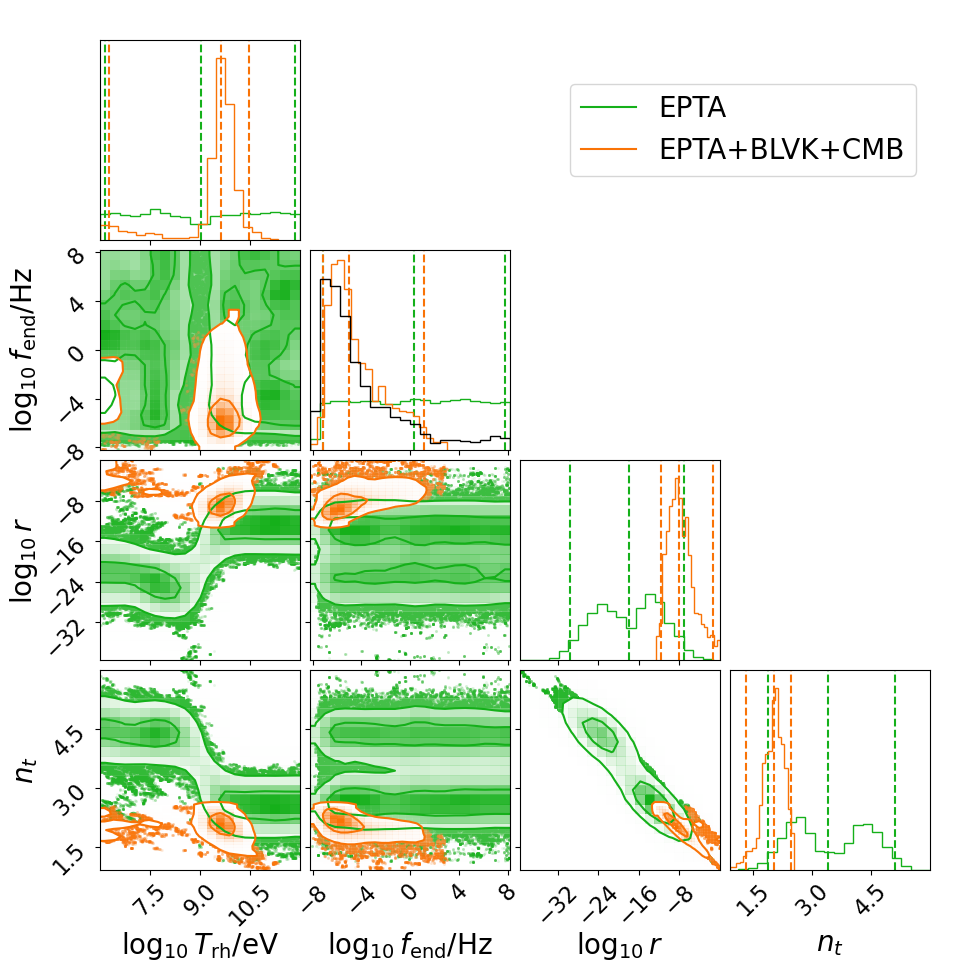
Fig 1: Posterior distributions for the Trh, fend, r and nt parameters obtained from the EPTA (green) and
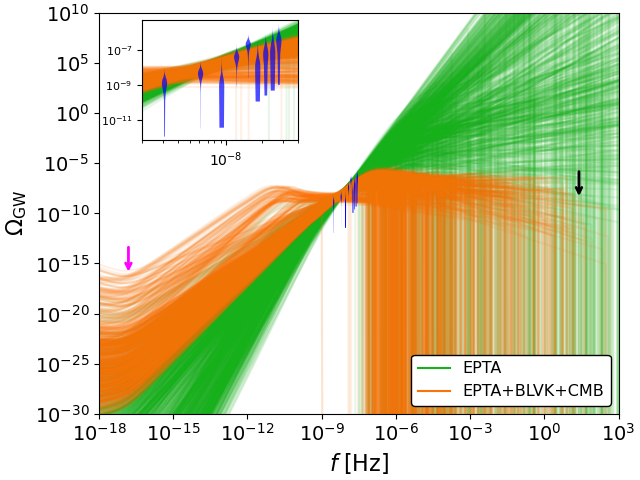
Fig 2: Theoretical predictions for ΩGW(f) randomly
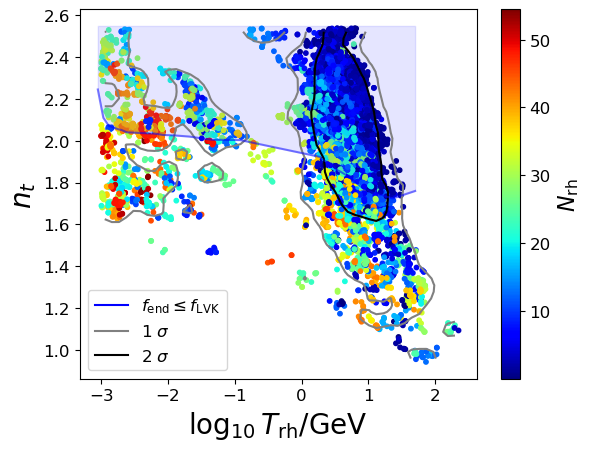
Fig 3: Number of e-folds of reheating in the posterior pa-
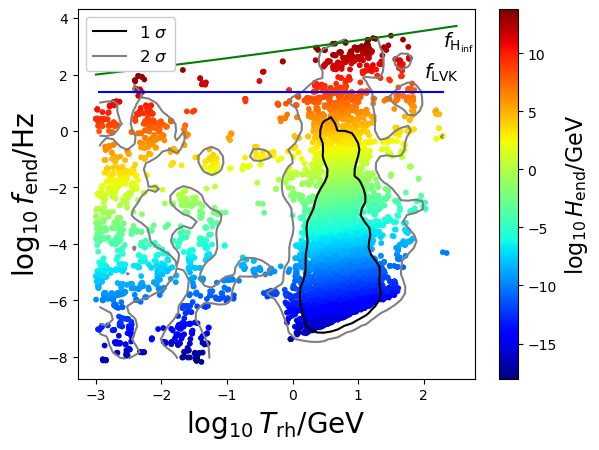
Fig 4: Hubble factor at the end of inflation in the
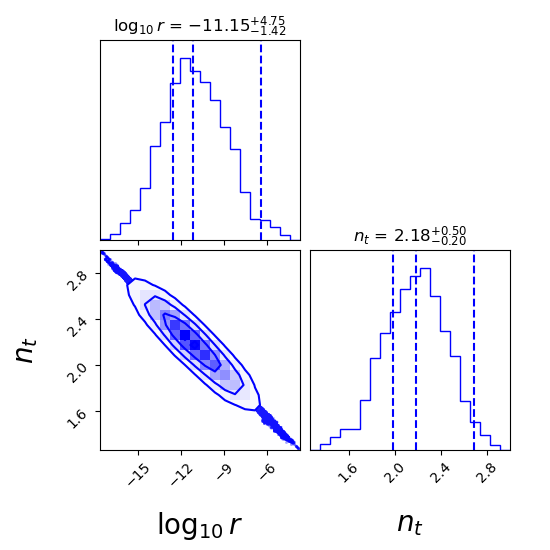
Fig 5: 95% CL posteriors for the parameters nt and log10 r
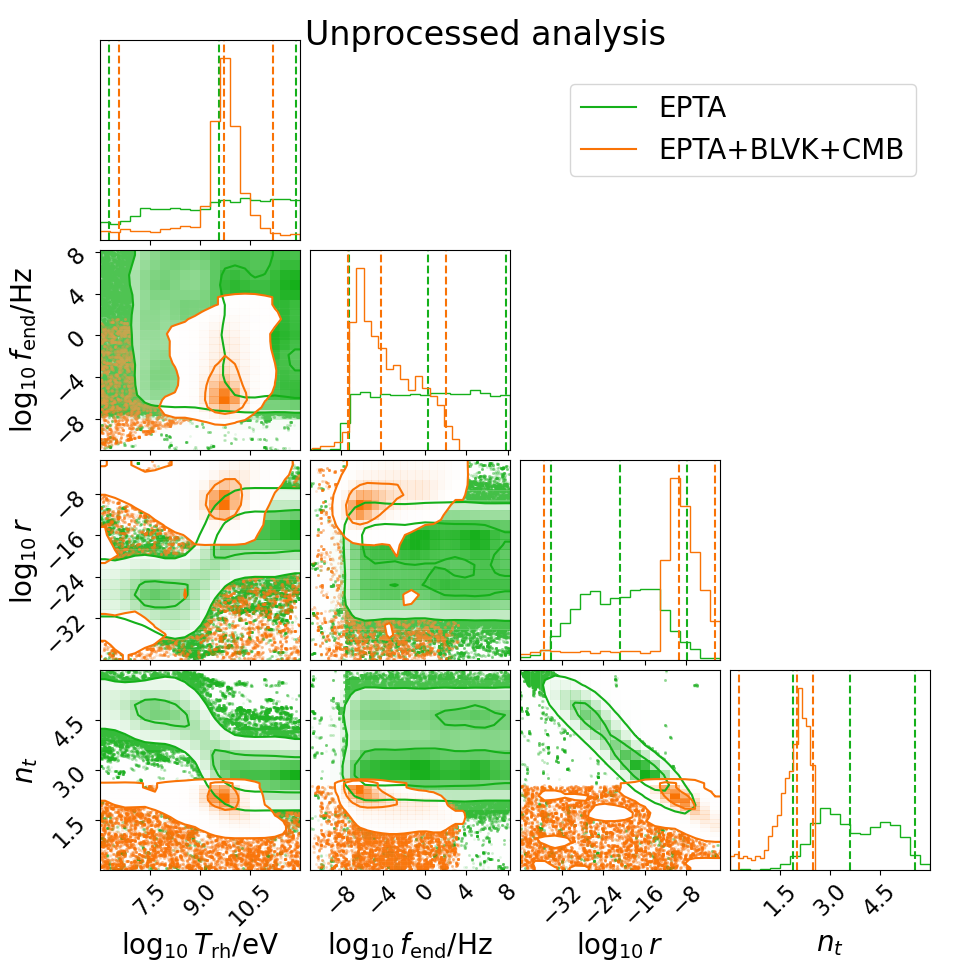
Fig 6: Posterior distributions for the Trh, fend, r and nt parameters obtained from the EPTA (green) and EPTA+BLVK+CMB
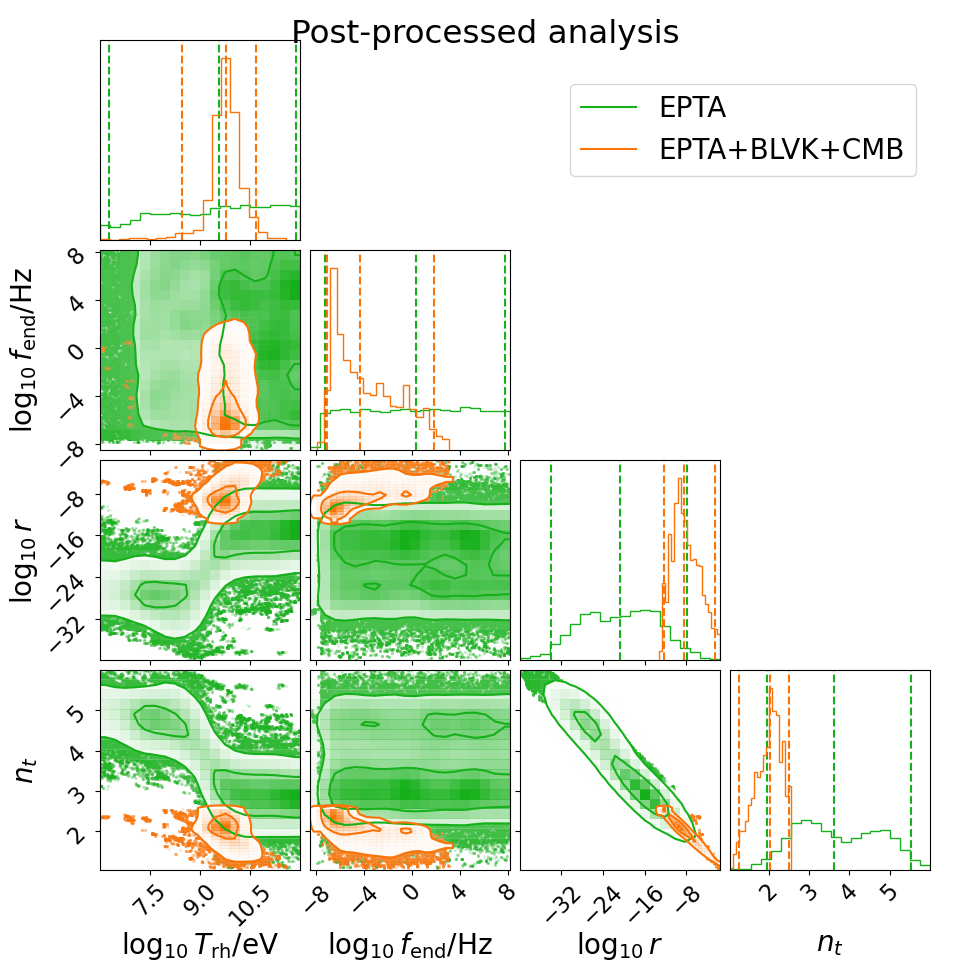
Fig 7: Theoretical predictions for ΩGW(f) randomly selected from the unprocessed (left panel) and post-processed (right
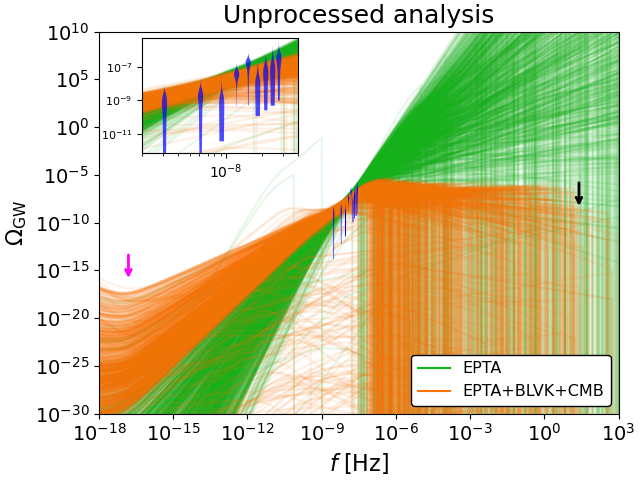
Fig 8 (page 15).
Limitations
- The reheating temperature posterior is highly prior dependent with current PTA data insensitive to this parameter without strong physical priors or external constraints, limiting direct PTA informativeness on reheating physics.
- The Common Uncorrelated Red Noise (CURN) approximation ignores spatial Hellings-Downs correlations, which may bias parameter estimates once PTA angular correlation measurements become more precise.
- Assumption of constant tensor spectral index nt across 18 orders of magnitude in frequency from CMB to PTA bands ignores possible running or scale dependence, which could alter derived constraints.
- The reheating effects are modeled assuming a quadratic inflaton potential; alternative potentials or non-standard reheating scenarios could change signal shape and constraints but were not explored.
- The upper bound prior on inflation cutoff frequency fend assumes instantaneous reheating bounds; exotic cosmologies like thermal inflation or bouncing models violating this assumption are not considered.
- Observational constraints used (BBN, CMB, LVK) are at fixed confidence levels and may be updated over time; analysis adopts somewhat conservative values but newer results could further restrict parameter space.
Open questions / follow-ons
- How would relaxing the assumption of a constant tensor spectral index nt across all frequencies affect the PTA inference on inflationary parameters?
- Could more realistic reheating models with non-quadratic potentials or non-perturbative reheating dynamics produce significantly different GW spectral features detectable by PTAs?
- What impact will inclusion of Hellings-Downs spatial correlations in the PTA noise model have on the recovered inflationary gravitational wave background parameters?
- How could combined PTA data from international arrays with longer baselines and enhanced sensitivity improve constraints on reheating temperature and inflation cutoff frequency?
Why it matters for bot defense
For bot-defense and CAPTCHA practitioners, this paper is an example of how careful integration of multi-modal astrophysical data with strict physical priors can dramatically constrain a parameter space prone to degeneracies and large uncertainties. The analysis demonstrates the power of combining noisy, indirect measurements (here pulsar timing residuals) with orthogonal external bounds (BBN, CMB, LVK) within a full Bayesian framework to extract meaningful constraints on underlying physical phenomena. In CAPTCHA and bot detection, this approach mirrors the need to fuse diverse signals (behavioral, network, biometrics) and ground-truth or conservative priors to discern subtle signals (e.g., bot signatures) amidst noisy backgrounds.
Moreover, the work highlights the necessity of including systematic uncertainties (here, noise models, reheating physics assumptions) and adopting flexible parameterizations that avoid overly restrictive theoretical assumptions (e.g., relaxing slow-roll inflation consistency). This corresponds to approaches in bot-defense where flexible modeling of attacker behaviors without overly narrow hypotheses may improve robustness. Finally, the explicit modeling of spectral transfer functions analogous to multi-stage signal transformations in a defensive pipeline may inform layered detection architectures integrating signals distorted by environmental factors.
Cite
@article{arxiv2606_09810,
  title={ Inflationary interpretation of the gravitational-wave signal in the European Pulsar Timing Array DR2 with constraints },
  author={ Philippe Turgeon and Chiara Caprini and Anton Chudaykin and Martin Kunz and Delphine Perrodin and Ismael Cognard and Lucas Guillemot and Gilles Theureau },
  journal={arXiv preprint arXiv:2606.09810},
  year={ 2026 },
  url={https://arxiv.org/abs/2606.09810}
}