
Signal-Driven Observation for Long-Horizon Web Agents
Source: arXiv:2606.06708 · Published 2026-06-04 · By Shubham Gaur, Ian Lane
TL;DR
This paper addresses a fundamental architectural inefficiency in long-horizon web agents: the obligate ingestion of the entire raw DOM and accessibility tree at every action step, even when most of that information is irrelevant to deciding the next action. This over-ingestion causes progressive context degradation that undermines reasoning, leading to failure modes such as context rot, loop-trapping, and goal drift, independent of model capacity or context window size. The authors argue this is distinct from the familiar problem of context length exhaustion and call it observation over-ingestion.
To address this, the paper proposes Signal-Driven Observation (SDO), a paradigm that decouples observation frequency from action frequency. SDO uses a lightweight, zero-LLM-cost signal detector to identify meaningful changes in the environment—such as URL transitions, new interactive ARIA elements, action failures, or exogenous page events—which then trigger a sub-call to an LM responsible solely for extracting a compact, task-relevant observation from the full DOM. Between such signals, the main (root) LM uses the latest summarized observation and executes planned actions with no extra DOM reads or LLM calls. This architectural separation prevents irrelevant context from accumulating and enables the root LM to maintain focused, stable task reasoning.
The paper does not provide experimental evaluation but demonstrates SDO’s potential through an e-commerce task case study, showing how the standard full-DOM ingestion agent fails due to context noise and goal drift while the SDO agent succeeds by maintaining a minimal, task-specific observation. It highlights several open challenges including designing comprehensive yet low-cost signals, maintaining filtering fidelity, closing the simulation-to-real gap, and enabling observation-level evaluation. Overall, the work reframes observation compression as a structural design decision rather than a downstream optimization, calling for new evaluation tools and research to operationalize this insight.
Key findings
- Observation over-ingestion is an architectural failure mode distinct from context length exhaustion that triggers context rot, loop-trapping, and goal drift in long-horizon web agents.
- Standard agents ingest raw DOM snapshots on every action step, causing contexts with tens of thousands of tokens of mostly irrelevant information that degrade reasoning.
- Signal-Driven Observation (SDO) decouples observation from action frequency via a lightweight signal detector monitoring URL changes, new interactive ARIA elements, action failures, and exogenous events.
- Sub RLM calls triggered only on signals return task-conditioned compact observations of relevant elements and selectors, reducing token counts dramatically between observations.
- In a long-horizon e-commerce purchase task, the SDO agent made 6 sub RLM calls and executed 12 actions, maintaining a compact context and avoiding context rot, goal drift, and failure modes that standard agents exhibit.
- The signal detector runs at zero LLM cost, enabling efficient triggering of re-observation only when environment state meaningfully changes.
- Current benchmarks and evaluation frameworks do not capture observation-level failures or whether agents act on stale observations; SDO surfaces the need for observation-level diagnostics.
- This architectural approach flips the community’s prior framing by treating observation compression as a first-class primitive rather than purely a compression or summarization problem applied post-hoc.
Threat model
The paper’s focus is not on adversarial threat modeling but on architectural weaknesses causing failure in autonomous web agents. The effective adversary is the complexity and dynamic unpredictability of web environments that cause agents to ingest large, irrelevant DOM observations at every action step, resulting in degraded reasoning. The agent cannot avoid repeated full DOM ingestion under current architectures but SDO proposes a way to reduce this burden. The adversary cannot manipulate agent policies or models but causes proxy failures through environmental complexities like exogenous DOM changes.
Methodology — deep read
Threat Model & Assumptions: The adversary model is implicit; the paper focuses on architectural inefficiencies rather than classical adversarial attackers. The assumed environment is a web browser controlled by Playwright, interacting with dynamic web pages that can change state due to agent actions or exogenous events. The main problem is causal: the agent’s observation architecture causes failures by repeatedly ingesting full DOMs regardless of changes.
Data & Environment: No datasets are used for training or evaluation in this conceptual work. The discussion references benchmarks like WebArena, WorkArena, BrowserGym, and others to contextualize the scale of observations (~20K-80K tokens). The case study example is an e-commerce purchase task involving multiple page loads, interactive elements, and interruptions like cookie banners.
Architecture / Algorithm: SDO consists of four runtime components:
- Root LM: Maintains the original task spec, a history of compact observations, and executed actions. Plans action sequences based only on compact observations, never directly reading raw DOM.
- Sub RLM: Invoked only on signals, reads the full DOM and accessibility trees, returns a task-conditioned compact observation summarizing only relevant interactive elements with selectors.
- Signal Detector: A zero-LLM-cost rule-based component that monitors four browser-native signals:
- URL transitions
- Newly visible ARIA elements relevant to interaction
- Action failures (exceptions, timeouts)
- Exogenous DOM mutations (e.g., cookie banners, AJAX changes)
- Browser: Executes Playwright actions and triggers signal detection after each. Root LM replans only when a new observation arrives from sub RLM, otherwise executes the action sequence without additional DOM reads or LLM calls.
Training Regime: The work does not include model training or empirical evaluation. The sub RLM and root LM can be the same LM with different prompts or separate models.
Evaluation Protocol: No quantitative evaluation is performed in this concept paper. Failure modes are analyzed qualitatively through a detailed case study comparing standard full-DOM ingestion to SDO on a long-horizon web task.
Reproducibility: The paper does not release code, data, or trained models. It explicitly states SDO is a sketch to motivate future infrastructure and experimentation.
Example end-to-end, step-by-step illustration of SDO operation is provided in an e-commerce task:
- Initial page load triggers sub RLM that summarizes 1,200 page elements into a single compact observation (search bar).
- Root LM plans actions (type query, click search).
- URL change triggers signal detector, sub RLM is reinvoked producing a compact summary of 6 relevant products from the 48 in DOM.
- Subsequent URL transitions and ARIA-element signals trigger sub RLM calls that extract task-relevant elements only (e.g., Add to Cart button, cookie banner flagged as blocking).
- Root LM plans using only these compact observations, never ingesting full DOM snapshots repeatedly.
- Agent avoids context rot and goal drift unlike naive ingestion approaches.
Unclear aspects include concrete sub RLM prompting or model configuration, quantitative impact on token counts or latency, and performance under adversarial or noisy real-web conditions.
Technical innovations
- Identification and formalization of observation over-ingestion as an architectural failure mode distinct from context length exhaustion.
- Proposition of Signal-Driven Observation (SDO), decoupling observation frequency from action frequency via lightweight, zero-cost browser-native signal detection.
- Introduction of a dedicated sub-model (sub RLM) that reads the full DOM only upon signals and returns a compressed, task-conditioned observation.
- Architectural separation ensuring the root LM never ingests raw DOM, preserving context clarity and mitigating cascading reasoning failures.
Figures from the paper
Figures are reproduced from the source paper for academic discussion. Original copyright: the paper authors. See arXiv:2606.06708.
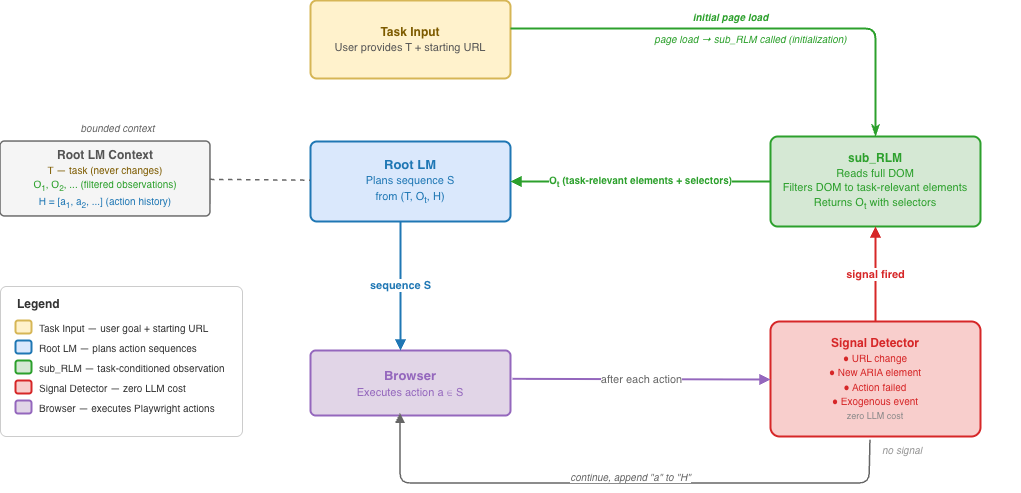
Fig 1: SDO architecture. The Signal Detector runs after every action at zero LLM cost. sub RLM is invoked only when a signal fires,
Limitations
- No experimental implementation or empirical evaluation of SDO is presented; claims are conceptual and illustrated via a single case study.
- The four signals defined do not guarantee completeness; some meaningful DOM changes (e.g., silent price updates) may escape detection, leading to stale observations.
- Filtering task-relevant elements via sub RLM is heuristic and may omit critical information or allow irrelevant info, introducing a compression-completeness tradeoff.
- Semantic errors without structural signals (e.g., wrong action chosen but no DOM change) remain undetected until downstream task failure.
- Simulation environments lack exogenous events, so RL-trained agents may never see such signals during training, limiting recovery in real settings.
- Accumulation of compact observations over very long horizons may still burden context, requiring further observation history management strategies.
Open questions / follow-ons
- How to design a comprehensive yet low-cost signal detection system that balances observation freshness against sub RLM call frequency?
- How to improve task-conditioned filtering to ensure sub RLM observations retain all relevant information for varied, open-ended tasks?
- What mechanisms can detect and recover from semantic errors during steady-state observations that produce no structural signals?
- How to bridge the gap between deterministic simulated training environments and noisy real web environments featuring exogenous events?
- How to manage the growing history of compact observations over very long task horizons without reintroducing context overload?
Why it matters for bot defense
For bot-defense and CAPTCHA practitioners, this work highlights a critical architectural inefficiency in sophisticated web agents performing long, multi-step interactions. Agents that ingest entire page DOMs at every action step accumulate noisy, irrelevant context that degrades their reasoning over time, ultimately leading to failure modes including loops, goal drift, and incoherent behavior. Applying the Signal-Driven Observation approach could mitigate these failure modes by systematically compressing what the agent observes and limiting observation updates to meaningful page changes. This principle suggests that defenders might detect or exploit observation over-ingestion failure points as attack surfaces or reliability weak spots.
From a CAPTCHA and bot-defense perspective, SDO underscores the importance of interaction dynamics rather than isolated page states. Bot detection could leverage the difference between agents that over-ingest observations at every step versus those that incrementally observe only on signals. Further, exogenous events like cookie banners or popup injections—which trigger re-observation signals in SDO—may provide meaningful points of intervention or monitoring. Conversely, builders of robust bots and CAPTCHAs should incorporate observation frequency and compression as fundamental design decisions, not mere optimizations, to improve reasoning and resilience over long task horizons.
Cite
@article{arxiv2606_06708,
  title={ Signal-Driven Observation for Long-Horizon Web Agents },
  author={ Shubham Gaur and Ian Lane },
  journal={arXiv preprint arXiv:2606.06708},
  year={ 2026 },
  url={https://arxiv.org/abs/2606.06708}
}