
Evolution of bilateral and multilateral collaboration of EU-14 countries across disciplines, 2010-2024
Source: arXiv:2606.06330 · Published 2026-06-04 · By Myroslava Hladchenko
TL;DR
This study investigates the evolution of bilateral and multilateral international research collaboration for nine EU-14 member states over the period 2010 to 2024, spanning six scientific disciplines using data from OpenAlex. The analysis reveals that bilateral collaboration rates remained largely stable and were predominantly concentrated within the EU-14 countries, with the USA, the UK, and China as key external partners. In contrast, multilateral collaboration increased significantly across all disciplines, especially in medicine and physics & astronomy, reflecting the growing importance of large-scale international consortia and infrastructure-intensive research fields. The study combines collaboration rates with the Relative Intensity of Collaboration (RIC) metric to assess not only frequency but also the strength of preferential collaboration ties. While RIC increased for both bilateral and multilateral collaboration, growth was strongest for multilateral networks. Collaboration with China increased markedly across STEM disciplines, whereas ties with the USA declined somewhat. Geopolitical disruptions like Brexit had limited impact on UK–EU collaboration, but Russia’s suspension from Horizon Europe coincided with reductions in physics & astronomy collaborations. The integrated analysis across multiple dimensions—collaboration type, discipline, partner group, and geopolitical context—highlights the dynamic landscape of European and global scientific collaboration over the last decade and a half.
Key findings
- Bilateral collaboration rates remained stable around 6% from 2010 (5.98%) to 2024 (5.78%), concentrated mainly within EU-14 countries (~35–37%) and with USA, UK, China.
- Multilateral collaboration rates increased significantly from 15.6% in 2010 to 17.9% in 2024 across all six disciplines.
- The largest increases in multilateral collaboration rate were in medicine (+4.3%) and life & environmental sciences (+2.9%), with physics & astronomy maintaining highest overall rates (~1.59 to 1.67 RIC).
- Relative Intensity of Collaboration (RIC) grew more strongly for multilateral ties (+0.28, from 0.94 to 1.22) than bilateral (+0.11, from 0.57 to 0.68), indicating stronger-than-expected multilateral engagement.
- Collaboration with China grew fastest, notably in engineering (bilateral from 3.4% to 14.8%) and physics & astronomy (multilateral from 13.1% to 25.9%), while collaboration with USA declined notably in social sciences (bilateral 20.7% to 11.5%) and medicine (24.8% to 16.1%).
- No substantive changes in collaboration rates or RIC with UK occurred after Brexit, reflecting stable EU-UK scientific ties.
- Multilateral collaboration with Russia declined sharply especially in physics & astronomy (24.3% to 14.8%) coinciding with suspension from Horizon Europe in 2022; medicine collaboration with Russia increased instead.
- Multilateral RIC fell below expected levels most frequently with South Korea, India, and China, despite overall growth.
Threat model
n/a — The paper is a scientometric analysis of international research collaboration patterns without adversarial or threat considerations.
Methodology — deep read
The study’s threat model assumes an analytical perspective without adversarial considerations; the focus is on measuring and characterizing international collaboration patterns rather than security threats. Data derive from the OpenAlex scholarly publication database accessed via BigQuery through the InSySPo project, covering articles published between 2000 and 2025 with at least one citation—this citation threshold helps ensure visibility and completeness, acknowledging that about 30% of authors annually have incomplete affiliation metadata, especially in recent years. The study focuses on nine EU-14 member states and 20 partner countries/groups, including EU-13, EU candidates, and major global actors such as USA, China, Russia, and South Korea. Analysis spans six broad disciplines aggregated from OpenAlex subfields: computer science, engineering, life & environmental sciences, medicine, physics & astronomy, and social sciences & humanities.
Collaboration is categorized into bilateral (exactly one foreign partner country) and multilateral (two or more foreign countries) co-authorships. Two primary metrics are used: collaboration rate (proportion of internationally co-authored articles relative to total publications per country/discipline/year) and Relative Intensity of Collaboration (RIC), an asymmetric metric comparing observed bilateral/multilateral collaboration proportions to expected values based on total publication outputs, where RIC >1 indicates stronger-than-expected collaboration.
Data preprocessing included filtering to cited articles with complete metadata, and mapping of OpenAlex classification into disciplines. Statistical analysis involved fitting two linear mixed-effects models (Model 1 for collaboration rates, Model 2 for RIC) with country as a random intercept and fixed effects for year (centered on 2010), collaboration type, partner group, and discipline, including all interactions. Predicted values for 2010 and 2024 allowed assessment of temporal trends, and post-hoc analyses examined the relationship between changes in collaboration magnitude and intensity.
For example, the end-to-end pipeline for physics & astronomy involved extracting all articles with EU-14 author affiliations, identifying co-authorships with foreign partners, categorizing by bilateral vs multilateral, calculating yearly collaboration rates and RIC for each partner, fitting mixed-effects models, and interpreting temporal trends showing physics & astronomy had highest multilateral collaboration rates and RIC, with strong growth in multilateral ties with China but a decline in collaboration with Russia after 2022. Visualizations such as Fig. 4, 5 and 6 illustrate these cross-discipline, partner, and collaboration-type patterns.
The study relies on OpenAlex data and R code for analysis but does not mention a public code release or frozen model weights, noting that OpenAlex data are publicly accessible but may have metadata completeness limitations. It acknowledges potential data coverage challenges in recent years due to citation thresholding and evolving affiliations. While statistically robust with linear mixed models and emmeans post-hoc contrasts, the study does not evaluate adversarial robustness or causal effects of specific policies.
Technical innovations
- Integrated simultaneous analysis of bilateral and multilateral scientific collaboration across multiple disciplines, partner regions, and geopolitical contexts over 2010–2024.
- Application of the Relative Intensity of Collaboration (RIC) metric to distinguish not only magnitude but preferential bias in collaboration ties in an asymmetric, network-aware manner.
- Use of linear mixed-effects models with country random intercepts and interaction terms to disentangle temporal, disciplinary, and geopolitical effects on collaboration rates and intensity.
- Empirical linkage of collaboration variations to major geopolitical events such as Brexit and Russia’s Horizon Europe suspension, contextualizing scientometric trends.
Datasets
- OpenAlex (via BigQuery, InSySPo project) — ~2000–2025 articles with at least one citation — public scholarly metadata repository
Baselines vs proposed
- Bilateral collaboration rate 2010: 5.98% → 2024: 5.78% vs multilateral collaboration rate 2010: 15.6% → 2024: 17.9%
- Multilateral RIC 2010: 0.94 → 2024: 1.22 vs Bilateral RIC 2010: 0.57 → 2024: 0.68
- Engineering bilateral collaboration with China 2010: 3.4% → 2024: 14.8%
- Multilateral collaboration in physics & astronomy with China 2010: 13.1% → 2024: 25.9%
- Social sciences bilateral collaboration with USA 2010: 20.7% → 2024: 11.5%
- Medicine bilateral collaboration with USA 2010: 24.8% → 2024: 16.1%
Figures from the paper
Figures are reproduced from the source paper for academic discussion. Original copyright: the paper authors. See arXiv:2606.06330.
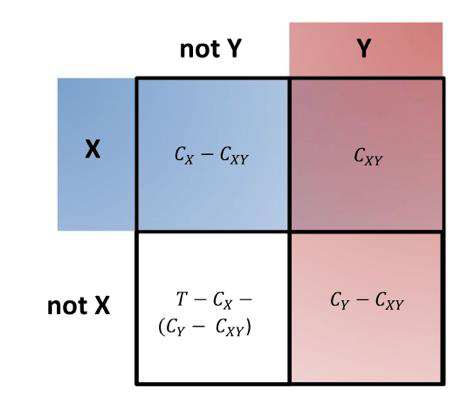
Fig 1: Diagram and formular of RIC (Fuchs et a., 2021).
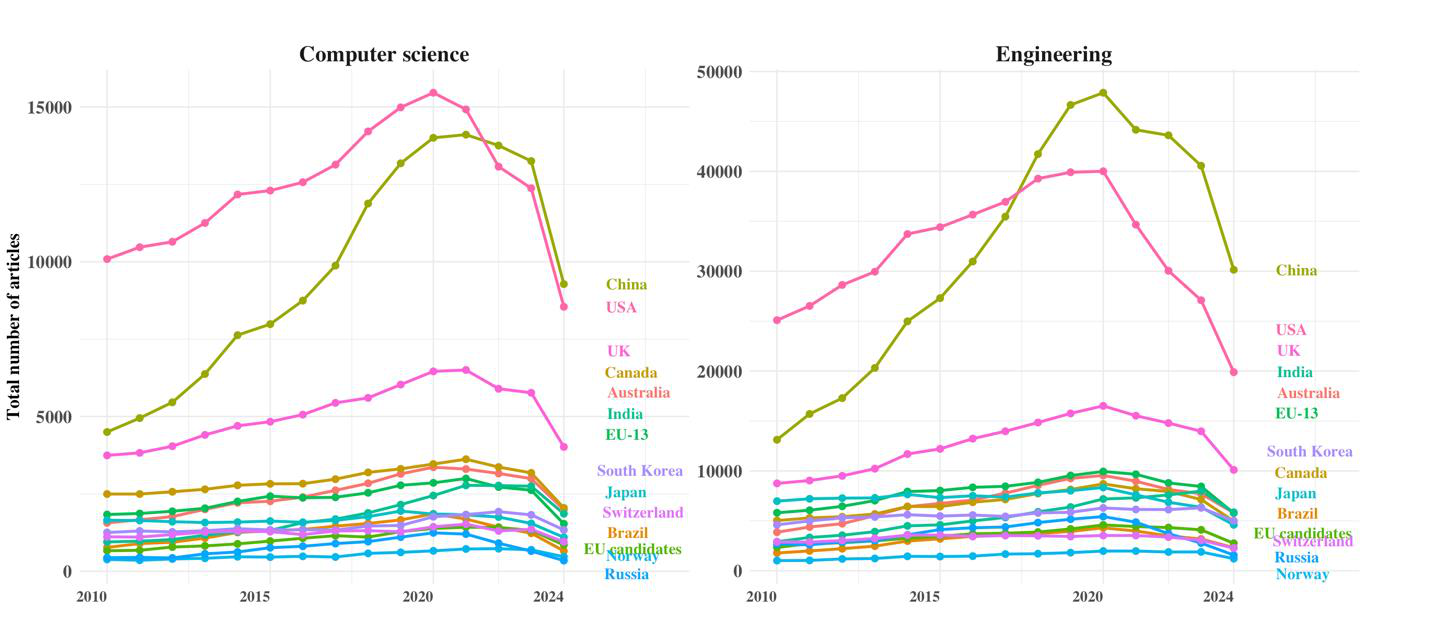
Fig 2: Total number of internationally co-authored articles (bilateral collaboration).
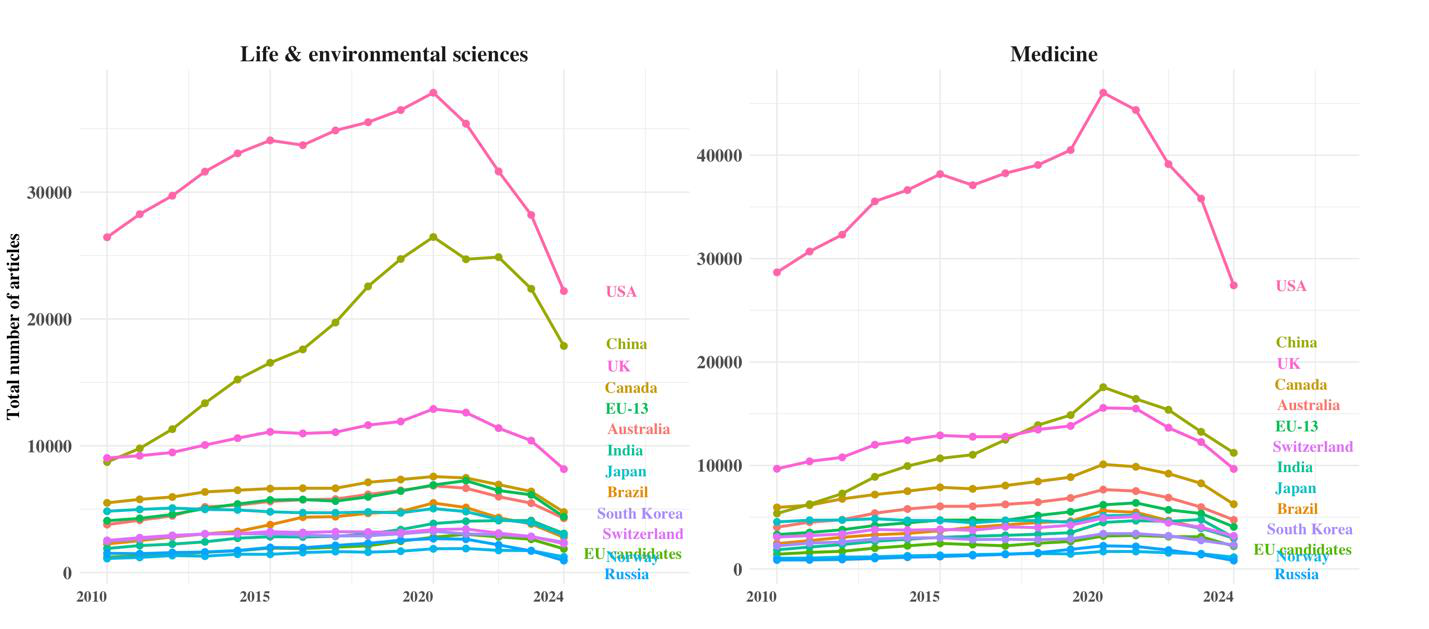
Fig 3: Total number of internationally co-authored articles (multilateral collaboration).
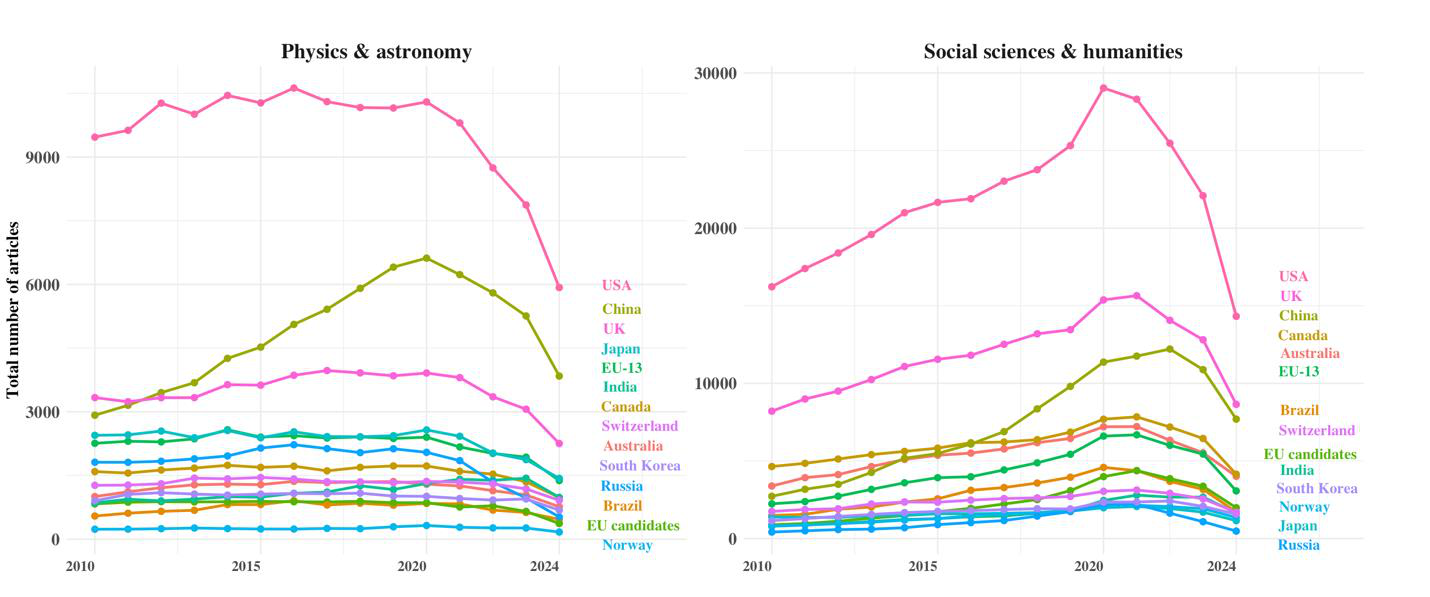
Fig 4 (page 7).
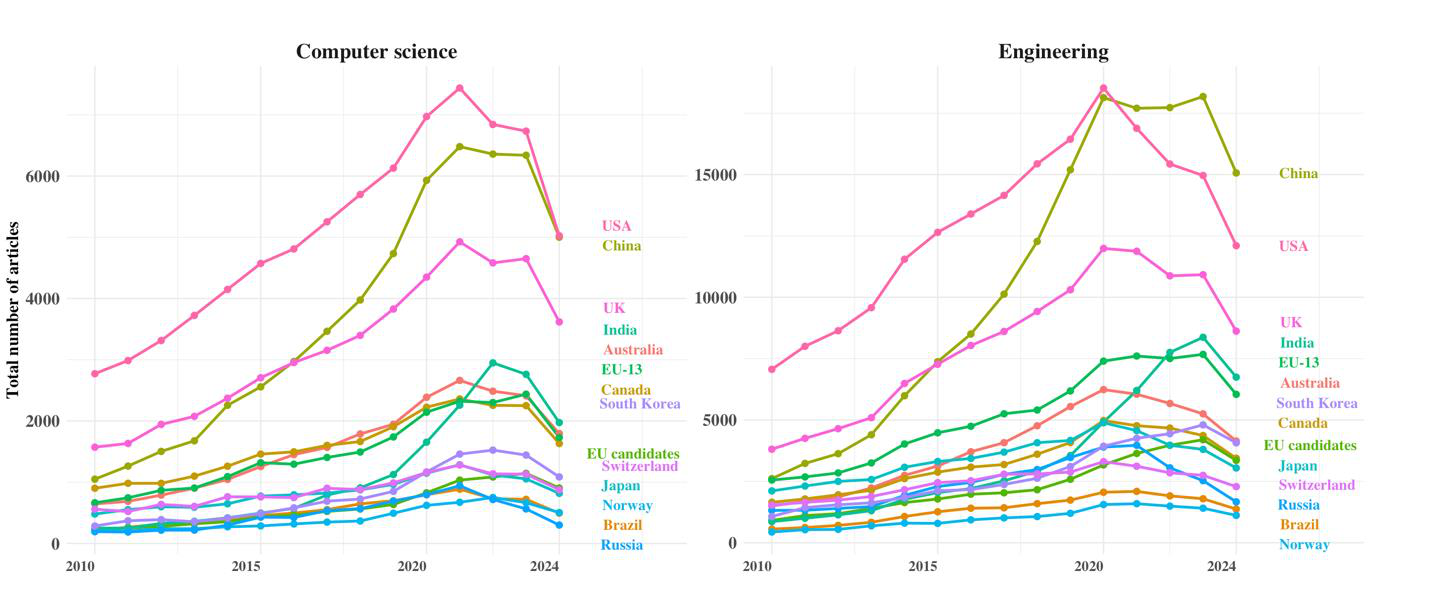
Fig 5 (page 8).
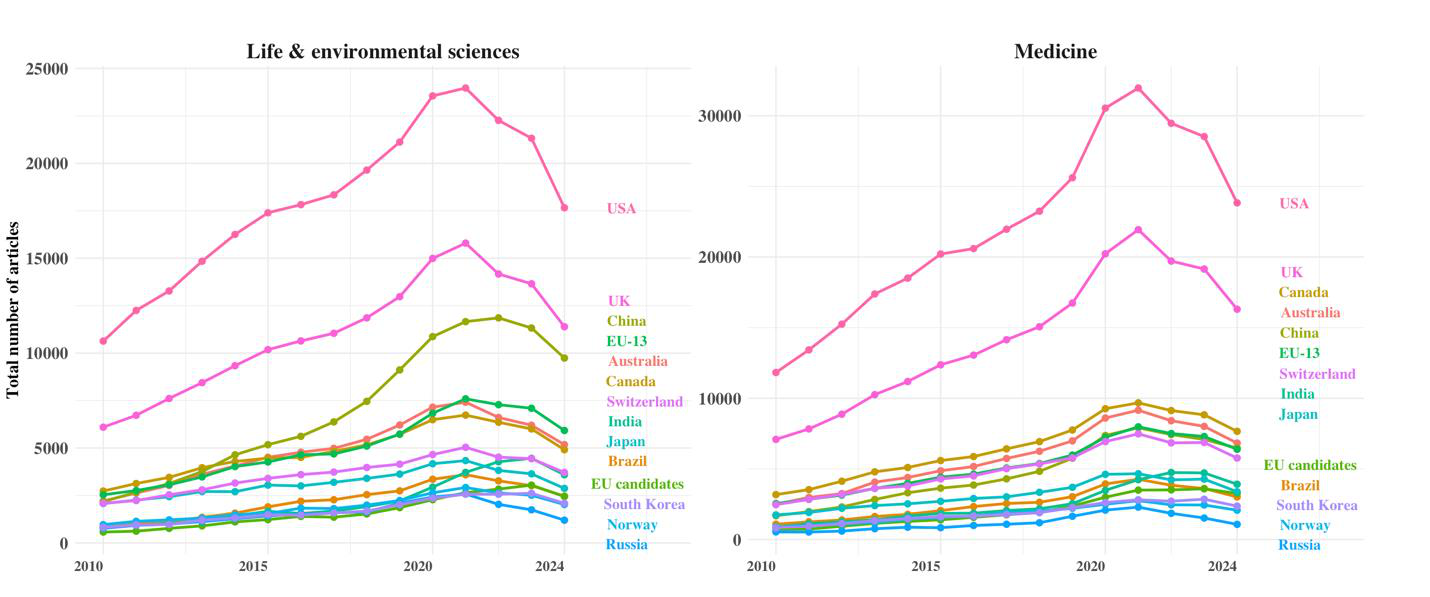
Fig 6 (page 8).
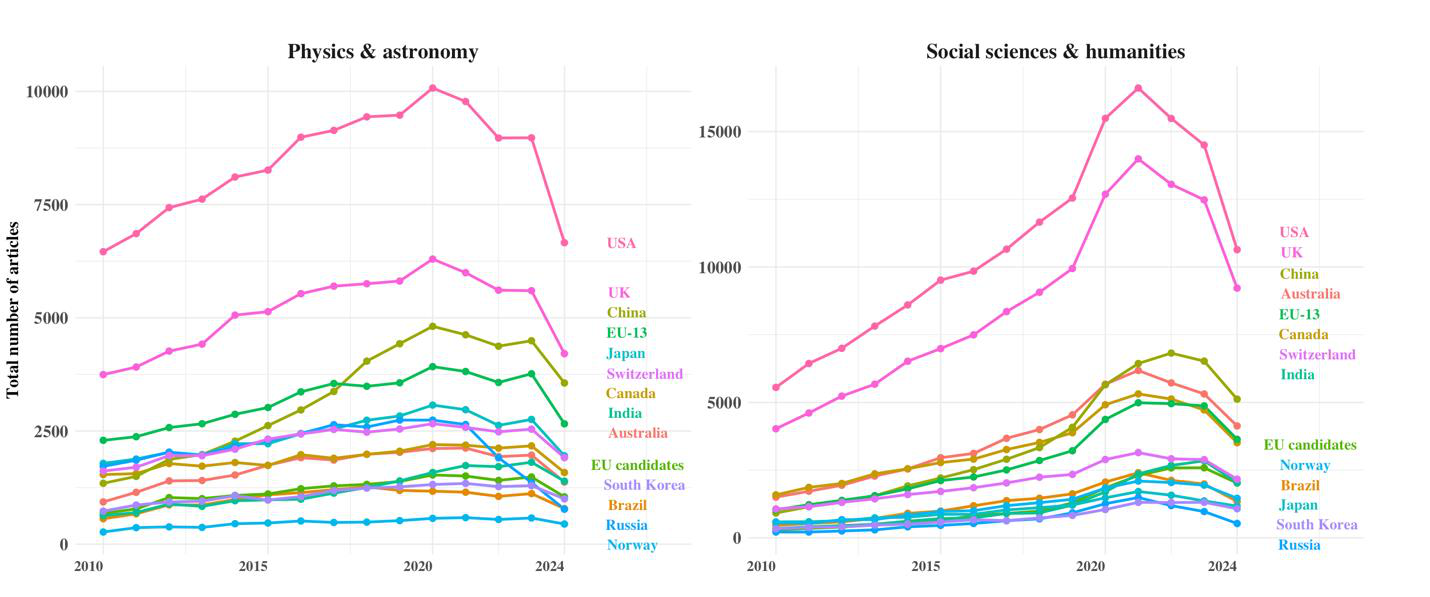
Fig 7 (page 8).
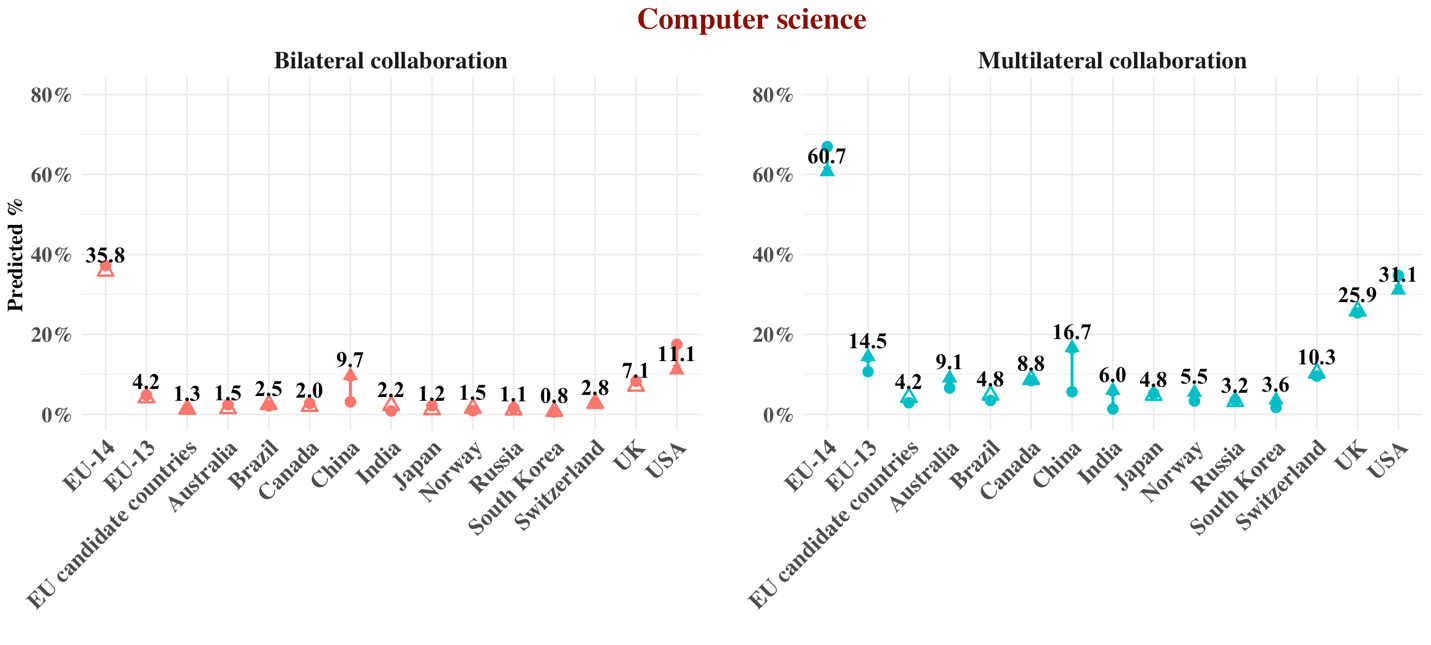
Fig 4: Predicted percentage of jointly co-authored articles across disciplines, 2010-2024.
Limitations
- Dataset restricted to articles with at least one citation to ensure metadata completeness, potentially biasing against very recent publications and rapid trends.
- Affiliation metadata in OpenAlex is incomplete (~30% missing per year), which may affect accuracy of country-level collaboration assignment, particularly in recent years.
- No adversarial or causal evaluation to attribute changes in collaboration rates specifically to policies such as Horizon Europe or Brexit beyond temporal association.
- The study aggregates diverse subfields into broad disciplines, which may mask finer-grained disciplinary heterogeneity in collaboration patterns.
- RIC metric is asymmetric and based on publication counts, possibly obscuring nuances of author contributions or collaboration quality (e.g., hyperauthorship).
- Lack of public release of analysis code or frozen data snapshot may limit straightforward reproducibility or verification.
Open questions / follow-ons
- How do institutional and individual-level factors mediate the observed bilateral and multilateral collaboration patterns within EU-14 countries?
- What are the causal impacts of EU funding policies (e.g., Horizon Europe) and geopolitical events on shifts in collaboration intensity and partner choice?
- How does the quality and impact of research outputs correlate with different collaboration types (bilateral vs multilateral) and disciplines?
- How will recent exclusions or restrictions (e.g., Chinese universities from Horizon Europe calls) affect future collaboration networks beyond 2024?
Why it matters for bot defense
This paper informs bot-defense and CAPTCHA practitioners about evolving global scientific collaboration networks involving major technology hubs such as EU-14 countries, China, USA, and others. Understanding multilateral and bilateral collaboration patterns, especially increases in multilateral collaboration in infrastructure-intensive fields like physics and medicine, can offer insights on where advanced research and technology ecosystems are densely interconnected internationally.
From a bot-defense perspective, this highlights the geopolitical and disciplinary contexts influencing technological innovation centers, potential sources of advanced adversarial research, and cross-border knowledge flows. The temporal stability of bilateral ties but increasing multilateral consortia participation suggests that attacker capabilities may evolve via large international collaborations. Also, the heterogeneous impacts of events like Brexit or sanctions on Russian participation emphasize the importance of monitoring how geopolitical shifts affect global research landscapes with potential security implications.
Although not directly about CAPTCHAs or bot detection methods, the methodology—using collaboration metrics like RIC combined with large-scale bibliometric data and robust statistical models—could inspire analogous approaches for analyzing collaborative threat intelligence sharing or botnet growth patterns. Practitioners can also consider how disciplines with high multilateral collaboration rates correlate with fields producing novel technologies relevant to automated attacks or defenses.
Cite
@article{arxiv2606_06330,
  title={ Evolution of bilateral and multilateral collaboration of EU-14 countries across disciplines, 2010-2024 },
  author={ Myroslava Hladchenko },
  journal={arXiv preprint arXiv:2606.06330},
  year={ 2026 },
  url={https://arxiv.org/abs/2606.06330}
}