
A-Live: Passive Liveness Detection via Neuromuscular Micro-Motion Signatures on Commodity Sensors
Source: arXiv:2606.05126 · Published 2026-06-03 · By Mohammed Gharib, Sam Burns, Martin Zizi
TL;DR
This paper addresses the challenge of liveness detection in biometric and digital interactions, which is increasingly critical due to sophisticated AI-driven spoofing that mimics human behavior. Traditional techniques rely on explicit user challenges, specialized hardware, or surface-level visual cues, all of which have limitations in scalability, usability, and robustness against advanced physical or software attacks. The key innovation is the use of neuromuscular micro-motion signatures — subtle involuntary micro-movements driven by human motor control processes — captured passively by commodity inertial measurement unit (IMU) sensors prevalent in smartphones and wearables. These micro-motions encode complex stochastic patterns tied to neurophysiology that are difficult for automated scripted or robotic adversaries to replicate.
The authors develop A-Live, a lightweight five-stage pipeline that preprocesses raw IMU time-series, extracts temporal, spectral, and stochastic features, and classifies interactions as live human or non-live agent. They validate on over 100 Android and iOS device models, testing with real users and a programmable robotic platform designed to mimic human motion. Results show A-Live achieves over 99.5% accuracy with low false acceptance and false rejection rates, demonstrating robust, scalable, and passive liveness detection without user friction or specialized hardware. This fundamentally different approach exploits physiological side-channels rather than surface-level behavior, advancing the security state-of-the-art for bot and spoof detection under emerging AI-based threat models.
Key findings
- A-Live achieves over 99.5% liveness detection accuracy across 101 smartphone and tablet models spanning Android and iOS platforms.
- False acceptance and false rejection rates remain consistently low, maintaining security under practical real-world conditions.
- The system operates on fixed-duration 1-second IMU signal windows containing accelerometer and gyroscope data, agnostic to device-specific sampling rates (∼50–1200 Hz).
- Preprocessing preserves fine-grained micro-movement structure while suppressing slow trends and sensor noise, avoiding aggressive filtering that could remove physiological signatures.
- Feature extraction combines temporal, spectral, and stochastic descriptors computed on original and PCA-transformed IMU signals to capture subtle neuromuscular micro-motions robust to device orientation variability.
- A programmable robotic motion platform generates physically actuated adversarial traces mimicking human-like coarse motion but lacking neuromuscular micro-motion patterns; A-Live successfully distinguishes these synthetic signals.
- The approach is fully passive, requiring no explicit user interaction, specialized hardware, or cooperation, enabling scalable deployment across commodity devices.
- Neuromuscular micro-movements produce structured stochastic signals tied to central/peripheral nervous system activity that are inherently difficult to replicate via software or mechanical actuation.
Threat model
The adversary is a strong attacker capable of generating interaction traces via automated software agents, AI-driven control policies, or robotic mechanisms designed to imitate coarse-grained human device motions. However, the adversary cannot access or replicate underlying neuromuscular control processes producing involuntary micro-movements detectable in IMU sensor data. The adversary also lacks privileged access to sensor data streams, relying solely on generating plausible input-level motion signals. The system does not rely on trusted hardware sensor protections, aiming instead to discriminate biological micro-motion signatures from synthetic or mechanically induced motion in commodity sensor data.
Methodology — deep read
The threat model assumes a strong adversary capable of automated scripted, AI-driven software agents, or robotic physical actuators generating interaction traces attempting to mimic human motor activity. However, the adversary cannot reproduce the intrinsic neuromuscular control dynamics that generate involuntary micro-movements measurable by IMUs on commodity devices.
Data is acquired from tri-axial accelerometer and gyroscope sensors embedded in smartphones and wearables. Sampling frequencies vary widely (50–1200 Hz) across 101 devices tested. Data is segmented into fixed 1-second windows (N = T * fs samples) for processing, independent of raw sampling rate, to standardize temporal resolution for micro-motion analysis.
Each raw IMU signal X(t) is modeled as a superposition of voluntary coarse motion M(t), neuromuscular micro-movement N(t), and sensor/environmental noise E(t). The preprocessing pipeline applies careful conditioning to remove slow-varying components (e.g., device drift, large-scale hand shaking) and noise artifacts while preserving the stochastic fine structure of N(t). Temporal alignment addresses clock skew between accelerometer and gyroscope streams to avoid temporal inconsistencies.
The core feature extraction stage computes a mapping ϕ(Xk) transforming each 1-second window into a feature vector combining temporal variability descriptors (motion smoothness, evolution), spectral energy distribution features (frequency-domain signatures characteristic of micro-motions), and stochastic/distributional metrics (impulsiveness, irregularity). Features are computed both on raw axis-aligned data and on PCA-transformed data to decorrelate axes and improve invariance to orientation.
The classifier is a lightweight model optimized for on-device real-time inference. Inputs are the extracted feature vectors, outputs a binary live/non-live decision based on a threshold τ applied to classifier score g(zk). The system is designed for computational efficiency and minimal user friction.
Training and evaluation use large-scale device farms enabling automated attacks and real-user scenarios for data diversity across platforms and hardware. The programmable robotic motion platform generates active spoofing attempts physically mimicking human coarse motion patterns but lacking neuromuscular micro-motions, testing robustness against sophisticated threats.
Evaluation metrics include detection accuracy, false acceptance rate (FAR), and false rejection rate (FRR) across devices and adversarial conditions. The system achieves over 99.5% accuracy consistently with low FAR/FRR, indicating reliable discrimination. The methodology stresses capturing physiological control process signatures via IMU data rather than relying on conventional biometric cues.
Code and data release details are not specified, but a reference implementation of the pipeline is provided for reproducibility guidance. Proprietary aspects are abstracted from full feature set details. Precise hyperparameters, optimizer choice, or classifier architecture details are minimally reported.
End-to-end example: Raw IMU signals collected at 100 Hz for a 1-second window are temporally aligned and preprocessed to suppress trends but preserve micro-motions. Temporal, spectral, and stochastic features are extracted on both axis-aligned and PCA domains. The feature vector is input to the classifier, which outputs a score thresholded to produce a binary live/non-live decision. This process runs continuously and passively during user interactions without explicit user prompts, differentiating legitimate human interactions from scripted or robotic mimicry.
Technical innovations
- Use of neuromuscular micro-movements captured by commodity IMU sensors as a fundamentally new modality for passive liveness detection, contrasting with prior coarse motion or visual appearance methods.
- A multi-stage feature extraction combining temporal, spectral, and stochastic descriptors computed on both axis-aligned and PCA-transformed inertial signals to robustly characterize subtle physiological micro-motion signatures.
- Design of a lightweight, real-time classifier operable on-device and agnostic to device-specific IMU sampling rates, enabling scalable deployment without specialized hardware.
- Development of a programmable robotic micro-motion platform to generate active physical spoofing attacks for robustness evaluation, addressing limitations of prior purely software-based attack models.
Datasets
- Cross-device IMU dataset — data collected from 101 smartphone and tablet models spanning Android and iOS platforms — source: in-house data collection on real devices and device farm
- Robotic micro-motion platform dataset — physically actuated synthetic micro-motion traces designed to mimic human motion dynamics — source: in-house adversarial platform
Baselines vs proposed
- No explicit quantitative baseline model comparisons reported; however, A-Live achieves >99.5% accuracy in differentiating human from non-human IMU traces across 101 devices and adversarial robotic motion attacks.
Figures from the paper
Figures are reproduced from the source paper for academic discussion. Original copyright: the paper authors. See arXiv:2606.05126.

Fig 4: Programmable adversarial motorized platform for generating controlled micro-motion perturbations.
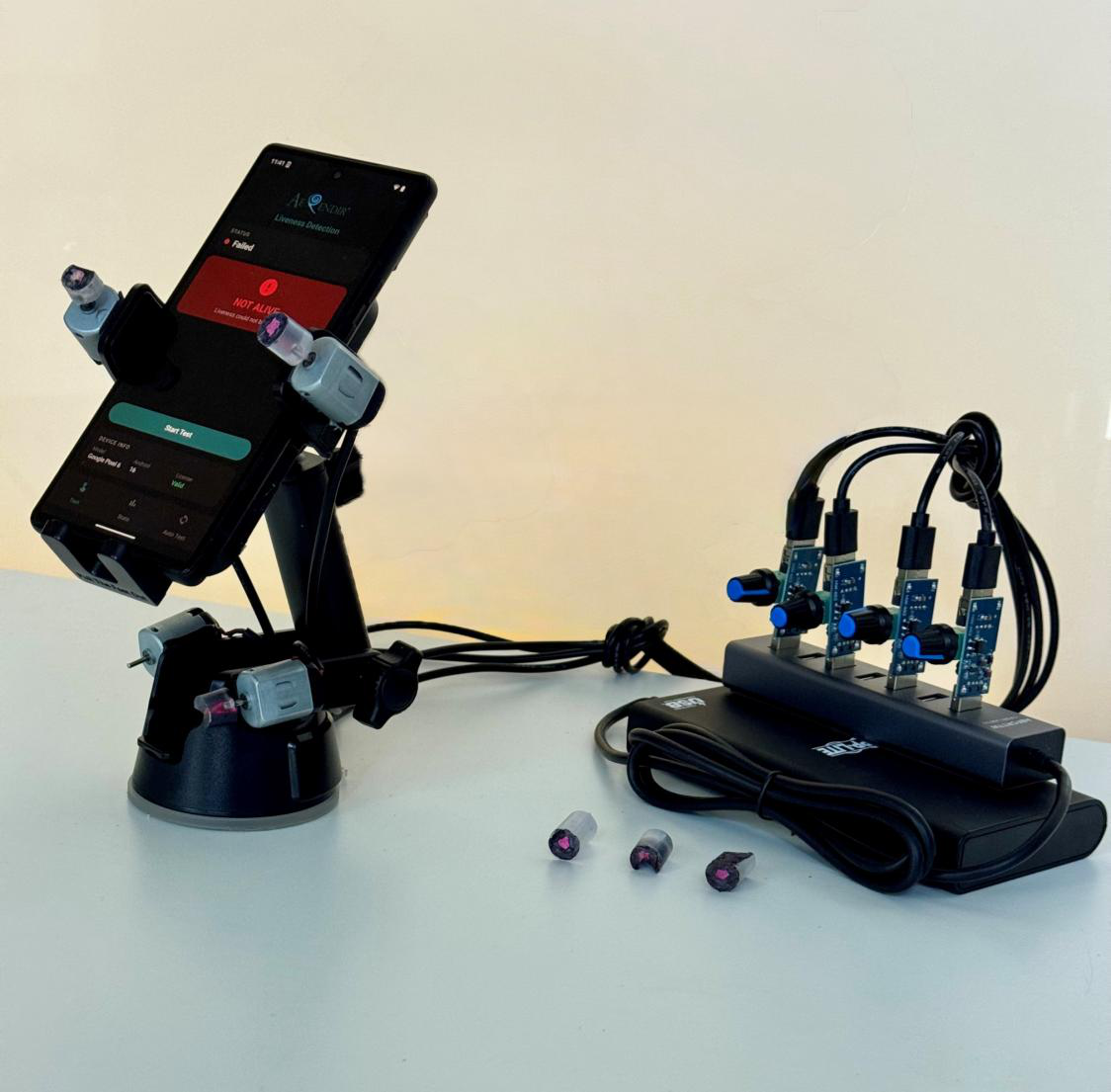
Fig 2 (page 12).

Fig 3 (page 12).
Limitations
- Lack of detailed description or public release of training data and feature extraction implementation limits reproducibility by external researchers.
- The system may be constrained by sensor quality and sampling variability, although the fixed 1-second window mitigates this to some extent.
- Evaluation primarily focuses on commodity smartphones and tablets; applicability to other wearable or sensor platforms remains to be tested.
- No explicit tests reported for long-term temporal consistency or adaptation to evolving adversarial strategies beyond the robotic platform.
- Adversarial model assumes no manipulation of raw IMU data streams beyond physical spoofing; software-level sensor spoofing or data injection attacks are not studied.
- Potential effects of diverse environmental noise conditions on micro-motion signal fidelity are acknowledged but not exhaustively quantified.
Open questions / follow-ons
- How well does A-Live perform under more diverse environmental conditions, such as outdoor use, variable noise, or on less frequently updated sensors?
- Can the approach be generalized to other sensor modalities (e.g., wearable EMG electrodes) or combined multimodal biometrics to improve robustness?
- How resilient is the system against future adversaries equipped with more fine-grained robotic actuators capable of inducing controlled micro-motions resembling neuromuscular signals?
- What is the impact of user variability (age, health conditions, physiological differences) on micro-motion signatures and classification robustness?
Why it matters for bot defense
For bot-defense practitioners and CAPTCHA engineers, the insights from A-Live emphasize the potential of leveraging physiological side-channel signals that passive commodity sensors can capture to enhance liveness verification without imposing additional user friction. By focusing on subtle neuromuscular micro-motions rather than explicit challenges or visual biometrics, A-Live offers a scalable, user-transparent approach suited for integration within multi-factor bot detection pipelines. Furthermore, the robustness shown against physically actuated spoofing highlights an important direction as adversaries increasingly utilize sophisticated physical or AI-driven mimicry attacks not detectable by surface cues alone. Deploying such liveness detection can raise the cost and complexity for automated agents attempting large-scale spoofing, especially in mobile and wearable environments where IMUs are standard. However, engineering teams should carefully consider variability across device types and environmental conditions, and the need to maintain model generalization as adversary capabilities evolve.
Cite
@article{arxiv2606_05126,
  title={ A-Live: Passive Liveness Detection via Neuromuscular Micro-Motion Signatures on Commodity Sensors },
  author={ Mohammed Gharib and Sam Burns and Martin Zizi },
  journal={arXiv preprint arXiv:2606.05126},
  year={ 2026 },
  url={https://arxiv.org/abs/2606.05126}
}