
Bipolar-doped superconducting infinite-layer cuprates
Source: arXiv:2606.03981 · Published 2026-06-02 · By Fengzhe Wang, Yueying Li, Heng Wang, Lizhi Xu, Xianfeng Wu, Lixiang Xu et al.
TL;DR
This work addresses a fundamental challenge in high-temperature cuprate superconductors: isolating intrinsic CuO2 plane physics by eliminating charge-reservoir layer complexities. Infinite-layer cuprates provide such a platform, but achieving controllable and uniform hole doping in these structurally simple materials has been elusive until now. The authors successfully realize bipolar doping—both electron and hole doping—in single-crystalline infinite-layer (Sr,Eu)CuO2 and (Ca,Li)CuO2+δ thin films using an advanced gigantic-oxidative atomic-layer epitaxy method. They map the electronic phase diagram and characterize the films' superconducting and magnetic properties with transport and angle-resolved photoemission spectroscopy (ARPES).
Their results reveal pronounced two-dimensional superconductivity on both doping sides, with highly anisotropic upper critical fields consistent with 2D Ginzburg–Landau theory. Crucially, ARPES shows persistent antiferromagnetic band folding coexisting with superconductivity across the phase diagram. On the hole-doped side at about 0.07 holes per Cu, corresponding to an underdoped regime, the authors observe that antiferromagnetic folding emerges alongside Fermi arcs within a single Fermi surface. This coexistence at a relatively high onset Tc (~60 K) challenges previous interpretations based on multilayer cuprates, where antiferromagnetism and superconductivity were often spatially separated in inequivalent CuO2 planes. The bipolar-doped infinite-layer films thus establish a clean, uniform model system to study the intrinsic interplay between magnetism and superconductivity in cuprates.
Key findings
- Bipolar doping achieved in infinite-layer (Sr,Eu)CuO2 and (Ca,Li)CuO2+δ films with tunable carrier concentrations by Eu content and oxygen pressure respectively.
- Electron-doped films exhibit a superconducting dome spanning Eu concentrations from ~0.05 to 0.17 with a peak onset Tc around 30 K near 0.11 electrons/Cu.
- Hole-doped films achieve superconductivity with onset Tc exceeding 60 K at hole doping ~0.07, despite remaining underdoped; higher ozone pressure increases Tc.
- Transport shows strong electrical resistance anisotropy; angular dependence of critical fields fits 2D Ginzburg–Landau and Tinkham models with anisotropy ratio ~5.7–6.0.
- ARPES reveals single, uniform Fermi surfaces with coexisting antiferromagnetic band folding and Fermi arcs on both electron- and hole-doped sides.
- At hole doping ~0.07, antiferromagnetic folding arises from Fermi arc tips on the same Fermi surface, demonstrating microscopic coexistence of magnetism and superconductivity.
- Structural characterization confirms phase-pure infinite-layer structure with atomically sharp interfaces and coherent epitaxy using a chain-type SrCuO2 buffer layer.
- Findings distinguish infinite-layer cuprates from multilayer systems by eliminating doping gradients and multiple Fermi surfaces, resolving previous debates on coexistence and proximity effects.
Methodology — deep read
Threat model & assumptions: The study assumes a materials-focused physics research context rather than an explicit adversarial threat model common in security. The goal is to isolate the intrinsic electronic and magnetic properties of CuO2 planes by eliminating complicating charge-reservoir layers and doping inhomogeneity. No adversarial actor is modeled.
Data: The data come from epitaxially grown single-crystalline thin films of infinite-layer cuprates (Sr,Eu)CuO2 for electron doping and (Ca,Li)CuO2+δ for hole doping. Carrier concentrations are controlled by tuning Eu content in the former and ozone partial pressure (affecting oxygen content) in the latter. Film thicknesses and substrates vary accordingly, with atomically flat surfaces confirmed. Transport data are collected via four-probe resistance measurements under varying temperature and magnetic field. ARPES data are measured at the SSRF synchrotron beamline with sub-15 K sample temperatures. Structural data use XRD and STEM imaging. No dataset splits or machine learning techniques are applied.
Architecture / algorithm: Not applicable; the study uses physical experimental synthesis and characterization methods. Key techniques include gigantic-oxidative atomic layer epitaxy (GAE) for growth under controlled oxidative conditions and high-resolution ARPES to map band structure and Fermi surfaces.
Training regime: Not applicable, but experimental synthesis conditions are tightly controlled: electron-doped films grown at 660–920 °C and 0.01 mbar O2; hole-doped films grown at 660–850 °C under varying ozone pressures. Annealing and post-growth handling preserve stoichiometry. ARPES samples transferred in ultrahigh vacuum suitcases maintaining temperatures below 150 K to prevent surface degradation.
Evaluation protocol: Transport characterization includes resistance vs temperature under in-plane and out-of-plane magnetic fields up to 14 T. Upper critical fields are extracted at 50% normal-state resistance. Angular dependence of Tc50% is measured to differentiate 2D vs 3D superconducting behavior, fitting with Tinkham's 2D superconductor model and anisotropic 3D Ginzburg-Landau model. ARPES maps Fermi surfaces and identifies band folding by momentum distribution curves, computing carrier doping from Luttinger volume. Structural integrity is assessed with XRD θ–2θ scans and atomic resolution STEM imaging.
Reproducibility: The paper details growth parameters, calibration via RHEED oscillations, precise stoichiometry control, and transport/ARPES measurement conditions. Specific experimental method references (e.g., gigantic-oxidative atomic-layer epitaxy) are given. Code or raw data availability is not stated explicitly. Synthesis requires advanced epitaxy facilities.
Example pipeline: To study hole doping at ~0.07, films of (Ca,Li)CuO2+δ were grown on NdGaO3 substrates with controlled ozone pressure (e.g. 0.06 mbar) to introduce oxygen content tuned for hole doping. The films' atomically flat surfaces and uniformity confirmed by RHEED and STEM enabled direct ARPES measurements after cryogenic vacuum transfer. ARPES revealed a single Fermi surface with Fermi arcs and clear antiferromagnetic folding near the nodal region. Transport measurements under magnetic fields confirmed quasi-2D superconductivity with onset Tc >60 K. This pipeline isolates intrinsic CuO2 plane physics without influence from charge-reservoir layers or doping gradients.
Technical innovations
- First realization of controllable and uniform bipolar doping (both electrons and holes) in infinite-layer cuprate single-crystal thin films using gigantic-oxidative atomic-layer-by-layer epitaxy.
- Direct spectroscopic observation (via ARPES) of persistent antiferromagnetic band folding coexisting with superconductivity across both electron- and hole-doped regimes in infinite-layer cuprates.
- Demonstration that at ultra-low hole doping (~0.07), Fermi arcs and antiferromagnetic folding coexist intrinsically within a single uniform Fermi surface, unlike multilayer cuprates where doping and disorder vary by layers.
- Use of a chain-type SrCuO2 buffer layer to stabilize high-quality infinite-layer CaCuO2 films on NdGaO3 substrates, enabling near-homoepitaxial growth of metastable phases.
Datasets
- (Sr,Eu)CuO2 — single-crystal thin films with varied Eu doping — synthesized in-house, no public release
- (Ca,Li)CuO2+δ — single-crystal thin films with oxygen doping controlled via ozone pressure — synthesized in-house, no public release
- Transport measurements datasets — various doping levels, resistance vs temperature and magnetic field curves, local to this experiment
- ARPES spectral data — measured in situ at SSRF beamline under ultrahigh vacuum, not publicly archived
Baselines vs proposed
- Electron-doped (Sr,Eu)CuO2 films: Tmax onset Tc ≈ 30 K at ~0.11 electrons/Cu doping.
- Hole-doped (Ca,Li)CuO2+δ films: Tmax onset Tc > 60 K at ~0.07 holes/Cu doping, more than double electron-doped Tc peak.
- Anisotropy ratio γ = Bc0∥/Bc0⊥ ≈ 5.7 (electron-doped) and 6.0 (hole-doped) consistent with 2D superconductivity models; 3D anisotropic GL model does not fit angular Tc50% data.
- Single Fermi surface with antiferromagnetic band folding detected, contrasting multilayer systems with multiple FSs; Luttinger volume matches nominal doping within measurement error.
Figures from the paper
Figures are reproduced from the source paper for academic discussion. Original copyright: the paper authors. See arXiv:2606.03981.
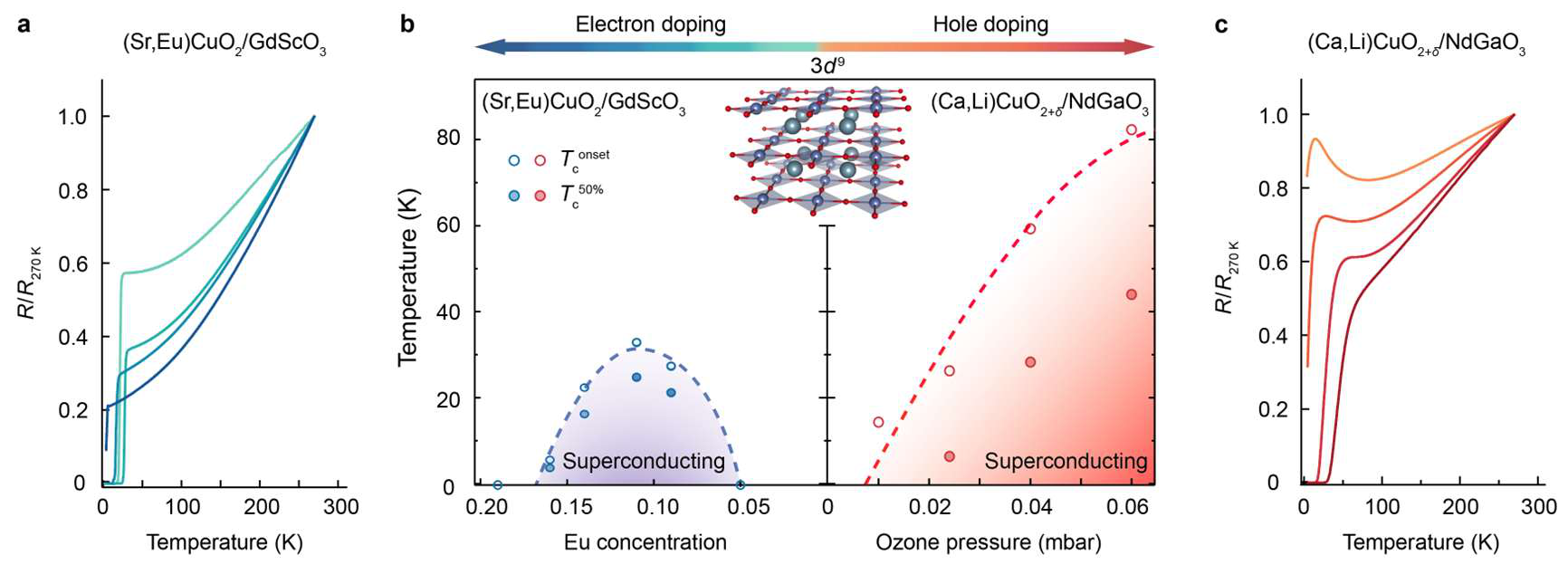
Fig 1: | Phase diagram of bipolar-doped infinite-layer cuprates. a, Normalized resistance-
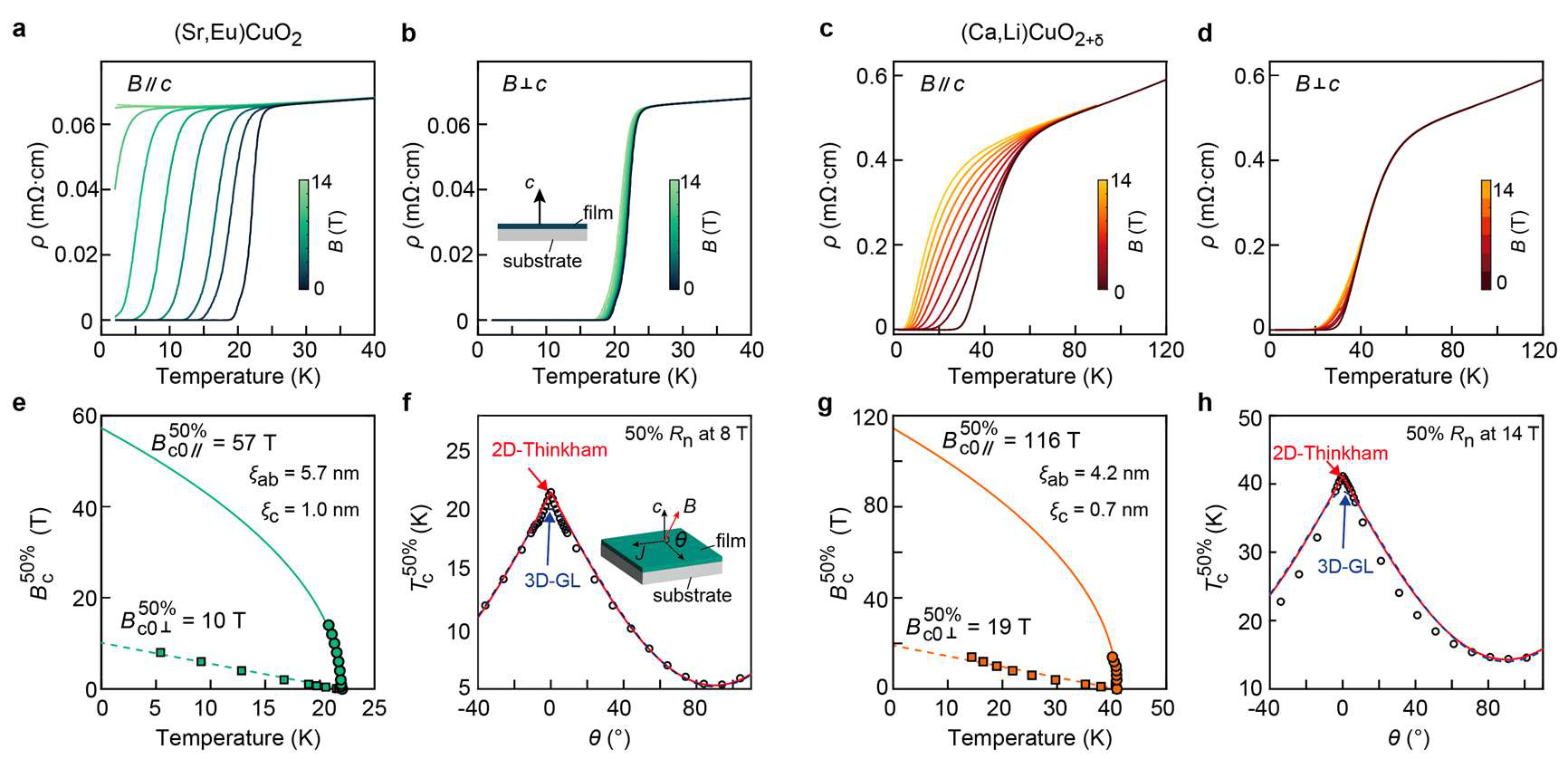
Fig 2: | Quasi-two-dimensional superconductivity in both electron- and hole-doped infinite-
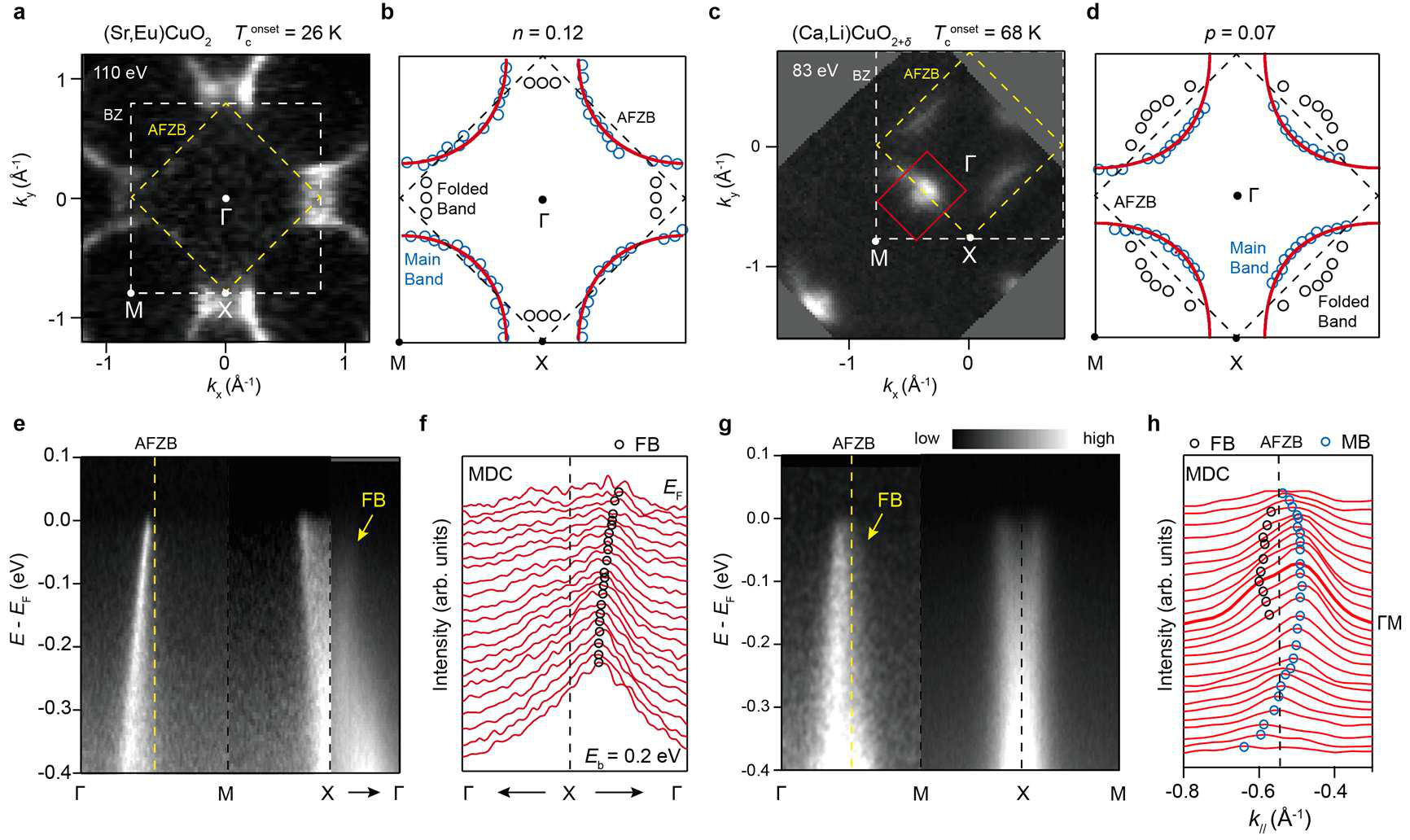
Fig 3: | Electronic structure of electron- and hole-doped infinite-layer cuprate films. a,c,
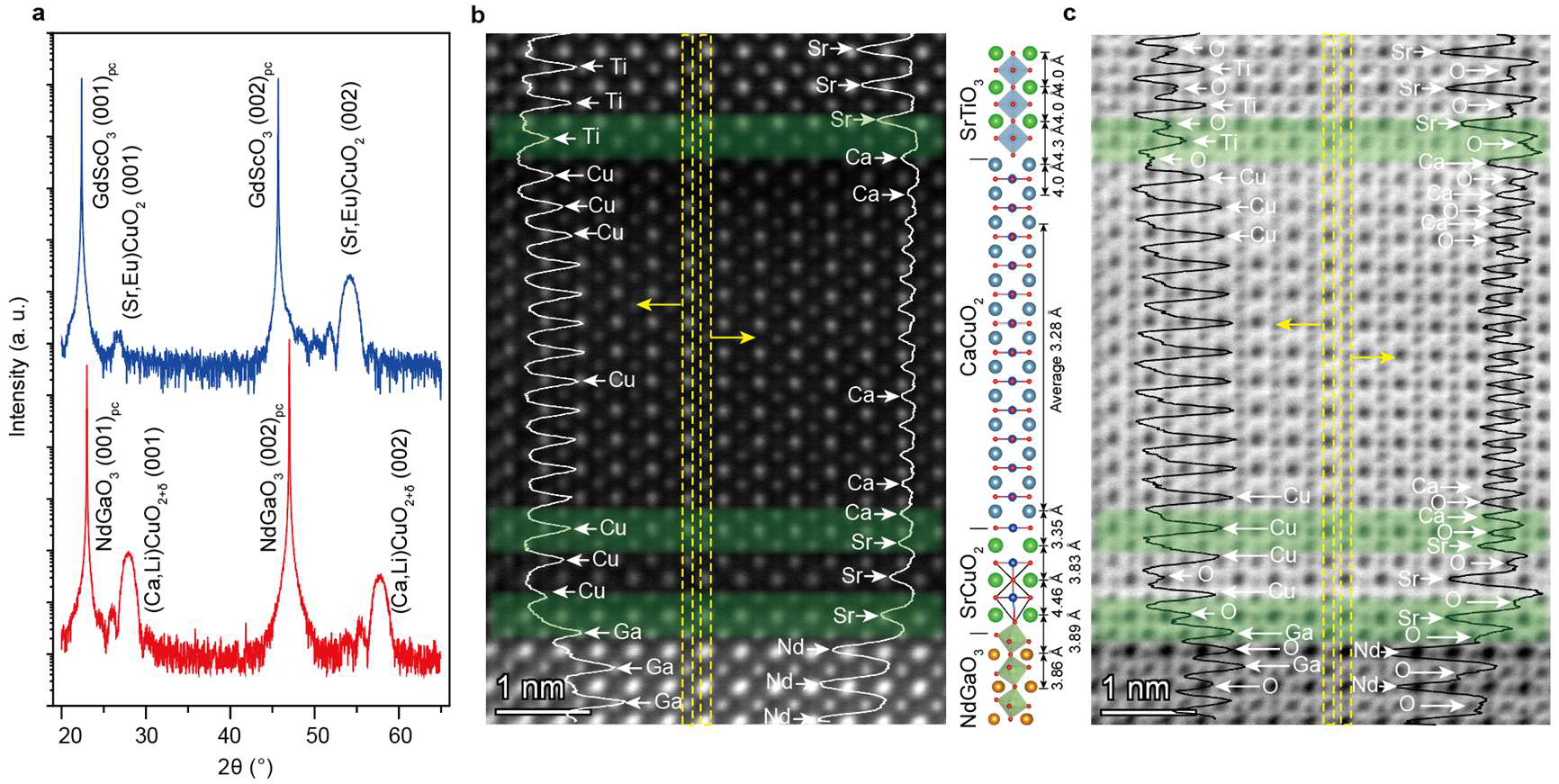
Fig 4: | Structural characterization of infinite-layer cuprates. a, X-ray diffraction θ–2θ scans
Limitations
- Hole doping range limited by current growth conditions; top of hole-doped superconducting dome not reached.
- ARPES measurements are surface sensitive, though uniform doping and film thinness alleviate ambiguity; deeper bulk properties inferred but not directly measured.
- No explicit tests for disorder or inhomogeneity beyond ARPES and transport; potential effects on electronic states not exhaustively ruled out.
- No direct measurements of pairing symmetry or dynamic magnetic correlations to complement band folding evidence.
- Growth methods require specialized equipment and precise control, limiting immediate reproducibility in all labs.
- No extensive investigation under extreme conditions (pressure, high magnetic fields beyond 14 T) or time-resolved studies.
Open questions / follow-ons
- What is the detailed microscopic mechanism enabling coexistence of antiferromagnetism and superconductivity at ultra-low hole doping within a single Fermi surface?
- How does the antiferromagnetic folding evolve across the full superconducting dome on the hole-doped side beyond currently accessible doping levels?
- What role do fluctuations, disorder, and dimensional crossover play in this bipolar infinite-layer system’s superconductivity and magnetism?
- Can this bipolar doping platform be extended to systematically study pairing symmetry and competing phases in the cuprates with minimal extrinsic complexity?
Why it matters for bot defense
While not directly related to bot defense or CAPTCHA, this paper's contribution lies in offering an exceptionally clean material platform — infinite-layer cuprates with uniform bipolar doping — that isolates the most intrinsic electronic phenomena relevant for understanding complex correlated electron systems. For CAPTCHA practitioners interested in leveraging or defending against bot technologies inspired by physical or quantum complexity, the research exemplifies how removing extraneous structural complexities reveals fundamental mechanisms. Analogously, CAPTCHA designers might note the power of reducing extraneous variables to isolate robust features distinguishing genuine human interactions from bots. Additionally, the rigorous approach to doping uniformity and surface preservation during transfer parallels the importance of preserving data integrity during security evaluations. However, the core scientific advances here pertain to superconductivity and electronic phase behavior, not direct application to bot-defense technologies.
Cite
@article{arxiv2606_03981,
  title={ Bipolar-doped superconducting infinite-layer cuprates },
  author={ Fengzhe Wang and Yueying Li and Heng Wang and Lizhi Xu and Xianfeng Wu and Lixiang Xu and Guangdi Zhou and Jin-Feng Jia and Peng Li and Haoliang Huang and Qi-Kun Xue and Zhuoyu Chen },
  journal={arXiv preprint arXiv:2606.03981},
  year={ 2026 },
  url={https://arxiv.org/abs/2606.03981}
}