
Practical Limits on Integrated Squeezers
Source: arXiv:2606.02524 · Published 2026-06-01 · By Devin J. Dean, Taewon Park, Lars S. Madsen, Alex Terrasson, Sam Robison, Geun Ho Ahn et al.
TL;DR
This paper addresses the practical fundamental limits on the generation and measurement of squeezed vacuum states using integrated photonic technologies. While recent integrated devices have demonstrated moderate squeezing, achieving high levels of squeezing is challenging due to various noise and loss mechanisms that degrade the quantum noise reduction advantage. The authors develop a unified analytic noise variance budget model that captures contributions from nonlinear gain, internal and external losses, pump saturation effects, phase noise, detection loss, and electronic noise, applicable across diverse squeezer designs and photonic platforms. By combining these terms into a compact variance sum, they provide general, interpretable bounds on achievable squeezing as a function of device parameters such as nonlinear gain rate and internal loss rate. Key results include closed-form expressions relating internal loss to the nonlinear gain-to-loss ratio, saturation noise bounds due to pump depletion and seed injection, and quantified phase noise limits relevant to integrated nanophotonic implementations.
Key findings
- The total measured squeezed quadrature variance can be decomposed into contributions from generation and detection noise terms, given approximately by equation (1).
- Internal loss contribution to squeezing degradation asymptotically bounds the noise variance by the inverse ratio of nonlinear gain rate to internal loss: ΔV_internal_loss ≳ α/g (equation (15)), e.g. achieving 20 dB squeezing with 0.1 dB/cm loss requires at least 10 dB/cm gain rate.
- External loss degrades squeezing roughly linearly as ΔV_external_loss ≈ 1 - ηe, where ηe is transmitted fraction (equation (12)), and is often the largest limiting factor in integrated devices due to propagation and coupling losses.
- Pump saturation from amplified coherent seeds induces noise coupling from pump to signal quadratures, limiting squeezing according to ΔV_pump_saturation ≳ P_+ / (2 P_3(0) V_-3) (equation (25)), where P_+ is amplified seed power and P_3(0) pump power.
- Phase noise mixes antisqueezed quadrature noise into the squeezed quadrature, adding noise scaling as ΔV_phase_noise = G sin^2(δθ) (equation (36)), where G is gain and δθ is RMS phase error; this imposes a fundamental squeezing limit (equation (37)).
- Signal-resonant squeezers provide effective interaction length enhancement but cannot surpass the internal loss bound given by the nonlinearity-to-loss ratio (equation (22)).
- The simplified noise summation approximation for sequential loss processes is valid and accurate at practically relevant squeezing levels (> 2 dB), enabling a simple variance budget (equation (5)).
Threat model
The threat model considers noise and loss sources as effective adversaries degrading squeezing performance; the adversary acts passively by introducing loss, phase noise, pump depletion, or detection inefficiencies. No active attacks or quantum hacking strategies are assumed. The settings are realistic for integrated photonic systems subject to intrinsic material loss, coupling losses, laser phase noise, and pump noise coupling. The adversary cannot alter device parameters or introduce correlated quantum noise beyond vacuum fluctuations and technical classical noise.
Methodology — deep read
The paper begins with a threat model relevant to integrated squeezed-light sources, considering an adversarial environment where excess noise and loss degrade squeezing but no active quantum attacks. The main assumptions are that squeezing is generated by nonlinear optical processes under Gaussian quantum optics, and noise sources can be modeled as beamsplitter interactions mixing vacuum noise into the signal.
The data basis is theoretical and experimental results consolidated across multiple prior integrated squeezing demonstrations. The authors build on known device parameters such as nonlinear gain rates (g), loss coefficients (α), pump power (P), and phase noise characterized by RMS phase deviations. No new datasets per se are used; instead, the paper synthesizes analytical models with published experimental parameters.
The architecture consists of generic integrated squeezers modeled with 𝜒(2) degenerate optical parametric amplification as an example (though 𝜒(3) systems and others are discussed). The nonlinear gain relates to device length and pump power (g∝√P), while loss and noise terms are conceptualized as effective beamsplitter transmissions mixing in vacuum fluctuations. They derive expressions for squeezing gain, internal/external loss, pump saturation noise, and phase noise, combining these into a single variance budget expression (Eq. 1).
Training here corresponds to physical device operation with the pump laser and detection apparatus rather than ML. Theoretical derivations involve treating squeezing and loss as cascaded beam-splitter channels with variances evolving according to Eq. (3). The key approximation for small noise mixing (1 - η_j ≪ 1) reduces the output variance to a simple sum of noise contributions (Eq. 5).
Evaluation compares derived analytic expressions against numerical simulations and previously published experimental results for integrated squeezers. Plots (e.g., Fig. 3 and 4) illustrate variance evolution versus device length, loss, and gain rate. They explore different squeezer designs: nonresonant traveling wave, pump-resonant, and signal-resonant cavities.
Reproducibility is theoretical and model-based; no open-source code or datasets are mentioned. However, the relations and analytic formulas are detailed extensively, allowing other researchers to compute noise budgets for integrated squeezers given device parameters. Supplemental derivations and parameters are cited from earlier established nonlinear optics and quantum optics literature.
One concrete example: For a nonresonant 𝜒(2) integrated squeezer with a gain rate g=12 dB/cm, internal propagation loss α=10 dB/m, and device length L=1 cm, the model predicts an effective squeezing variance bounded by internal loss ΔV_internal loss ~ α/(α+g) ≈ 10 dB/m / (10 dB/m + 120 dB/m) ~ 0.077, which corresponds to about 11 dB squeezing limit. Increasing length beyond a critical L0 saturates squeezing improvement due to loss. This matches well with plotted model behavior in Figure 3d and 3e.
Technical innovations
- Unified analytic noise variance budget combining generation and detection noise terms into a single compact model applicable to diverse integrated squeezer designs.
- Derivation of a universal internal loss bound for squeezing based on the nonlinear gain-to-loss ratio (α/g), independent of specific device architecture.
- Quantification of pump saturation noise impact due to seeded signal amplification, formalizing noise transfer from pump quantum fluctuations to output squeezing.
- Detailed analysis of phase noise contributions arising from path length mismatch and locking imperfections, establishing squeeze variance bounds linked to laser linewidth and integrated photonics length scales.
Baselines vs proposed
- External loss effect: Squeezing variance degrades as V_- = η_e * V_-0 + (1 - η_e), with approximation holding well for small losses and moderate squeezing levels (Fig. 3b).
- Internal loss in nonresonant squeezer: Numerical simulations match analytic approximation ΔV_internal loss ≈ α / (α + g) within 1 dB across gain rates g=12 to 27 dB/cm (Fig. 3d,e).
- Pump saturation noise: Experimental observations from referenced prior works [35-38] indicate coherence seed leakage reduces squeezing in line with derived bounds (Eq. 25).
- Phase noise contribution: Model predictions of squeezing deterioration with increasing phase error δθ agree qualitatively with prior reported measurements from bulk and chip-scale systems (Fig. 5c).
Figures from the paper
Figures are reproduced from the source paper for academic discussion. Original copyright: the paper authors. See arXiv:2606.02524.
Fig 8: Noise summation approximation validity. (a) Output variance as a function
Fig 2 (page 25).
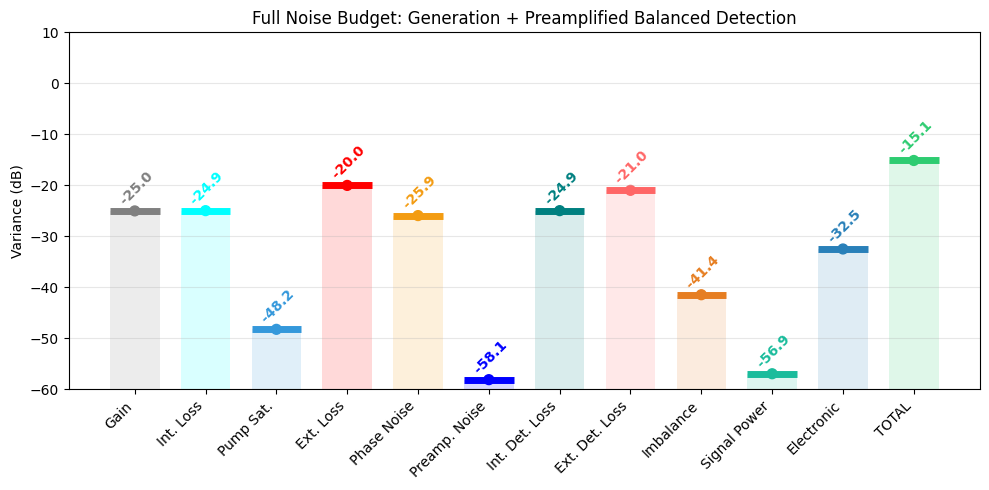
Fig 9: Example noise contribution visualization with model. To see the exact
Limitations
- The analysis assumes Gaussian quantum optics approximation, limiting validity when optical parametric generation dominates or highly non-Gaussian regimes appear.
- Experimental validation is indirect and based on consolidating published results; no new integrated squeezing device is demonstrated.
- No adversarial or active attack scenarios on squeezers or detectors are considered; assumptions are mostly classical noise.
- Phase noise modeling neglects some technical complexities of integrated phase-locking systems and long-term drifts beyond MHz frequencies.
- Pump saturation treatment assumes small seed powers relative to pump; thorough treatment of large seed or multimode effects is outside scope.
Open questions / follow-ons
- How do multimode effects and non-Gaussian noise sources influence squeezing limits in integrated photonics beyond the Gaussian approximation?
- What are the detailed impacts of dynamic environmental perturbations and thermal drifts on integrated phase noise in long-term squeezing stability?
- Can advanced pump stabilization or active noise cancellation techniques effectively push squeezing closer to the inverse-loss limit in practical integrated devices?
- What are the trade-offs and achievable squeezing levels incorporating fully on-chip references and detectors with imperfect quantum efficiencies?
Why it matters for bot defense
Although not directly related to CAPTCHA or bot-detection, this work offers significant insights for practitioners designing integrated photonic systems requiring precise quantum-limited measurements, such as quantum optics sensors or quantum random number generators. Understanding fundamental limits on noise and loss—especially from internal device parameters and detection inefficiencies—helps security engineers anticipate and mitigate hardware-level noise that could affect signal quality or measurement reliability. For CAPTCHA engineers exploring hardware security primitives based on quantum photonics or novel noise sources, the paper's noise variance budget framework provides a quantitative foundation for benchmarking integrated photonic components and assessing practical constraints on noise-resilience and sensitivity. Additionally, the phase noise analysis highlights challenges in maintaining stable references, relevant in any system relying on optical coherence, including certain quantum-secured authentication approaches.
Cite
@article{arxiv2606_02524,
  title={ Practical Limits on Integrated Squeezers },
  author={ Devin J. Dean and Taewon Park and Lars S. Madsen and Alex Terrasson and Sam Robison and Geun Ho Ahn and Ziyu Wang and Hubert S. Stokowski and Luke Qi and Jesse J. Slim and Joel Corney and Darwin Serkland and Warwick P. Bowen and Martin M. Fejer and Amir H. Safavi-Naeini },
  journal={arXiv preprint arXiv:2606.02524},
  year={ 2026 },
  url={https://arxiv.org/abs/2606.02524}
}