
A derivative-free particle method for optimization in Hilbert spaces
Source: arXiv:2605.31565 · Published 2026-05-29 · By Hui Huang, Hicham Kouhkouh
TL;DR
This paper addresses the extension of Consensus-Based Optimization (CBO), a derivative-free particle-based global optimization method, to infinite-dimensional separable Hilbert spaces. Classical CBO is well-studied in finite-dimensional Euclidean spaces but faces foundational analytic and algorithmic challenges when generalized to infinite-dimensional function spaces commonly encountered in stochastic optimization, optimal control, PDE-constrained optimization, inverse problems, and calculus of variations. The authors develop an infinite-dimensional CBO model formulated as a McKean-Vlasov stochastic differential equation (SDE) driven by a Q-Wiener process to maintain trajectories within the Hilbert space, overcoming the infinite variance issue of standard Brownian motion.
Key theoretical contributions include establishing global well-posedness of the proposed infinite-dimensional CBO dynamics using contraction arguments in Wasserstein space, and proving global exponential convergence to the unique minimizer under realistic assumptions on the objective functional. They address the difficulty that injected noise energy must decay along infinite orthogonal directions by introducing a decomposed Hilbert space with a finite-dimensional active subspace containing the minimizer. Noise is restricted to this subspace via a novel projected isotropic diffusion operator, ensuring exploration maintains finite energy yet fixes the problem of premature convergence caused by low noise in higher modes. The practical relevance is further supported by the study of the finite-particle system and numerical experiments illustrating convergence in function-space settings.
Overall, this work rigorously extends the applicability of CBO to broad classes of infinite-dimensional nonconvex optimization problems with robust analytic guarantees, laying a mathematical foundation for derivative-free optimization in functional analytic contexts.
Key findings
- Established global well-posedness (existence and uniqueness) of infinite-dimensional CBO dynamics as a McKean-Vlasov SDE in separable Hilbert spaces (Theorem 2.6).
- Proposed a novel projected isotropic diffusion operator restricting noise to a finite-dimensional active subspace V ⊂ H, overcoming infinite trace noise issues (Assumption 2.4 and Proposition 2.5).
- Proved a localized Lipschitz bound for the consensus point map mα(µ) in 2-Wasserstein metric Wasserstein space P2,R(H) (Lemma 2.7), enabling a fixed-point well-posedness argument.
- Derived quantitative global convergence guarantees to the unique global minimizer under polynomial growth, coercivity, and local Lipschitz continuity assumptions on the objective functional (Section 3, Theorem 3.6).
- Showed that the stochastic dynamics maintain strictly positive mass in any neighborhood of the minimizer, circumventing small ball measure problems inherent in infinite dimensions.
- Validated the finite-particle approximation dynamics and proposed a practical algorithm suitable for numerical implementation (Section 4 and 5).
- Demonstrated through examples that the framework naturally encompasses infinite-dimensional problems such as stochastic optimization in L2 spaces, optimal control of ODEs/PDEs, inverse problems, and calculus of variations models (Section 1.1).
- Identified the necessity to balance finite energy stochastic noise with exploration capacity to avoid premature convergence, resolved by decomposition into active subspace with injected noise and deterministic drift orthogonal to it.
Methodology — deep read
The authors begin with the problem of minimizing a possibly nonconvex, nonsmooth energy functional E defined on a separable infinite-dimensional Hilbert space H, aiming to find a global minimizer x* ∈ H. Recognizing that classical CBO relies on particle swarms undergoing isotropic noise exploration with drift toward a weighted consensus point, they fully generalize this dynamics to infinite-dimensional settings via a McKean-Vlasov SDE:
dX_t = -λ(X_t - m_α(μ_t)) dt + σ D(X_t - m_α(μ_t)) dW^Q_t, where μ_t = Law(X_t) is the particle distribution at time t; m_α(μ_t) is the exponential weighted expectation consensus point of the swarm; λ, σ, α are positive parameters controlling drift intensity, exploration noise, and inverse temperature respectively.
Central to the construction is using a Q-Wiener process W^Q_t with covariance operator Q: H → H satisfying trace-class properties (Tr(Q) < ∞) as driving noise, replacing ill-defined infinite-dimensional Brownian motion. This ensures sample paths remain within H.
To address the tradeoff that trace-class noise decays in higher orthogonal dimensions and may cause premature convergence, the model splits H orthogonally as H = V ⊕ V^⊥, with V finite-dimensional, containing x*, and assumes the initial distribution support is contained in V. The diffusion operator D(x): H→L(H,H) is defined as scaling by ∥x∥_H composed with orthogonal projection P_V onto the active subspace V. This confines stochastic noise to the finite active subspace, while the orthogonal complement dynamics become purely deterministic drift towards consensus, preserving finite energy noise injection and maintaining exploration capability.
The main analytic challenge arises from the nonlinear, nonlocal consensus point m_α(μ) defined by integrating against an exponential Gibbs weighting exp(-α E(x)) which only satisfies local Lipschitz and polynomial growth conditions. The authors prove m_α is locally Lipschitz continuous with respect to the 2-Wasserstein metric on probability measures supported on V with bounded second moments (Lemma 2.7).
The well-posedness proof uses a measure-freezing fixed-point approach: for a fixed continuous measure path μ_t on [0,T], the McKean-Vlasov equation reduces to a standard Hilbert space SDE with deterministic drift and noise coefficients. The deterministic path m_α(μ_t) then drives the dynamics. The authors prove existence and uniqueness of strong solutions using contraction arguments for the map μ → Law(X^μ). The finite-dimensionality of V is critical here.
For convergence, the key novel infinite-dimensional Itô calculus arguments establish that the dynamics keep positive mass near the global minimizer, allowing application of Laplace principles to guarantee exponential concentration of the swarm around minimizers as t→∞ (Theorem 3.6).
The finite-particle system with N particles approximating the mean-field dynamics is studied next. The authors ensure propagation of chaos and propose a practical explicit Euler discretization algorithm for numerical use.
The methodology is illustrated with concrete infinite-dimensional optimization examples: stochastic optimization problems lifted to L2(Ω;U), optimal control of ODEs, PDE-constrained optimization, inverse problems with Tikhonov regularization, and calculus of variations models like Allen-Cahn and Cahn-Hilliard equations.
Overall, the methodology provides a fully rigorous stochastic optimization framework in infinite-dimensional function spaces leveraging modern measure-theoretic, stochastic analysis, and functional analysis tools. The key innovation is the constructive noise restriction and consensus point regularity enabling well-posedness and convergence that overcome fundamental infinite-dimensional difficulties.
Technical innovations
- Formulation of infinite-dimensional Consensus-Based Optimization as a McKean-Vlasov SDE driven by a Q-Wiener process to maintain finite-energy stochastic trajectories in separable Hilbert spaces.
- Introduction of a novel projected isotropic diffusion operator restricting noise exclusively to a finite-dimensional active subspace containing the minimizer, balancing noise energy and exploration.
- Rigorous global well-posedness proof via contraction mappings in continuous measure flows under 2-Wasserstein metric accounting for non-local, nonlinear consensus mappings.
- Application of infinite-dimensional Itô calculus and positive mass arguments to prove global exponential convergence despite the lack of local small ball probabilities.
- Extension of the classical finite-dimensional CBO to infinite-dimensional variational problems, PDE control, inverse problems with explicit analytical framework.
Figures from the paper
Figures are reproduced from the source paper for academic discussion. Original copyright: the paper authors. See arXiv:2605.31565.
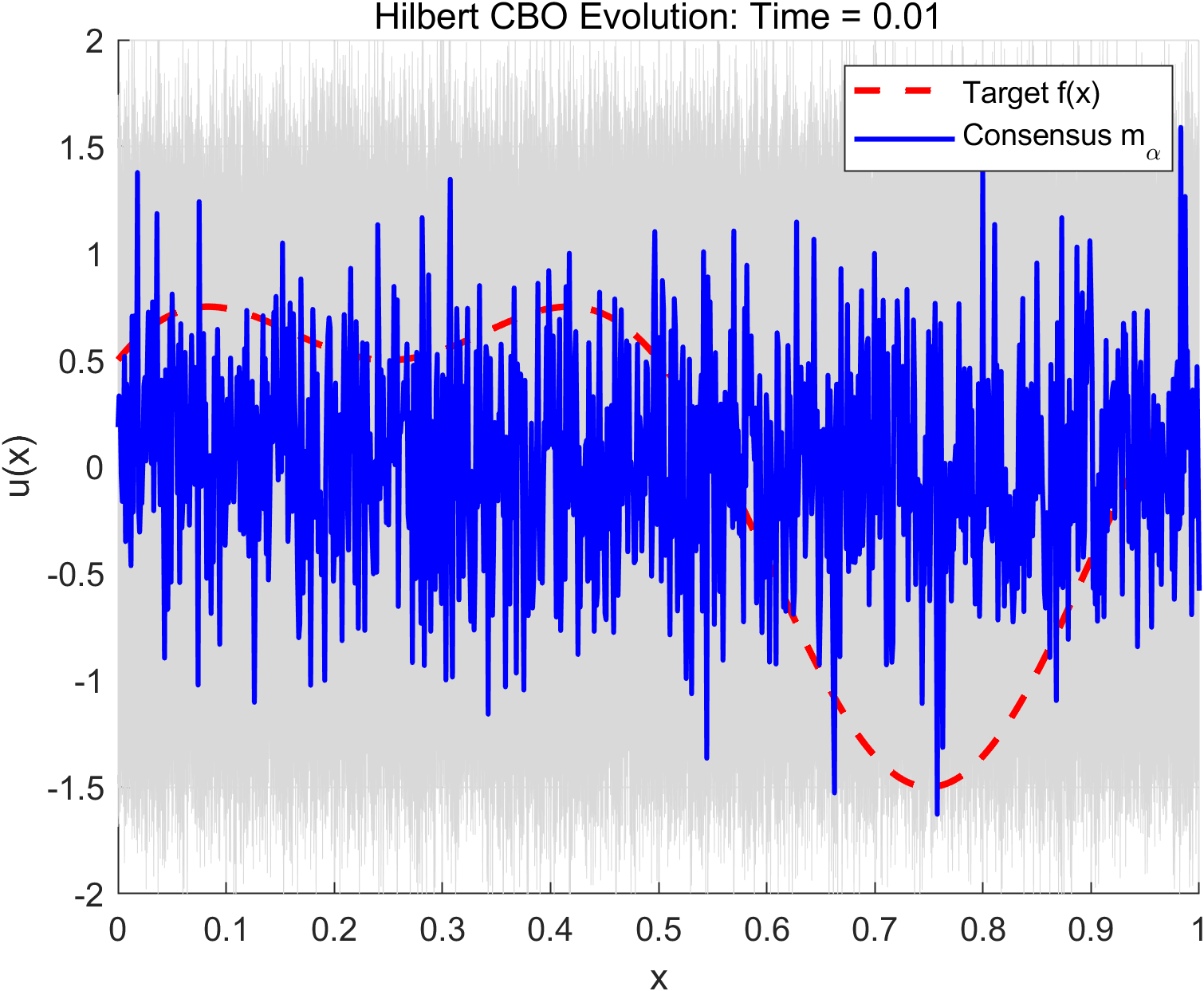
Fig 1: Evolution of CBO particle swarm in L2([0, 1]). Red dashed:
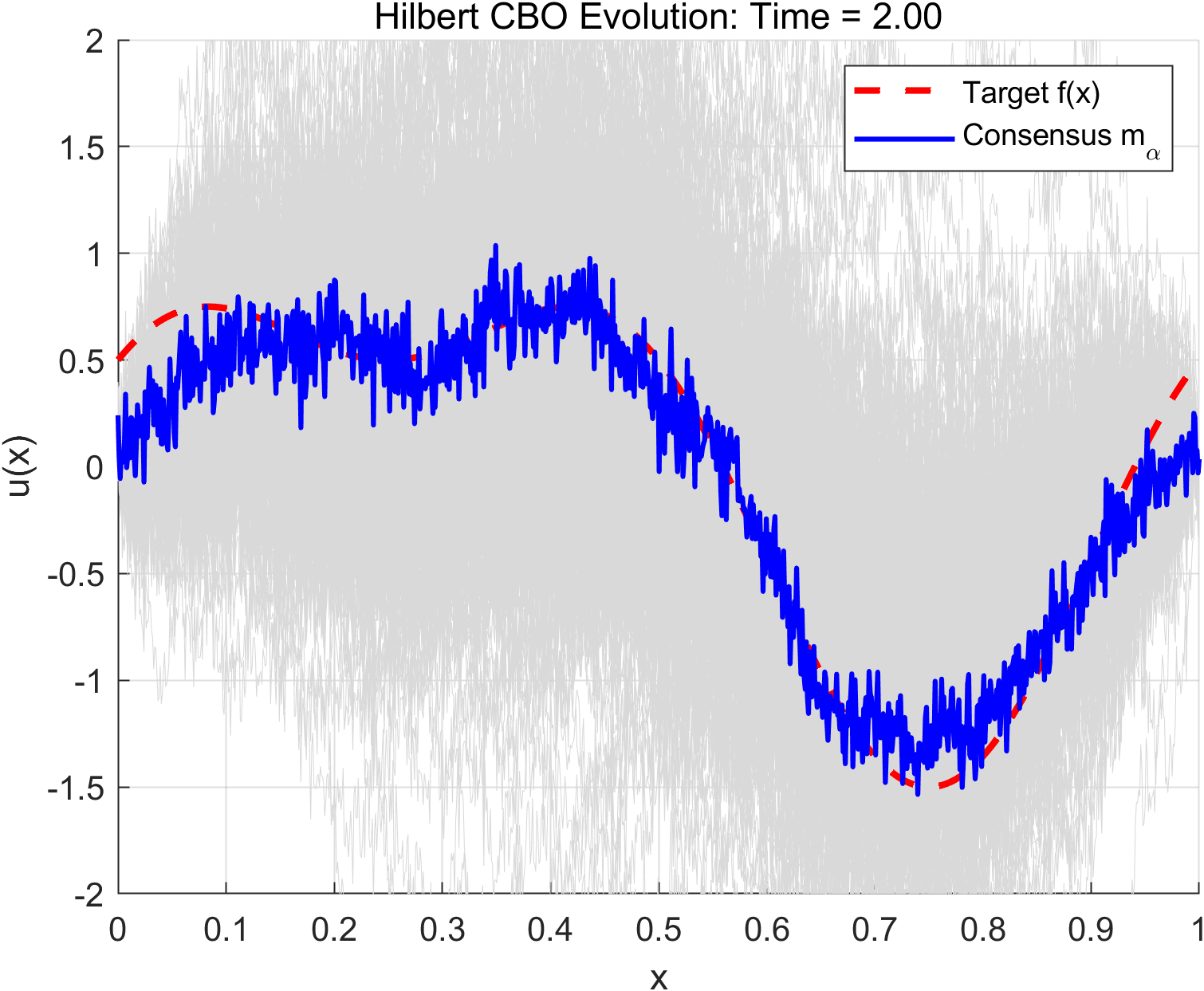
Fig 2: Empirical validation of Theorem 3.6. The line represents
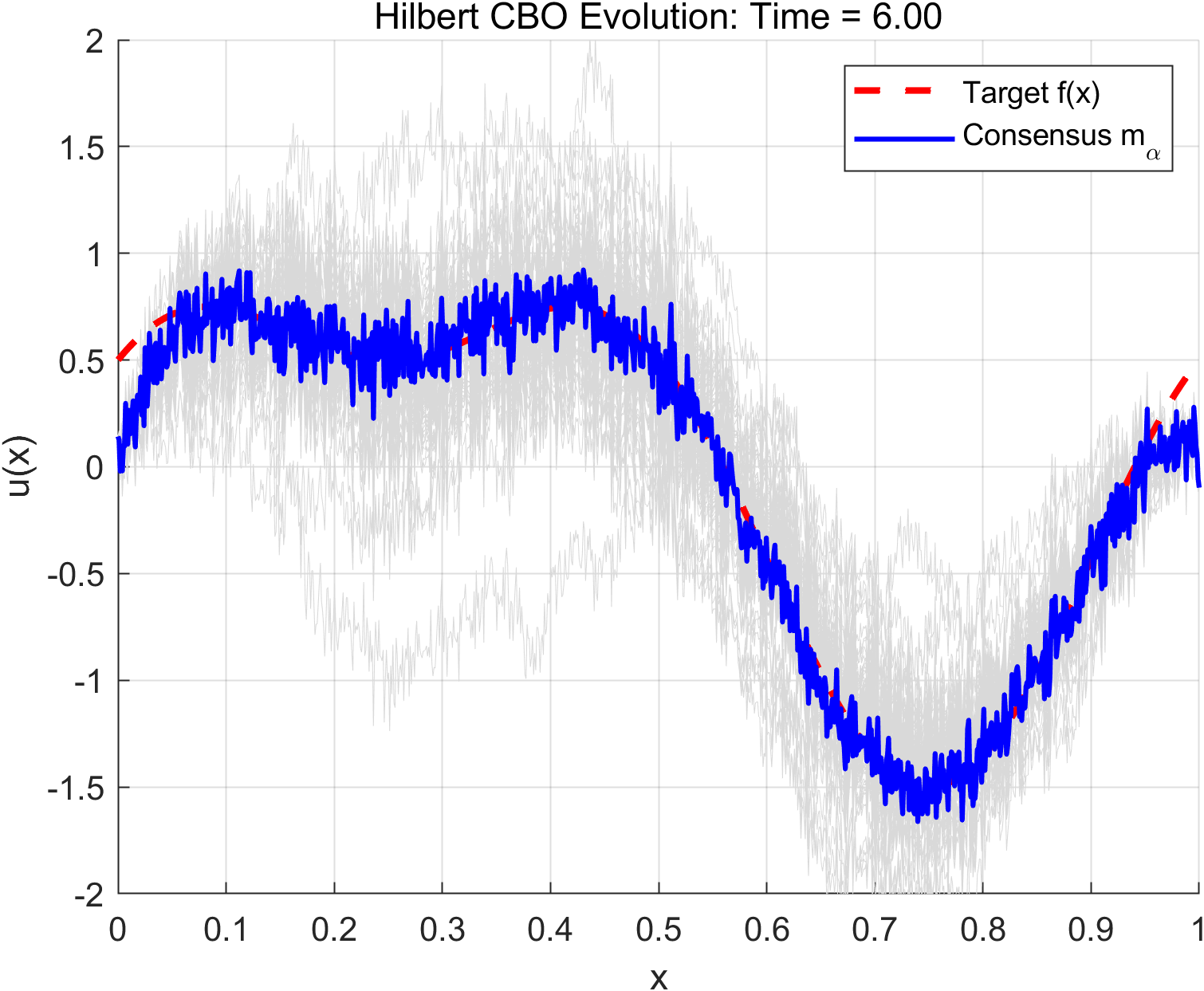
Fig 3 (page 41).
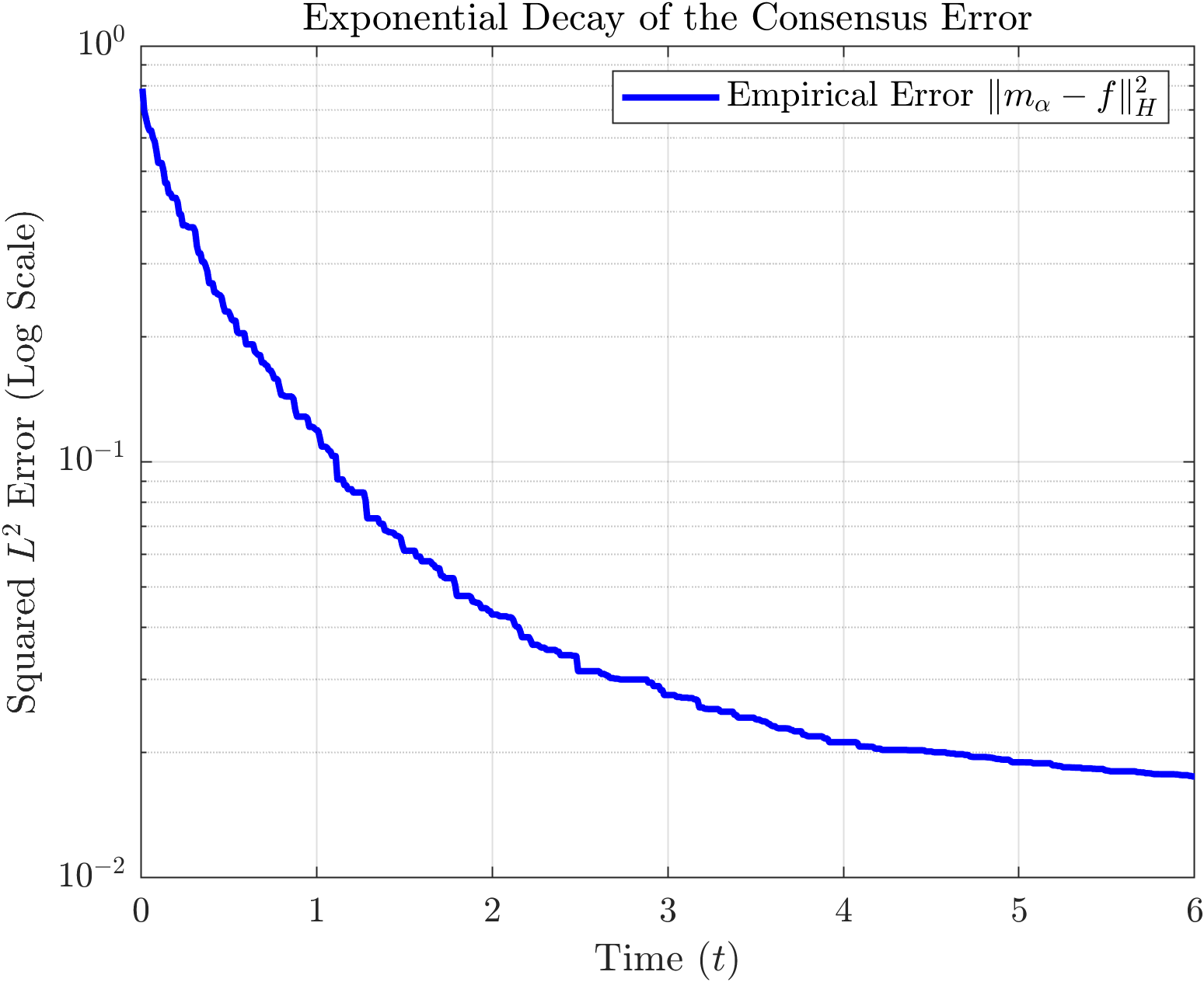
Fig 4 (page 41).
Limitations
- Assumes existence of a finite-dimensional active subspace V containing the global minimizer and initial distribution support, which may not hold in all infinite-dimensional problems.
- The noise injection is constrained to the active subspace only, so if the minimizer has significant components outside V, performance may degrade.
- Convergence proofs depend on polynomial growth, coercivity, and local Lipschitz assumptions on the objective functional which may be restrictive for some highly non-smooth problems.
- Finite particle system analysis and numerical experiments are limited in scale and breadth; generalization to large scale or more complex Hilbert spaces remains to be seen.
- No adversarial or robustness analysis to perturbations in objective functional or sampling noise is provided.
- Does not explicitly handle constraints beyond the Hilbert space setting or non-standard boundary conditions.
- Practical selection or learning of the active subspace V in real applications is not addressed.
Open questions / follow-ons
- How to automatically identify or learn the finite-dimensional active subspace V from data or problem structure?
- Extensions to more general infinite-dimensional spaces without finite-dimensional decompositions, e.g., manifolds or Banach spaces.
- Robustness of the method under model misspecification, noise in observations, or adversarial perturbations.
- Scalable and efficient numerical schemes for high-dimensional discretizations of the particle system and their convergence rates.
Why it matters for bot defense
For bot-defense and CAPTCHA engineering, this paper's core contributions revolve around expanding derivative-free optimization techniques rigorously into infinite-dimensional function spaces. While not directly about CAPTCHA or bot-detection algorithms, the methodology informs foundational approaches to explore and optimize functions without gradient information in very high or infinite-dimensional settings.
Practitioners designing adaptive challenge mechanisms or learning-based defenses constrained by functional spaces or infinite-dimensional policies (e.g., control-based CAPTCHAs or dynamic challenge generation governed by PDE models or stochastic processes) could leverage the analytic foundation and algorithms here to perform global optimization reliably without explicit gradients. The concepts of decomposing the search space and limiting noise injection to an active subspace may inspire algorithmic architectures balancing exploration-exploitation in complex nonparametric bot-defense models.
Moreover, the rigorous well-posedness and convergence guarantees in infinite dimensions provide a theoretical grounding that could support the stable deployment of derivative-free optimization routines embedded in CAPTCHA frameworks with functional analytic constraints or continuous-time dynamic components. Overall, bot-defense engineers interested in scalable, derivative-free methods for optimizing complex infinite-dimensional signals or policies may find the paper conceptually valuable.
Cite
@article{arxiv2605_31565,
  title={ A derivative-free particle method for optimization in Hilbert spaces },
  author={ Hui Huang and Hicham Kouhkouh },
  journal={arXiv preprint arXiv:2605.31565},
  year={ 2026 },
  url={https://arxiv.org/abs/2605.31565}
}