
ODIN: Rest-frame Optical Morphologies and Star Formation Activity of Lyα Emitters at z=2.4, 3.1, and 4.5
Source: arXiv:2605.29344 · Published 2026-05-28 · By Sang Hyeok Im, Ho Seong Hwang, Jeong Hwan Lee, Robin Ciardullo, Eric Gawiser, Caryl Gronwall et al.
TL;DR
This study investigates the rest-frame optical morphologies and star formation activity of Lyα emitters (LAEs) at redshifts z = 2.4, 3.1, and 4.5 identified by the ODIN survey, using JWST/NIRCam imaging data from the COSMOS-Web program. The authors compare the LAEs to a large control sample of typical star-forming galaxies (SFGs) selected from the COSMOS2025 catalog at similar redshifts, utilizing non-parametric star formation history (SFH) reconstructions to measure their physical properties more robustly. They find that LAEs tend to have systematically smaller optical sizes at fixed stellar mass than typical SFGs, especially at z=2.4 and 3.1, with the size difference diminishing towards z=4.5. The LAEs also show larger Sérsic indices than typical SFGs at the lower two redshifts but not at z=4.5. Across all redshifts, LAEs exhibit elevated star formation rates, consistent with starbursting behavior. The Lyα rest-frame equivalent width (REW) is anticorrelated with galaxy size and positively correlated with Sérsic index and the ratio of instantaneous to 100 Myr-averaged SFR, suggesting the compact and bursty nature of these galaxies. These observations are qualitatively reproduced by the Horizon Run 5 cosmological hydrodynamical simulation. The results support a picture where LAEs are compact, highly star-forming galaxies facilitating Lyα photon escape through structural and star-formation conditions.
Key findings
- LAEs at z = 2.4 and 3.1 have sizes smaller by ~0.2 dex in effective radius at fixed stellar mass compared to typical SFGs (p-values < 0.001 in KS and AD tests).
- At z = 4.5, the size difference between LAEs and SFGs reduces to ~0.05 dex, with only marginal statistical significance (KS p=0.05).
- LAEs show larger Sérsic indices (median n ≈ 3–5) than SFGs (median n ≈ 1–2) at z = 2.4 and 3.1, but no significant difference at z = 4.5 (pKS ~ 0.65).
- LAEs have systematically higher instantaneous star formation rates compared to typical SFGs across all redshifts studied, indicative of ongoing starburst activity.
- Strong positive correlation observed between Lyα rest-frame equivalent width and the ratio of instantaneous SFR to SFR averaged over the last 100 Myr (SFR_inst / SFR_100Myr), linking Lyα emission strength to recent starbursting.
- Negative correlation between Lyα REW and galaxy size, and positive correlation with Sérsic index, implying more compact, centrally concentrated morphologies favor stronger Lyα escape.
- Qualitative reproduction of size and Sérsic index differences between LAEs and SFGs by the Horizon Run 5 cosmological hydrodynamical simulation.
- Contamination fraction of LAEs in ODIN narrow-band selection is low (~10%), validated by DESI spectroscopy for z=2.4 and 3.1 samples.
Methodology — deep read
Threat model & assumptions: The authors assume observational galaxy samples with no direct adversarial concerns; the goal is to characterize physical morphology and star formation differences in LAEs versus typical SFGs at similar redshifts. The 'threat' is intrinsic observational biases or contamination from foreground emitters, addressed via carefully validated narrow-band selections and photometric redshift consistency.
Data provenance and preprocessing: The LAE samples come from the ODIN survey, which uses three custom narrow-band filters targeting Lyα emission at z=2.4 (N419), 3.1 (N501), and 4.5 (N673). The 5σ limiting magnitudes are ~25.5–25.9 mag over ~9 deg² in the COSMOS field. Narrow-band excess and broad-band color criteria select LAE candidates with Lyα REW > 20 Å. The final LAE numbers within the JWST COSMOS-Web DR1 footprint are 338 (z=2.4), 316 (3.1), and 420 (4.5), trimmed to 111, 109, and 134 respectively after photometric redshift and isolation criteria. Typical SFGs are drawn from COSMOS2025, selecting galaxies with |Δz_phot|<0.2, classified as galaxies by LePHARE code, no photometry flags, and specific star-formation rate log(sSFR) > −9.5 yr⁻¹ at matched redshifts, resulting in final samples of 23,342, 12,819, and 10,160 at z=2.4, 3.1, and 4.5 respectively.
Morphological analysis: They utilize JWST NIRCam imaging from COSMOS-Web DR1 in F277W and F444W filters (central wavelengths 2.77 and 4.44 μm) to probe approximate rest-frame 8000 Å morphologies at these redshifts, minimizing dust effects. Cutouts (3''×3'') are extracted and neighbors masked. Objects with multiple NIRCam detections within 0.7'' or unresolved point sources (using half-light radius and magnitude criteria) are excluded. GALFIT is run to fit single Sérsic profiles to measure effective radius (Re) and Sérsic index (n), using empirically constructed PSFs per mosaic and filter to account for instrumental effects. Constraints include centroid offset ±3 pixels, Re range [0.1,50] pixels, n range [0.1,10], and magnitude within ±0.5 mag of Petrosian magnitude. Residual flux fraction (RFF) is computed to assess fit quality; only fits with RFF ≤ 0.5 and converged parameters (with errors δn < n) are accepted.
Physical parameters: Stellar masses and star formation rates come from SED fitting results of COSMOS2025 using CIGALE with non-parametric SFH models reconstructed in 10 logarithmic time bins, fixing redshifts to LePHARE photometric estimates. This approach alleviates biases from parametric SFHs commonly used in earlier works. The ratio of instantaneous SFR to SFR averaged over last 100 Myr (SFR_inst / SFR_100Myr) is calculated to probe burstiness.
Statistical analysis and evaluation: Size-mass relations of typical SFGs are fit via MCMC using a power-law relation with intrinsic scatter. Size excess Δlog Re of galaxies relative to typical SFG mean at given mass quantifies size deviation of LAEs. KS and Anderson–Darling tests assess whether LAE and SFG size and Sérsic index distributions differ significantly. Correlations between Lyα REW and morphology or star-formation parameters are evaluated. Random subsets of SFGs matched in sample size to LAEs verify robustness against sample size imbalance.
Simulation comparison: They use Horizon Run 5 hydrodynamical cosmological simulations to compare modeled size and Sérsic index trends with observed LAEs and SFGs.
Reproducibility: The COSMOS2025 catalog and JWST COSMOS-Web DR1 data are publicly available. The ODIN survey sample selections and LAE catalogs will be published in accompanying works. No frozen model weights are applicable.
Concrete example flow: At z=3.1, an ODIN LAE is identified by narrow-band excess in the N501 filter at 3.1 redshift. It is cross-matched with COSMOS2025 to obtain photometric redshift, stellar mass, and SFR from CIGALE non-parametric SED fitting. A 3'' JWST/NIRCam F277W and F444W cutout is extracted, masking neighbors. The object passes isolation and point source exclusion. GALFIT fits a single Sérsic profile on the F277W and F444W cutouts, interpolating morphology to rest 8000 Å, yielding effective radius and Sérsic index with good residuals. Its size excess relative to typical SFG size-mass relation and Lyα REW from narrow-band measurement are linked, showing a smaller size and high REW indicative of compact starbursting LAE behavior.
Technical innovations
- Use of JWST NIRCam imaging in F277W and F444W filters to measure rest-frame ~8000 Å morphologies of large samples of LAEs at z=2.4, 3.1, and 4.5, minimizing dust attenuation uncertainties from UV studies.
- Combination of ODIN narrow-band survey LAEs with COSMOS2025 catalog galaxies employing non-parametric star formation history reconstructions from CIGALE to more reliably derive stellar masses and bursty SFRs.
- Robust morphological analysis pipeline using GALFIT with empirically constructed PSFs per mosaic and filter to accurately extract effective radius and Sérsic index from JWST imaging.
- Systematic comparison of LAEs with large samples of typical star-forming galaxies matched in redshift and photometric quality, addressing previously limited sample sizes and selection biases at these redshifts.
- Demonstrated strong correlations between Lyα emission strength (REW) and compact, centrally concentrated morphologies and recent bursty star formation, providing constraints on the physical conditions favoring Lyα photon escape.
Datasets
- ODIN LAE sample — ~6100 (z=2.4), 5782 (z=3.1), 4101 (z=4.5) candidates over ~9 deg² COSMOS field — ODIN narrow-band survey (custom filters N419, N501, N673)
- COSMOS2025 catalog — ~36,621 (z=2.4), 20,885 (z=3.1), 17,536 (z=4.5) star-forming galaxies — multiwavelength photometry catalog over COSMOS field
- COSMOS-Web DR1 JWST NIRCam imaging — 0.54 deg², F115W, F150W, F277W, F444W filters with 30 mas pixel scale — Public JWST Early Release Science data
- Horizon Run 5 cosmological hydrodynamical simulation — used for qualitative comparison of observed morphological trends
Baselines vs proposed
- Typical SFGs at z=2.4: median log(Re/kpc) defined by best-fit power-law; LAEs show median ∆log Re ~ −0.2 dex relative to this baseline.
- Typical SFGs at z=3.1: size difference for LAEs relative to SFGs ~ −0.2 dex (pKS, pAD < 0.001).
- Typical SFGs at z=4.5: LAE size difference reduces to ~ −0.05 dex with weaker significance (pKS=0.05, pAD=0.003).
- Sérsic index of typical SFGs ~1–2 at z=2.4 and 3.1 vs LAEs ~3–5 (significant by KS and AD tests); difference disappears at z=4.5 (p>0.25).
- LAEs exhibit systematically higher instantaneous SFRs than typical SFGs at all redshifts (specific quantitative comparison depends on stellar mass, dataset).
- Correlation coefficient between Lyα REW and SFR_inst / SFR_100Myr is strongly positive (quantitative value not explicitly given).
- Horizon Run 5 simulation qualitatively reproduces observed trends of smaller sizes and larger Sérsic indices for LAEs compared to SFGs.
Figures from the paper
Figures are reproduced from the source paper for academic discussion. Original copyright: the paper authors. See arXiv:2605.29344.

Fig 1 (page 1).
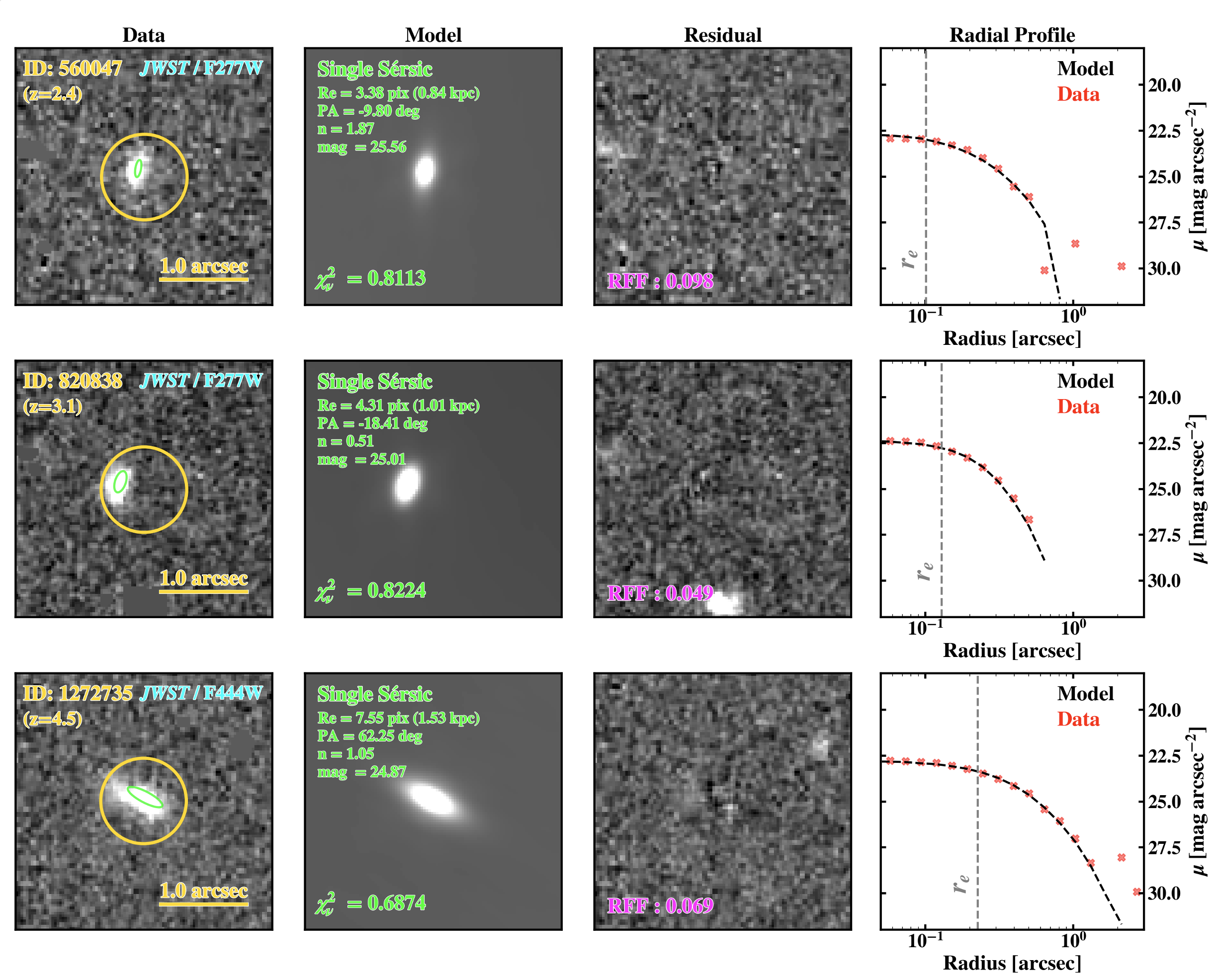
Fig 1: Representative results of the GALFIT fitting for ODIN LAEs at z = 2.4, 3.1, and 4.5. Each row represents a case for
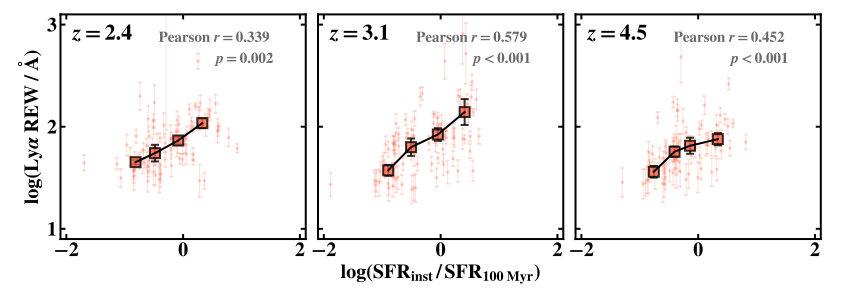
Fig 7: Correlations between the rest-frame equivalent width (REW) of Lyα emission line and galaxy properties for ODIN
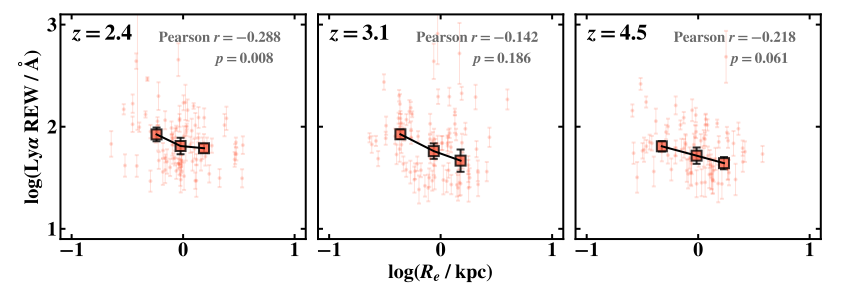
Fig 8: shows the resulting size-mass relations of
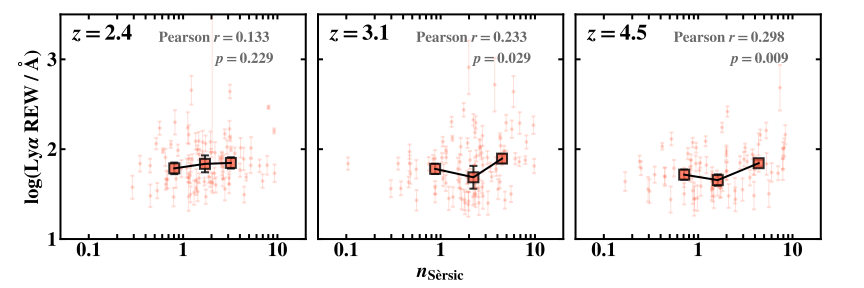
Fig 5: Relations between stellar mass and star-formation rate of ODIN LAEs and the star-forming galaxies from COS-
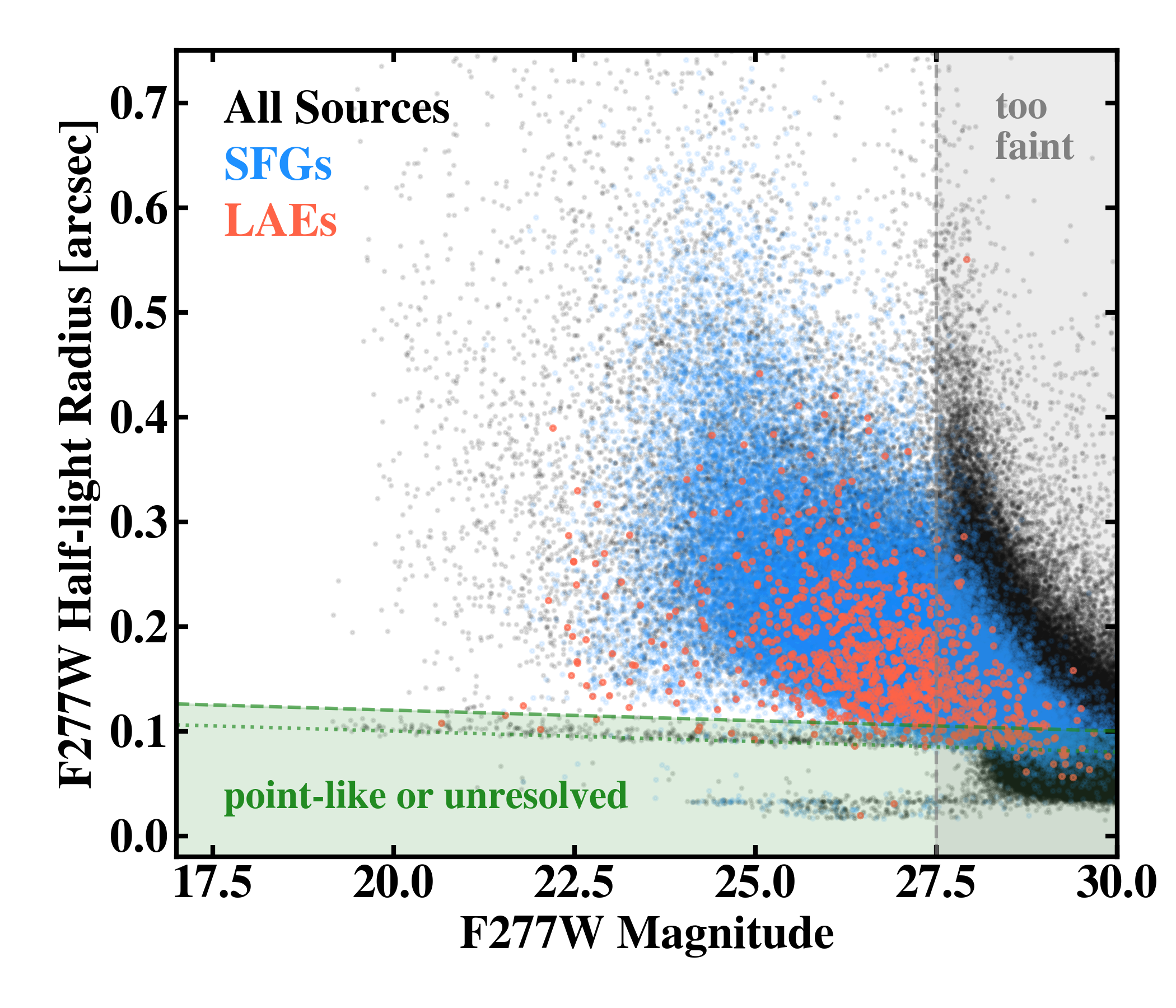
Fig 12: Relation between the half-light radius (rh) and
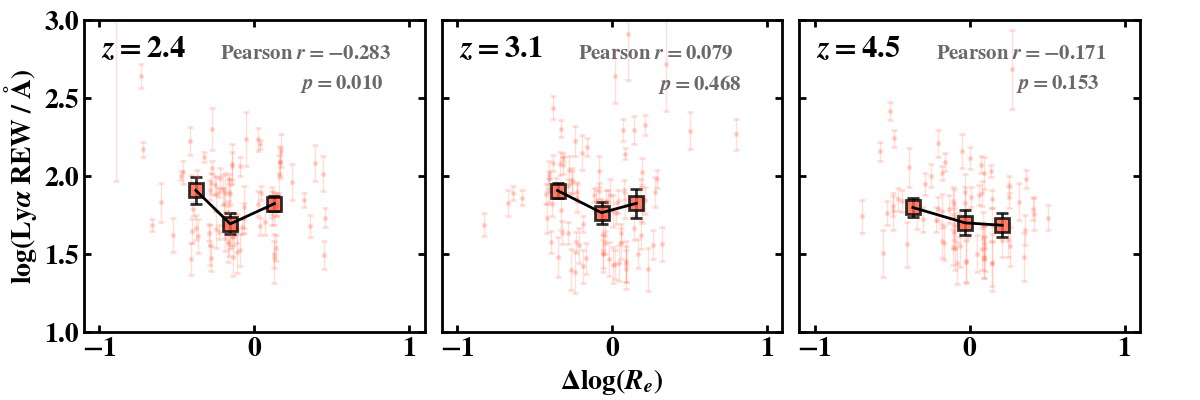
Fig 13: Relation of Lyα REW with stellar mass (upper panels), and with the size excess relative to the size-mass relation
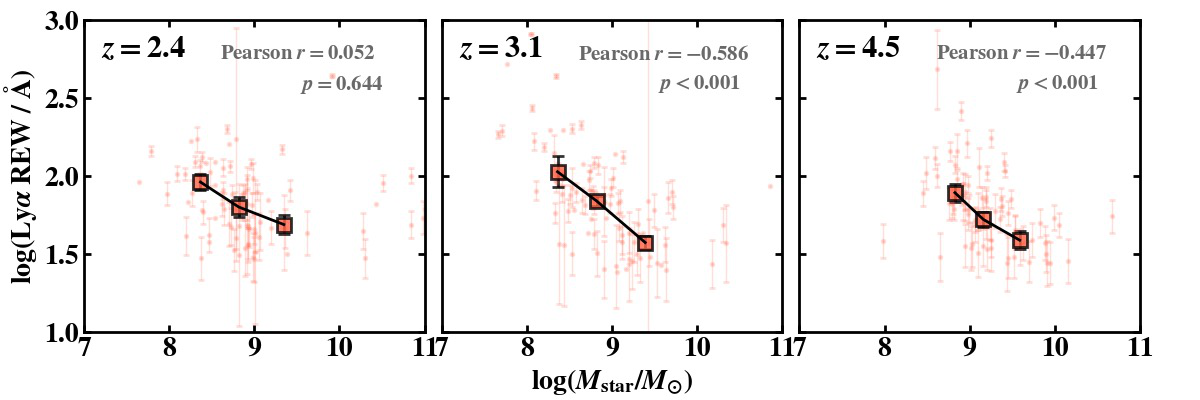
Fig 8 (page 19).
Limitations
- LAE sample limited to galaxies within COSMOS-Web DR1 footprint (~0.54 deg²), a small subset relative to full ~91 deg² ODIN survey area, potentially biasing representativeness.
- Rest-frame optical morphology measured by single Sérsic profile fits may oversimplify complex galaxy structures, especially for irregular or merging systems.
- No explicit accounting for potential systematic uncertainties in photometric redshift assignments or SED fitting with fixed redshifts, which could affect physical parameters.
- Star formation activity inferred from non-parametric SFH SED fittings still subject to degeneracies and limited time resolution, possibly smoothing burstiness metrics.
- Size measurements for sources smaller than PSF FWHM have increased uncertainty (~0.1 dex overestimate) that may impact comparative size analyses.
- Correlation analysis between Lyα REW and structural/star formation parameters is observational; causal physical mechanisms remain inferred but not directly tested.
Open questions / follow-ons
- What detailed physical processes in the interstellar and circumgalactic medium enable efficient escape of Lyα photons in compact starbursting galaxies?
- How do environmental factors such as galaxy density and cosmic web location impact the morphology and Lyα emission properties of LAEs over cosmic time?
- Can more complex morphological modeling (e.g., multi-component profiles, nonparametric shapes) improve characterization of LAEs and clarify links to Lyα emission?
- How representative are the compact, high-Sérsic index LAEs of the overall high-redshift galaxy population contributing to cosmic reionization?
Why it matters for bot defense
Though this paper is astrophysical in nature and does not address bot defense or CAPTCHA directly, it exemplifies the use of large, heterogeneous observational datasets combined with robust multi-parameter statistical modeling to disentangle populations with specific emission properties (here LAEs vs typical SFGs). Bot-defense engineering can similarly benefit from employing statistically rigorous approaches that combine multi-modal data (e.g., behavioral, biometric) to identify and characterize bot populations versus human users, especially when signals may be subtle or confounded by complex environment effects. The use of physically or behaviorally motivated features (analogous to Sérsic index or instantaneous-to-historical star formation ratios here) may help improve classification and detection. Finally, the paper shows the importance of building carefully matched comparison sets to avoid selection biases when evaluating defense efficacy.
Cite
@article{arxiv2605_29344,
  title={ ODIN: Rest-frame Optical Morphologies and Star Formation Activity of Lyα Emitters at z=2.4, 3.1, and 4.5 },
  author={ Sang Hyeok Im and Ho Seong Hwang and Jeong Hwan Lee and Robin Ciardullo and Eric Gawiser and Caryl Gronwall and Lucia Guaita and Woong-Seob Jeong and Ankit Kumar and Kyoung-Soo Lee and Changbom Park and Vandana Ramakrishnan and Akriti Singh and Hyunmi Song and Sungryong Hong and Juhan Kim and Jaehyun Lee and Christophe Pichon and Caitlin M. Casey and Maximilien Franco and Santosh Harish and Jeyhan S. Kartaltepe },
  journal={arXiv preprint arXiv:2605.29344},
  year={ 2026 },
  url={https://arxiv.org/abs/2605.29344}
}