
Magnetic Configuration Imprints on Quasi-Periodic Variability in GRMHD Simulations of Thin Accretion Disks
Source: arXiv:2605.28676 · Published 2026-05-27 · By Jing-Ze Xia, Hong-Xuan Jiang, Indu K. Dihingia, Yosuke Mizuno
TL;DR
This paper addresses the longstanding problem of understanding the origin of quasi-periodic oscillations (QPOs) in accretion disks around black holes, focusing on the role of magnetic field configurations in shaping disk structure and variability. Using high-resolution 2D and 3D global general relativistic magnetohydrodynamic (GRMHD) simulations of geometrically thin, SANE (Standard And Normal Evolution) accretion disks initialized with multi-loop magnetic fields, the authors demonstrate that magnetic topology crucially regulates disk truncation radii, inner disk puff-up, and localized resonant cavities. This magnetic structuring supports viscous-epicyclic overstability that drives coherent inertial-acoustic oscillations manifesting as QPO-like variability in mass accretion rates and turbulent viscosity (αM).
Their results show that QPO frequencies correspond closely to the local radial epicyclic frequency and its harmonics and that these oscillations produce inclined stripe-like patterns in time-radius diagrams. Importantly, as the disk thickens and turbulence-driven diffusion increases, overstability weakens and QPO coherence fades, matching observational trends for black hole X-ray binaries through outburst cycles. This work provides the first global GRMHD demonstration linking detailed magnetic field geometry to viscous-epicyclic overstability and QPO phenomenology in thin accretion flows, thus advancing theoretical understanding of accretion-driven variability.
Key findings
- Mass accretion rates and normalized horizon magnetic flux are stable across models and do not reach MAD levels (ΦBH/√˙M < 15) despite different multi-loop field configurations.
- Jet power varies strongly with initial magnetic loop size, with large-loop Model C producing ∼10× higher Blandford-Znajek jet power than small-loop Model A (Fig 1,3).
- Inner disk truncation radius correlates positively with magnetic loop size: Model A truncates at ∼60 rg, B at ∼40 rg, and C at ∼20 rg (Fig 4).
- Low plasma β (magnetically dominated, β < 1) regions coincide spatially with puffed-up inner disk zones, supporting vertical expansion due to magnetic pressure (Fig 6).
- Space-time diagrams reveal inclined, radially propagating stripe-like oscillations in scale height and Maxwell α viscosity correlating with inertial-acoustic wave modes (Fig 5,7).
- Time series of αM and scale height at multiple radii show quasi-periodic oscillations with frequency near local radial epicyclic frequency νr and harmonics, supporting viscous-epicyclic overstability (Fig 8,9).
- Power spectral density analysis finds early-time QPO bands aligned with νr and harmonics that fade as disk thickens and turbulence damps modes (Fig 10).
- 3D simulations qualitatively reproduce 2D results, showing puffed-up inner regions and loop-induced disk structure, indicating robustness of findings beyond axisymmetric models.
Methodology — deep read
The authors conduct global 2D axisymmetric and selected 3D GRMHD simulations using the GPU-accelerated KHARMA code. They solve ideal MHD equations in a Kerr spacetime with spin parameter a. The computational grid uses modified Kerr-Schild coordinates to concentrate resolution near the thin disk midplane and relax timestep constraints near poles.
Initial conditions set a geometrically thin accretion disk based on Novikov-Thorne density profiles, threaded by multi-loop poloidal magnetic field configurations inspired by Nathanail et al. (2020). Five 2D models vary loop radial wavelength (λr from 20 to 60 gravitational radii) and radial weighting parameters to adjust magnetic topology and field strength radial profile. Resolutions are 1024×768 (2D) and 384×192×192 (3D). Simulation runtimes reach up to 38,000 GM/c³ time units in 2D and 18,000 in 3D.
Primary quantities analyzed include mass accretion rate ˙M at event horizon, normalized horizon magnetic flux ΦBH/√˙M, jet power Pjet via integral of magnetic and kinetic stresses in magnetically dominated regions, and local disk structure characterized by shell-averaged density-weighted scale height H/r. Plasma beta β=p_gas/p_mag and effective Maxwell α viscosity (αM) are calculated to relate magnetic and turbulent stresses to thermal pressure.
Temporal variability is studied via space-time diagrams of scale height and αM, time series at fixed radii, and Fourier power spectral densities (PSDs) of αM to detect QPO signatures. Cross-correlations between pressure and stress quantify viscous-epicyclic overstability phase lag. Epicyclic frequency νr and other characteristic frequencies are computed from local orbital parameters in relativistic Kerr geometry.
2D simulations allow extensive parameter variation and long runtimes to establish quasi-steady state disk structure and variability regimes. 3D simulations focus on validating main structural and variability findings in full magnetized turbulence without axisymmetry.
This approach tightly couples global GRMHD turbulence with analytic viscous overstability theory via detailed magnetic topology control, enabling exploration of how field loop size and radial distribution affect inner disk geometry, resonant cavity formation, and excitation/damping of inertial-acoustic oscillations responsible for QPO-like features. The work blends numerical precision, physical realism, and theoretical interpretation of magnetically regulated thin disk variability.
Technical innovations
- Use of multi-loop, SANE-like magnetic field configurations in thin disk GRMHD simulations to control inner disk puff-up and truncation radius systematically.
- Identification of viscous-epicyclic overstability as the physical mechanism driving coherent inertial-acoustic QPO-like oscillations in global GRMHD thin disk turbulence.
- Demonstration that magnetic topology regulates formation of resonant cavities supporting inertial-acoustic mode trapping and amplifying viscous overstability.
- Detailed spatio-temporal correlation analysis between Maxwell stress and pressure to measure viscous-stress phase lag and directly connect simulation turbulence to overstability theory.
Datasets
- 2D GRMHD thin disk simulation sets — ∼5 variants with loop sizes λr=20–60 rg — generated in-house, non-public
- 3D GRMHD thin disk simulations — 2 variants mirroring 2D parameter space — generated in-house, non-public
Baselines vs proposed
- Magnetically arrested disk (MAD) regime: ΦBH/√˙M ≥ 15 threshold — all models remain below threshold in SANE regime
- Model A (small loop) jet power: Pjet (BZ) baseline — ∼10× lower than Model C (large loop)
- PSD αM QPO power at early stage: Model A > Model C > Model D > Model E (thicker disks suppress sustained oscillations)
- Inner disk truncation radius: Model A (60 rg) > Model B (40 rg) > Model C (20 rg), correlates inversely with loop size
Figures from the paper
Figures are reproduced from the source paper for academic discussion. Original copyright: the paper authors. See arXiv:2605.28676.

Fig 1: Time evolution of the mass accretion rate mea-
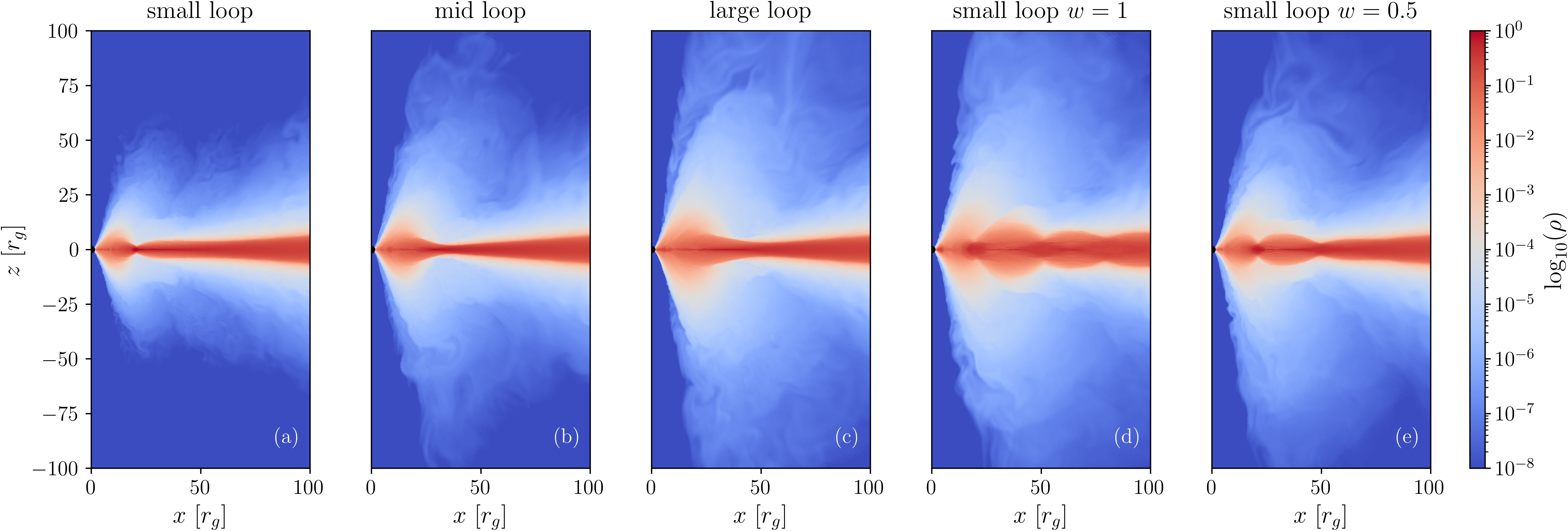
Fig 2: Logarithmic density distributions at t = 25,000 M for different magnetic configurations. The labels in the lower right
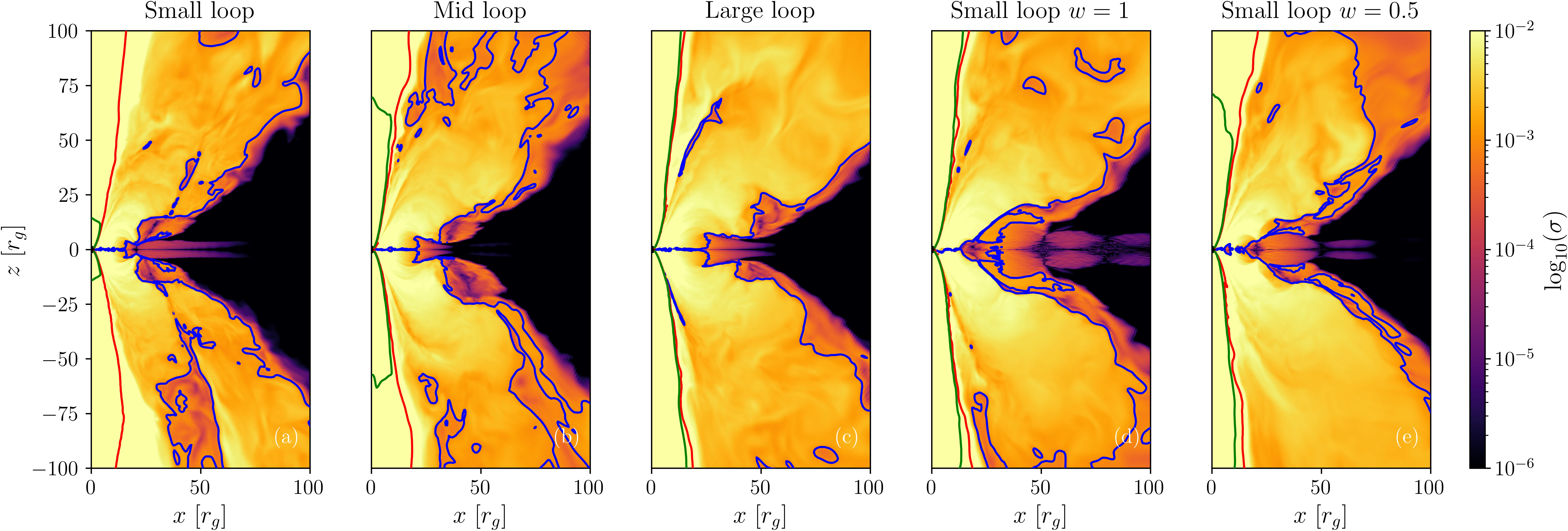
Fig 3: The figure shows the distribution of time-averaged magnetization σ over the interval t = 24,000 M to 25,000 M. The
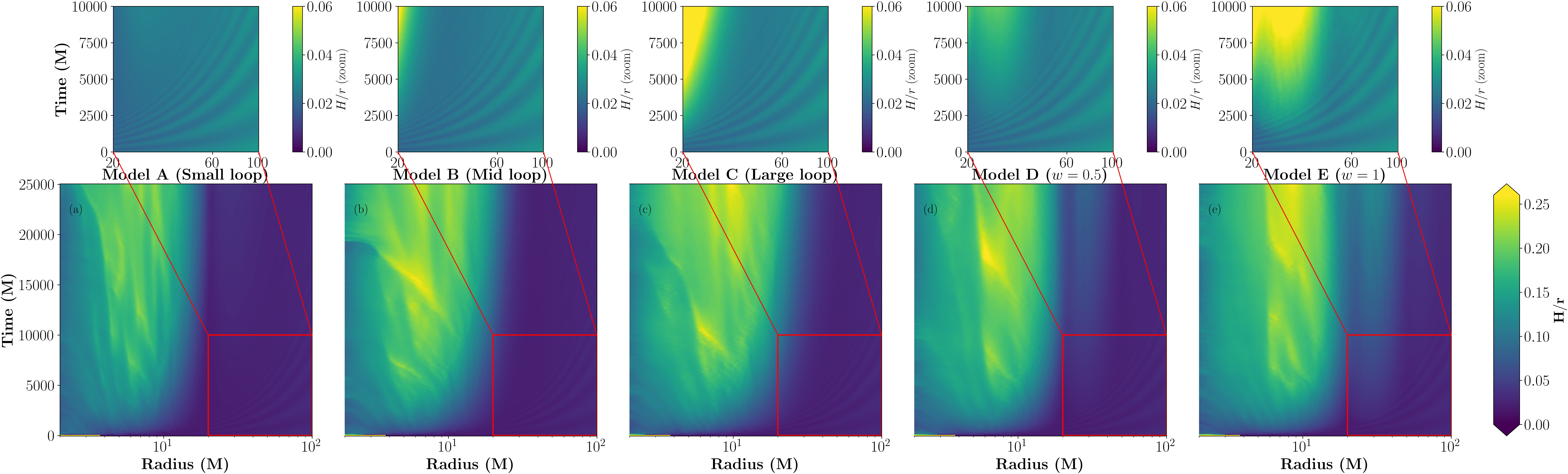
Fig 5: Space-time distribution of the scale height for different models. The labels in the upper-left corner of each panel
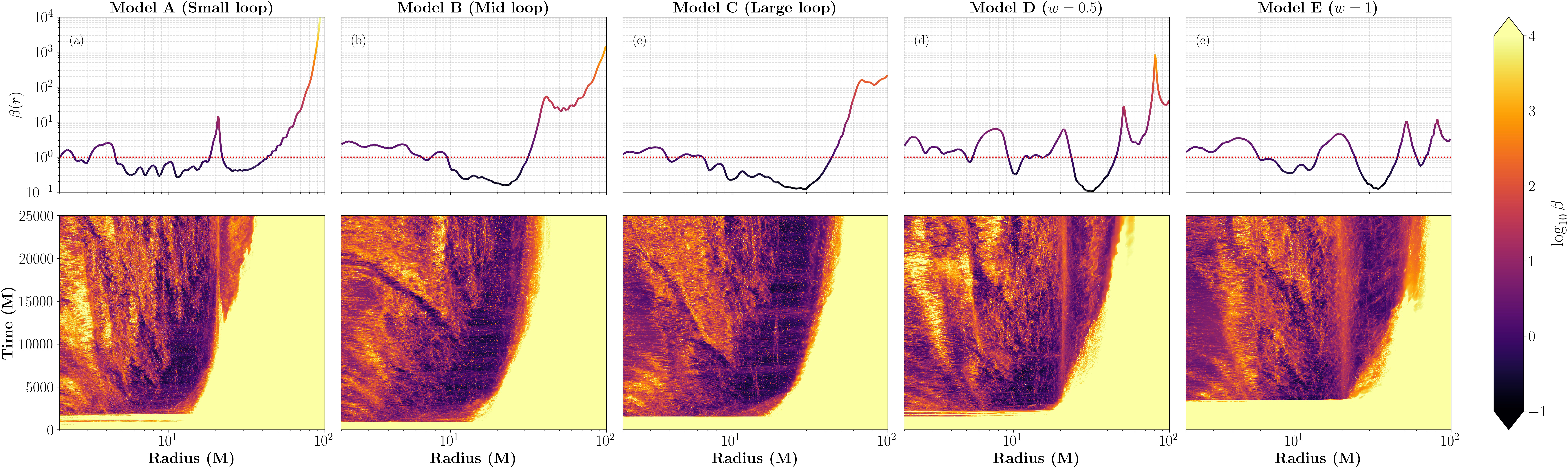
Fig 6: Upper panels: time-averaged plasma β over the interval t = 24,000 M to 25,000 M, computed using shell-integrated
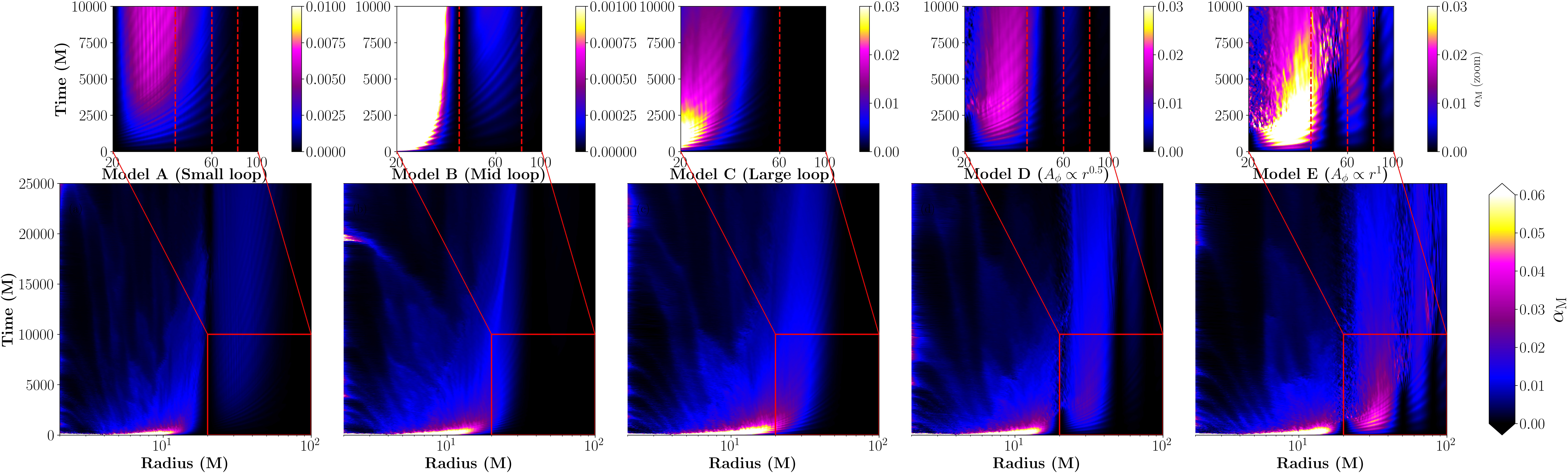
Fig 7: Same labeling as in Figure 5, but shown for αM in different models. Red dash lines refer to the interfaces between
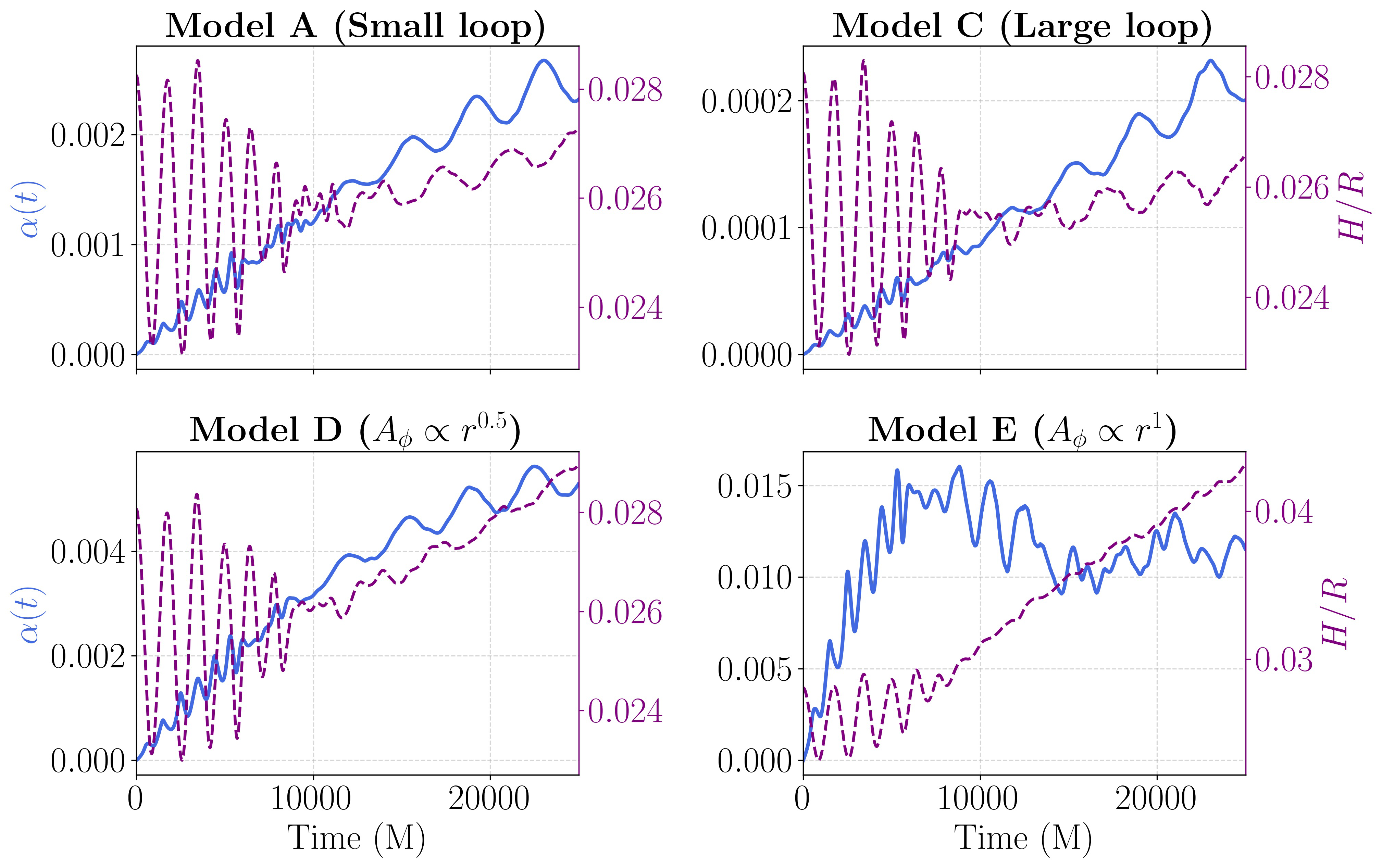
Fig 8: Time evolution of αM and the scale height at
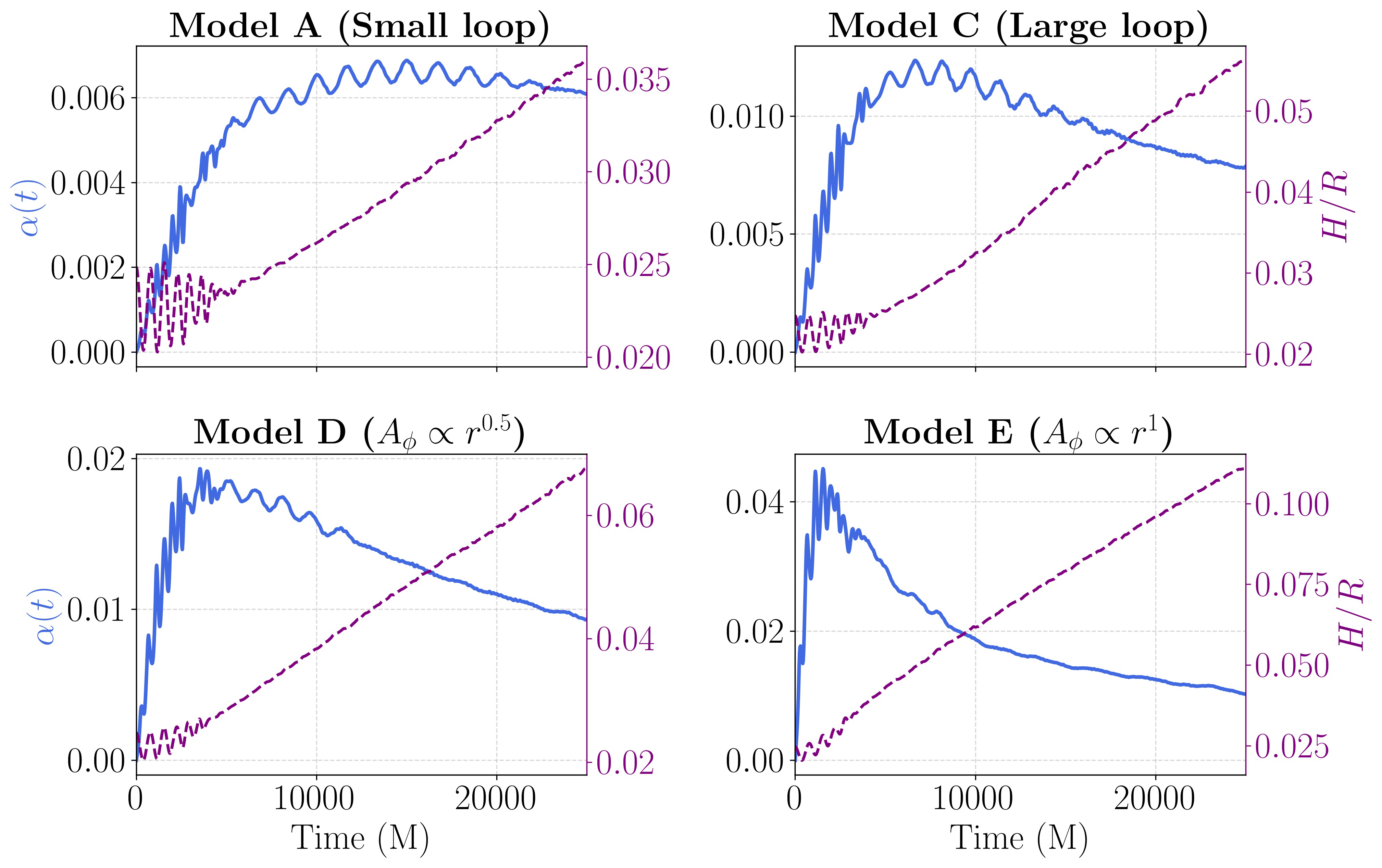
Fig 9: Same as Figure 8 but at r = 35 rg
Limitations
- 2D axisymmetric simulations lack full 3D turbulence dynamics and non-axisymmetric modes, possibly affecting QPO mode structure and saturation.
- Limited 3D runs reduce ability to fully confirm multi-dimensional robustness of viscous overstability and magnetic cavity resonances.
- Shorter 3D runtimes (~18,000 M) compared to longest 2D runs may miss late-time disk evolution and variability damping observed in 2D.
- Assumed ideal MHD and no radiation transport; radiative cooling and microphysics neglected, which can influence thin disk thermal and vertical structure.
- Disk parameters fixed to certain spin and initial density profiles; generalization to different spins or accretion rates requires further study.
- No direct comparison with observed flux or spectral variability; connection to observational QPOs inferred only from frequency ranges.
Open questions / follow-ons
- How do non-axisymmetric 3D MHD turbulence and magnetic reconnection processes influence viscous overstability and QPO coherence?
- What is the impact of realistic radiative cooling and microphysical transport (e.g., radiation-MHD effects) on disk vertical structure and overstability?
- Can varying black hole spin or accretion rate broaden or shift the QPO frequency ranges predicted by magnetic topology-driven viscous overstability?
- How do evolving magnetic field geometries generated self-consistently via disk dynamo processes modify resonant cavity formation and overstability over long timescales?
Why it matters for bot defense
While this work is firmly astrophysical in context, bot-defense practitioners interested in CAPTCHA or challenge-response systems could draw conceptual analogies from the interplay between spatially localized structures (resonant cavities) and temporal oscillations driven by nonlinear feedback mechanisms (viscous–epicyclic overstability). Understanding how system configurations (here magnetic topology) control robustness or suppression of quasi-periodic signals might inspire analogous strategies in CAPTCHA design to create or suppress certain automated response signatures. The identification of physical parameters that govern mode trapping and frequency selectivity could inform feature engineering for distinguishing automated from human behavior in time-series or system interaction data. However, direct applicability is limited by domain differences and lack of adversarial testing typical in security contexts.
Cite
@article{arxiv2605_28676,
  title={ Magnetic Configuration Imprints on Quasi-Periodic Variability in GRMHD Simulations of Thin Accretion Disks },
  author={ Jing-Ze Xia and Hong-Xuan Jiang and Indu K. Dihingia and Yosuke Mizuno },
  journal={arXiv preprint arXiv:2605.28676},
  year={ 2026 },
  url={https://arxiv.org/abs/2605.28676}
}