
Spectral Tail Auxiliary Learning for AI-Generated Image Detection
Source: arXiv:2605.22751 · Published 2026-05-21 · By Xingyi Li, Jiahui Zhang, Yiheng Li, Yun Cao, Wenhao Wang
TL;DR
This paper addresses the problem of detecting AI-generated images, which increasingly resemble real images and are thus harder to detect. While prior work often uses frequency-domain cues described broadly as frequency artifacts or high-frequency discrepancies, this paper identifies and rigorously characterizes a specific, recurring spectral phenomenon they term "spectral tail uplift." This is a localized anomalous increase in energy at the ultra-high-frequency end of the radial log-power spectrum of generated images, deviating from the power-law decay typical of natural images. Through theoretical analysis and controlled experiments on diverse generative models (GANs, diffusion, VAEs), the authors attribute the uplift to nonlinear harmonic accumulation caused by repeated nonlinear activations combined with learned convolutional filters in generative decoders.
Based on this insight, they propose Spectral Tail Auxiliary Learning (STAL), which uses a frequency-domain tail-aware teacher as an auxiliary supervisory signal during training to inject spectral tail features into a spatial-domain detector. Critically, STAL discards all frequency modules at inference time for efficiency and robustness. Experiments on 9 public datasets show STAL outperforms state-of-the-art detectors in balanced accuracy, generalizes well across generators and distributions, and remains robust under common image post-processing. This work advances understanding of specific frequency signatures of generated images and demonstrates how to leverage these cues for practical, generalizable detection.
Key findings
- Generated images across GANs, diffusion models, and VAEs consistently exhibit a spectral tail uplift—an anomalous localized increase in power in the ultra-high-frequency tail (ρ ∈ [0.7,1]) of the radial power spectrum, deviating from the power-law decay seen in real images (Fig. 1).
- Nonlinear activation functions inside generative models (e.g., SiLU, ReLU) cause harmonic generation that accumulates across layers, producing the spectral tail uplift; replacing activations with identity ablates the uplift almost completely (Fig. 2).
- STAL using frequency-domain auxiliary supervision achieves an average balanced accuracy of 97.0% across 9 datasets, outperforming the strongest baseline DDA* by +2.8 percentage points and reducing cross-dataset standard deviation from 5.8 to 2.6.
- STAL ranks first on 7 out of 9 benchmarks, including challenging in-the-wild datasets with unknown generators and post-processing (SynthWildx, WildRF).
- STAL maintains strong robustness under perturbations: balanced accuracy drops by only 2.38 points under JPEG compression at Q=60, 1.35 points with 0.5 resizing, and 3.10 points under Gaussian blur, outperforming all compared methods (Fig. 4).
- Using spectral tail uplift as training-time auxiliary supervision improves the final spatial-only detector more than directly fusing frequency and spatial features at inference (+0.8% BAL), and focusing on the tail band yields better performance (+1.9%) than full-frequency or without-tail (Table 4).
- The spectral tail uplift mechanism is explained theoretically via harmonic generation and propagation in multi-layer nonlinear convolutional generators (Theorems 1 and 2), identifying the nonlinear activations as the key source.
- STAL requires no additional inference time overhead as all frequency-domain modules are discarded at test time.
Threat model
The adversary is an image generation model capable of producing high-quality synthetic images using GAN, diffusion, or VAE architectures. The adversary does not have control over the detector and cannot perfectly mimic the spectral tail uplift signature induced by nonlinear harmonic accumulation in ordered convolution-activation cascades. The defender’s detection system assumes no prior knowledge of the adversary’s model weights, architecture, or post-processing and aims for a generalizable detector robust to diverse generators and perturbations.
Methodology — deep read
Threat Model & Assumptions: The adversary is a generator producing synthetic images from various architectures (e.g., GANs, diffusion models, VAEs). The defender's goal is to distinguish real from AI-generated images with no knowledge of the specific backbone or post-processing applied. The adversary cannot perfectly simulate the spectral tail uplift phenomenon tied to nonlinear activations in generative modeling.
Data: Training uses MSCOCO real images and their reconstructed versions for supervision. Testing spans 9 public datasets including GenImage, DRCT-2M, Synthbuster, EvalGEN, AIGCDetectionBenchmark, ForenSynths, Chameleon, SynthWildx, and WildRF encompassing a mix of GAN, diffusion, and autoregressive models, including unknown in-the-wild scenarios. Datasets involve multiple generators with varying data distributions and post-processing. Labels are binary (real vs generated). Preprocessing includes geometric augmentations for spatial views, excluding those that distort spectral properties for frequency views.
Architecture / Algorithm: STAL contains two branches only during training: a frequency teacher and a spatial detector. The frequency teacher encodes spectral tail information via a frequency encoder processing radial log-power spectra and local DCT statistics, followed by a "tail head" module to produce tail-aware embeddings and auxiliary predictions. The spatial detector uses a convolutional backbone (DINOv3-H+) to extract spatial representations and produce binary predictions. A projection head maps spatial features into the frequency teacher's feature space. The auxiliary losses align these features (via cosine similarity), enforce tail-aware classification, and guide the spatial detector with supervised contrastive and BCE losses. At inference, all frequency branches and projection heads are discarded, evaluating only the spatial detector.
Training Regime: Trained for one epoch on MSCOCO reconstructions, batch size 16 per GPU, AdamW optimizer (lr=1e-4, weight decay=0.005). LoRA finetuning applied to spatial backbone for efficiency. Curriculum weighting ramps down auxiliary frequency loss over time to prevent over-dependence on the teacher. Training jointly minimizes classification, contrastive, alignment, and frequency auxiliary losses.
Evaluation Protocol: Evaluation across 9 public benchmarks reports balanced accuracy (mean of real and generated image accuracy). Results are aggregated over dataset subsets when applicable. STAL is compared to state-of-the-art methods using publicly released models. Robustness is tested under distortions such as JPEG compression, downsampling, and Gaussian blur. Ablations study frequency usage modalities, frequency-band selections, and backbone choices. No information on cross-validation splits or statistical tests is provided.
Reproducibility: The paper does not explicitly mention code or model release. Dataset sources are public benchmarks. The frequency auxiliary branch design, loss weights, and training settings are described for replication. However, some hyperparameter details (e.g., exact loss weight values) appear in the appendix and other implementation specifics could be clarified.
Example End-to-End: A real or generated image is first augmented into a spatial view and a frequency-preserving view. The frequency view is transformed into YCbCr, and the radial log-power spectrum plus local DCT stats are computed and encoded by the frequency teacher branch, producing a tail-aware embedding. The spatial view passes through the spatial backbone to extract features, which are projected for alignment with the frequency teacher target. The spatial branch is supervised by classification and contrastive losses while the frequency branch receives auxiliary classification and tail losses. Over training epochs, the spatial detector learns to encode spectral tail cues internally. At inference, the spatial detector alone classifies unseen images without frequency input or extra compute.
Technical innovations
- Identification and systematic characterization of spectral tail uplift: an anomalous localized increase in ultra-high-frequency energy in generated images, diverging from the typical power-law spectral decay of real images.
- Theoretical explanation of spectral tail uplift through nonlinear harmonic generation and propagation produced by cascaded nonlinear activations and trained convolutional filters in generative decoders.
- Spectral Tail Auxiliary Learning (STAL): a frequency-domain teacher-to-spatial auxiliary supervision framework that transfers spectral tail cues during training but requires no frequency-domain inputs or branches at inference.
- Tail-aware frequency teacher design combining radial log-power spectrum encoding with explicit tail embedding and auxiliary classification to robustly capture spectral tail signatures across diverse generators.
Datasets
- GenImage — unspecified size — public benchmark with 1GAN + 7 diffusion generators
- DRCT-2M — unspecified size — 13 diffusion generators
- Synthbuster — unspecified size — 3 GAN + 2 autoregressive
- EvalGEN — unspecified size — 9 diffusion generators
- AIGCDetectionBenchmark — unspecified size — 11 GAN generators
- ForenSynths — unspecified size — 7 GAN + 10 diffusion generators
- Chameleon — in-the-wild unknown generators
- SynthWildx — in-the-wild unknown generators
- WildRF — in-the-wild unknown generators
Baselines vs proposed
- DDA* (DINOv3-H+): average balanced accuracy = 94.2% vs STAL: 97.0%
- DDA (NeurIPS'25): 90.0% vs STAL: 97.0% (with better backbone and auxiliary training)
- FatFormer (CVPR'24): 61.3% avg vs STAL: 97.0%
- C2P-CLIP (AAAI'25): 64.7% avg vs STAL: 97.0%
- Under JPEG compression at quality 60: best competitor loses > 10 points BAL, STAL drops only 2.38 points
- On AIGCDetectionBenchmark, STAL average BAL 96.9% vs second-best DDA* 92.4%
- On SynthWildx and WildRF, STAL achieves 95.2% and 97.9% BAL respectively, outperforming all baselines
Figures from the paper
Figures are reproduced from the source paper for academic discussion. Original copyright: the paper authors. See arXiv:2605.22751.

Fig 3: Overview of STAL. A tail-aware frequency teacher extracts spectral-tail cues from a
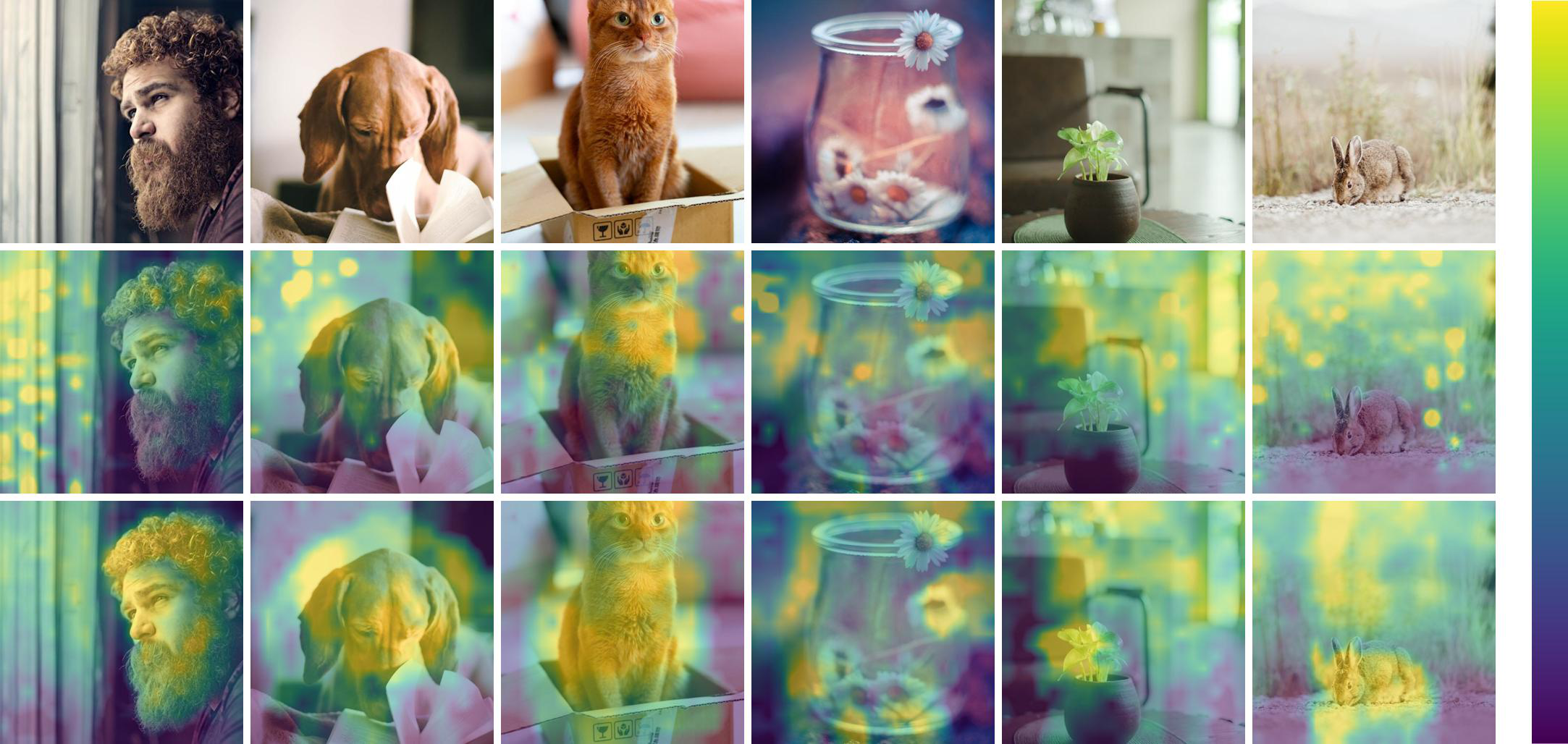
Fig 7: Visualization of model attention. From top to bottom, the three rows show the original
Limitations
- Frequency auxiliary branch relies mainly on radial spectrum and local DCT statistics, which may miss fine-grained spectral variations specific to some generators.
- Experiments lack detailed analysis under adaptive adversarial attacks aimed at circumventing spectral tail features.
- The approach has been evaluated on public datasets but generalization to future unseen generators or highly novel architectures remains to be tested.
- Training requires carefully constructed frequency-preserving views, which may impose pipeline complexity.
- Only one epoch of training on MSCOCO reconstructions is reported; longer training or larger datasets might impact performance.
- No publicly released code or pretrained weights, limiting straightforward reproducibility.
Open questions / follow-ons
- Can adaptive frequency-band selection or dynamic tailoring of spectral supervision improve capture of diverse generator spectral nuances beyond radial and DCT features?
- How robust is spectral tail uplift detection against adversarially crafted images or generative models trained specifically to suppress harmonic accumulation?
- Can the STAL framework be efficiently extended to multimodal generated content detection (e.g., video, audio), leveraging analogous spectral tail phenomena?
- What is the tradeoff between strength of auxiliary frequency supervision and spatial backbone capacity in shaping learned representations for detection?
Why it matters for bot defense
For bot-defense and CAPTCHA practitioners, this paper highlights a stable, interpretable spectral fingerprint—spectral tail uplift—that generalizes across a wide variety of image generators. The demonstrated transfer of frequency-domain cues into spatial detectors via training-time auxiliary supervision is valuable, as it enables robust, zero-overhead inference compatible with real-time detection constraints common in bot-defense contexts. The insights into nonlinear harmonic origins provide a principled signal for detection pipelines that can complement behavioral or text-based bot signals.
Practitioners should consider integrating spectral tail-inspired auxiliary losses or features into their AI-generated content detectors to improve detection robustness against unseen generator architectures and post-processing perturbations frequently encountered in adversarial or real-world attack scenarios. However, care must be taken to ensure that training pipelines maintain frequency-preserving augmentations to effectively distill these spectral cues without impacting operational inference speed.
Cite
@article{arxiv2605_22751,
  title={ Spectral Tail Auxiliary Learning for AI-Generated Image Detection },
  author={ Xingyi Li and Jiahui Zhang and Yiheng Li and Yun Cao and Wenhao Wang },
  journal={arXiv preprint arXiv:2605.22751},
  year={ 2026 },
  url={https://arxiv.org/abs/2605.22751}
}