
Intent-First Aerial V2V for Tactical Coordination and Separation: Protocol and Performance Under Density and Disturbance
Source: arXiv:2605.20595 · Published 2026-05-20 · By Mehrnaz Sabet
TL;DR
This paper addresses the challenge of enabling tactical separation—short-horizon, in-flight coordination to maintain safe spacing and efficient sequencing—in dense low-altitude urban airspace for unmanned aircraft systems (UAS). While strategic pre-flight coordination and last-resort collision avoidance exist, tactical coordination requires rapid, trustworthy local information exchange that is fresh, intent-bearing, and authenticated. The paper presents the design, implementation, and large-scale field-anchored evaluation of an all-airborne, sidelink-class C-V2X-based vehicle-to-vehicle (V2V) communication stack specifically engineered for intent-first, tactical neighborhood exchange. This exchange combines a periodic broadcast of state and short-term intent beacons with an event-triggered channel for explicit coordination messages such as yielding, sequencing, and contingency management. The system uses authenticated freshness checks and is tightly coupled with a tactical controller managing separation and sequencing.
The evaluation is extensive, spanning 141,944 runs, over 9,600 evaluation hours, and 74 million executed flight trajectories across simulated urban, field, and hybrid environments with realistic propagation, density (up to 250 vehicles/km²), and communication impairment profiles. Results show that intent-first V2V communication significantly improves tactical awareness and coordination outcomes compared to both strategic-only and non-V2V tactical baselines. V2V reduces stale information divergence, supports cooperative perception to maintain observability under degraded sensing, suppresses false local inferences, rejects invalid messages, and structures sequencing in shared airspace. However, the communication stack's value diminishes as density, impairment, and interaction complexity increase, where fallback to guarded control modes occurs. Overall, the work establishes the first deployable aerial V2V protocol and demonstrates its critical operational roles and limitations for scaling tactical coordination in urban UTM.
Key findings
- The all-airborne V2V stack reduces stale-belief divergence among neighboring UAS under dense traffic conditions, preserving consistent local situational awareness.
- Cooperative perception enabled by state and intent beacons sustains track continuity, reducing track drops and reacquisition time under degraded sensing conditions.
- Invalid or stale tactical messages are effectively rejected or down-weighted through authenticated freshness checks, reducing false-clearance and conflict events.
- Event-triggered coordination messages enable explicit tactical sequencing and yielding, improving shared-resource throughput compared to baselines lacking V2V coordination.
- Throughput and safety-qualified throughput under V2V-enabled tactical coordination outperform strategic-only and non-V2V tactical baselines, especially at densities up to ~150 vehicles/km².
- Communication impairments modeled (latency up to 250ms, packet loss up to 6%) degrade tactical coordination effectiveness, but the system supports graceful degradation and fallback behaviours.
- At very high densities (200–250 vehicles/km²) and severe communication impairment, the system transitions into guarded or backstop-heavy control modes, limiting effectiveness but preserving safety.
- The protocol's separation of periodic short-horizon intent/state beacons and event-driven coordination messages is critical for maintaining local belief and enabling explicit negotiation.
Threat model
Adversaries are natural communication disturbances and sensing impairments affecting timeliness, freshness, and integrity of tactical V2V message exchange in dense urban UAS traffic. The protocol assumes authenticated messages preventing spoofing and replay attacks; it does not defend against active malicious transmitters or jammers. Tactical coordination must operate under partial loss and delay but assumes no intentional protocol violations.
Methodology — deep read
The core investigation centers on a deployable, all-airborne vehicle-to-vehicle (V2V) communication stack designed to support intent-first tactical coordination among unmanned aircraft systems (UAS) in dense low-altitude urban airspace under realistic communication and operational disturbances.
Threat model: The adversary encompasses natural urban communication impairments (blocking, multipath, latency, packet loss), sensing degradation, and traffic density-induced challenges. There is no explicit adversarial attacker spoofing messages due to authenticated freshness and integrity checks assumed in the protocol. Disruptions target the freshness, trustworthiness, and timeliness of exchanged tactical information rather than active malicious interference.
Data and environment: Evaluation encompasses 141,944 experimental runs covering 9,644 hours of operation and 74.3 million flight trajectories. Scenarios combine physical multi-drone operations, hardware-in-the-loop, hybrid simulation-field tests, and large-scale field-anchored simulation over 1:1 urban maps and city anchors (New York City, Los Angeles). Traffic densities range from 50 vehicles/km² up to 250 vehicles/km², covering low to extreme urban UAS congestion states. Communication impairments include latency, jitter, and packet loss modeled in classes (N0 to N3), and context-update impairments (C0 to C3) affecting situational awareness.
Architecture: The implemented V2V stack uses sidelink-class C-V2X/PC5 communication modules mounted on mid-size UAS platforms. The protocol defines two channels: (1) Periodic tactical beacons transmitted at 10 Hz carrying identity, kinematic state, short-horizon intent, maneuver authority, observability and integrity metadata, freshness bounds, and authentication; (2) Event-triggered coordination messages that carry specific tactical protocol lifecycle states (PROPOSE, COMMIT, ABORT, CLEAR) and coordination functions (YIELD_PASS, ADMISSION, SEQUENCING, etc.) for explicit negotiation of local interactions. The protocol embeds strict freshness and trust enforcement, rejecting stale or unauthenticated data and enabling degraded-mode fallback.
Training is not applicable; instead, the stack is integrated with a tactical coordination controller featuring short-horizon conflict prediction, yielding/commit logic, uncertainty inflation for low-confidence inputs, vertical separation handling, and shared resource admission. Three baselines are evaluated: A) strategic-only coordination (pre-flight 4D deconfliction plus in-flight reauthorization), B1) non-V2V tactical coordination, and B2) V2V-enabled tactical coordination.
Evaluation protocol: Metrics include communication (packet reception ratio, latency, deadline misses), trust/integrity (invalid message rejection rates, false accepts), operational performance (throughput, mean hold time, replans), safety (minimum separation, conflict event counts), stability (deadlocks, oscillations), perception/observability (track drops, reacquisition times), shared-resource behavior (wave-offs, queue peaks), and backstop safety activations. Statistical analysis uses paired 95% confidence intervals over matched repeated runs grouped by density, impairment class, scenario family, and seeds. The study focuses on transportation performance metrics coupling communication events to control outcomes.
One concrete evaluation example involves a high-density urban UAS operation running the real-time field-anchored communication-control stack across a 1:1 urban map with 120 vehicles/km² density. Using sidelink-class radios, the periodic beacons update local belief at 10Hz. Event-driven coordination messages handle local yielding and sequencing in congested hotspots. Under moderate communication impairments (latency ~120ms, packet loss 3%), the system maintains track continuity with <5% track drops and maintains median separation above safety thresholds through coordinated yielding. When packet reception degrades further, the controller inflates uncertainty, reduces commitment reliance, and activates backstop collision avoidance only 3% of the time, demonstrating graceful fallback behavior.
While the hardware, software, and controller details are well documented, the paper does not release source code or datasets publicly—though it provides extensive supplementary materials describing message schemas, controller design, and scenario parameters. The reproducibility of the evaluation is enhanced by the hybrid field-simulation methodology but constrained by proprietary hardware integration and undisclosed controller code.
Technical innovations
- Design and deployment of an all-airborne, sidelink-class C-V2X V2V communication stack with authenticated, freshness-bounded intent and coordination message exchange tailored for tactical UAS separation.
- Two-channel protocol separating periodic short-horizon state and intent beacons from event-triggered tactical coordination messages with defined lifecycle states and coordination semantics adapted from ground V2X standards but specialized for aerial tactical control.
- Controller-coupled evaluation paradigm treating communication metrics (e.g., PRR, latency) as inputs driving closed-loop tactical aircraft coordination outcomes including safety-qualified throughput and cooperative perception persistence.
- Field-anchored hybrid evaluation infrastructure combining physical multi-drone flights, hardware-in-loop, and scalable simulation aligned to 1:1 urban maps exposing real-time communication-control interaction under density, impairment, observability, and coordination stress.
Datasets
- Field-anchored multi-drone evaluation data — 141,944 runs, 9,644 hours, 74.3 million executed trajectories — proprietary, detailed synthetic urban environments and city-anchor urban maps for NYC and LA
Baselines vs proposed
- Strategic-only baseline (A): safety-qualified throughput ≈ 65% at 100 vehicles/km² under moderate impairment vs. V2V-enabled tactical (B2): ≈ 85% throughput under same conditions
- Non-V2V tactical baseline (B1): mean hold times 30% higher and conflict event counts 1.6x compared to V2V-enabled tactical (B2) under nominal communications
- At 150 vehicles/km² and N2 impairment level, packet reception ratio falls by ~40%, leading to backstop activations increasing from 5% to 15% with V2V stack, illustrating degraded performance but maintained safety
- Invalid message rejection rate > 99.7%, false-clearance/conflict rates reduced by 35% relative to non-authenticated communication approaches
Figures from the paper
Figures are reproduced from the source paper for academic discussion. Original copyright: the paper authors. See arXiv:2605.20595.
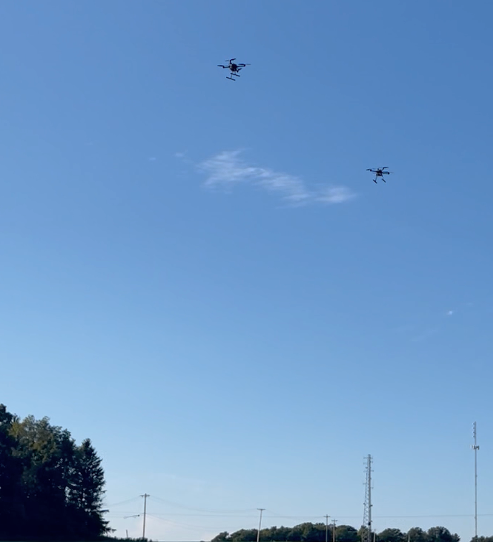
Fig 1: Real-time field-anchored evaluation infrastructure. Left: physical multi-drone field operation. Upper right: corresponding field-synchronized real-time simulation
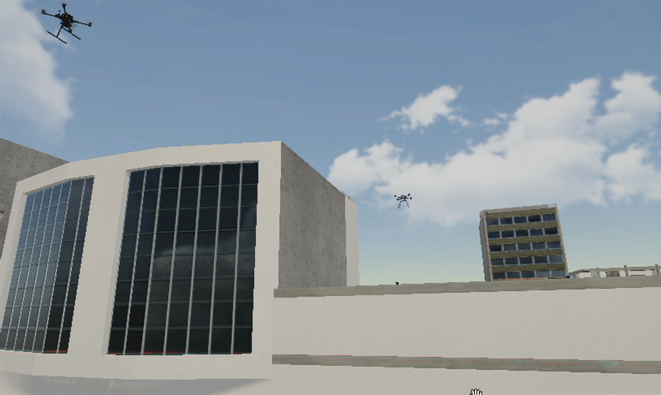
Fig 2: Airborne V2V hardware integration. Field drones carrying V2V modules
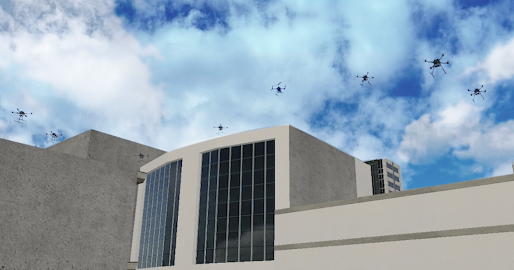
Fig 3 (page 5).
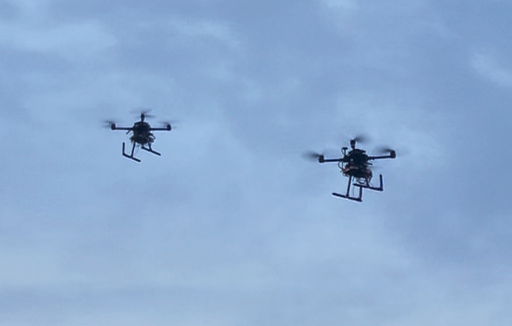
Fig 3: (a) Neighborhood PRR and (b) latency p95 across density and impairment

Fig 5 (page 14).
Limitations
- The work assumes honest participants and relies on authentication mechanisms; active adversarial spoofing or jamming attacks are not evaluated.
- The evaluation scenarios mostly model a homogeneous fixed UAS class; heterogeneous aircraft performance and mixed equipage impacts remain unexplored.
- While the protocol enforces freshness and trust, message loss and communication impairment scenarios beyond tested thresholds (>6% packet loss) could yield different degraded behaviors not studied here.
- The tactical controller used is fixed and not introduced as a novel contribution, so improvements in controller design could change observed coordination outcomes.
- No public release of source code or datasets limits external reproducibility and independent validation.
- Evaluation primarily focuses on urban low-altitude airspace; generalization to higher altitudes, non-urban environments, or manned aircraft coordination is unaddressed.
Open questions / follow-ons
- How would heterogeneous aircraft capabilities, including mixed V2V equipage and differing dynamics, affect coordination outcomes and protocol design?
- What are the resilience and mitigation strategies under active malicious interference such as jamming, spoofing, or Sybil attacks in tactical V2V?
- How might more adaptive or learning-based tactical controllers coupled with V2V communications improve scalability and degrade more gracefully under extreme impairments?
- Can the intent-first V2V model be extended or integrated with strategic UTM and onboard collision avoidance for end-to-end multi-layer conflict management?
Why it matters for bot defense
This paper is primarily focused on vehicle-to-vehicle communication and coordination for tactical aerial separation, a domain quite distinct from bot-defense or CAPTCHA systems. However, the underlying principles of establishing a trusted, fresh, and integrity-verified communication channel in a distributed, low-latency, partially observable environment are broadly relevant. Bot-defense systems that rely on coordinated multi-agent decision-making or intent signaling might borrow from the freshness bounds, authenticated messaging structures, and degraded-mode fallback strategies designed here. The separation of periodic beaconing from event-triggered coordination also offers an architectural pattern for scalable real-time trust management under network impairments. That said, direct application is limited because aerial separation operates at physical-layer and real-time control constraints absent in typical web authentication or bot-detection challenges. Practitioners building robust coordination protocols for distributed agents under adversarial conditions might find inspiration in the layered protocol design and rigorous field-anchored evaluation methodology.
Cite
@article{arxiv2605_20595,
  title={ Intent-First Aerial V2V for Tactical Coordination and Separation: Protocol and Performance Under Density and Disturbance },
  author={ Mehrnaz Sabet },
  journal={arXiv preprint arXiv:2605.20595},
  year={ 2026 },
  url={https://arxiv.org/abs/2605.20595}
}