
Advancing the detection of low surface brightness galaxies. I. ATTILA: multi-tAsking deTecTIon tool for Lsb gAlaxies
Source: arXiv:2605.21598 · Published 2026-05-20 · By E. Borsato, F. Fonzo, N. Bellucco, E. Iodice, E. M. Corsini, M. Spavone et al.
TL;DR
The paper addresses the challenging problem of detecting and characterizing low surface brightness (LSB) galaxies, particularly ultra-diffuse galaxies (UDGs), which are faint and diffuse stellar systems difficult to reliably identify in deep imaging surveys. Existing automated tools such as SExtractor often miss these sources or fragment them due to blending and low signal-to-noise ratios, motivating the development of a specialized detection pipeline. To this end, the authors present ATTILA, a new Python-based, multitasking detection tool purpose-built to maximize completeness for faint, extended LSB galaxies by combining multi-band information, tiling with overlaps to mitigate edge effects, iterative deblending, and 2D surface brightness modeling.
The authors test ATTILA on deep g- and r-band OmegaCAM imaging from the VEGAS survey targeting the Hydra I galaxy cluster, using a total surveyed area of 3.6×2.4 deg². ATTILA recovers over 80% of the previously known LSB galaxies in the cluster core and identifies 24 new UDG candidates, doubling the known population to 48, as well as 92 additional LSB galaxies. Quantitatively, it outperforms existing standard tools in automated detection completeness. The paper provides extensive methodological details on the detection, deblending, and characterization pipeline steps, and validates the photometric and structural parameter measurements through profile fitting and color-magnitude relation analyses. The results demonstrate ATTILA’s ability to build a more complete census of LSB galaxies in clusters, important for constraining galaxy formation and ΛCDM predictions at the low-mass end.
Key findings
- ATTILA recovers more than 80% of previously known LSB galaxies in the core of Hydra I cluster, improving automated detection rates relative to standard methods like SExtractor.
- The tool identified 24 new UDG candidates in Hydra I, doubling the cluster’s known UDG population to 48.
- A further 92 additional LSB galaxies were detected using ATTILA across the 3.6×2.4 deg² Hydra I survey area.
- The detection pipeline uses a combined g- and r-band noise-weighted image with SNR threshold = 3 and minimum segment area = 25 pixels (~0.07 kpc²) for robust faint source recovery.
- Iterative deblending with 32 thresholds and contrast parameters c = 0.1 and 0.01 was applied to separate blended sources while controlling fragmentation.
- Preliminary selection criteria include segment circularized radius ≥0.2 kpc, peak surface brightness ≥21 mag arcsec⁻², mean surface brightness ≥24 mag arcsec⁻², and g-r color ≤1.1 mag to select cluster member candidates.
- ATTILA’s tile-based processing with overlapping regions (tiles of 15×15 arcmin² with 45 arcsec overlap) mitigated edge truncation effects common in large images.
- Using Sérsic profile fitting on isophotal radial profiles enabled accurate structural parameter extraction critical for classifying UDGs.
Threat model
The system is designed to detect extremely faint and diffuse LSB galaxies against a noisy astronomical background and complicated blending with nearby sources. The 'adversary' is the confusion noise and overlapping sources that can hide or distort faint galaxies. ATTILA assumes no malicious interference or adversarial attack but rather observational limitations such as blending, low signal-to-noise, and non-uniform backgrounds. It aims to overcome these intrinsic observational challenges within controlled multi-band, calibrated imaging data.
Methodology — deep read
Threat Model & Assumptions: The adversary here is not a malicious human but inherent complexities in astronomical image data: extremely faint, diffuse low surface brightness sources blended with other astronomical objects and sky noise. The challenge is to detect and characterize these LSB galaxies amidst severe blending, low signal-to-noise, and background contamination. The tool assumes access to deep, multi-band imaging with calibrated photometry and good astrometric consistency (WCS).
Data: Data come from the VST Early-Type Galaxy Survey (VEGAS) using the OmegaCAM imager on the VLT Survey Telescope. Fields cover the Hydra I cluster core and three adjacent regions, in g and r bands, with exposure times of 2.5–6.5 hr per band across four mosaicked fields totaling ~3.6×2.4 deg². Images have a pixel scale of ~0.2 arcsec, and limiting surface brightness of ~25.0–25.8 mag arcsec⁻² (5-σ). Data reduction used the AstroWISE pipeline, including sky subtraction and modeling/removal of bright stars. Tiles of 15×15 arcmin² with 45 arcsec overlaps were used for processing.
Architecture & Algorithm: ATTILA is a Python-based modular detection and analysis pipeline optimized for large, multi-band imaging. The main novel steps are:
- Combining g+r images via noise-weighted mean to improve SNR, producing a detection array normalized by noise estimate.
- Tile-based processing with overlapping regions minimizes edge artifacts.
- Source detection via thresholding segments on the combined SNR image with SNR≥3 and minimum size 25 pixels.
- Iterative multi-threshold deblending (watershed algorithm) at two contrast levels (c=0.1,0.01) to split blended sources.
- Preliminary characterization of segments: centroid via 2D quadratic fit, size, peak and mean surface brightness, segment magnitudes in g and r, color, extinction correction per pixel.
- Applying cuts to select LSB candidates: radius ≥0.2 kpc, peak SB ≥21 mag/arcsec², avg SB ≥24 mag/arcsec², g-r ≤1.1 mag, plus selection on curve of growth to reject centrally concentrated or diffuse halo regions.
- Visual inspection of ~100–600 candidate segments per tile to remove shredding or artifacts.
- For final LSB candidates, 2D galaxy modeling used to deblend neighboring sources precisely.
- 1D isophotal elliptical fitting extracts radial SB profiles.
- Fitting of 1D profiles with Sérsic functions yields structural parameters (effective radius, Sérsic index, total magnitude).
Training Regime: Not machine learning; more an algorithmic pipeline with parameter tuning. Parameters (threshold, kernel size σ=3 pixels, tile size/overlap) were empirically tuned and fine-tuned based on recovery of known LSB galaxies in prior work. No GPUs used; run on AMD Ryzen 7 CPU with 30 GB RAM. Preliminary detection and deblending took ~30 minutes per image.
Evaluation Protocol: Performance benchmarked against a "gold standard" visually selected sample of 46 known LSB galaxies and UDGs in Hydra I core. ATTILA’s recovery fraction (~80%) and new detections were compared to previous catalogs built with SExtractor and visual inspection. Completeness increased, blending artifacts reduced through iterative deblending. Structural parameter distributions validated against literature criteria for UDGs (µ₀,g ≥24 mag/arcsec², Re ≥1.5 kpc). Cluster membership refined through color-magnitude relation of early-type galaxies.
Reproducibility: Code is Python-based using photutils and AstroWISE pipelines; however, no explicit public code release or frozen weights mentioned. Dataset is public VEGAS imaging, but some reduction steps are proprietary. Details enable replication with access to similar deep multi-band imaging.
Example: A concrete example is the candidate LSB 82. Initially detected in the combined g+r SNR map over a tile, followed by segmentation with SNR≥3. It was deblended at contrast c=0.01 producing multiple sub-segments. Preliminary parameters measured on this segment include radius, total flux, and color to select it as LSB candidate. Then 2D deblending and profile fitting were applied, yielding Sérsic parameters to confirm its classification as a UDG candidate.
Technical innovations
- Combination of multi-band (g+r) imaging into a noise-weighted mean SNR map for improved detection sensitivity of faint, diffuse LSB galaxies.
- Tiling strategy with partial overlapping tiles to mitigate image edge effects and enable consistent source detection across large surveys.
- Iterative multi-threshold watershed deblending with configurable contrast parameters to better separate blended extended sources without excessive fragmentation.
- Integration of preliminary source selection based on direct segment properties (size, surface brightness, color) with subsequent 2D modeling and isophotal profile fitting for robust structural parameter estimation.
Datasets
- VEGAS Hydra I cluster fields — 3.6 × 2.4 deg² coverage with deep g- and r-band imaging — Public ESO OmegaCAM data reduced via AstroWISE
Baselines vs proposed
- SExtractor-based catalogs: ~less than 80% recovery of known LSB galaxies in Hydra I core — ATTILA: >80% recovery rate and 24 new UDG candidates added
- Standard detection pipelines: known population 24 UDGs in Hydra I — ATTILA: doubles UDG count to 48
- Detection threshold: SNR=3 with min 25 pixels segments — optimized for faint source extraction compared to typical higher detection thresholds leading to missed LSB galaxies
Figures from the paper
Figures are reproduced from the source paper for academic discussion. Original copyright: the paper authors. See arXiv:2605.21598.
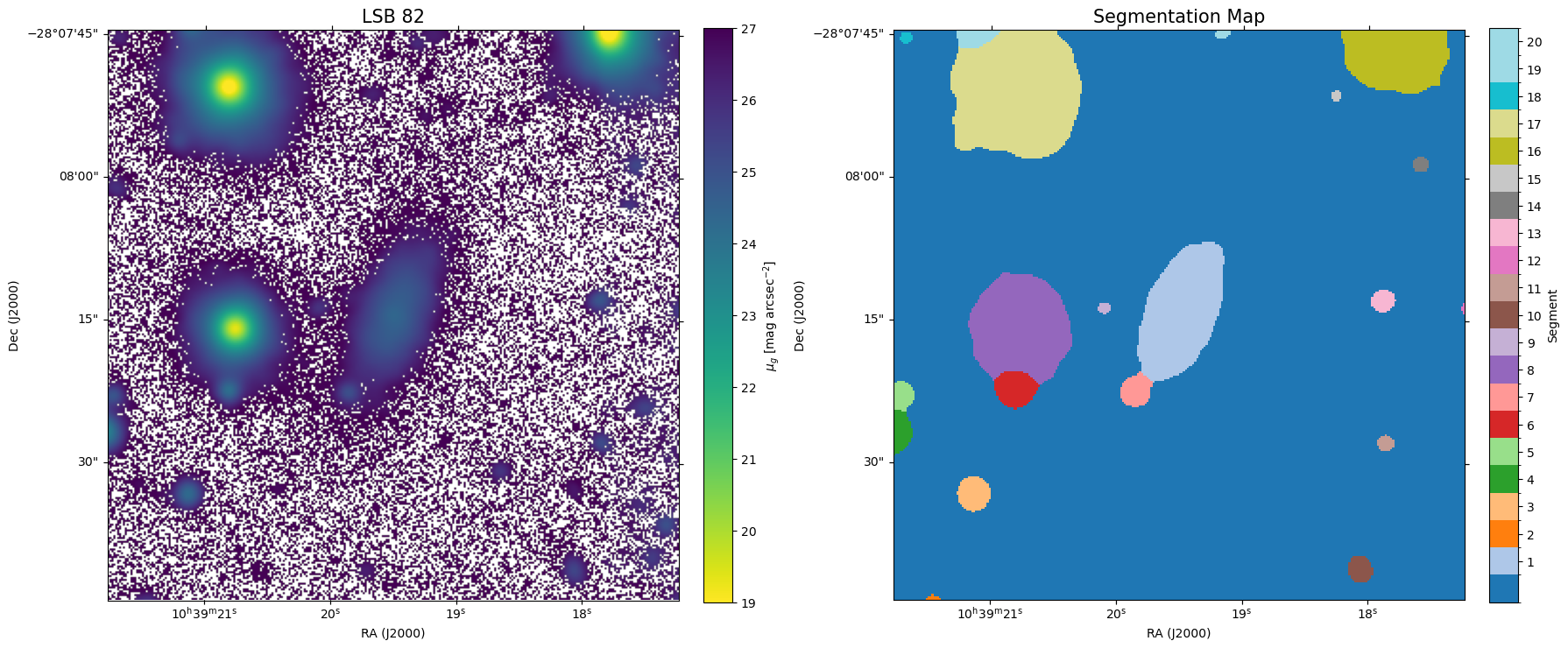
Fig 2: The galaxy LSB 82 detected by ATTILA (left panel) and its corresponding segmentation map adopting a deblending contrast
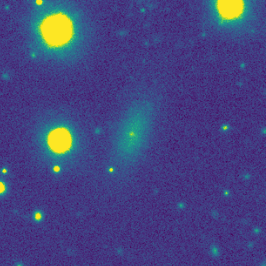
Fig 4: Schematic overview of the analysis process of the LSB galaxy candidate LSB 82. Panel a): The segmentation map and mask
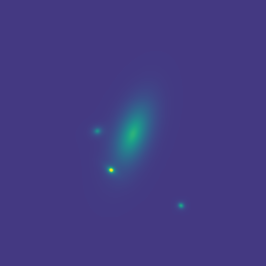
Fig 5: Color–magnitude distribution of LSB galaxies in the Hydra I cluster. The top panel shows the Gaussian kernel density
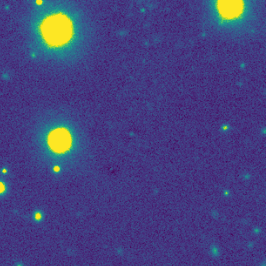
Fig 4 (page 10).
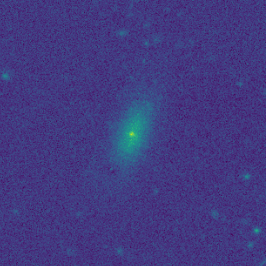
Fig 5 (page 10).
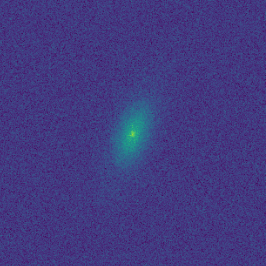
Fig 6 (page 10).
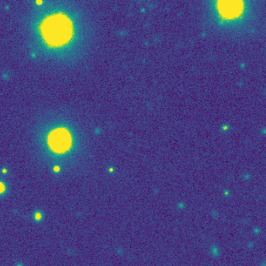
Fig 7 (page 10).
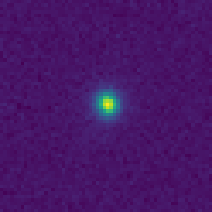
Fig 8 (page 12).
Limitations
- Detection depends on empirically tuned parameters (threshold, tile size, kernel), which may require adaptation for other datasets or survey depths.
- Deblending can still lead to fragmentation (shredding) or flux loss at source edges, affecting photometric accuracy for strongly blended sources.
- No adversarial or simulated injection tests shown; impact of noise fluctuations on false positive rate not quantified explicitly.
- Cluster membership inferred from color cuts may misclassify some foreground/background contamination without spectroscopic confirmation.
- Code and pipeline not explicitly released for external reproduction at the time of publication.
- Limited testing focused mainly on the Hydra I cluster; performance across diverse environments or redshifts remains to be demonstrated.
Open questions / follow-ons
- How well does ATTILA generalize to other galaxy clusters or large-scale surveys with differing depths, resolutions, and noise characteristics?
- What is the false positive rate in ATTILA detections, especially for the faintest LSB candidates, and how can it be further minimized?
- Can further integration of advanced machine learning approaches complement ATTILA’s algorithmic pipeline to improve classification or deblending?
- What are the impacts of systematic uncertainties in background subtraction and point spread function modeling on ATTILA’s structural parameter extraction?
Why it matters for bot defense
For bot-defense engineers and CAPTCHA practitioners, the paper offers a detailed case study on detecting extremely faint and diffuse signals embedded in complex noisy backgrounds with overlapping sources. The challenges of low signal-to-noise ratio detection combined with source blending mirror certain adversarial detection scenarios in automated recognition systems. ATTILA’s multi-stage processing — combining multi-channel data, tile-based overlapping segmentations, adaptive threshold deblending, and parametric modeling — exemplifies a robust pipeline architecture for extracting weak signals while controlling false positives and fragmentation.
This methodology suggests that CAPTCHAs or bot detectors dealing with varying user signals or challenging backgrounds may benefit from similar multitiered detection, overlapping tiling strategies to avoid edge artifacts, and iterative deblending or separation of blended inputs. Also, the use of physical or domain-specific priors (e.g., color-magnitude relations to confirm membership) highlights how integrating contextual constraints can improve classification of ambiguous detections. While the domain details differ, the general approach of optimizing sensitivity, mitigating blending artifacts, and leveraging multi-band or multi-view data is broadly instructive for improving detection in noisy, difficult-to-segment settings.
Cite
@article{arxiv2605_21598,
  title={ Advancing the detection of low surface brightness galaxies. I. ATTILA: multi-tAsking deTecTIon tool for Lsb gAlaxies },
  author={ E. Borsato and F. Fonzo and N. Bellucco and E. Iodice and E. M. Corsini and M. Spavone and S. Pasquato and C. Buttitta and M. Cantiello and M. D'Onofrio and M. Gullieuszik and A. La Marca and A. Moretti and A. Nucita and M. Paolillo and A. Pizzella and E. Portaluri and C. Tortora },
  journal={arXiv preprint arXiv:2605.21598},
  year={ 2026 },
  url={https://arxiv.org/abs/2605.21598}
}