
Decentralized Direct Volume Rendering: A Browser-Native GPU Architecture for MRI Digital Twins in Resource-Constrained Settings
Source: arXiv:2605.19737 · Published 2026-05-19 · By Oserebameh Augustine Beckley
TL;DR
This paper addresses the critical bottleneck in deploying interactive, patient-specific anatomical Digital Twins for clinical use, especially in resource-constrained settings (RCS). Existing approaches rely heavily on Server-Side Rendering (SSR) or expensive local workstations, which introduce high infrastructure costs, network latency, and potential privacy concerns due to off-device Protected Health Information (PHI) transmission. The authors propose a fully decentralized, client-side architecture implemented via the emerging WebGPU browser API that executes direct volume rendering (DVR) of MRI scans natively on low-cost integrated edge GPUs. This design bypasses traditional SSR pipelines and heavyweight deep learning inference, instead leveraging deterministic single-pass raymarching combined with in-shader morphological gradient and curvature calculations to perform scanner-agnostic, explainable tissue segmentation and visualization within the browser.
Key findings
- Achieves Time to First Pixel (TTFP) of 917 ms for healthy volumes and 750 ms for pathological scans on Intel Iris Xe integrated GPU.
- Maintains stable interactive throughput at ≥ 82 FPS during dynamic tissue parameter manipulation.
- Radiometric normalization aligns tissue peaks across scanners with mean normalized intensities for CSF (0.076 ±0.030), Gray Matter (0.141 ±0.023), and White Matter (0.224 ±0.074) consistent across cohorts.
- Eliminates network latency and PHI offloading inherent to Server-Side Rendering by fully client-side execution in browser via WebGPU.
- Bypasses costly deep learning and segmentation mask dependencies using deterministic in-shader gradient and curvature computations (first and second derivatives) to isolate tissue.
- Dynamic alpha compositing based on the intersection of normalized intensity and morphological edge strength suppresses scanner-specific radiometric noise effectively.
- Supports zero-latency transfer function updates by mapping interactions directly to uniform buffers for continuous interaction fidelity.
- Validated on 19.2M voxels at sub-second latency while preserving tissue structural fidelity and pathological feature unmasking without precomputed segmentation.
Threat model
The adversary is implicitly the resource constraints and infrastructure limitations in clinical settings, including limited GPU compute and network bandwidth, as well as regulatory privacy requirements preventing PHI transmission. The system assumes trustworthy client hardware but no reliance on remote servers or cloud for rendering or segmentation. It does not consider active adversarial attacks or attempts to manipulate the rendering pipeline.
Methodology — deep read
The threat model assumes a clinical environment where computational resources are limited and privacy concerns around PHI transmission preclude off-device processing. The adversary is a resource-constrained clinical setting rather than an active attacker; the focus is on removing dependency on centralized servers or deep learning models requiring large downloads.
Data provenance includes three cohorts: (1) BrainWeb synthetic T1-weighted neurological phantom MRI volumes (scanner-agnostic, noise-free ground truth), (2) multi-phase 1.5T pathological MRI volumes from Mendeley Data exhibiting lesions, and (3) internal uncurated clinical T1 MRI volumes representing real-world edge hardware deployment.
All volumes were in or converted to NIfTI-1 format for standardized, client-side ingestion. Preprocessing included a global min-max normalization converting raw intensities to a 0-1 float scale per dataset to handle scanner-dependent intensity drift.
The architecture is implemented fully in WebGPU shaders running in the client's browser on integrated GPUs. Key compute modules include a central difference gradient shader computing first-order spatial derivatives per voxel, a Hessian calculation shader deriving directional curvature by projecting second-order derivatives onto local gradient directions, and a raymarching fragment shader performing single-pass, front-to-back volume rendering. The raymarcher calculates voxel opacity as a function of normalized intensity windowing, gradient magnitude edge strength, and curvature weighting. Accumulation uses classical emission-absorption optical models with alpha compositing.
Training is not applicable as this is a deterministic pipeline without learned components. Instead, the methodology focuses on mathematically precise morphological operators. Hyperparameters include voxel spacing h, tissue intensity windows derived from tri-modal histograms, and optional curvature weighting functions.
Evaluation includes quantitative tissue peak alignment across cohorts (mean and standard deviation of normalized intensities per tissue class), qualitative visual compositing of anatomical structures and lesions, and computational performance benchmarks on Intel Iris Xe integrated GPUs. Render latency (TTFP) and frame rate (FPS) are key metrics. Ablations around inclusion/exclusion of curvature weighting or tissue windowing are implied but not explicitly detailed.
The system is validated end-to-end client-side with no server or cloud dependencies, demonstrating reproducibility by processing real clinical scans from raw volume to interactive rendering wholly in-browser. No code release or frozen weights are mentioned explicitly. The datasets used are publicly available BrainWeb and Mendeley Data repositories, as well as internal clinical scans not public.
Technical innovations
- Leveraging WebGPU's compute shaders and storage buffers to perform deterministic volumetric spatial derivative calculations (gradients and Hessians) at edge GPU in-browser.
- Single-pass morphologically modulated raymarching that computes voxel opacity as intersection of normalized intensity and structural edge strength without segmentation masks or deep learning.
- Scanner-agnostic intensity normalization coupled with morphological boundary detection to eliminate need for N4 bias correction or explicit skull-stripping preprocessing.
- Zero-latency user interaction fidelity via uniform buffers directly controlling tissue transfer functions during volume rendering, enabling instantaneous dynamic visualization.
Datasets
- BrainWeb T1-weighted neurological phantoms — ~12.5M voxels — public synthetic MRI dataset
- Mendeley Data multi-phase 1.5T pathological MRI with lesions — ~12.8M voxels — public clinical dataset
- Internal clinical uncurated T1-weighted MRI volumes — ~19.2M voxels — private hospital data
Baselines vs proposed
- Server-Side Rendering (SSR) pipeline: typical TTFP > 1 s due to network latency vs proposed client-side WebGPU: TTFP < 920 ms
- Progressive Monte Carlo volume rendering: suffers temporal noise artifacts during rapid manipulation vs proposed deterministic raymarching: no temporal artifacts and zero-latency interaction
- Browser-based deep learning segmentation: latency from model download/CPU-bound inference vs proposed model-free shader-based morphology: immediate loading with no external dependencies
Figures from the paper
Figures are reproduced from the source paper for academic discussion. Original copyright: the paper authors. See arXiv:2605.19737.
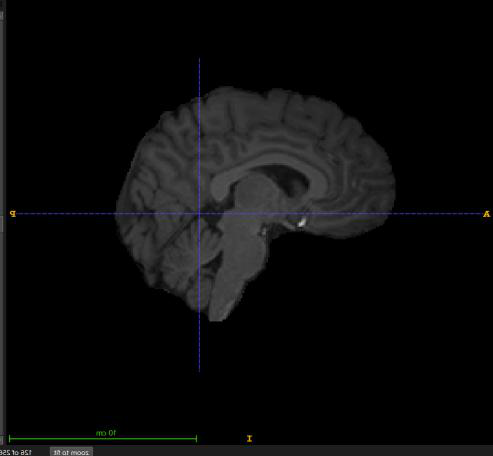
Fig 1: Automated tri-modal neuroanatomical reconstruction of cohort A using heuristic window-
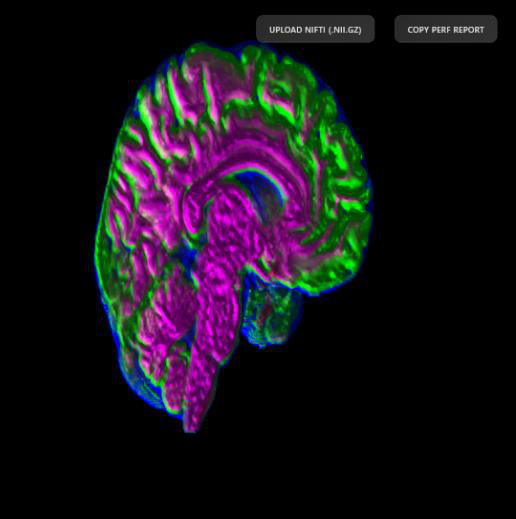
Fig 2: Visualization of high-intensity pathological and vascular features via alpha-channel ex-
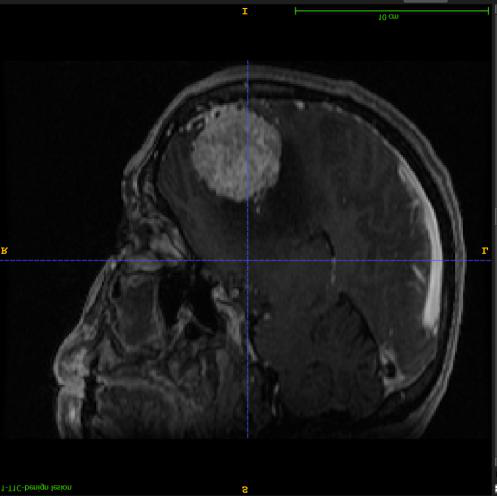
Fig 3 (page 7).
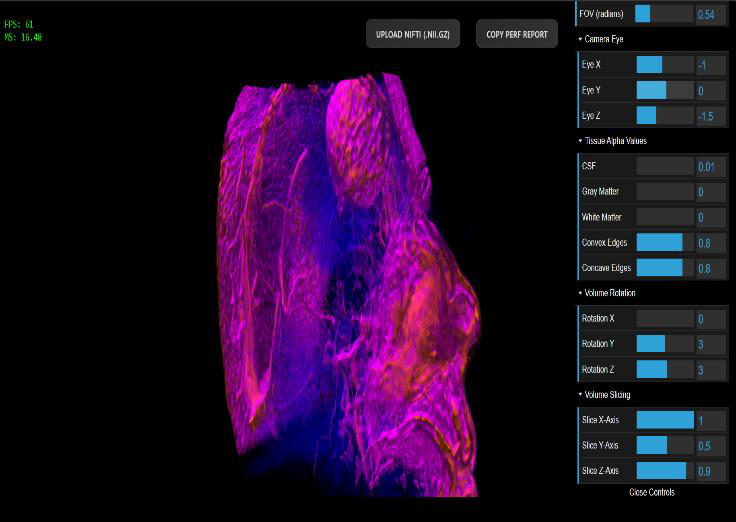
Fig 4 (page 7).
Limitations
- Assumes spatial coherence in input volumes; extreme artifacts such as metallic implants or motion blur disrupt gradient fields and degrade visualization quality.
- No adversarial robustness testing or evaluation under intentional attack conditions is performed.
- Validation focuses on intensity peak alignment and qualitative visual assessment; no standard binary segmentation metrics like Dice coefficient are applied due to continuous opacity representation.
- The approach is demonstrated only on MRI; extension to other modalities (CT, PET) is suggested but not implemented or validated.
- The system currently does not incorporate in-shader spatial smoothing or denoising, which might improve artifact resilience at cost of some latency.
- No publicly released code or complete reproducibility package is mentioned, limiting third-party verification.
Open questions / follow-ons
- Can the WebGPU morphology and rendering pipeline be extended and validated for other imaging modalities like CT or PET?
- What algorithmic or filtering enhancements (e.g. in-shader smoothing) can improve robustness against artifacts such as metallic implants or motion blur without losing zero-latency performance?
- How can this decentralized architecture be modularly integrated with open-source viewers like OHIF or Cornerstone3D in clinical workflows?
- Can formal quantitative metrics capturing continuous opacity-based segmentation fidelity be developed to better benchmark against standard binary metrics?
Why it matters for bot defense
For bot-defense and CAPTCHA practitioners focusing on secure, privacy-preserving client-side workloads, this paper demonstrates an advanced use-case of decentralized GPU compute in browsers via WebGPU that bypasses trusting third-party servers. The architecture shows how complex, compute-intensive tasks like 3D medical volume rendering and segmentation can be executed deterministically at the edge with low latency and strong privacy preservation by eliminating data transmission. This technique suggests potential analogies for client-side bot detection or CAPTCHA rendering that require real-time high-fidelity computations without server roundtrips. Additionally, the novel approach of combining classical mathematical morphology with GPU raymarching shaders may inspire new secure rendering pipelines resistant to adversary latency manipulation or sensor spoofing attacks. However, real adversarial robustness considerations remain unexplored here and will need dedicated assessments.
Cite
@article{arxiv2605_19737,
  title={ Decentralized Direct Volume Rendering: A Browser-Native GPU Architecture for MRI Digital Twins in Resource-Constrained Settings },
  author={ Oserebameh Augustine Beckley },
  journal={arXiv preprint arXiv:2605.19737},
  year={ 2026 },
  url={https://arxiv.org/abs/2605.19737}
}