
Inside Baseball: The Automated Ball-Strike System as an Object Lesson in Technological Rule Enforcement
Source: arXiv:2605.16237 · Published 2026-05-15 · By Andrea Wen-Yi Wang, Waki Kamino, David Mimno, Karen Levy, Malte F. Jung
TL;DR
This paper presents an in-depth ethnographic case study of Major League Baseball's (MLB) Automated Ball-Strike System (ABS), a technology designed to automate calling balls and strikes by enforcing the strike zone rule. Although the strike zone is clearly defined in MLB's rulebook, it took seven years for MLB to design, test, and refine the ABS before full integration. The authors argue that this long iterative process reveals a substantial "distance" between the written rule and technological implementation, stemming from historical contestations of the strike zone and the complex stakeholder ecosystem in which ABS is embedded. The study contributes a nuanced sociotechnical perspective, showing that rule automation is not simply a technical problem but involves negotiations of values such as technical feasibility, economic interests, integrity, stability, and gamesmanship. This perspective challenges conventional evaluation methodologies based purely on comparing outputs to a formal rule, instead advocating for evaluation frameworks grounded in real user experience and social contexts.
Key findings
- MLB's strike zone rule defines a 3D volume based on batter stance, but ABS enforces a 2D strike zone plane based on batter height, reflecting technical feasibility constraints (Table 2).
- The width of the ABS strike zone was adjusted multiple times over seven years: 17in (2019), 19in (2020), back to 17in (2023) (Table 3).
- ABS moved from full automation (making every call) to a mixed human-technology challenge system due to stakeholder preferences; by 2026, ABS challenge system adopted in all major league games.
- Fan and player surveys show 54% of players prefer ABS challenge system, 38% favor human umpires, and only 8% support full automation; fans show similar patterns (Section 3).
- Historical and interview data reveal the strike zone has always been a "hybrid" between the written rule and umpire judgment, with umpires as the final authority ('they ain’t nothin’ until I call ’em') (Section 5.2).
- Televised broadcasts and MLB data platforms display strike zones differing from the rulebook definition (2D vs. 3D), creating competing 'ground truths' for balls and strikes (Section 5.3).
- ABS implementation reflects tradeoffs among technical feasibility, economic concerns, the integrity and stability of the game, and preservation of gamesmanship (Section 6).
- This study supports viewing automated enforcement technology as a rule in itself, not a mere approximation to an external ground truth, requiring sociotechnical evaluation frameworks (Section 7).
Threat model
The adversary is not a traditional attacker but the complex interplay among MLB stakeholders—players, umpires, managers, fans, and the league—each with competing interests and perceptions of rule enforcement. The threats include technological infeasibility, stakeholder rejection, loss of legitimacy or integrity, and unintended social consequences. The model assumes no adversaries seeking to deceive the system, but focuses on how automated enforcement navigates ambiguous ground truth and socio-cultural dynamics.
Methodology — deep read
The authors take a multi-method qualitative ethnographic approach focused on MLB's ABS from 2019-2025.
Threat Model & Assumptions: The adversary is not a malicious actor but the complex ecosystem of baseball stakeholders (players, umpires, managers, fans, leagues). Assumptions include that the official strike zone is 'clear' in the rulebook but operationalized variably by human judgment, and that technology must align with multiple competing values. Technical constraints and social acceptance present challenges.
Data: Data sources include field observations at four MLB Spring Training games (some with and without ABS), one Triple-A minor league game, and the 2025 MLB All-Star Game (online viewing). The study involved shadowing umpire training camps (Southern Umpires Camp and MLB Umpire Camp), and attendance at the SABR Analytics Conference. Archival document analysis was conducted on baseball rule history and prior technology. The authors conducted 18 semi-structured interviews with seven MLB executives and 11 fans ranging from their 20s to 70s. Additional data include fan surveys conducted by MLB and media reports on ABS implementation.
Architecture / Algorithm: The ABS technology involved multiple pitch-tracking systems: Trackman (2019) and Hawk-Eye (from 2020 onwards). Hawk-Eye uses 12 high-speed cameras and computer vision algorithms to track ball trajectories and determine strike calls relative to a strike zone defined by batter height and plate position. The ABS strike zone is a 2D plane, not the 3D volume in the rulebook, a key technical departure noted. The actual pitch location is digitized and compared to this strike zone to call ball or strike, with the algorithm incorporating evolving parameter settings (zone height, width, placement).
Training Regime: Details on training pitch-tracking models or optimizers are not disclosed in the paper as it is primarily a social science study focusing on rule interpretation and implementation rather than technical system training.
Evaluation Protocol: Evaluation is qualitative and ethnographic rather than quantitative. It included participant observation of ABS challenges during games, interviews capturing stakeholder perspectives, survey analysis of fan and player preferences, and retrospective analysis of media coverage and historical documents. There were no traditional ML metrics or direct quantitative performance evaluations reported here.
Reproducibility: The study did not release code or datasets as it is based on ethnographic and archival research. The focus is on sociotechnical interpretation of ABS as a technological enforcement system rather than on replicable computational experiments.
Example end-to-end scenario: A pitch is thrown during an MLB game under ABS challenge format. The human plate umpire makes an initial call. If a manager challenges the call, ABS technology tracks the ball trajectory with feathered camera data, compares the 2D location to the ABS-defined strike zone based on batter height and plate midpoint, and electronically determines if the pitch was a ball or strike. If ABS overturns the call, the umpire reverses the decision. The entire process is embedded in a socio-technical ecosystem where stakeholder preferences, broadcast presentation, and rule definitions are negotiated continuously.
Technical innovations
- Framing rule enforcement technology as an active "rule" that embodies negotiated social values rather than a passive approximation to a formal legal rule.
- Demonstrating how contested ground truths in rule enforcement complicate automation, even for seemingly objective, well-defined rules.
- Applying Science and Technology Studies (STS) frameworks to operationalize technical feasibility, economic interest, game integrity, and gamesmanship as multi-dimensional values shaping technological rule enforcement.
- Identifying a novel implementation of a strike zone as a 2D plane derived from batter height rather than the traditional 3D rulebook volume, balancing technical constraints with social acceptance.
Baselines vs proposed
- Fan preference metrics from MLB survey: ABS challenge system favored by 54% of players and 47% of fans, versus 38% players and 30% fans preferring human umpires, and 8% players with 23% fans preferring full automation.
Figures from the paper
Figures are reproduced from the source paper for academic discussion. Original copyright: the paper authors. See arXiv:2605.16237.
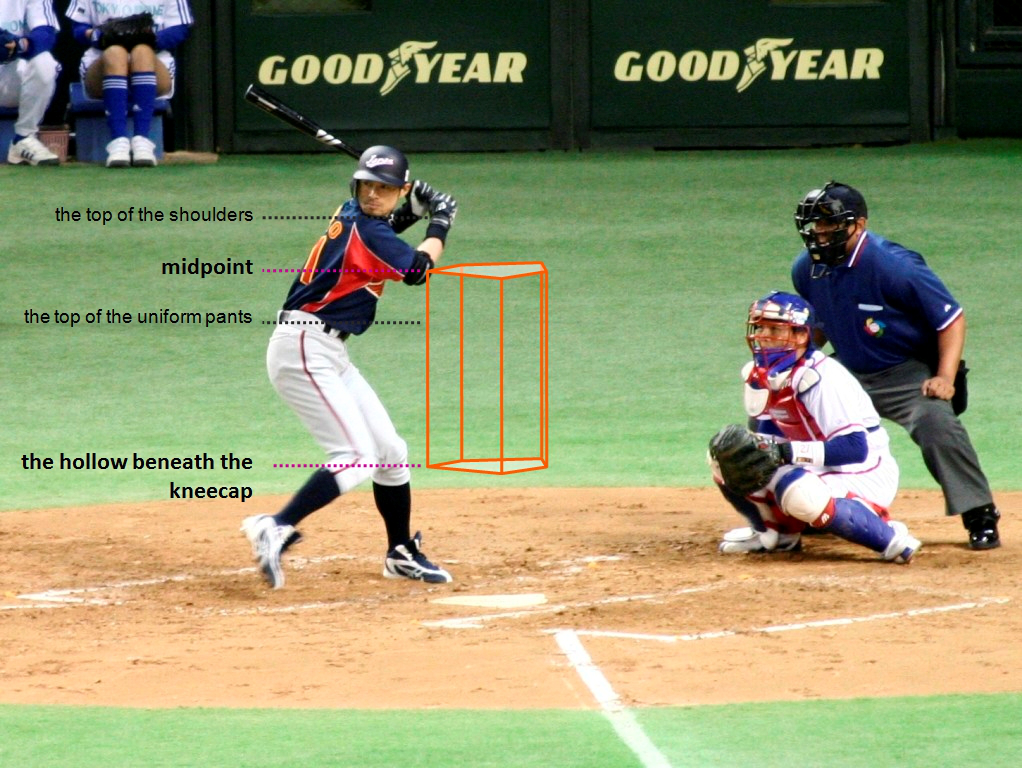
Fig 1: The official strike zone per the MLB rulebook, a three-
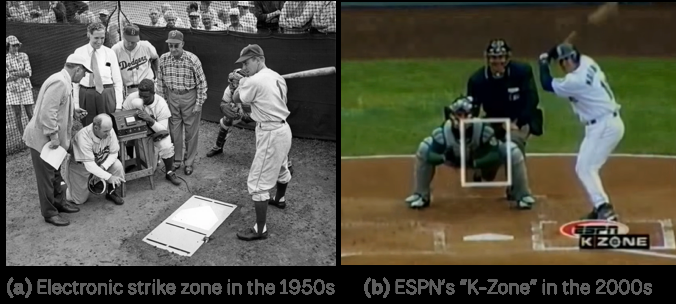
Fig 2: Making the strike zone visible. (a) The Brooklyn Dodgers experimented
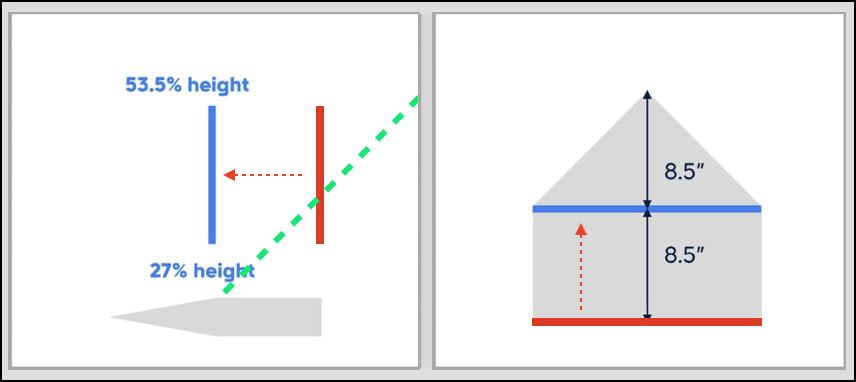
Fig 3: Moving the ABS strike zone from the front of home plate (red) to
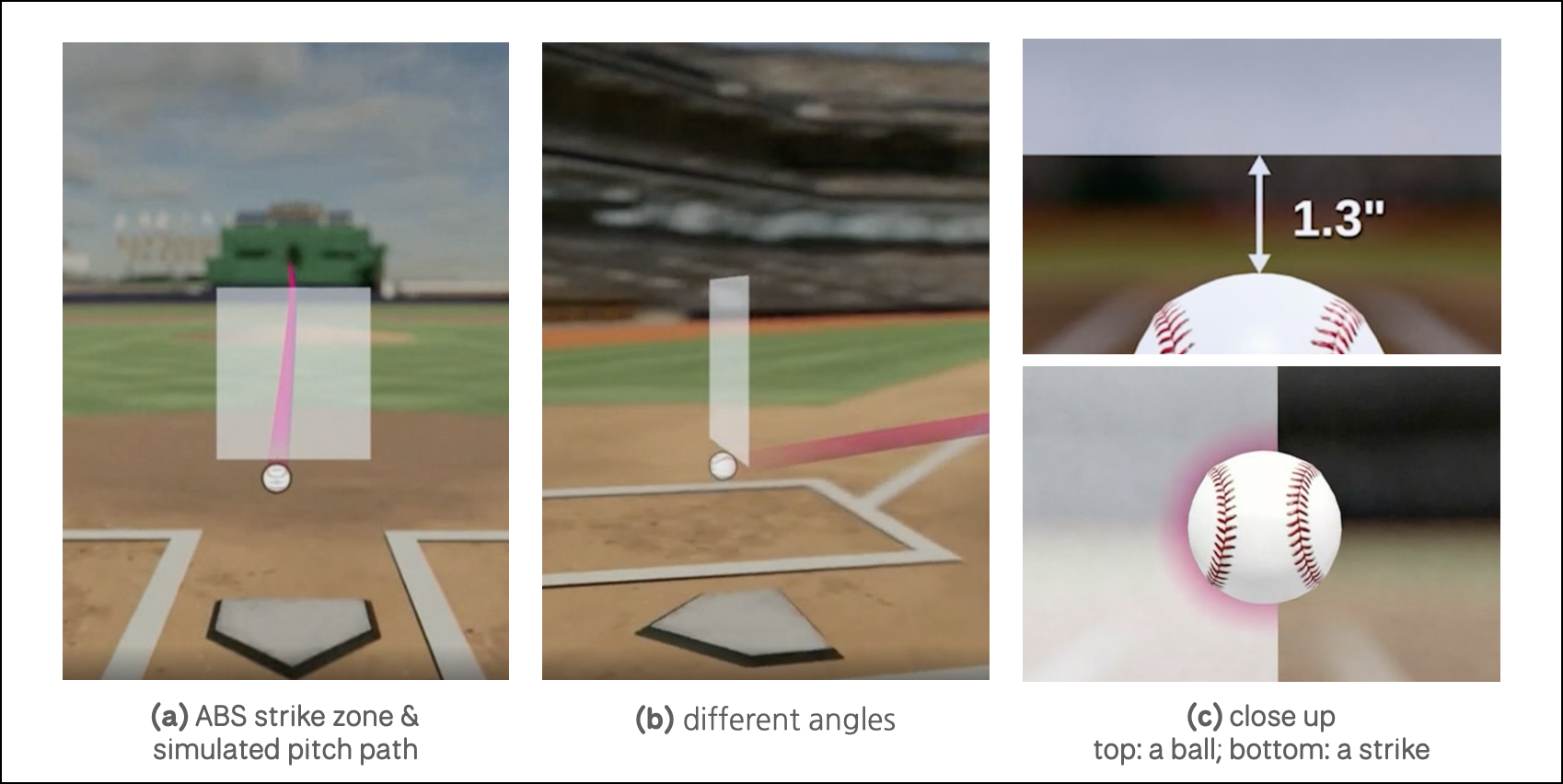
Fig 4: MLB designed a roughly 10-second video to play when players invoke ABS to challenge an umpire’s call. This video
Limitations
- The study does not perform quantitative accuracy or error-rate evaluations of the ABS pitch calls relative to the rulebook or human umpires.
- Research is focused on sociotechnical and ethnographic perspectives; system internal technical specifications and raw data from ABS pitch-tracking technology are not disclosed.
- Analysis is limited to MLB contexts in the U.S.; generalizability to other sports or technological rule enforcement domains may vary.
- The contested nature of the strike zone and interpretation of stakeholder values may limit consensus on some conclusions.
- Stakeholder interviews are primarily with MLB executives and a limited number of fans; direct input from umpires or players is less represented.
- The study covers ABS developments until 2025; further evolution of technology or user acceptance beyond this is not addressed.
Open questions / follow-ons
- How to develop evaluation frameworks that capture user experience and social acceptance alongside technical accuracy for rule enforcement technologies?
- What are best practices for balancing technical feasibility with competing stakeholder values in other automated sociotechnical enforcement systems?
- How does enforcement technology evolve over time as social norms and stakeholder preferences shift, and how to design for adaptable rule enforcement?
- What roles should human oversight and discretion retain when automation challenges traditionally human-judged thresholds or decisions?
Why it matters for bot defense
This study provides a valuable sociotechnical lens for bot defense and CAPTCHA practitioners by illustrating that even apparently straightforward enforcement rules can require complex translation and negotiation to automate effectively. It highlights that deploying an automated enforcement system is not only a technical challenge but also a deeply social process requiring balancing multiple stakeholder values and existing ecosystems. For CAPTCHA and bot defense, this underscores the importance of aligning system design with users’ expectations and social norms, beyond optimizing for raw technical accuracy alone.
Moreover, the findings question conventional evaluation paradigms that center only on deviations from a fixed "ground truth." Instead, engagement and perceived legitimacy among users and administrators become critical metrics. Bot defense systems can benefit from this perspective by including qualitative user experience assessments and stakeholder involvement during design and iterative deployment, especially for enforcement at scale. The ABS case also warns of potential resistance when full automation removes human discretion, suggesting mixed human-in-the-loop approaches may offer a more socially acceptable transition.
Cite
@article{arxiv2605_16237,
  title={ Inside Baseball: The Automated Ball-Strike System as an Object Lesson in Technological Rule Enforcement },
  author={ Andrea Wen-Yi Wang and Waki Kamino and David Mimno and Karen Levy and Malte F. Jung },
  journal={arXiv preprint arXiv:2605.16237},
  year={ 2026 },
  url={https://arxiv.org/abs/2605.16237}
}