
Understanding How International Students in the U.S. Are Using Conversational AI to Support Cross-Cultural Adaptation
Source: arXiv:2605.15127 · Published 2026-05-14 · By Laleh Nourian, Anisa Callis, Stephanie Patterson, Jadeline Miao, Jamison Heard, Garreth W. Tigwell
TL;DR
This paper investigates how first-time international students in the United States utilize conversational AI tools, such as ChatGPT and Google Gemini, to support their cross-cultural adaptation. Recognizing that international students face multifaceted challenges including socio-cultural, academic, psychological, and logistical stressors, the authors conducted a mixed-method study involving a survey of 60 students followed by in-depth interviews with 14 participants. The study aims to understand which challenges prompt AI use, the nature of such use, and students' perceptions of AI's helpfulness and limitations.
The key contribution lies in revealing a nuanced usage pattern: international students predominantly deploy conversational AI for immediate, task-oriented needs (e.g., academic writing, immigration paperwork, and language translation) rather than for long-term emotional or socio-cultural adaptation. Students consistently rely on human and peer support for deeper psychological or cultural challenges. While AI is appreciated as a convenient first-aid, short-term assistant, participants express desire for AI to evolve into a more socially attuned, privacy-conscious, and integrated companion that can support longitudinal cultural integration and community building. The study offers concrete design recommendations tailored to these needs.
Key findings
- 75% of surveyed international students reported socio-cultural and language challenges as their biggest stressors during adaptation.
- 43% reported academic challenges; 39% reported psychological challenges; 29% reported logistical challenges.
- Although only 29% experienced logistical difficulties, 86% used conversational AI to address logistical tasks, making it the most common AI use domain.
- 86% used AI for academic challenges such as essay writing and communication with professors.
- 82% used AI to handle socio-cultural challenges like understanding social etiquette and language issues.
- Only 20% used AI to address psychological or mental health challenges, indicating low AI adoption for chronic, emotional support needs.
- Most students used English exclusively in AI interactions; ChatGPT was the dominant tool (used by all AI users), followed by Gemini (used by 32).
- Privacy concerns related to visa/immigration data and AI’s lack of social nuance were major barriers to deeper reliance on AI for long-term support.
Threat model
N/A — This is a human-computer interaction and user behavior study focused on international students' adaptation challenges and AI tool usage rather than adversarial security threats.
Methodology — deep read
The study adopts a mixed-method approach involving a survey and semi-structured interviews grounded in Kim's stress–adaptation–growth framework for cross-cultural adaptation.
Threat model & assumptions: The 'adversary' here is not a malicious entity but rather the challenges inherent in cross-cultural adaptation. The study assumes conversational AI acts as an assistive tool for students, not an adversarial agent.
Data: The survey targeted first-time international students currently enrolled in U.S. institutions who moved directly from their home countries without prior international study experience. 194 responses were collected via social media and institutional outreach; after filtering duplicates and incomplete entries, 60 complete survey responses remained. Participants included 33 women and 27 men, averaged 26 years of age, predominantly graduate students (34 PhD, 16 Master's, 9 undergraduates), mostly fluent in English and digitally literate. The follow-up interviews involved 14 voluntary participants from the survey cohort, allowing deeper exploration of motivations and perceptions.
Architecture/algorithm: Not applicable as this is a user study focused on behavioral patterns, not AI system development.
Training regime: N/A.
Evaluation protocol: Quantitative survey data were analyzed descriptively with means and correlations using non-parametric tests (Spearman's rank, Mann-Whitney U, Wilcoxon signed-rank) suited to ordinal Likert-scale data. Qualitative open-ended responses underwent thematic coding by researchers, triangulating with quantitative results for coherence. The survey examined three research questions regarding AI usage types, challenge domains addressed by AI, and perceived helpfulness. Interviews were analyzed to understand motivations behind observed usage patterns and identify needs for future AI support.
Reproducibility: Data collection and analysis protocols are detailed but raw data and code are not stated as publicly released. The dataset is based on human subjects surveys and interviews, likely restricted.
Concrete example: A student struggling to open a bank account used ChatGPT to interpret bureaucratic forms and visa requirements, enabling timely completion of paperwork. Conversely, for emotional challenges like loneliness, students preferred human support rather than AI. Thus, AI was mainly a practical, task-help tool rather than an emotional companion.
Technical innovations
- Identification and mapping of conversational AI use patterns onto specific cross-cultural adaptation challenge domains for international students, highlighting task-oriented short-term vs. emotional long-term support distinctions.
- Integration of Kim’s stress–adaptation–growth model as a theoretical lens to frame the survey and interview instruments for nuanced understanding of AI’s role in cultural adaptation.
- Qualitative insight into barriers such as privacy concerns linked to visa status and AI’s lack of social nuance, informing design priorities for ethical, context-aware AI support tools.
- Empirical finding that despite lower prevalence, logistical challenges receive outsized AI support, uncovering gaps between challenge incidence and AI adoption.
- Participant-derived recommendations for evolving conversational AI from quick-assist tools to integrated, community-building support companions tailored to international students.
Datasets
- Survey dataset — 60 first-time international students in U.S. institutions — collected via social media and university outreach (not publicly released)
- Interview dataset — 14 survey participants — semi-structured qualitative interviews (not publicly released)
Baselines vs proposed
- N/A — No machine learning baselines or performance metrics compared; study is qualitative and survey-based.
Figures from the paper
Figures are reproduced from the source paper for academic discussion. Original copyright: the paper authors. See arXiv:2605.15127.
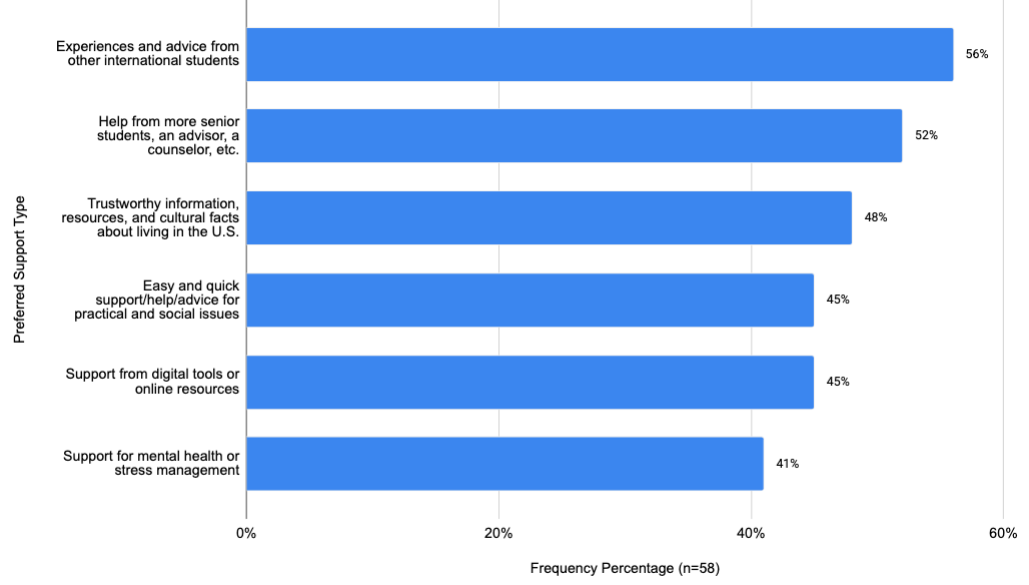
Fig 1: Support types that international students prefer
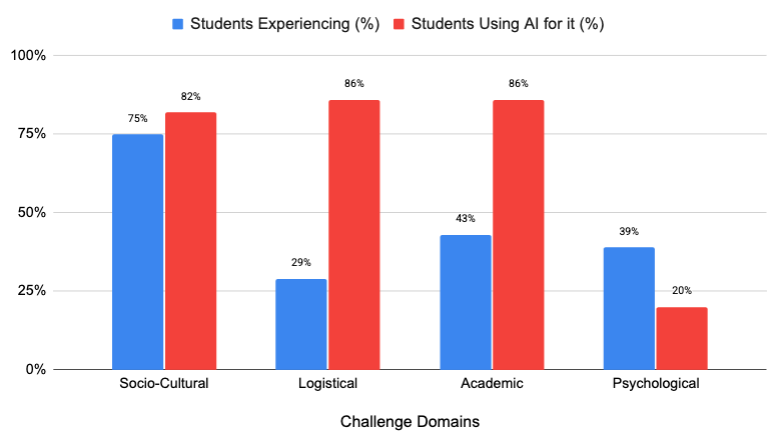
Fig 2: Comparative analysis of international students’ challenges and usage of conversational AI for each challenge domains
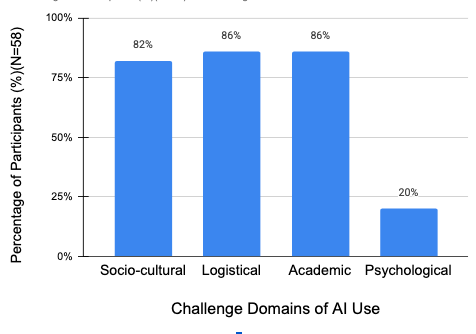
Fig 3: AI usage distribution among the four challenge domains
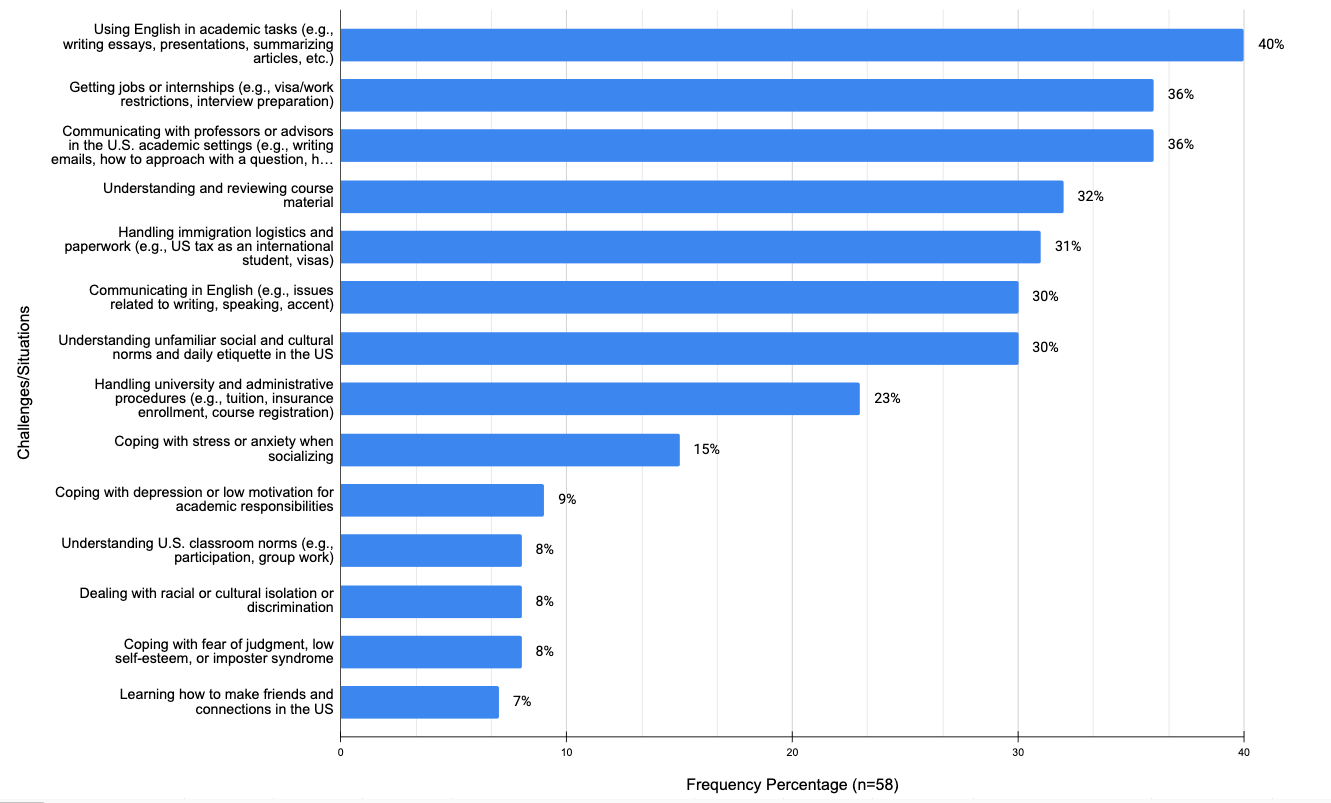
Fig 4: AI usage distribution for detailed tasks among the four challenge domains
Limitations
- Relatively small sample size (n=60 survey, n=14 interviews) limits generalizability across all international student populations.
- Potential sampling bias as participants self-selected via online recruitment; may overrepresent digitally literate and AI-aware students.
- Study restricted to first-time international students in the U.S., excluding students with prior international study experience who may have different coping mechanisms.
- No adversarial evaluation or longitudinal tracking of AI use over time; usage and perceptions may evolve with changing AI capabilities.
- AI tool usage self-reported and not objectively logged; possible recall bias or social desirability bias in responses.
- Dataset and code are not publicly available, limiting reproducibility and further analysis by third parties.
Open questions / follow-ons
- How can conversational AI systems be designed to better address long-term emotional and social adaptation needs, including privacy-sensitive scenarios for international students?
- What mechanisms can enable AI tools to integrate effectively with university support systems and human advisors to complement rather than replace human support?
- How do international students' AI usage patterns evolve over different phases of their adaptation journey in longitudinal settings?
- Can personalized, culturally aware AI models reduce perceived social nuance gaps and increase trust among diverse international student populations?
Why it matters for bot defense
This study is relevant to bot-defense and CAPTCHA practitioners interested in understanding real-world user behavior around conversational AI adoption in culturally complex contexts. Although not focused on security threats, it surfaces critical considerations about user trust, privacy concerns, and contextual appropriateness of AI tools. For CAPTCHA systems colocated in university or international student portals, insights about students’ preference for human support over AI for sensitive, long-term challenges highlight the importance of designing multi-modal access control and support ecosystems that balance automation with human touchpoints.
Additionally, the finding that students heavily rely on AI for short-term, task-specific challenges (like paperwork or language queries) suggests potential leverage points and user expectations around automated assistance tools that resemble CAPTCHA in usability and effectiveness. Understanding user perceptions and adoption boundaries can inform bot-defense strategy designs that respect user privacy needs, minimize friction for international users, and avoid over-automation, which might alienate vulnerable user groups.
Cite
@article{arxiv2605_15127,
  title={ Understanding How International Students in the U.S. Are Using Conversational AI to Support Cross-Cultural Adaptation },
  author={ Laleh Nourian and Anisa Callis and Stephanie Patterson and Jadeline Miao and Jamison Heard and Garreth W. Tigwell },
  journal={arXiv preprint arXiv:2605.15127},
  year={ 2026 },
  url={https://arxiv.org/abs/2605.15127}
}