
Translation symmetry-enforced long-range entanglement in mixed states
Source: arXiv:2605.15200 · Published 2026-05-14 · By Ryan Thorngren, Lei Gioia, Carolyn Zhang
TL;DR
This paper investigates a novel and subtle form of long-range entanglement (LRE) that arises in mixed quantum states invariant under translation symmetry. While translation symmetry allows symmetric short-range entangled (SRE) eigenstates, the authors show there are insufficient such SRE states to span the zero momentum (translation-invariant) sector. Consequently, the maximally mixed state over all zero momentum states (the fixed point representative of spontaneous translation symmetry breaking, SWSSB) cannot be approximated by any mixture of SRE states and is therefore LRE. This LRE is subtle because it cannot be detected by long-range connected correlation functions, which decay exponentially.
The key technical advance is a counting argument bounding the dimension of the span of translation-invariant depth-d shallow quantum circuits (or short-range entangled states generated by time-τ local Hamiltonian evolution). This dimension grows too slowly (approximately polynomial in system size) to cover the exponentially large space of all translation-invariant states. As a result, the trace distance between the maximally mixed zero-momentum state and any mixture of SRE states generated within sublinear time is large. The authors prove a lower bound on the required circuit depth (or time) to approximate this state of order √n/polylog n in 1D spin chains of length n. They also extend heuristic arguments to higher dimensions. This provides a new mechanism for translation symmetry enforcing LRE in mixed states without detectable long-range correlations.
Using tools from matrix product state (MPS) geometry, circuit depth counting, and quantum channel theory, the work rigorously characterizes the geometric and algebraic obstruction to spanning translation-invariant states with short-range entangled states. It also relates to spontaneous symmetry breaking in quantum channels. This establishes a new category of LRE induced purely by translation symmetry and its subtle interplay with circuit complexity and dimensionality of state space.
Key findings
- The space of translation-invariant short-range entangled (SRE) states generated by depth-d circuits or time-τ range-r Hamiltonian evolution grows at most polynomially in system size n.
- The dimension of the entire space of translation-invariant states grows exponentially in n (as counted by q-ary necklaces).
- Therefore, the maximally mixed state ρTI over all translation-invariant states cannot be approximated by a mixture of depth-d SRE states unless d or τ grows at least as O(√n/polylog n) (Theorem 1).
- The upper bound dimension of span of depth-d translation-invariant states on a ring of length n is given by D_SRE(n,d,q) ≤ 2d(2d+1)q^4 * binomial(n/(2d+1)+2d(2d+1)q^4−1, 2d(2d+1)q^4−1) (Proposition 2).
- The trace distance D(ρTI, στ) between ρTI and any mixture στ of time-τ evolved product states satisfies D≥ 1−ϵ²−δ where δ upper bounds the projector onto depth-d states, and d = O(τ polylog(nτ/ϵ)) (Lemma 1).
- Connected correlation functions of ρTI decay exponentially with system size, so long-range entanglement is undetectable by such correlators.
- A nonlocal quantum channel example exhibits steady states showing spontaneous translation symmetry breaking as LRE mixed states.
- Results generalize to higher dimensions with effective local dimension q ∝ exp(L) where L is transverse size.
Threat model
The adversary context here corresponds to any procedure attempting to prepare or approximate the maximally mixed translation-invariant zero momentum state ρTI by mixtures of short-range entangled states generated by local finite-depth quantum circuits or finite-time evolution under local Hamiltonians. The adversary is limited to geometric locality, bounded evolution time τ, and cannot produce nonlocal or deep circuits beyond τ. They cannot circumvent the polynomial parameter counting constraints inherent to short-depth circuits to generate the full exponentially large zero momentum subspace. No assumptions are made about noise or decoherence since this is a pure quantum state complexity question.
Methodology — deep read
The authors start by defining the notion of mixed-state long-range entanglement (LRE) as states that cannot be approximated by any mixture of short-range entangled (SRE) states, where SRE states are prepared by shallow, geometrically local quantum circuits of bounded depth d or equivalently by time-τ evolution of a range-r local Hamiltonian with controlled Lieb-Robinson bounds.
Their threat model and setting assumes translation symmetry on a 1D periodic chain of length n with local physical dimension q. The symmetry sectors are labeled by momentum k, with zero momentum states invariant under translation.
They define the maximally mixed translation-invariant state ρTI as the equal mixture over an orthonormal basis of zero momentum states in the Hilbert space.
The problem is to prove that ρTI cannot be approximated by any mixture of SRE states with circuit depth smaller than √n/polylog(n).
They prove this by a counting argument: they derive an upper bound on the dimension of the space spanned by SRE translation-invariant states prepared by depth-d circuits (Proposition 2). This uses decomposition of depth-d circuits into MPOs, the group structure of translations, and polynomial bounds on matrix product state parameters.
The total number of translation invariant states grows exponentially with n, counted exactly by numbers of q-ary necklaces (Eq. 40).
Since SRE states only span a polynomially growing subspace, the projector onto this subspace has exponentially small overlap with ρTI, which implies a large trace distance (using Lemma 1, the tails lemma).
The tails lemma relates the trace distance of approximating ρTI by mixtures of time-τ SRE states to the trace of the projector onto depth-d states on ρTI, where d grows polylogarithmically with τ, n, and approximation error ϵ.
They combine these bounds asymptotically (Eqs. 38–54) to extract a lower bound for the circuit depth d and time τ for approximation. This lower bound scales as τ = Ω(√n/polylog(n)).
They give concrete examples using translation-invariant matrix product states (TIMPS) as warm-up, then extend to generic translation-invariant depth-d circuits.
They review physical relevance by connecting the ρTI state to strong-to-weak spontaneous symmetry breaking (SWSSB) phases in translation symmetry and thermalizing Floquet dynamics.
They carefully check that connected correlation functions decay exponentially, explaining why this LRE cannot be detected by standard correlation diagnostics.
The analysis relies on known results relating time-evolution under local Hamiltonians to finite-depth circuits (Theorem 2 from [19]) and standard combinatorics of necklace counting.
The paper also discusses applicability to higher dimensions, presence of other symmetries, and conjectures about strong non-onsite symmetries enforcing LRE.
No explicit code release or numerical experiments are reported; the work is fully analytical and rigorous in nature.
For example, the key proof step involves splitting the chain into blocks of size [2d+1], cutting the depth-d circuit accordingly, and re-expressing the state as a translation-invariant matrix product state with controlled bond dimension to count parameters, showing the polynomial growth in dimension. This is then contrasted with exponential dimension of full translation invariant sector to prove the approximation lower bound.
Technical innovations
- A novel counting argument upper bounding the dimension of the span of translation-invariant short-range entangled states generated by depth-d circuits, revealing polynomial scaling versus exponential full space dimension.
- Construction and analysis of the projection onto the zero momentum sector (ρTI) as a mixed state demonstrating long-range entanglement not detectable via long-range correlation functions.
- Extension of previous results on symmetry-enforced entanglement to translation symmetry, which is anomaly-free but still enforces LRE through a mismatch of SRE spanning sets.
- Use of circuit cutting and matrix product state representations to tightly bound the number of parameters defining translation-invariant states obtained by shallow local circuits.
Baselines vs proposed
- Dimension of translation-invariant states: D_T_I(n, q) ≥ (1/n) q^n vs dimension of SRE depth-d states: polynomial in n from Proposition 2, demonstrating exponential gap.
- Trace distance lower bound D(ρTI, στ) ≥ 1 − ϵ² − δ with δ upper bounded by ratio of SRE subspace dimension to full space dimension, showing no approximation possible by shallow time evolution τ < Ω(√n/polylog n).
Figures from the paper
Figures are reproduced from the source paper for academic discussion. Original copyright: the paper authors. See arXiv:2605.15200.
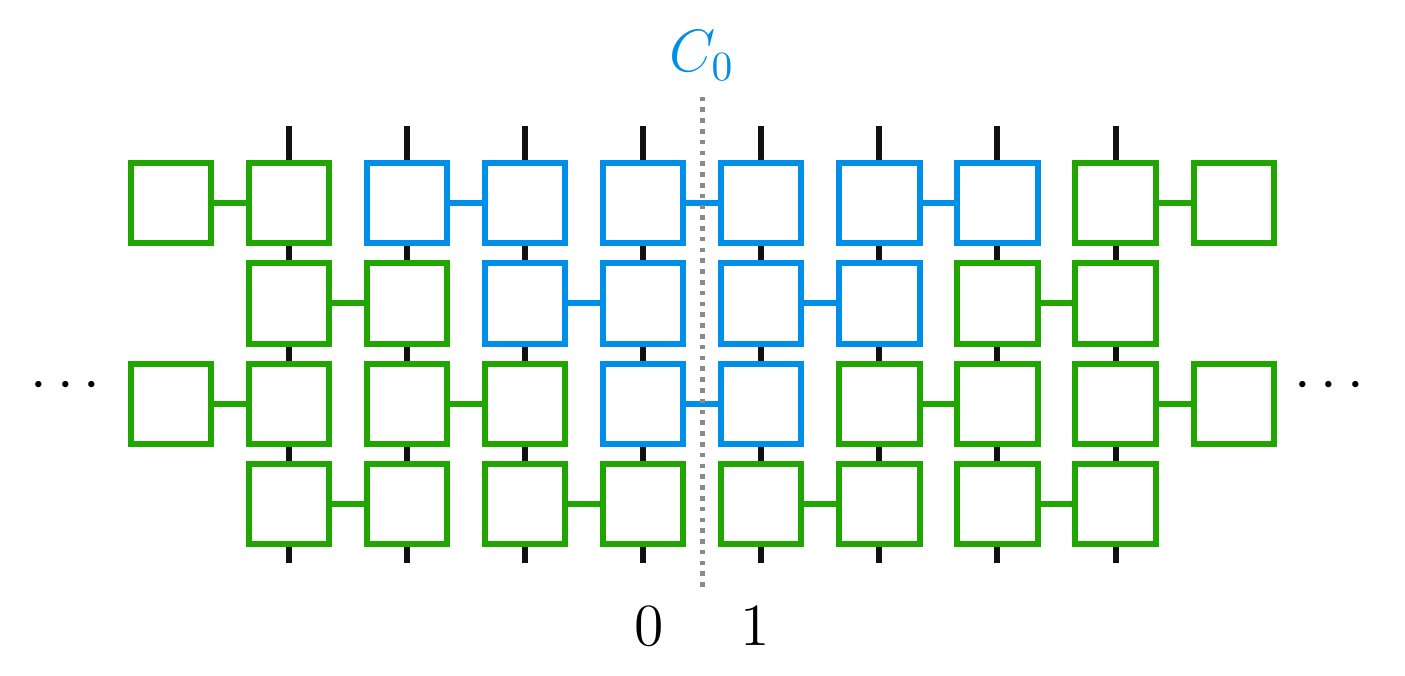
Fig 1 (page 3).
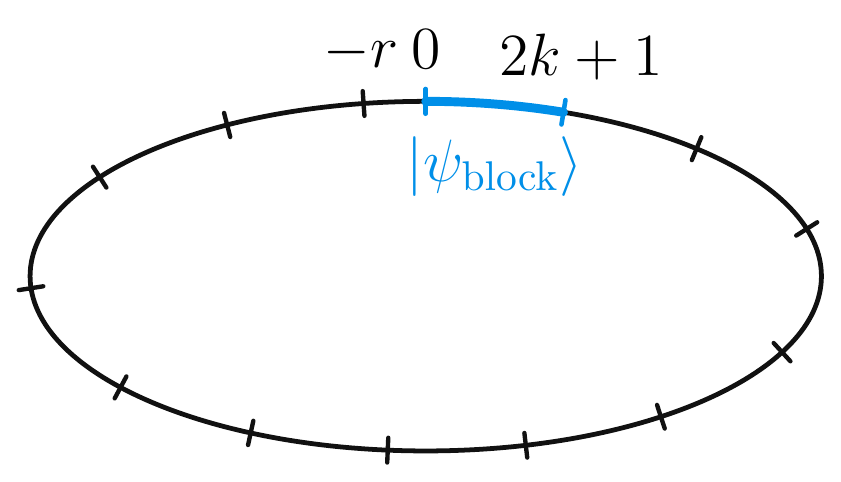
Fig 2 (page 3).
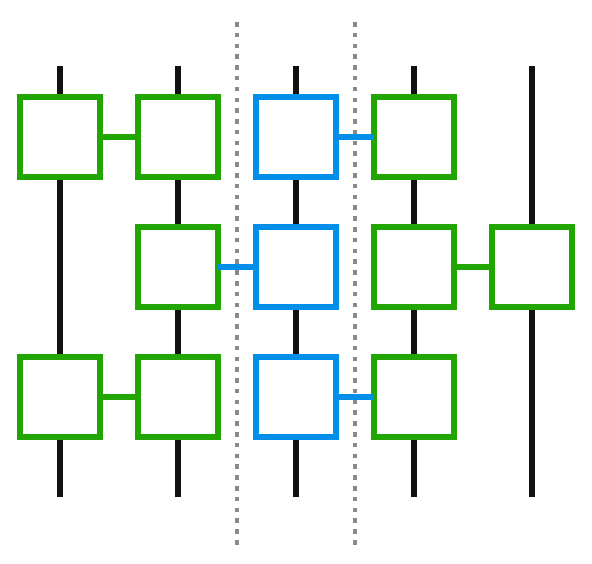
Fig 3 (page 4).
Limitations
- The lower bound on circuit depth/time is asymptotic and implicit, with constants and tightness of polylogarithmic factors unclear.
- Proofs and results primarily focus on 1D periodic chains; higher dimensional generalizations are argued heuristically but not rigorously proven with full detail.
- No explicit adversarial or noise robustness analysis; the notion of LRE here is defined in idealized noiseless frameworks.
- Only considers translation symmetry in isolation or combined with simple discrete on-site symmetries; behavior with more complex symmetry groups or continuous symmetries remains open.
- Reliance on exact translation invariance; small symmetry breaking or perturbations may affect conclusions.
- No numerical experiments or explicit constructions beyond theoretical counting and bounding arguments.
Open questions / follow-ons
- Can the quantitative lower bound on approximation time τ or circuit depth d be tightened with better constants or smaller polylog factors?
- How does spontaneous translation symmetry breaking induced LRE manifest and generalize in higher-dimensional lattice systems rigorously?
- What is the relationship between on-siteability of symmetries and existence of SRE maximally mixed invariant states (MMIS) in general, beyond translation and abelian groups?
- Can the alternative view via projector onto nonzero momentum sectors being LRE lead to a new proof or classification framework for translation-enforced LRE?
Why it matters for bot defense
From a bot-defense or CAPTCHA perspective, this work provides a rigorous example of a fundamental complexity barrier to generating certain symmetric mixed states using shallow, local operations. Analogously, bot detection techniques rely on identifying complexity or entanglement patterns that distinguish easy-to-produce benign user interactions from hard-to-emulate adversarial ones. The new form of long-range entanglement enforced by translation symmetry here implies that certain global symmetric mixed states cannot be approximated by low-depth or localized strategies. This underscores the value of symmetry and entanglement constraints as subtle, nonlocal fingerprints for bot or synthetic behavior detection. However, the highly idealized physics context and asymptotic nature of the results mean practical translation to operational CAPTCHA schemes would require mapping these abstract complexity measures to measurable user or interaction features. The result that connected correlation functions fail to detect this type of entanglement also cautions that simple statistical tests may be insufficient, motivating more sophisticated structural complexity metrics.
Cite
@article{arxiv2605_15200,
  title={ Translation symmetry-enforced long-range entanglement in mixed states },
  author={ Ryan Thorngren and Lei Gioia and Carolyn Zhang },
  journal={arXiv preprint arXiv:2605.15200},
  year={ 2026 },
  url={https://arxiv.org/abs/2605.15200}
}