
Mid-infrared Assisted THz Phonon Amplification in a 2D Semiconductor for Room Temperature Detection
Source: arXiv:2605.15123 · Published 2026-05-14 · By Christopher Sumner, Jakob Ziewer, Anju Sajan, Fumin Huang, Rohit Chikkaraddy
TL;DR
This paper addresses the challenge of efficiently and selectively exciting lattice vibrations (phonons) in two-dimensional semiconductors at room temperature, which is critical for nanoscale energy flow control and sensing but difficult with conventional optical methods due to heating and decoherence. The authors introduce a novel mid-infrared assisted phonon amplification (MIRAPA) technique. MIRAPA uses mid-infrared (MIR) light tuned near THz phonon frequencies to directly couple energy into specific out-of-plane lattice vibrations (notably the A1g mode) in few-layer MoS2, bypassing electronic excitation pathways that cause heating. Measuring via surface-enhanced resonant Raman scattering (SERRS) with visible excitation near the exciton resonance, the technique yields over 80% amplification of targeted phonons at room temperature with nearly 300 times lower MIR power density than visible pumping, indicating highly efficient vibrational energy injection with minimal lattice heating.
The phonon amplification is mode-specific to out-of-plane phonons, robust over extended operation exceeding 2800 on/off cycles and more than 15 hours without degradation, and results in a noise-equivalent power around 0.3 nW/sqrt(Hz) for MIR detection. Temperature-dependent and power-dependent studies reveal the critical interplay between MIR drive, exciton-phonon coupling, and phonon mode symmetry, establishing MIRAPA as a stable, sensitive platform for phonon control, mid-infrared sensing, and potentially phonon-based coherent devices like phonon lasers without electrical injection or cryogenic cooling.
Key findings
- MIR-assisted phonon amplification (MIRAPA) achieves >80% increase in out-of-plane A1g phonon population at room temperature in few-layer MoS2 (Fig.1g, Fig.3c).
- MIR power density required for this amplification is nearly 300× lower than visible-light excitation to achieve comparable anti-Stokes Raman enhancement, making MIRAPA significantly more power-efficient (Fig.3c,d and Fig.S13).
- Phonon population ratios extracted from anti-Stokes / Stokes SERRS intensities show order-of-magnitude departures from thermal equilibrium under MIR pumping (e.g. anti-Stokes/Stokes ratio for A1g mode goes from 0.58 to 1.16 at 200K, versus expected 0.056) (Eq.1, Eq.6).
- Temperature-dependent measurements show MIR-induced amplification peaks at ~190K and decreases away from this temperature, correlating with the resonance detuning of A and B excitons; other phonon modes show minimal change, confirming mode-specific MIR coupling (Fig.2c,d).
- MIR pumping causes linewidth narrowing (negative optical damping) of the A1g mode, interpreted as phonon amplification via exciton-mediated optomechanical coupling with an effective coupling rate ~17-34 GHz (Fig.2d, 7) in the weak-coupling regime.
- Long-term stability is demonstrated over 15 hours and more than 2800 MIR on/off modulation cycles with only ~1.9% fluctuation in modulation depth and <3% drift per hour, proving robustness for sensing applications (Fig.3e,f).
- The effective noise-equivalent power (NEP) for MIR detection with MIRAPA is approximately 0.27-0.3 nW/√Hz, competitive with uncooled bolometric MIR detectors, despite operating at room temperature and purely optically (no electrical or cryogenic components).
- Mode-selective MIR amplification strongly favors out-of-plane phonons (A1g) linked to dz2 orbitals and exciton transitions, while in-plane modes (E2g) remain largely unaffected, due to symmetry and enhanced local field coupling near metal substrate.
Methodology — deep read
The study investigates the selective amplification of THz-frequency phonons in few-layer MoS2 at room temperature via mid-infrared (MIR) assisted phonon pumping combined with visible resonant Raman readout.
Threat model & assumptions: The authors assume a system with strong exciton-phonon coupling, where MIR irradiation directly drives phonon modes resonant in the THz regime, bypassing electronic excitations which normally induce heating and decoherence. The adversary or noise sources are standard thermal effects; no adversarial attacks are considered.
Data: The samples are few-layer MoS2 flakes (~5 nm thick) exfoliated onto 15 nm gold (Au) coated fused silica substrates using metal-assisted exfoliation, yielding atomically flat, air-stable samples. The MIR light at 4.65 μm (267 meV) is focused on the flakes on Au foil, and visible laser illumination at 633 nm excites the A and B excitons near resonance. Raman spectra are collected via a custom microscope with volume holographic grating filters allowing simultaneous Stokes and anti-Stokes measurement from 80 K to 300 K. The visible excitation spot size is ~1.7 μm^2; MIR spot size is 0.14 mm^2. Temperature is carefully calibrated with a silicon reference. Spectral resolution is 1.34 cm-1. Data includes Stokes and anti-Stokes Raman intensities of phonon modes (A1g, E2g, LA, 2LA+) under MIR and visible illumination.
Architecture / algorithm: No machine learning models are used. The authors develop an analytical, physics-based model for phonon population estimation from the measured anti-Stokes to Stokes intensity ratio under resonant exciton-enhanced Raman scattering. They apply Bose-Einstein statistics for thermal phonon population and extend it to out-of-equilibrium phonon populations under MIR pumping (Eq.1-6). The optomechanical coupling is modeled as a weak-coupling cavity optomechanics system, where MIR drive induces negative optical damping (linewidth narrowing) and phonon amplification.
Training regime: N/A (no ML training).
Evaluation protocol: Raman spectra are acquired under controlled temperatures (80-300 K), varying MIR and visible power densities independently. They compare phonon intensities and linewidths with/without MIR pumping to quantify amplification, mode selectivity, and optomechanical coupling rates. Long-term stability is assessed through repeated on/off MIR modulation for 2800+ cycles over >15 hours. Noise-equivalent power (NEP) is calculated by integrating the signal-to-noise ratio over the measurement duration. Spectral fits distinguish phonon modes and overtones. Temperature dependence of amplification is linked to exciton resonance shifts. Additional controls include visible excitation detuned from excitons (no amplification). Power-dependent nonlinearities and heating effects are evaluated by monitoring Fano-like distortions and spectral shifts.
Reproducibility: Detailed methods for sample preparation, optical setup, temperature control, and calibration are provided. Supporting Information supplies additional figures and control experiments. The mid-infrared quantum cascade laser and visible lasers used are commercially available, but code or data release is not explicitly mentioned. Datasets are experimental spectra recorded on custom setups and are not publicly released.
Concrete example: At 200 K, with visible excitation resonant to MoS2 A/B excitons at 633 nm and MIR excitation at 4.65 μm focused on few-layer MoS2 on Au foil, the anti-Stokes intensity of the A1g mode increases by >50% under MIR compared to no MIR, while visible laser power is kept low to avoid optomechanical pumping. The anti-Stokes to Stokes ratio changes from 0.58 to 1.16, significantly above the thermal expectation of 0.056. Linewidth measurements show narrowing consistent with a linearized optomechanical coupling rate of ~0.07-0.14 meV. The MIR power density used is ~3.3 μW/μm^2, nearly 300 times lower than required visible power density (~1 mW/μm^2) for a similar phonon amplification, demonstrating efficient vibrational energy injection. Long-term intensity modulation remains stable and reproducible over 2800 on/off cycles with <2% variability, validating the robustness of MIRAPA as a sensing modality.
Technical innovations
- Introduction of mid-infrared assisted phonon amplification (MIRAPA), enabling direct vibrational bond pumping near THz phonon frequencies without electronic excitation.
- Use of surface-enhanced resonant Raman scattering (SERRS) combined with exciton-phonon coupling in few-layer MoS2 to sensitively monitor non-equilibrium phonon populations.
- Demonstration of >80% room temperature selective amplification of out-of-plane A1g phonons with nearly 300× lower power density than visible light excitation.
- Identification and quantification of exciton-mediated optomechanical coupling causing linewidth narrowing (negative optical damping) and phonon gain under MIR pumping.
Datasets
- Few-layer MoS2 Raman spectra — experimental dataset of Stokes and anti-Stokes spectra under varied temperature, MIR and visible powers — not publicly released
Baselines vs proposed
- Visible laser excitation alone (1.1 mW/µm2): A1g phonon anti-Stokes intensity ≈ baseline
- With MIRAPA (3.3 µW/µm2 MIR power density and 280 µW/µm2 visible): >80% increase in A1g phonon anti-Stokes intensity
- MIR power density for 80% phonon amplification: ~3.3 µW/µm2 vs Visible power density for similar amplification: ~1 mW/µm2, ~300× difference (Fig.3c,d)
Figures from the paper
Figures are reproduced from the source paper for academic discussion. Original copyright: the paper authors. See arXiv:2605.15123.
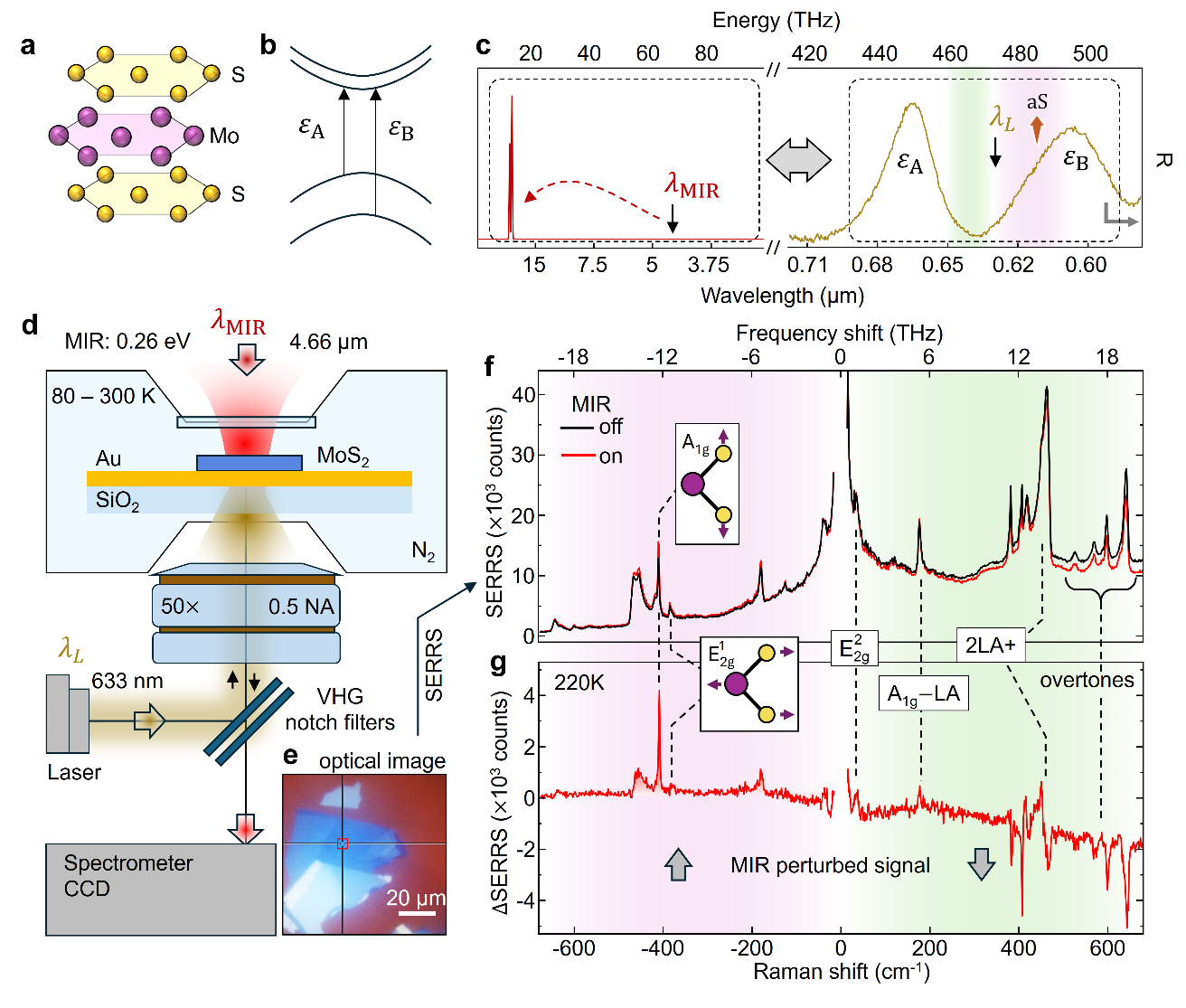
Fig 1: MIR excitation and THz-SERRS of MoS2 phonons. (a) Schematic of a monolayer MoS₂ crystal
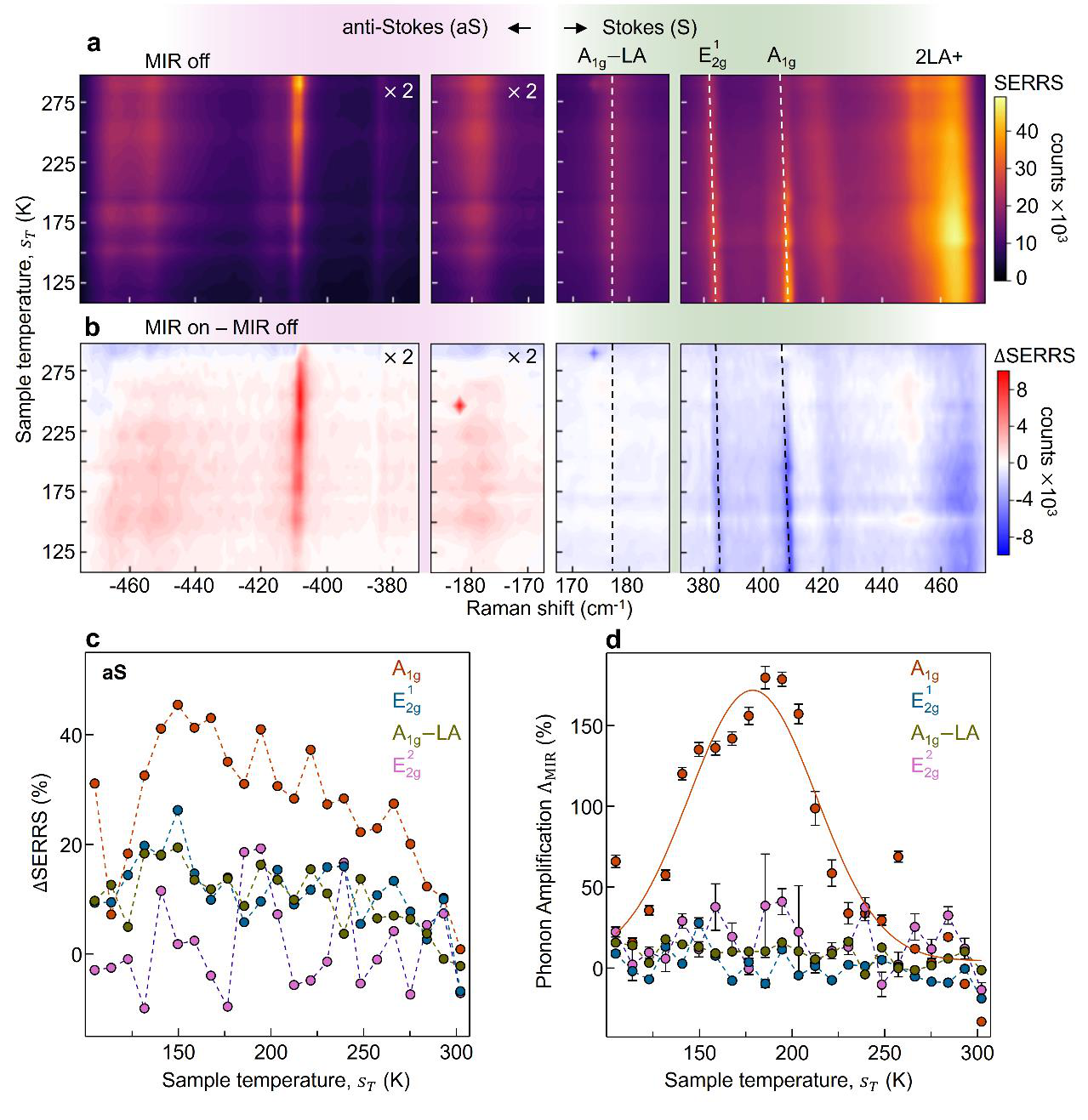
Fig 2: Temperature-dependent MIR-induced phonon amplification. (a) Stokes and anti-Stokes
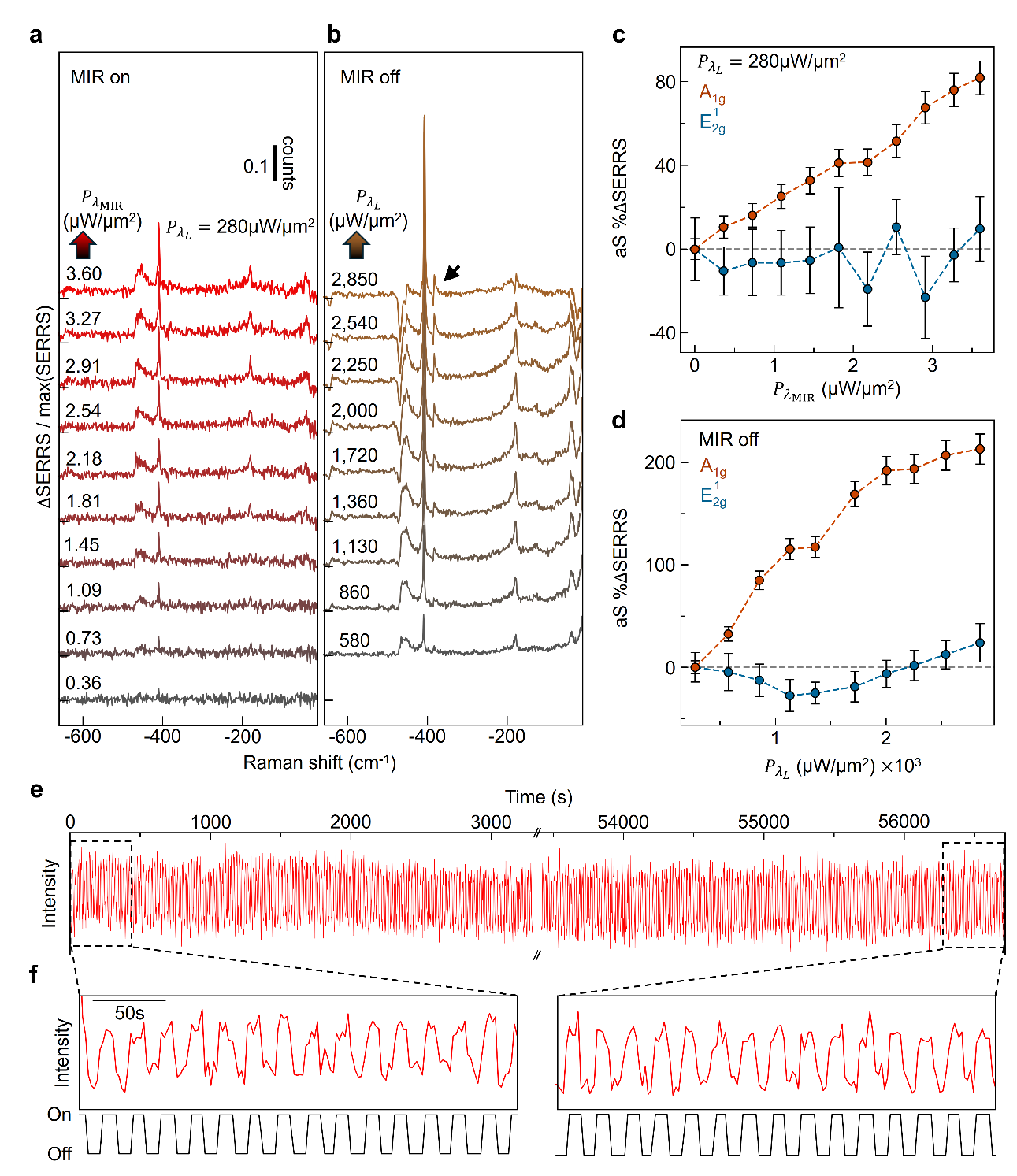
Fig 3: MIR and visible power dependence of anti-Stokes SERRS. (a) Differential anti-Stokes SERRS
Limitations
- The study focuses only on few-layer MoS2 exfoliated on gold substrates; transferability to other materials or substrates requires further study.
- No adversarial or extreme environmental perturbations analyzed to test robustness beyond controlled temperature and power ranges.
- The optomechanical coupling is in the weak-coupling regime; stronger coupling regimes or coherence effects not explored in detail.
- MIR excitation is fixed at 4.65 µm; systematic variation of MIR wavelength vs phonon mode resonance and its effect on amplification efficiency remain to be thoroughly mapped.
- Phonon lasing or stimulated emission is discussed only conceptually; no direct demonstration of coherent phonon emission was conducted.
- Limited release of complete raw datasets and code may hamper reproducibility by independent researchers.
Open questions / follow-ons
- Can MIRAPA be extended to achieve strong-coupling or coherent phonon lasing in 2D materials integrated with optical cavities?
- How does varying MIR wavelength across different phonon resonances affect the amplification selectivity and efficiency?
- Can this approach be generalized to other van der Waals or magnetic 2D materials with distinct phonon or exciton characteristics?
- What are the limits of phonon modulation speed and temporal coherence achievable with MIR pumping?
Why it matters for bot defense
For bot-defense and CAPTCHA practitioners, the MIRAPA approach represents a fundamentally different modality of sensing and signal modulation that leverages selective phonon amplification rather than conventional electronic or photonic transitions. While the technique is currently situated in the physics domain of vibrational sensing and mid-infrared detection, its demonstration of highly sensitive, low-power, and stable modulation at room temperature could inspire new hardware-based bot detection mechanisms that rely on optomechanical or vibrational signatures rather than traditional optical challenge-response patterns. The low power requirements and robustness over thousands of modulation cycles indicate potential for integration into compact, efficient sensor devices. However, practical application in security contexts would require engineering photonic or phononic transduction layers compatible with consumer electronics. Additionally, the demonstrated mode-selective amplification via MIR might motivate novel CAPTCHA challenges that require interaction with specialized phonon-sensitive detectors or MIR sources, raising the bar for automated spoofing. Nevertheless, the transition from laboratory MIR phonon amplification to scalable CAPTCHA or bot defense tech remains exploratory and would benefit from cross-disciplinary research linking phononics, optomechanics, and security protocols.
Cite
@article{arxiv2605_15123,
  title={ Mid-infrared Assisted THz Phonon Amplification in a 2D Semiconductor for Room Temperature Detection },
  author={ Christopher Sumner and Jakob Ziewer and Anju Sajan and Fumin Huang and Rohit Chikkaraddy },
  journal={arXiv preprint arXiv:2605.15123},
  year={ 2026 },
  url={https://arxiv.org/abs/2605.15123}
}