
Detecting the Axion-Photon Conversion Background
Source: arXiv:2605.15175 · Published 2026-05-14 · By Felix Weber, Vikram Ravi
TL;DR
This paper addresses the challenge of detecting axion dark matter via its conversion to photons in astrophysical environments, focusing on signals arising from neutron star (NS) magnetospheres and the interstellar medium (ISM). The authors develop a detailed Galactic neutron star population model and compute the composite axion-photon conversion background arising from the ensemble of NS magnetospheres in the Milky Way. They estimate this diffuse background signal as on the order of 1 mJy per steradian near the Galactic Center at ~2 GHz, and argue that it can be detected using higher order statistical techniques applied to radio interferometric data at submillimeter frequencies (200–950 GHz). In contrast, their analysis of ISM Primakoff processes involving free electrons finds axion signals too weak (~10^-15 Jy sr^-1 m_a/eV) to detect with current instruments. The overall conclusion is that the best detection strategy for QCD axions over a plausible mass range is through statistical radio imaging of large sky areas rich with neutron stars, rather than searches in the diffuse ISM plasma. They show that instruments like ALMA have the sensitivity, given integration times and frequency bands, to detect the expected axion-induced background by leveraging spectral and higher moment statistics of survey images. The authors demonstrate how large neutron star populations produce a stochastic but statistically characterizable axion line background and highlight limitations from Doppler broadening and confusion noise. This work extends prior single-source studies of axion conversion in NS magnetospheres into a full Galactic background framework and bridges astrophysical modeling with advanced radio image statistics for indirect axion searches.
Key findings
- The total axion-photon conversion signal from all Galactic neutron star magnetospheres is estimated at ≳ 1 mJy sr^-1 near the Galactic Center at 2 GHz for a KSVZ axion model.
- Using a detailed neutron star population synthesis of ~10^7 stars, the authors reproduce ∼3600 pulsars consistent with the ATNF catalog, validating their model's spatial and parameter distributions.
- Primakoff conversion of axions to photons in the ISM produces extremely weak signals (~10^-15 Jy sr^-1 · m_a/eV), with a cosmological upper bound locally of 10^-8 Jy sr^-1 · m_a/eV, too faint for current detection techniques.
- Higher-order statistical moments (e.g., variance, kurtosis) of radio interferometric survey images can improve sensitivity to the axion background beyond individual source detection by exploiting the increased confusion noise and point-source statistics of the axion-induced spectral line.
- Simulated SNR calculations show that instruments like the Deep Synoptic Array (DSA) at ~1 GHz have SNRs <10^-5 for detection of this background, effectively ruling out detection at low frequencies.
- At submillimeter frequencies (200–950 GHz), using ALMA's compact array configuration, the computed SNR for higher moment statistics exceeds 5σ for a 1 hour integration over a 30°×30° field, making detection plausible.
- The axion signal's spectral line width corresponds to velocity dispersions ∼300 km/s, suggesting the optimal bandwidth for detection scales as ~10^-3 times the observing frequency.
- False alarm probabilities and noise systematics place limits on detecting individual axion spectral lines from single neutron stars, motivating the use of higher moment statistics over large fields.
Threat model
N/A — This is an astrophysical signal detection paper rather than a security/adversarial setting. The implicit 'adversary' corresponds to instrumental noise, astrophysical foregrounds, and statistical confusion noise which limit detection sensitivity. There is no active adversary or attacker modeled.
Methodology — deep read
The paper applies astrophysical modeling combined with interferometric data analysis concepts to quantify the axion-photon conversion background. The core methodology unfolds as follows:
Threat Model & Assumptions: The authors assume axions exist as the dark matter component with mass between 10^-7 to 10^-2 eV and couple to photons according to KSVZ/DFSZ models. The dark matter halo is assumed smooth with local density ~0.4 GeV/cm^3. Adversaries, i.e., observational biases or environmental factors, are not explicitly modeled as attackers but as noise and confusion limiting detection.
Data & Neutron Star Population Model: They synthesize a population of 10^7 neutron stars born over the last 1 Gyr at ~1 per 100 years, using birth distributions estimated from pulsar spin periods, magnetic fields (log-normal with mean ~10^12.5 G), birth locations along four Galactic spiral arms, and kick velocities modeled as exponential with mean 100 km/s. The time evolution of spin period P is governed by magnetic dipole spin down with constant magnetic field. Radio-loudness is modeled via the standard pulsar death line but radio-quiet stars are retained in the axion calculation. The synthesized population predicts ~3600 bright pulsars observable consistent with surveys cataloged by ATNF.
Axion-Photon Conversion Model: The axion-photon conversion power dP/dΩ for each neutron star is computed following Berghaus et al. (Eq. 2.11), scaling with axion mass m_a, surface magnetic field B, spin period P, and local dark matter density. Geometric averaging over random orientations yields an effective average factor of about 0.1.
Galactic Kinematics & Doppler Broadening: The neutron star velocities combine Galactic rotation curves and natal kick velocities treated as perturbations, generating radial velocity distributions with RMS ~110 km/s leading to spectral line widths ~300 km/s. These velocity-induced frequency shifts broaden the axion spectral line and affect stacking of signals across the population.
Signal Simulation & Statistical Detection: The cumulative axion spectral line is simulated as a superposition of Doppler-shifted sources weighted by their flux, binned by radial velocity. Detection prospects are analyzed using moment statistics (cumulants) of interferometric survey images, notably variance and third central moment (kurtosis), which are sensitive to unresolved point source fluctuations (confusion noise).
Instrument Modeling and Sensitivity: The authors model thermal noise and beam sizes for instruments like the DSA, VLA, ALMA, and Herschel. Thermal noise per beam and the number of independent beams are computed to estimate uncertainties in cumulant statistics. Scaling laws for signal-to-noise ratio (SNR) of the n-th cumulant with axion mass and beam parameters are established.
Evaluation: Sensitivity curves for detecting axion coupling constants g_{aγ} with 5-σ significance are derived for each instrument under survey assumptions (e.g. 30°×30° sky area, 1 hr integration per field, spectral resolution ~300 km/s). They contrast results for full surveys against more realistic smaller-scale (~1.5°×1.5°) surveys with 1 min integration.
Limitations & Uncertainties: They acknowledge simplified assumptions like constant magnetic fields (no decay), no inclusion of millisecond pulsars, neglect of axion clouds, and approximations in Galactic dynamics. Uncertainties in population parameters and pulsar birth rates translate directly into variations in predicted signals.
A concrete example end-to-end: the authors simulate the aggregate axion spectral line profile at 2 GHz for a 6 m dish antenna using their 10^7 neutron star population, convolving Doppler velocity distributions with per star line powers, resulting in expected micro-Jansky level spectral lines (Figure 5). They then translate this to survey image statistics for instruments like DSA (Fig 6) and ALMA (Fig 7) to establish detection feasibility.
Technical innovations
- Development of a synthetic Galactic neutron star population (~10^7 stars) combining spatial, spin, magnetic, and kinematic distributions tailored for axion signal modeling.
- Application of higher order image moment statistics (variance, skewness, kurtosis) of radio interferometric survey data as a sensitive statistical detection method for weak axion-photon conversion backgrounds.
- Demonstration that the axion-induced spectral line’s Doppler broadening (~300 km/s) sets an optimal frequency channel bandwidth scaling with observing frequency for detection.
- Prediction that submillimeter interferometers like ALMA, despite smaller collecting area than radio arrays, can detect axion backgrounds by trading frequency band and utilizing improved moment statistics.
Datasets
- ATNF Pulsar Catalog — thousands of known pulsars — public archival data
- Synthetic Neutron Star Population Model — 10 million simulated NS — generated by authors (non-public)
Baselines vs proposed
- DSA (1.35 GHz): expected SNR in cumulant statistics < 10^-5 vs ALMA (950 GHz): SNR > 5 for same integration time and survey area
- KSVZ axion coupling sensitivity: baseline theoretical predictions ~10^-13 to 10^-12 GeV^-1 across radio bands matched or exceeded by ALMA at high frequencies
- Foreground removal reduces SNR but still allows significant detection at >300 GHz for ALMA (Fig 7 vs Fig 6)
- Individual point source detection challenged by high false alarm rates vs statistical detection via higher moments improves robustness
Figures from the paper
Figures are reproduced from the source paper for academic discussion. Original copyright: the paper authors. See arXiv:2605.15175.
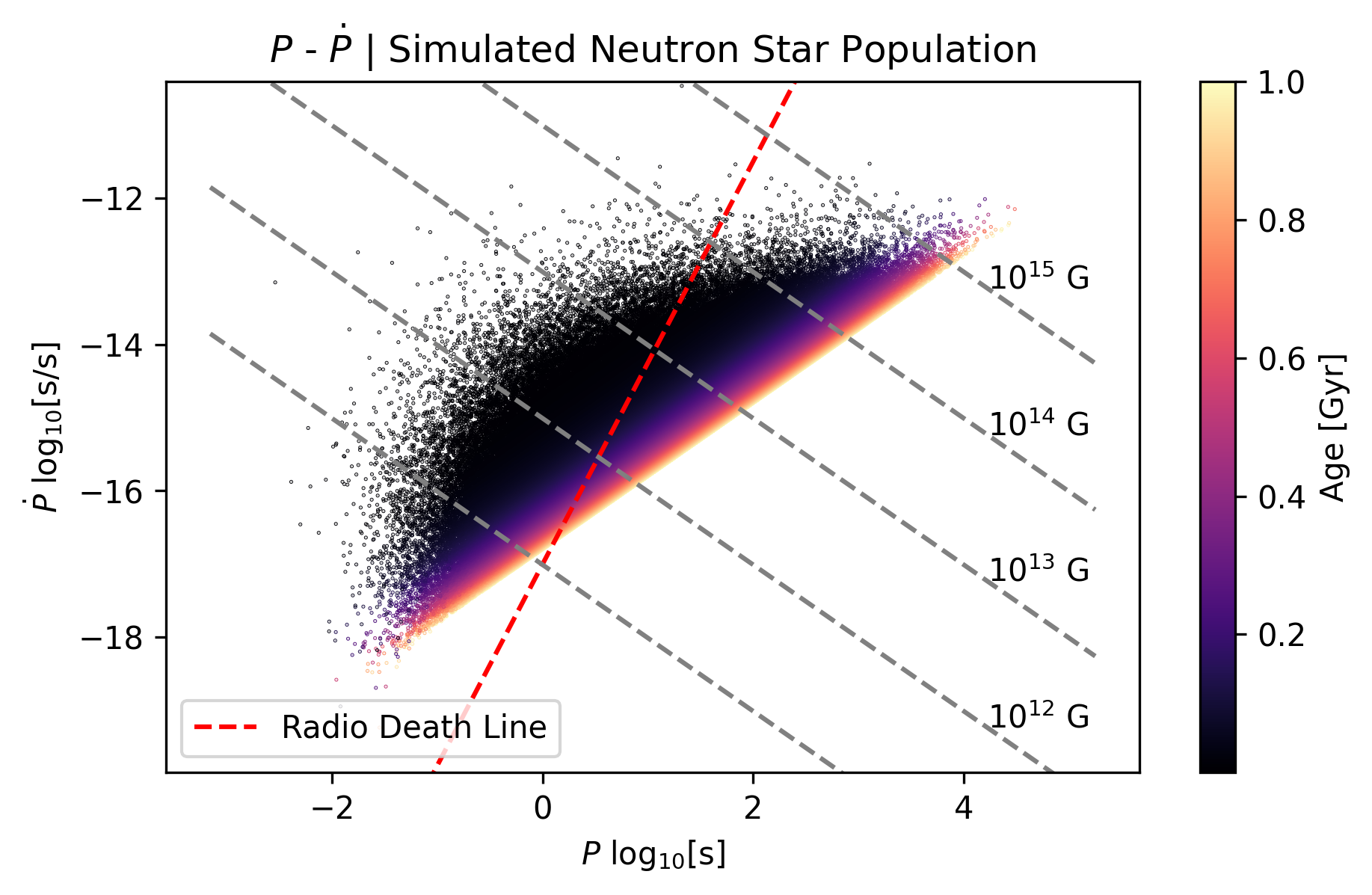
Fig 1: A complete P - ˙P diagram of our population model
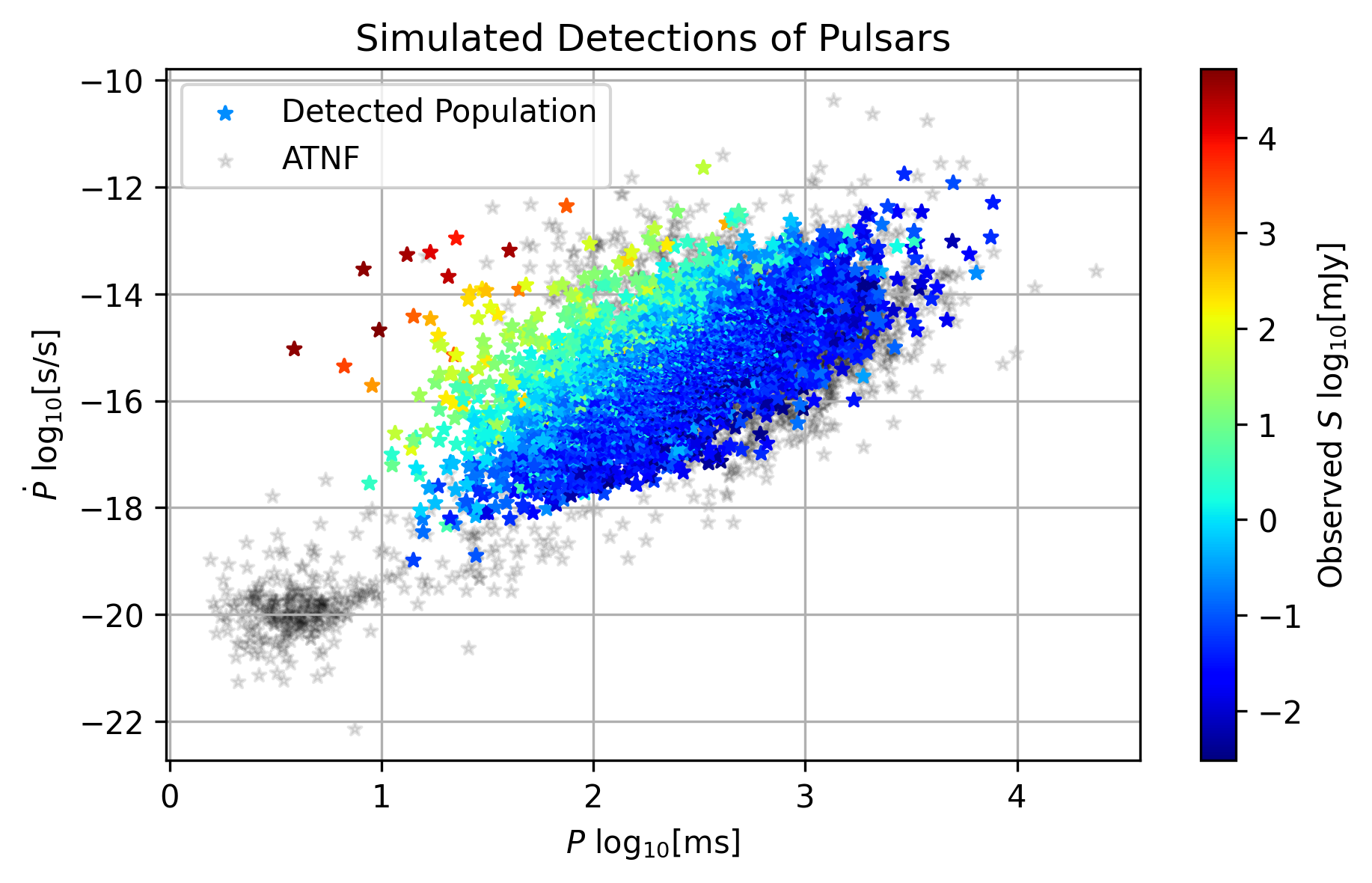
Fig 2: Assuming a beaming fraction of 15% and comparing
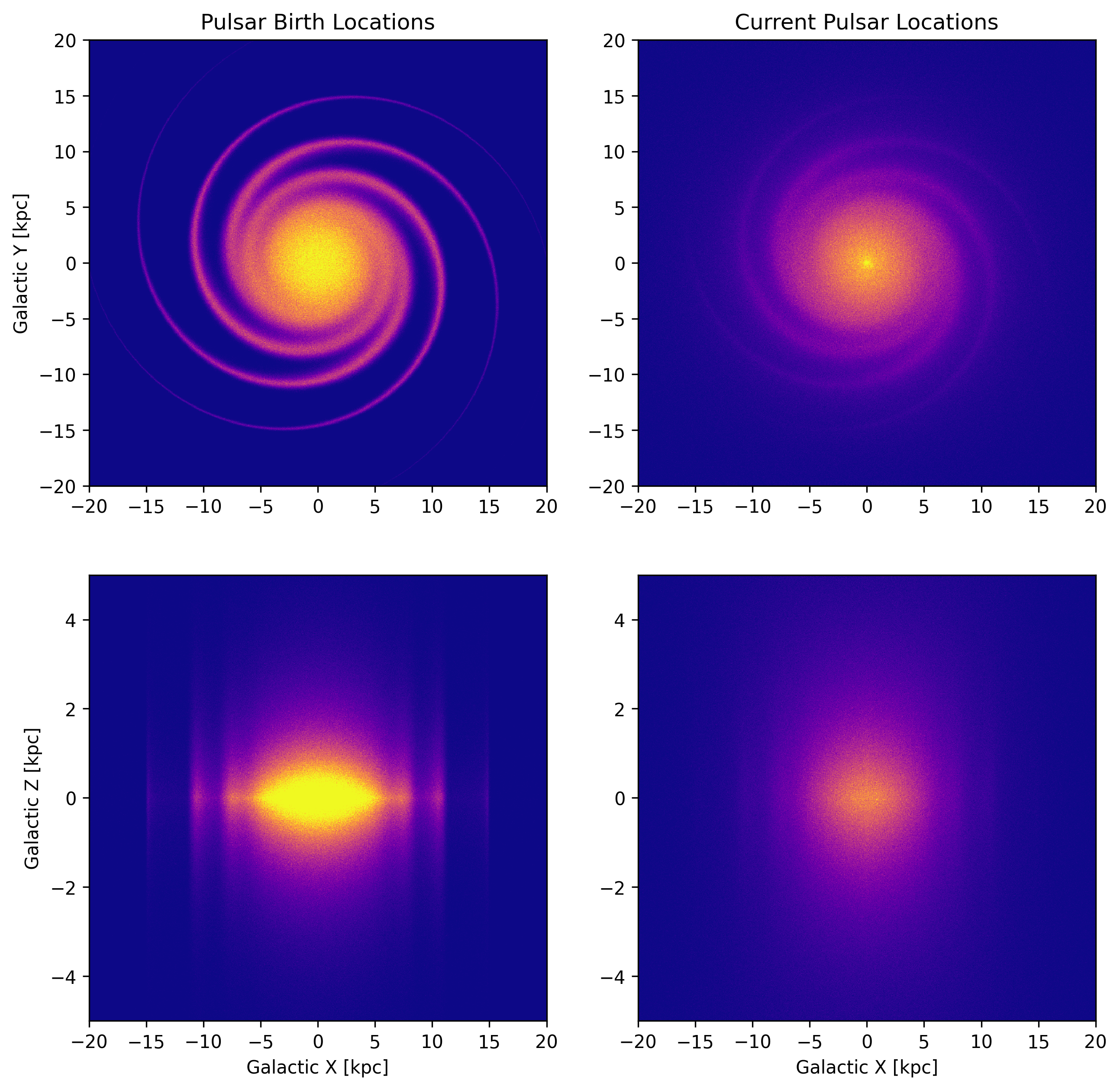
Fig 3: Left column: neutron stars histogramed by birth lo-
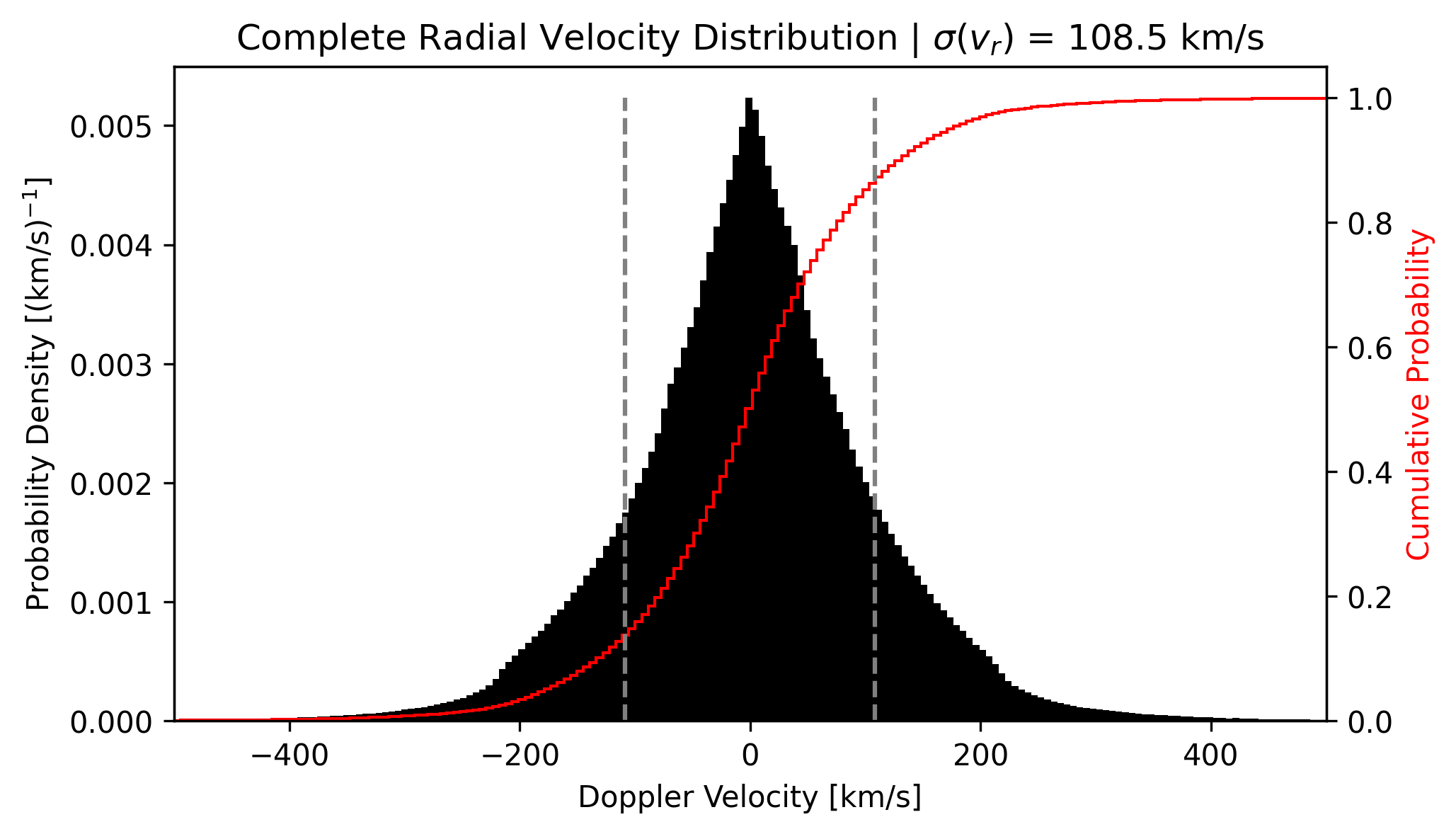
Fig 4: The complete probability density and cumulative
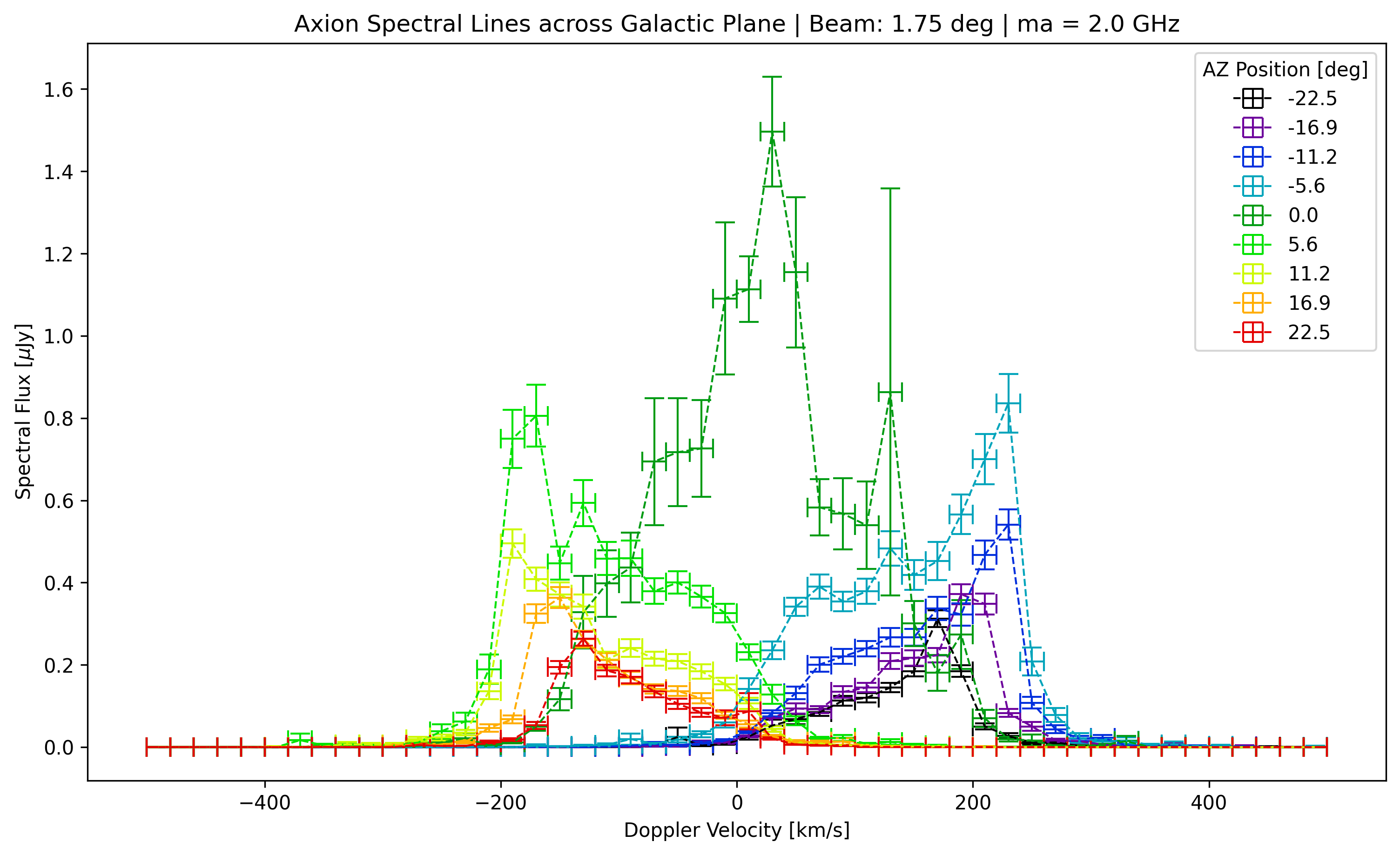
Fig 5: Simulated spectral lines from axion conversion from
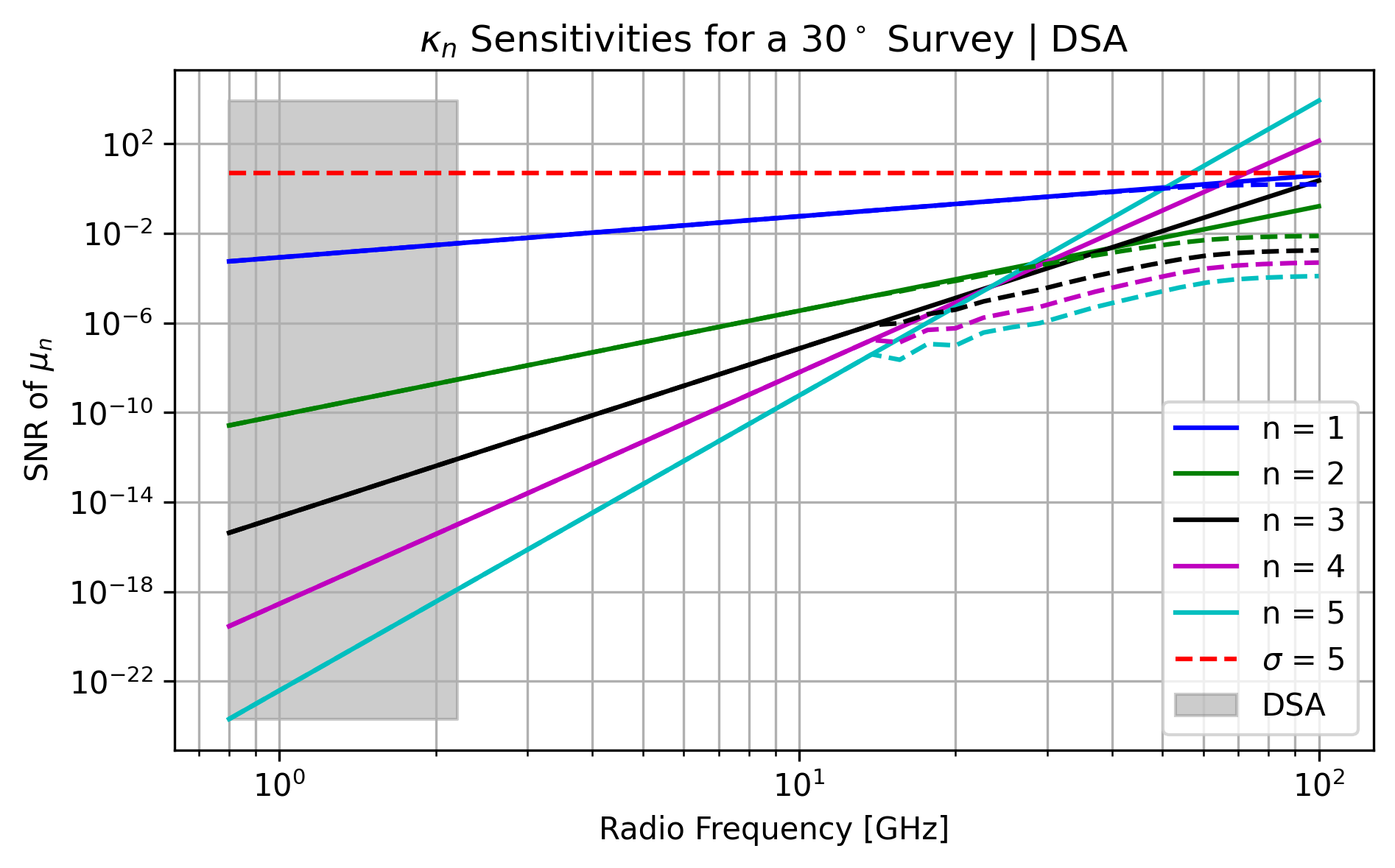
Fig 6: The expected SNR of the n-th cumulant statistic
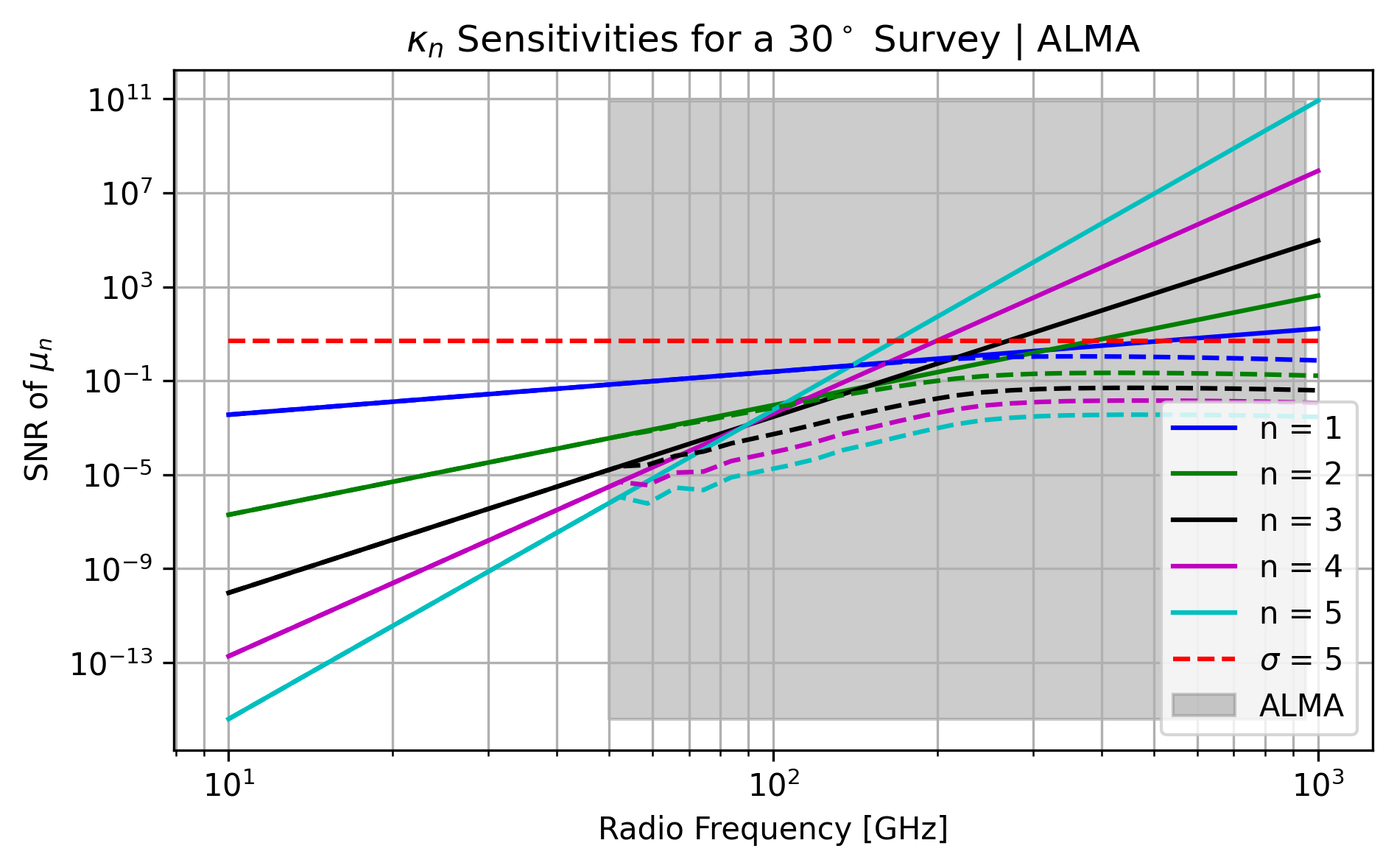
Fig 7: The expected SNR of the n-th cumulant statistic
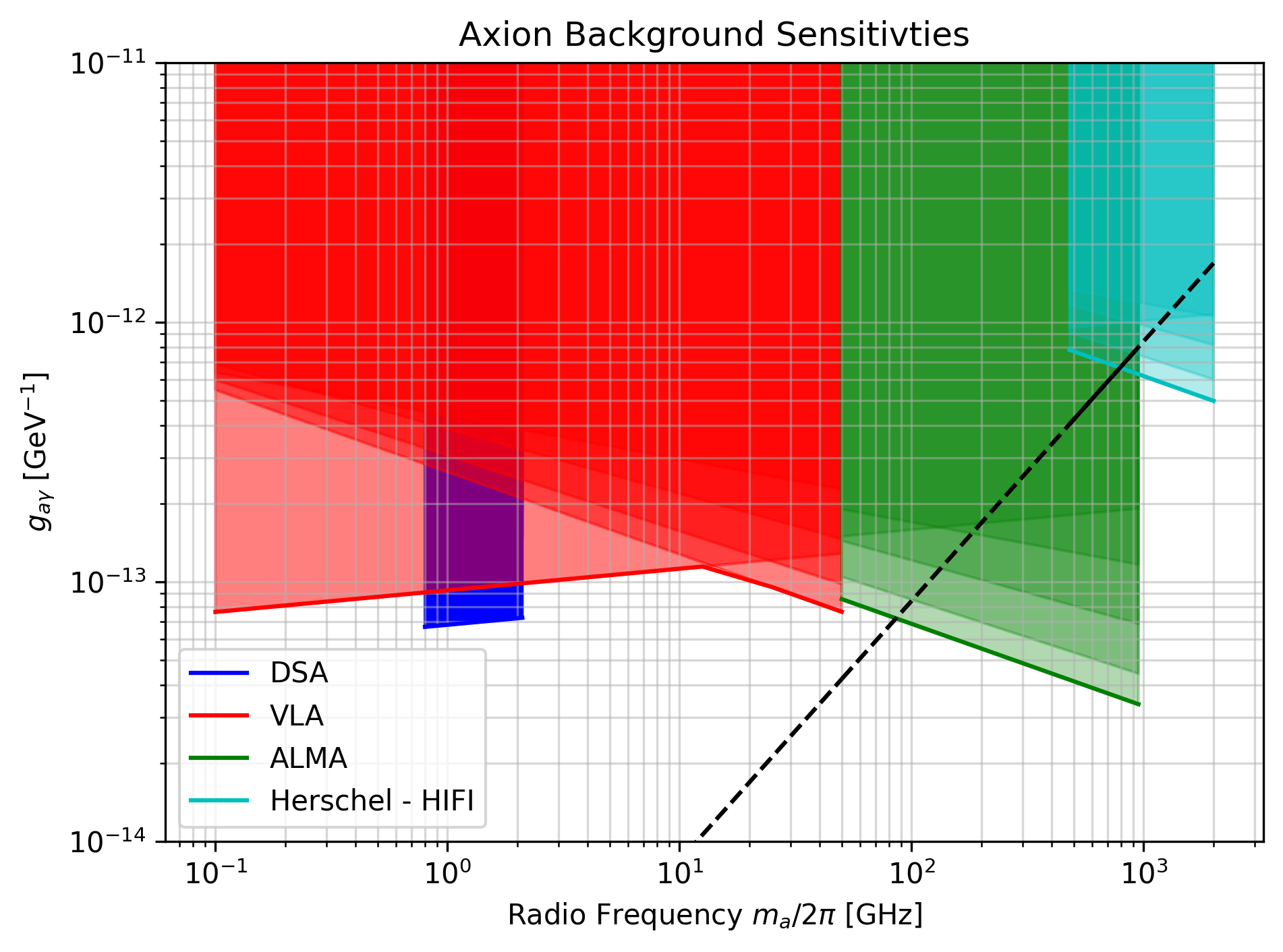
Fig 8: 5-σ-sensitive sectors of the axion coupling constant
Limitations
- Population model assumes constant magnetic fields, ignoring decay or millisecond pulsars (no spin-up processes modeled).
- Kinematic treatment of neutron stars simplifies orbital dynamics treating kick velocities as perturbations; detailed trajectories not tracked.
- Axion cloud effects around pulsars, which may enhance signals, are neglected to isolate dark matter contribution.
- Foreground subtraction and real-world systematics like calibration errors or RFI not fully modeled; only thermal noise considered for statistical detection.
- Large uncertainties in total neutron star count (10^7 assumed vs potential 10^9) and parameter distributions propagate to signal strength estimates.
- Survey assumptions (integration times, sky coverage) for ALMA often impractical for large areas due to enormous observing times.
Open questions / follow-ons
- How do millisecond pulsars and evolving magnetic fields affect the aggregate axion-photon conversion background?
- Can axion cloud signals be disentangled from dark matter axion backgrounds in neutron star spectra?
- What are optimal data analysis pipelines integrating higher moment statistics and machine learning to separate axion signals from complex radio foregrounds?
- How robust are assumptions on ISM turbulence and magnetic spectra below electron scales in modulating axion signals?
Why it matters for bot defense
While the paper is focused on astrophysical dark matter detection rather than bot detection or CAPTCHAs, several methodological insights are potentially relevant. The use of higher order statistical moments (beyond simple power or mean measurements) to detect faint, distributed, and stochastic signals parallels ideas in bot detection where subtle anomalies or aggregate patterns emerge only in complex feature statistics. The challenge of distinguishing weak signals embedded in noisy, confounded backgrounds also resonates with CAPTCHA anti-abuse where adversarial signals are hidden within user interaction data. Finally, the emphasis on careful physical and statistical modeling of signal sources, noise, and instrumental characteristics can inspire rigor in bot-detector calibration and adversarial robustness evaluations. However, no direct algorithmic or model architectures transfer since the domain and data modalities (radio interferometry vs. interaction logs) markedly differ.
Cite
@article{arxiv2605_15175,
  title={ Detecting the Axion-Photon Conversion Background },
  author={ Felix Weber and Vikram Ravi },
  journal={arXiv preprint arXiv:2605.15175},
  year={ 2026 },
  url={https://arxiv.org/abs/2605.15175}
}