
Light-driven octupolar inverse Faraday effect and multipolar order in Mott insulators
Source: arXiv:2605.08049 · Published 2026-05-08 · By Saikat Banerjee, Tara Steinhöfel, Florian Lange, Matthias Eschrig, Holger Fehske
TL;DR
This paper addresses the challenge of controlling and detecting 'hidden' multipolar orders — specifically quadrupolar and octupolar states — in spin-orbit-coupled Mott insulators with d2 electronic configurations and edge-sharing octahedral geometry. These orders are 'hidden' because they lack conventional magnetic dipole moments and are therefore invisible to standard probes like neutron scattering or magneto-optical Kerr effect measurements. The central question is whether circularly polarized light (CPL) can serve as a direct, reversible handle on such hidden quantum states, both generating them out of equilibrium and providing a structural fingerprint for their detection.
The authors approach this via a Floquet Schrieffer-Wolff transformation (FSWT) applied to a driven Hubbard-Kanamori model. By projecting onto the low-energy non-Kramers Eg doublet — which hosts two quadrupolar moments (time-reversal even) and one octupolar moment (time-reversal odd) — they derive an effective pseudospin Hamiltonian containing two qualitatively new, light-induced terms absent in equilibrium: (1) a uniform field hm that couples linearly and selectively to the magnetic octupole operator Txyz, identified as an octupolar inverse Faraday effect (OIFE), and (2) a bond-dependent anisotropic exchange Γ(3) that mixes octupolar and quadrupolar sectors and, when expressed in cubic coordinates, generates a Kitaev-like bond-directional coupling K proportional to Γ(3). These two couplings are the paper's central microscopic output.
Solving the resulting effective Hamiltonian via exact diagonalization (ED) and cross-checking with DMRG real-space textures, the authors map out a nonequilibrium multipolar phase diagram in the (Γ(3)/Jeff, hm/Jeff) plane. They find five distinct regimes: antiferro-octupolar (AFO), ferro-octupolar (FO), partially polarized ferro-quadrupolar (PPFQ), Ising octupolar (IO), and a multipolar liquid (ML) phase. Crucially, only the AFO phase survives in equilibrium — all other phases are light-induced. Additionally, the FO and PPFQ orders are shown to couple to the lattice, generating reversible trigonal and tetragonal distortions respectively, which provide structural fingerprints detectable via pump-probe x-ray diffraction.
Key findings
- CPL generates an effective static octupolar field hm that couples linearly to the magnetic octupole moment Txyz (the OIFE), confirmed analytically by hm ∝ |E(Ω) × E*(Ω)|, establishing an inverse-Faraday-type origin from optical helicity — a coupling absent in equilibrium due to time-reversal symmetry.
- A bond-dependent anisotropic exchange Γ(3) is simultaneously induced by CPL; when rewritten in cubic coordinates via Eq. (13), it generates a Kitaev coupling K = −√2 Γ(3), meaning K grows linearly with drive-induced anisotropy and dominates for Γ(3)/Jeff > 1.
- The driven multipolar phase diagram contains at least five phases — AFO, FO, PPFQ, IO, and ML — of which only the AFO phase exists in the undriven equilibrium system; all others are nonequilibrium light-induced states accessible by tuning Γ(3)/Jeff and hm/Jeff.
- Using representative microscopic parameters (tpd = 1.5 eV, t2 = 0.25 eV, Ũ = 3.0 eV, Δc = 5.0 eV, Ω ≈ 100 THz), Fig. 3 shows that Γ(3)/Jeff grows substantially with drive strength ζ, reaching values comparable to the dominant exchange scale, meaning the bond-dependent anisotropy is not perturbatively small but can compete directly with Jeff.
- The prethermal lifetime is estimated as τ* ~ (ℏ/Λ) exp(α ℏΩ/Λ); with Ω ~ 100 THz and exchange scale Λ in the meV range, ℏΩ/Λ ≫ 1, placing the system in the high-frequency prethermal regime with τ* estimated in the several-picosecond range, within reach of pump-probe experiments.
- FO order couples to trigonal lattice distortions, while PPFQ order couples to tetragonal distortions of the ideal octahedral environment; both distortions are reversible — vanishing when the drive is removed — providing structural fingerprints for otherwise hidden multipolar order.
- In the minimal single-hopping-amplitude model (single t2), hm and Γ(3) are proportional to each other (Fig. 3b), confining the Floquet trajectory to a diagonal path in the (Γ(3)/Jeff, hm/Jeff) phase diagram; this constraint is lifted by introducing multiple symmetry-allowed t2g hopping channels or an independent static magnetic field along [111].
- A hidden symmetry of Eq. (4) maps the exchange term onto an antiferromagnetic Heisenberg form (Eq. 9) under a sublattice pseudospin rotation, with Γ(3) appearing as a bond-dependent DM-like frustration coupling (Eq. 10), making transparent why large Γ(3) destabilizes ordered phases and promotes the multipolar liquid regime.
Methodology — deep read
The threat model here is not adversarial in the security sense; instead the 'challenge' being addressed is the inaccessibility of hidden multipolar order to external control and detection. The assumed material setting is a 4d2/5d2 Mott insulator with edge-sharing octahedral geometry on a honeycomb lattice, driven by off-resonant CPL applied perpendicular to the [111] plane. The key assumption is the prethermal regime: the drive frequency Ω is assumed to be smaller than the charge-transfer gap Δc and local excitation gap Ũ, yet larger than the exchange energy scales, placing the system in the high-frequency off-resonant Floquet regime where heating is parametrically suppressed and the dynamics is governed by a long-lived effective Hamiltonian over timescales τ* ~ several picoseconds.
The microscopic starting point is a Hubbard-Kanamori model parameterized by on-site Coulomb repulsion U, Hund's coupling JH, spin-orbit coupling λ, charge-transfer energy Δc, TM-ligand hopping tpd, and direct TM-TM hopping t2. CPL is introduced via time-dependent Peierls phases: ϕij(t) = −rij·A(t) for TM-TM hops and θil(t) = −ril·A(t) for TM-ligand hops, with A(t) = (E0/Ω)(x̂ sin Ωt + ŷ cos Ωt). Slater-Koster rules fix the relative signs of TM-ligand hopping amplitudes, and the edge-sharing geometry constrains which hopping paths (upper vs. lower triangular paths in Fig. 2d,e) contribute with finite amplitude.
The derivation proceeds via a Floquet Schrieffer-Wolff transformation (FSWT) expanded to third order, with selected fourth-order contributions included because the perturbative hierarchy assigns hopping processes proportional to t²₂, t²pd·t2, and t⁴pd all to the same order s⁴. The FSWT is applied to a four-site cluster along the z bond, and cubic symmetry is then used to obtain x and y bond interactions. The resulting Hamiltonian is projected onto the low-energy non-Kramers Eg doublet — the two spin-orbit-entangled states |⇑⟩ = (|Jz=2⟩ + |Jz=−2⟩)/√2 and |⇓⟩ = |Jz=0⟩ — which host two quadrupolar Stevens operators (O²₀, O²₂) and one octupolar operator (Txyz). These three operators form an SU(2) algebra, allowing identification of effective pseudospin components σ̃x (quadrupolar), σ̃y (octupolar), σ̃z (quadrupolar). The effective exchange couplings Jeff(ζ), Γ(3)(ζ), and hm(ζ) are expressed as sums over Floquet photon indices n,l,m (constrained to n+l+m=0) of products of Bessel functions Jn(A) weighted by virtual energy denominators (Ũ−mΩ)⁻¹ and (Δc−nΩ)⁻¹, as given in Eqs. (6a)–(6f). The Floquet sum is truncated at p=7 photon sectors, which the authors argue is controlled because Bessel function weights suppress high-order terms and all denominators remain away from resonances.
With the effective Hamiltonian Heff in hand (Eq. 4), the authors perform finite-size exact diagonalization (ED) of a honeycomb cluster (largest cluster size N cited in Fig. 5 captions as the 'largest ED cluster,' exact N not fully visible in truncated text) over the two-dimensional parameter space (Γ(3)/Jeff, hm/Jeff) with Jeff=1 fixed. Multipolar structure factors are computed for ferro (mᵅF) and antiferro (mᵅAF) channels in all three pseudospin components α={x,y,z} using Eq. (14). Because first moments vanish identically on finite clusters (except σ̃y pinned by hm), the primary diagnostics are structure factors, ground-state energy derivatives, and the fidelity susceptibility to locate phase boundaries. DMRG real-space textures are additionally computed on quasi-1D strips to provide spatial consistency checks of the dominant multipolar patterns in each identified regime. No statistical significance tests or cross-validation are reported, as this is an analytical/numerical theory paper rather than an ML or empirical study. Reproducibility is limited: no code repository or dataset is referenced; the results depend on analytical Floquet expressions and ED/DMRG numerics with the cited parameters.
As a concrete end-to-end example: starting from the z-bond four-site cluster with the time-dependent Peierls phases, the FSWT generates virtual hopping processes at third order involving two TM-ligand hops (each contributing a Bessel-function factor Jn(A) from the ligand Peierls phase) and one TM-TM hop (contributing Jm(A0)), constrained by n+l+m=0. The sine factor sin[(n−l)ψ0] in Eqs. (6e–6f) vanishes for left/right circularly polarized light reversed (since sin changes sign), confirming the helicity dependence of both hm and Γ(3). In contrast, the cosine factor in J(3) (Eq. 6c) is helicity-even, contributing to the isotropic exchange Jeff. This is the microscopic mechanism by which CPL chirality selectively activates the octupolar field and the bond-anisotropic exchange while preserving (or modifying) the isotropic exchange.
Technical innovations
- Octupolar Inverse Faraday Effect (OIFE): derivation of an effective static field hm that couples linearly and selectively to the magnetic octupole moment Txyz in a d2 Mott insulator under CPL — extending the conventional spin-sector IFE of Ref. [26] to hidden higher-rank multipolar degrees of freedom.
- Drive-induced bond-dependent anisotropic multipolar exchange Γ(3): a light-generated interaction that mixes octupolar and quadrupolar sectors with bond-selective frustration, absent in equilibrium and shown via Eq. (13) to generate a Kitaev coupling K = −√2 Γ(3) in the cubic-coordinate pseudospin Hamiltonian.
- Floquet Schrieffer-Wolff derivation of a multipolar J-K-Γ-Γ' Hamiltonian from the driven Hubbard-Kanamori model including both TM-ligand (tpd) and direct TM-TM (t2) hopping to fourth perturbative order, establishing the microscopic origin of all light-induced multipolar exchange channels.
- Demonstration that drive-induced multipolar order (FO and PPFQ) couples to the lattice via symmetry-allowed distortions (trigonal for FO, tetragonal for PPFQ), providing reversible structural fingerprints detectable by pump-probe x-ray diffraction — a proposed detection scheme for otherwise hidden order.
- Mapping of the nonequilibrium multipolar phase diagram containing five phases (AFO, FO, PPFQ, IO, ML) in the (Γ(3)/Jeff, hm/Jeff) plane, establishing that four of these phases are purely light-induced and inaccessible in the equilibrium system, where only AFO survives.
Baselines vs proposed
- Equilibrium undriven model (Γ(3)=0, hm=0): only AFO phase present vs. driven model: four additional phases (FO, PPFQ, IO, ML) accessible by tuning Γ(3)/Jeff and hm/Jeff
- Conventional spin-sector inverse Faraday effect (Ref. [26], coupling to spin dipole): couples to spin moment vs. OIFE proposed here: couples linearly to magnetic octupole Txyz, a qualitatively different and higher-rank hidden order parameter
- Kitaev-like multipolar liquid regime at equilibrium (implied by prior work Refs. [17,18]): narrow or absent vs. driven system with Γ(3)/Jeff > 1: enlarged ML regime due to dominant K = −√2 Γ(3) Kitaev coupling
Figures from the paper
Figures are reproduced from the source paper for academic discussion. Original copyright: the paper authors. See arXiv:2605.08049.
Fig 1: Schematic illustration of the central mecha-

Fig 2: (a) Schematic representation of an edge-sharing octa-
Fig 3 (page 1).

Fig 4 (page 1).
Fig 5 (page 1).
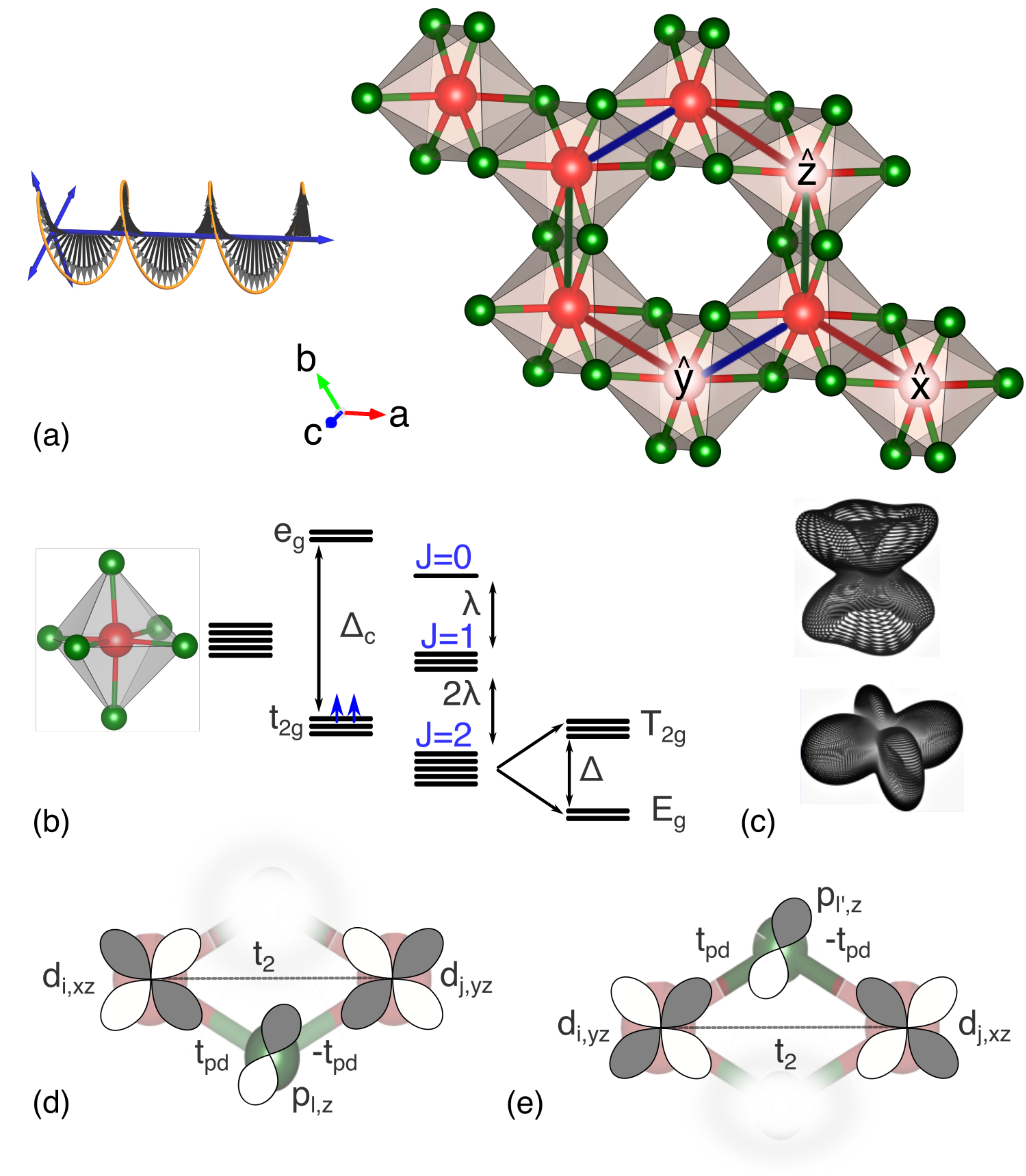
Fig 6 (page 3).
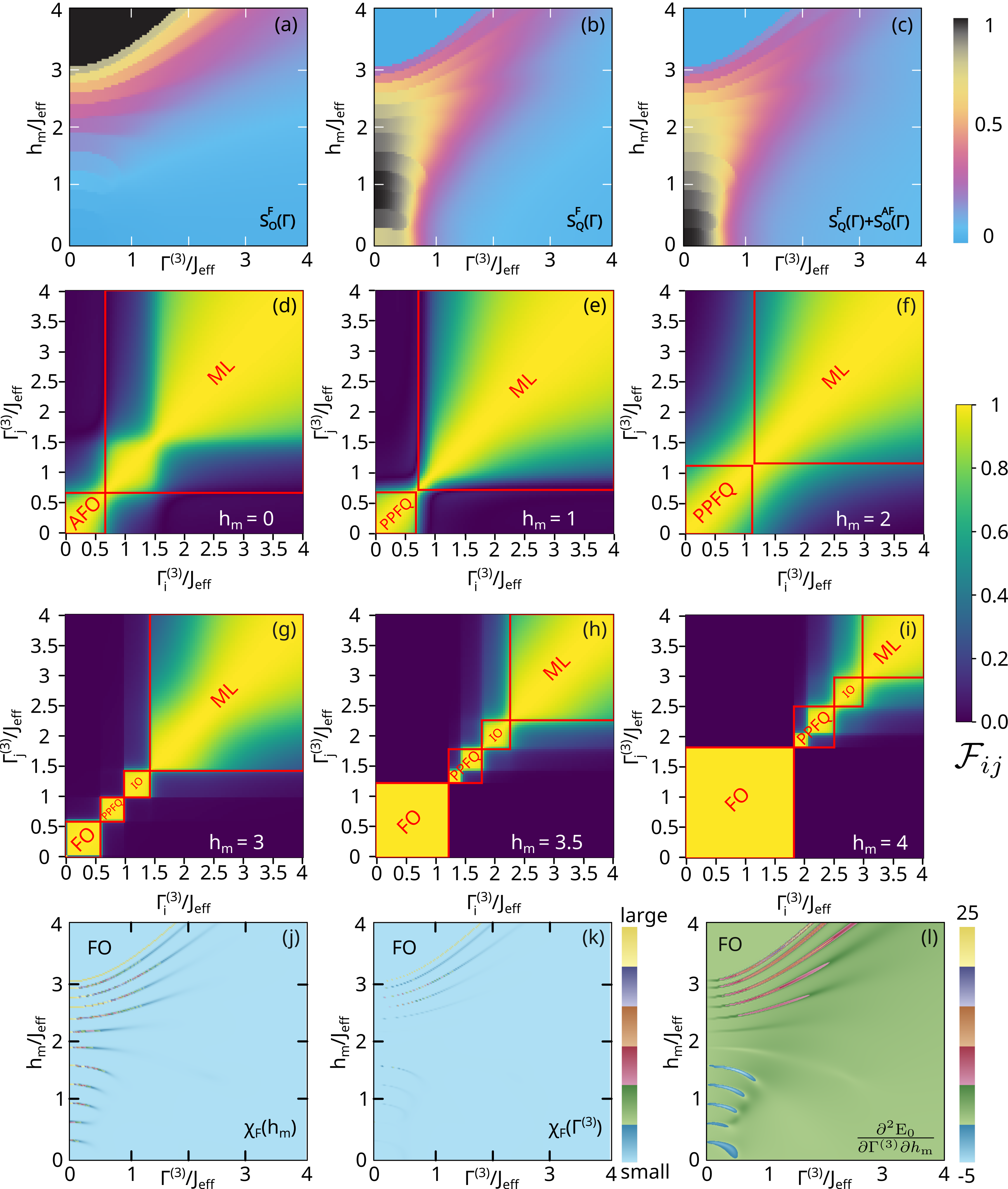
Fig 5: (a–c) Heat maps of the relevant multipolar structure factors in the Γ(3)–hm plane for the largest ED cluster (N =

Fig 8: Schematic multipolar phase diagram of the effective
Limitations
- The minimal microscopic model uses a single effective TM-TM hopping amplitude t2, which forces hm and Γ(3) to be proportional (Fig. 3b), severely restricting the accessible region of the phase diagram to a diagonal trajectory; the authors acknowledge this and propose multiple hopping channels or an external magnetic field as remedies, but do not implement this in the main numerical results.
- ED is performed on finite honeycomb clusters whose exact size is not fully legible in the truncated text; finite-size effects on phase boundaries and the identification of the ML phase (which requires absence of long-range order) are not systematically quantified with finite-size scaling.
- The prethermal lifetime estimate τ* ~ several picoseconds is a rough order-of-magnitude based on Eq. (5) with α ~ O(1); quantitative material-specific absorption channels (phonon coupling, higher electronic resonances) that would reduce τ* in real compounds are not modeled.
- No specific material realization is quantitatively validated: ReCl5 is cited only as an illustrative structural example with the correct edge-sharing d2 geometry, not as a target compound with fitted parameters, leaving open whether the predicted phases are experimentally accessible in any known material.
- The lattice distortion analysis (trigonal/tetragonal) is described as phenomenological; the authors estimate mean static distortions in ordered states but do not provide a quantitative coupling to phonon modes or calculate x-ray diffraction intensities that would be measurable in a pump-probe experiment.
- The DMRG calculations are used only as real-space consistency checks on quasi-1D geometries and are not used to determine phase boundaries or check the 2D phase diagram systematically; no convergence parameters (bond dimension, truncation error) are reported in the truncated text.
Open questions / follow-ons
- Can the proportionality constraint between hm and Γ(3) be broken in realistic multi-orbital tight-binding models of specific 4d2/5d2 compounds (e.g., including all symmetry-allowed t2g hopping channels), and if so, what regions of the (Γ(3)/Jeff, hm/Jeff) phase diagram become accessible by CPL alone without a supplementary static magnetic field?
- What is the quantitative prethermal lifetime τ* in specific candidate materials, accounting for electron-phonon coupling and realistic electronic excitation spectra, and can pump-probe experiments on the picosecond timescale actually thermalize within the driven phase before heating becomes significant?
- Do the proposed Ising octupolar (IO) and multipolar liquid (ML) phases persist in 2D thermodynamic limit (infinite system size), and can the ML phase be rigorously distinguished from a disordered paramagnetic state using topological or entanglement diagnostics such as topological entanglement entropy?
- Can the reversible trigonal and tetragonal lattice distortions induced by FO and PPFQ orders be quantitatively predicted (distortion amplitude, diffraction peak shifts) for a specific compound, providing a concrete experimental target for pump-probe x-ray scattering or ultrafast electron diffraction?
Why it matters for bot defense
This paper is condensed matter physics theory with no direct relevance to bot defense, CAPTCHA, or anti-automation systems. It concerns quantum many-body physics — specifically the optical control of hidden multipolar order in correlated electron systems — and introduces no methods, datasets, or concepts applicable to behavioral analysis, bot detection, or human-machine interaction challenges.
For completeness: the Floquet engineering and effective Hamiltonian derivation techniques used here are standard tools in quantum physics and have no analogue in the ML-based bot detection stack. A bot-defense or CAPTCHA practitioner would find nothing actionable in this work. It is recommended to filter this paper out of bot-defense literature review pipelines at the title/abstract stage.
Cite
@article{arxiv2605_08049,
  title={ Light-driven octupolar inverse Faraday effect and multipolar order in Mott insulators },
  author={ Saikat Banerjee and Tara Steinhöfel and Florian Lange and Matthias Eschrig and Holger Fehske },
  journal={arXiv preprint arXiv:2605.08049},
  year={ 2026 },
  url={https://arxiv.org/abs/2605.08049}
}