
Sensitivity Projections for Low-Mass Dark Matter Annihilation with the IceCube Upgrade
Source: arXiv:2605.06600 · Published 2026-05-07 · By R. Abbasi, M. Ackermann, J. Adams, J. A. Aguilar, M. Ahlers, J. M. Alameddine et al.
TL;DR
This paper presents sensitivity projections for the IceCube Upgrade (a seven-string infill of the DeepCore subarray, referred to as IC93) to neutrino signals from dark matter (DM) annihilation, targeting DM masses in the 3–500 GeV range. The core problem being addressed is that the current IceCube/DeepCore detector configuration (IC86) has a practical energy threshold of ~5 GeV and peak sensitivity to DM masses of ~100 GeV–1 TeV, leaving much of the low-mass WIMP parameter space poorly constrained. The Upgrade's denser string spacing (20–30 m vs. 40–70 m), finer vertical module spacing (3 m vs. 7 m), and new multi-PMT optical modules (D-Egg and mDOM) extend sensitivity into the sub-10 GeV regime and improve effective area by up to two orders of magnitude at the lowest energies. Two distinct source regions are analyzed: the solar core (leveraging WIMP capture-annihilation equilibrium) and the Galactic Center (using an NFW dark matter density profile).
The methodology is entirely simulation-based — no real data are used. Signal templates are generated with the χaroν package for three annihilation channels (bb̄, τ+τ−, νν̄), and background templates incorporate atmospheric muons, conventional atmospheric neutrinos, and solar atmospheric neutrinos. A binned Poisson likelihood framework with a truncated chi-squared test statistic (critical value 1.64 rather than the standard 2.71, verified with ~10^4 pseudoexperiments) is used to derive median exclusion sensitivities assuming the null hypothesis. Event selection employs a GNN-based noise cleaner (DynEdge/GraphNeT), three ML-based background classifiers, and a veto-region filter, reducing atmospheric muon contamination by roughly six orders of magnitude relative to trigger level.
The projected sensitivities indicate that three years of IC93 data will produce leading or near-leading limits on spin-dependent and spin-independent WIMP-proton cross sections for DM masses below ~100 GeV, surpassing current IceCube results and competing with or exceeding limits from experiments such as ANTARES, Super-Kamiokande, and direct detection experiments in specific mass and channel combinations. The paper is explicitly a projection study: no unblinding or data-driven background validation is reported.
Key findings
- The IC93 effective area is enhanced by up to two orders of magnitude relative to IC86 at the lowest neutrino energies (sub-10 GeV), as shown in Fig. 2, directly translating to larger DM signal statistics in the low-mass regime.
- The GNN-based noise cleaning (DynEdge/GraphNeT) reduces noise pulses by an order of magnitude while retaining 95% of signal pulses, cutting the residual noise fraction to 6.8% compared to ~70% with the previous method.
- The combined ML event selection (GNN plus two BDTs) achieves roughly six orders of magnitude total reduction in atmospheric muon background relative to trigger level (three orders from multiplicity cuts, three from ML classifiers), leaving a neutrino-dominated sample with no surviving simulated pure noise events.
- The solar analysis adopts a lower DM mass bound of 3.7 GeV (the solar evaporation mass), with the evaporation rate verified to be below 10^-3 of the annihilation rate at this threshold and the cross sections probed, confirming capture-annihilation equilibrium holds.
- Signal templates for the solar analysis are binned in three dimensions: 36 linear bins in opening angle (0°–180°), 12 logarithmic bins in reconstructed energy (3–300 GeV), and 3 bins in track score (0–1), enabling morphological separation of νμ CC track-like events from cascades.
- The truncated chi-squared test statistic (modified due to non-negativity constraint on signal normalization) has a 90% critical value of 1.64, verified against the standard Wilks' theorem value of 2.71 using ~10^4 pseudoexperiments.
- Three annihilation channels are considered — bb̄ (soft spectrum), τ+τ− (hard spectrum), and νν̄ (line-like peak) — covering a representative range of spectral shapes; hadronic suppression in the solar core relative to the GC is explicitly modeled, as charged pions lose energy via inelastic scattering in the dense solar medium.
Methodology — deep read
The threat/signal model assumes WIMPs with masses between 3 GeV and 500 GeV that are gravitationally captured in the solar core or concentrated in the Galactic Center via an NFW halo profile. For the solar case, capture-annihilation equilibrium is assumed, meaning the neutrino flux depends only on the WIMP-proton scattering cross section (spin-dependent or spin-independent) and the annihilation channel, not on the annihilation cross section independently. For the GC case, the signal flux depends on the velocity-averaged annihilation cross section ⟨σv⟩ and the line-of-sight integral over the DM density squared (the J-factor). No beyond-Standard-Model mediator structure is assumed; annihilation proceeds through a single dominant two-body SM channel.
All signal and background distributions are derived entirely from Monte Carlo simulation; there is no real IceCube Upgrade data yet. Neutrino interactions are injected with GENIE, sampled from an E^{-2.5} spectrum (biased toward low energies to improve low-energy statistics), covering all flavors, both neutrinos and antineutrinos, with interaction vertices sampled within a cylinder enclosing the DeepCore fiducial volume. Both CC and NC interactions are included. Atmospheric muons are simulated with MuonGun on a cylinder just outside the fiducial volume, with energy and angular distributions biased toward events likely to survive later selection stages; the bias is corrected via event weights. Muons (from atmospheric and νμ CC sources) are propagated with PROPOSAL; other final-state particles use GEANT4. Photon propagation uses CLSim with the IceCube glacial ice model. PMT response includes quantum efficiency, angular acceptance (for legacy DOMs), Gaussian timing smear, and noise PE injection; pulses within 2 ns are merged. The full IC93 geometry (280 D-Eggs + 400 mDOMs on 7 new strings, plus existing IC86 strings) is simulated.
Event selection proceeds in several stages. A GNN-based noise cleaner (DynEdge architecture, implemented in GraphNeT) removes spurious PMT noise pulses, retaining 95% of signal while cutting noise to 6.8% of the sample — a ~10× improvement over the prior approach. A veto-region filter then rejects events with signals in the outer detector consistent with incoming atmospheric muons. Five sequential hard cuts on pulse multiplicity, fiducial pulse count, first-hit z-position, pulse time span (before and after noise cleaning) reduce pure noise triggers by more than three orders of magnitude. Three ML classifiers — one GNN and two BDTs using reconstructed event properties and pulse spatio-temporal distributions — then reduce the residual muon background by a further three orders of magnitude. The output quantities used in the final analysis are: reconstructed energy Ereco, reconstructed opening angle to the source (cos θreco or Δψ), and a Track Score (0–1) from a morphological classifier distinguishing νμ CC track topologies from cascades and showers.
For the solar DM analysis, signal templates are constructed by randomly sampling event times in a three-year window, computing the Sun's position at each time using the Positional Astronomy Library (with IceCube's geographic coordinates), and retaining only events whose true direction falls within the ~0.5° solar disk. Events are accumulated across many epochs to produce a smoothed distribution that accounts for the annual variation in solar position. The 3D binning (36 angle × 12 energy × 3 track-score bins) captures both spectral and directional information. Background templates include atmospheric muons, conventional atmospheric neutrinos, and solar atmospheric neutrinos. For the GC analysis, the analysis bins differ (specific binning not fully detailed in the truncated text), and the signal templates are derived from the NFW-integrated flux weighted by the χaroν-computed neutrino spectra per annihilation.
The statistical framework uses a binned Poisson likelihood (Eq. 4.1–4.2) with two free parameters: the DM signal normalization αχ and the background normalization αbg. A profile likelihood ratio test statistic (Eq. 4.3) is computed, and pseudodata are generated under the background-only hypothesis (αχ = 0) via Poisson sampling. The TS distribution follows a truncated chi-squared with one degree of freedom (critical value 1.64 at 90% CL rather than 2.71) due to the non-negativity constraint on αχ; this is verified with ~10^4 pseudoexperiments. Bins with zero MC background events (sparse phase-space boundaries with limited simulation statistics) are masked from the likelihood to avoid undefined Poisson terms. The median exclusion sensitivity is the median of the exclusion normalizations αχ^excl across many pseudoexperiment realizations.
Reproducibility and code: The simulation pipeline references published packages (GENIE, MuonGun, PROPOSAL, GEANT4, CLSim, GraphNeT, χaroν). The ice model, detector geometry, and trigger logic are described in referenced IceCube publications. No independent code release or frozen simulation weights are mentioned for this specific paper. The underlying detector simulation is described as following Ref. [45] (the IceCube Upgrade performance paper). The dataset is entirely simulated and not public. A concrete end-to-end example: for mχ = 63 GeV annihilating to bb̄ in the solar core with σχp = 10^{-40} cm², χaroν produces a soft neutrino spectrum (Fig. 3), events are injected via GENIE, propagated, reconstructed, and binned into the 36×12×3 template shown in Fig. 4, which is then compared against the background template (Fig. 5, atmospheric-dominated) via the profile likelihood to derive the exclusion cross section.
Technical innovations
- Deployment of a GNN-based noise cleaner (DynEdge/GraphNeT) as the first processing stage for IC93 data, reducing residual noise fraction from ~70% to 6.8% while retaining 95% of signal — a qualitative improvement over the previous threshold-based approach used in IC86 analyses.
- A new IC93-specific trigger based on local coincidence (LC) logic — requiring 8 LCs within a 175 µs window across modules within 8 vertical positions or 10 ns on the same DOM — designed for the denser mDOM/D-Egg geometry, replacing the DeepCore SMT3 trigger for the Upgrade strings.
- Use of a truncated chi-squared test statistic (critical value 1.64 vs. the Wilks' theorem value of 2.71 for a standard 1-DOF chi-squared) arising from the physical non-negativity constraint on signal normalization, with the cutoff verified via ~10^4 pseudoexperiments rather than assumed analytically.
- End-to-end sensitivity projection pipeline combining full IC93 detector simulation, three-year time-averaged solar position sampling, and χaroν-based DM flux modeling to produce the first published sensitivity projections for IC93 to low-mass (3–500 GeV) DM annihilation in both the solar core and Galactic Center simultaneously.
- Morphological event classification via a continuous Track Score (0–1) used as a third binning dimension alongside energy and angle, enabling partial retention of cascade-like events (not just tracks) and thereby improving sensitivity at lower DM masses where cascade topologies dominate.
Datasets
- IceCube Upgrade Monte Carlo simulation — full IC93 detector simulation (280 D-Eggs + 400 mDOMs + existing IC86 strings), size not explicitly stated — internal IceCube Collaboration simulation, not public
- GENIE neutrino interaction events — E^{-2.5} spectrum, all flavors, CC+NC, sampled within DeepCore fiducial cylinder — generated internally, not public
- MuonGun atmospheric muon simulation — size not stated, weighted to match physical flux — generated internally, not public
Baselines vs proposed
- IC86 (current IceCube/DeepCore without Upgrade): effective area at sub-10 GeV vs IC93: up to two orders of magnitude lower (Fig. 2)
- IC86 angular resolution (median ΔΨ for νμ CC): quantitatively worse than IC93 across the 1–100 GeV range (Fig. 2; specific degree values not extracted from truncated text)
- Previous noise cleaning method (IC86 pipeline): noise fraction ~70% retained vs IC93 GNN cleaner: 6.8% noise fraction, with 95% signal retention
- Current IceCube solar WIMP limits (spin-dependent cross section, bb̄/τ+τ− channels): projected IC93 3-year sensitivity achieves leading or competitive limits below ~100 GeV — specific numerical cross section values not extractable from truncated text
- ANTARES, Super-Kamiokande (solar DM indirect): IC93 3-year projections described as achieving leading sensitivities in some low-mass channels — specific cross section values not fully available in truncated text
Figures from the paper
Figures are reproduced from the source paper for academic discussion. Original copyright: the paper authors. See arXiv:2605.06600.
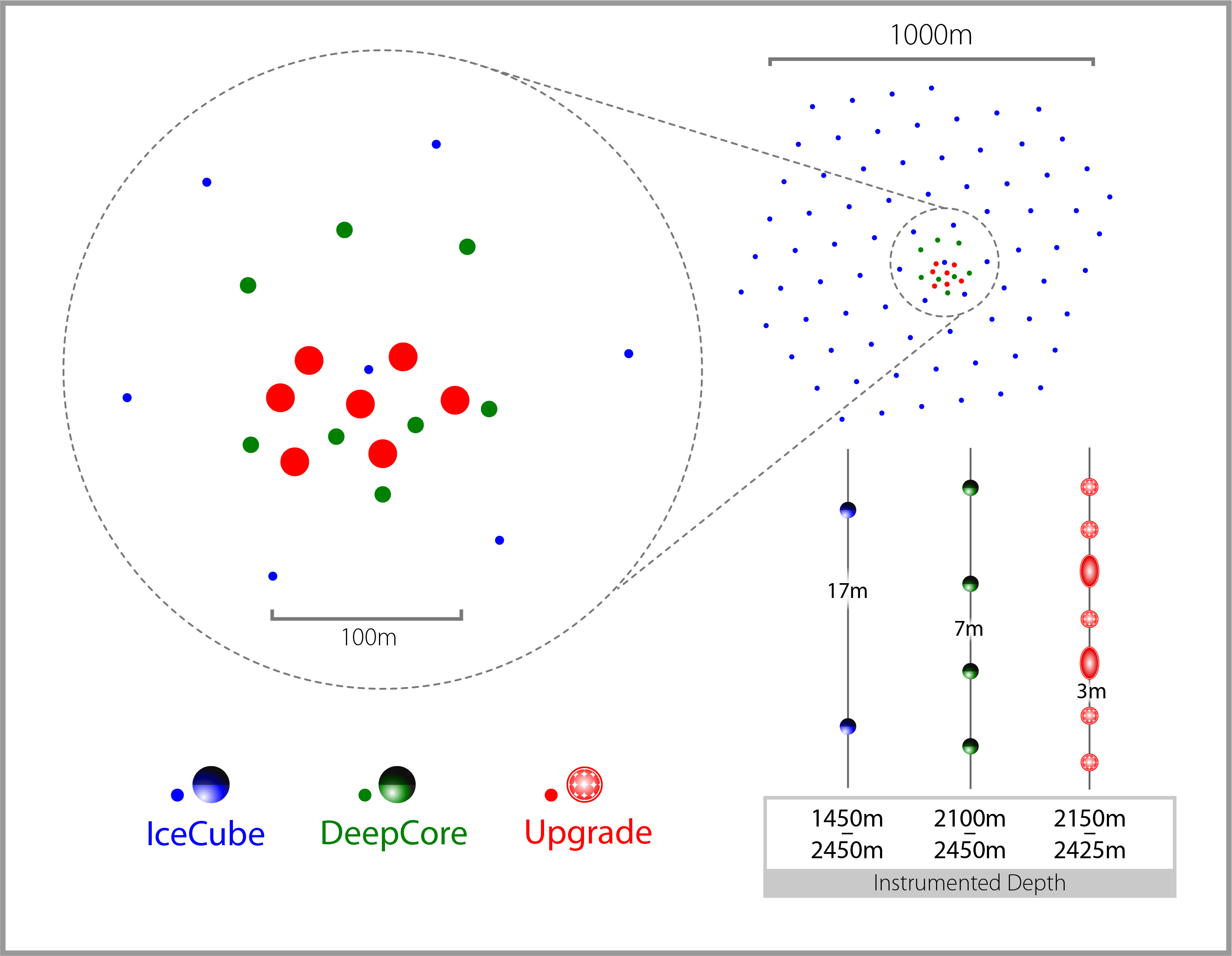
Fig 1: Top-down View of the IC93 detector. Each point represents one of the
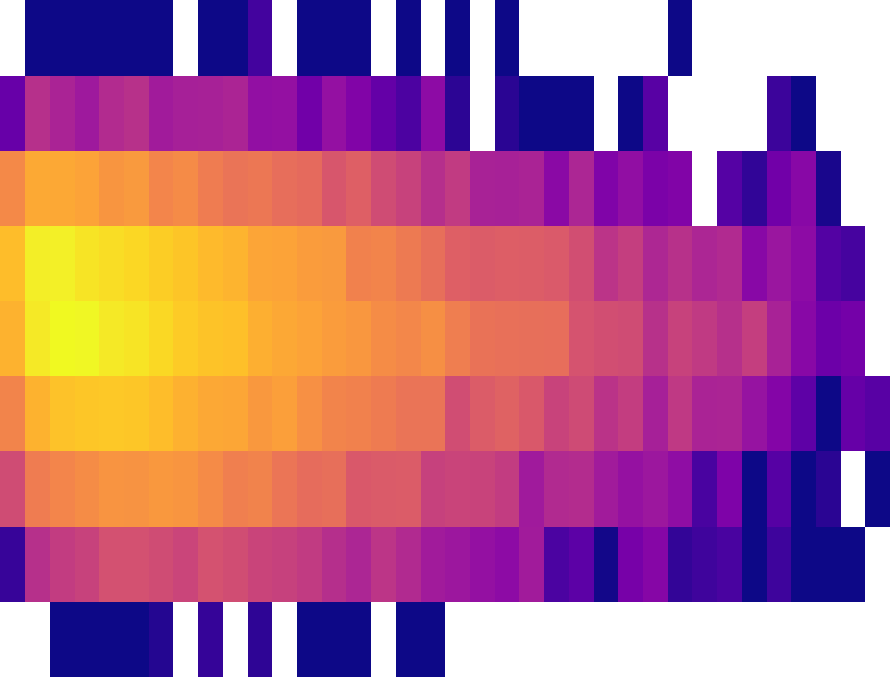
Fig 4: Example signal distribution for solar DM. The distribution is simulated for
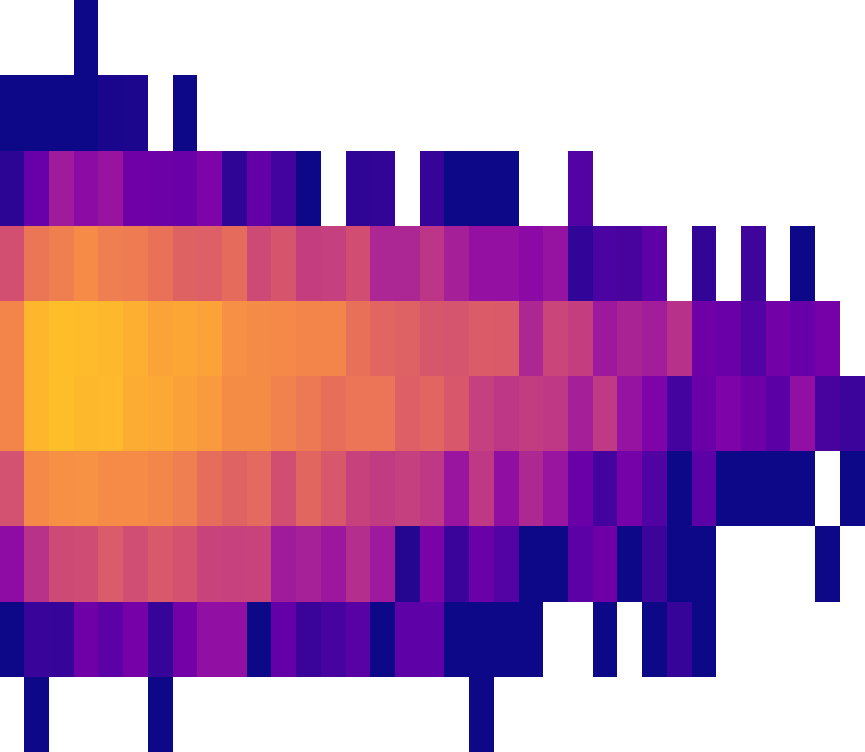
Fig 5: Background distribution for solar analysis. The simulation includes events

Fig 6: Example signal distribution for GC DM. The distribution is simulated for
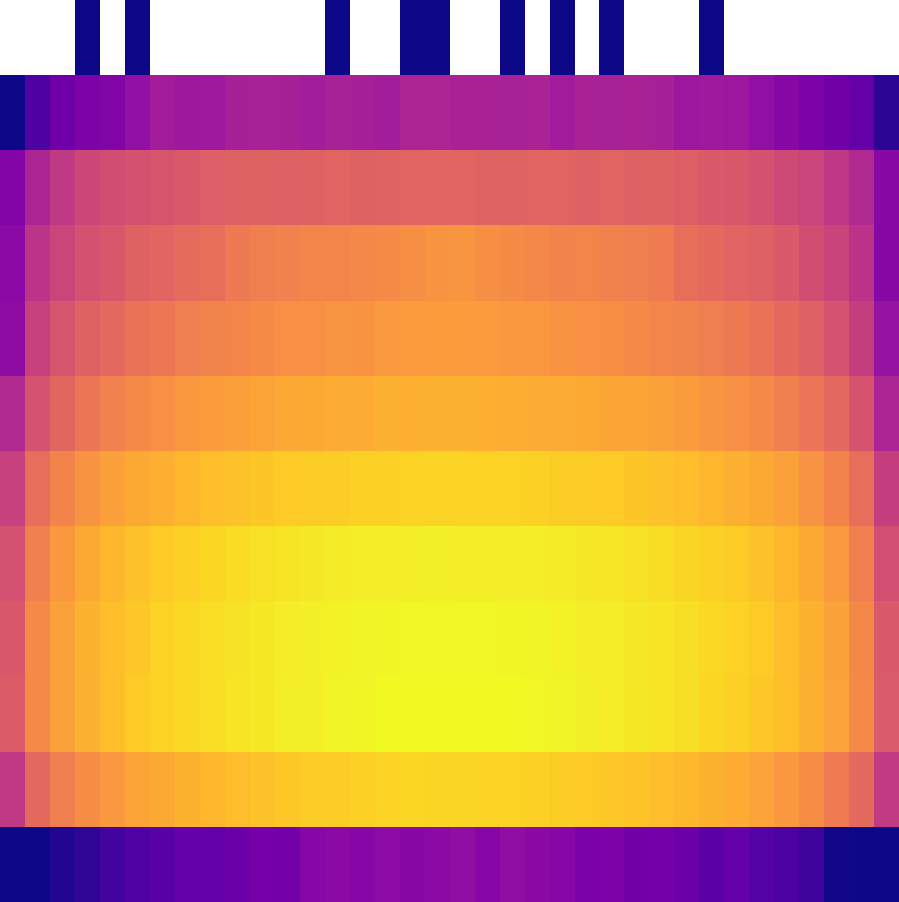
Fig 7: Background distribution for GC analysis. The simulation includes events
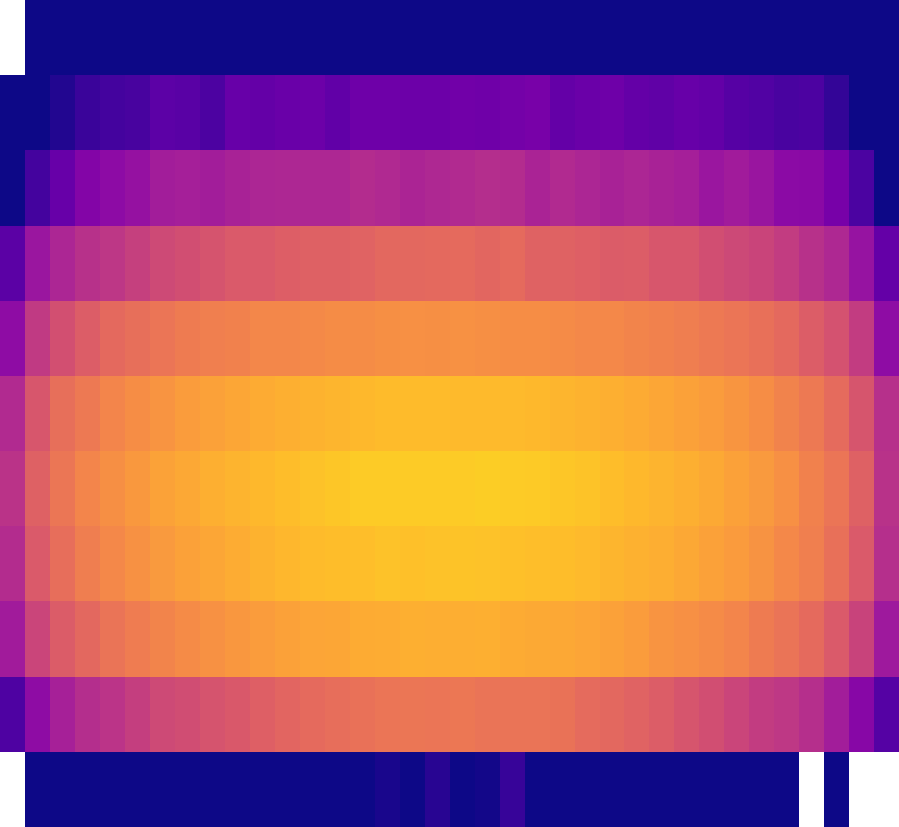
Fig 6 (page 14).
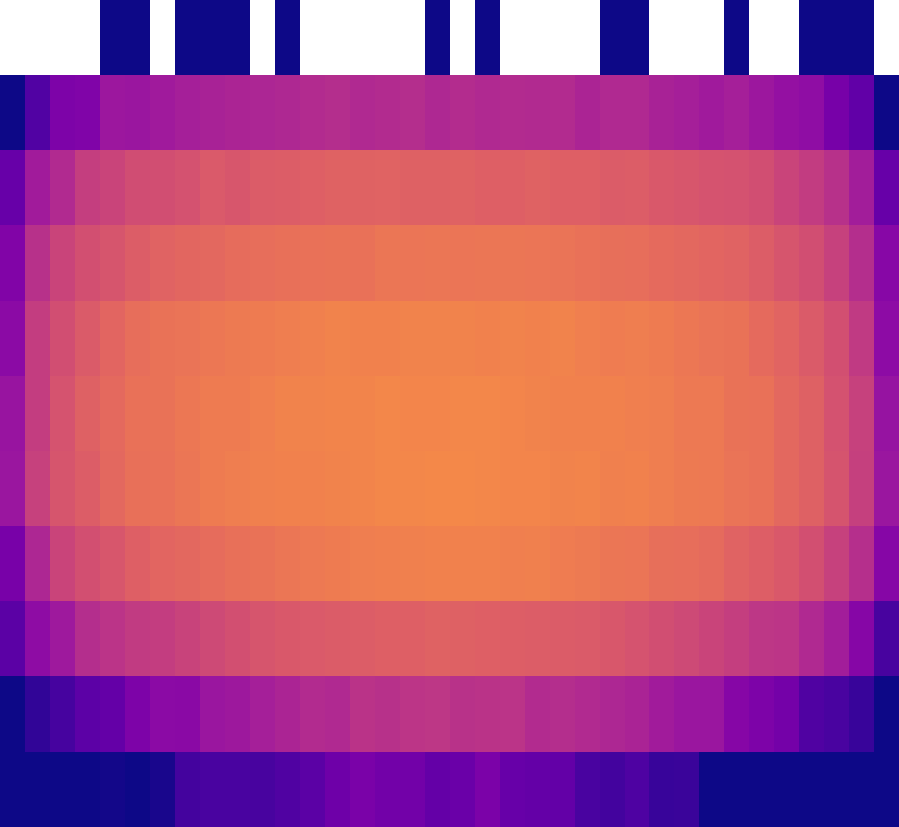
Fig 7 (page 14).
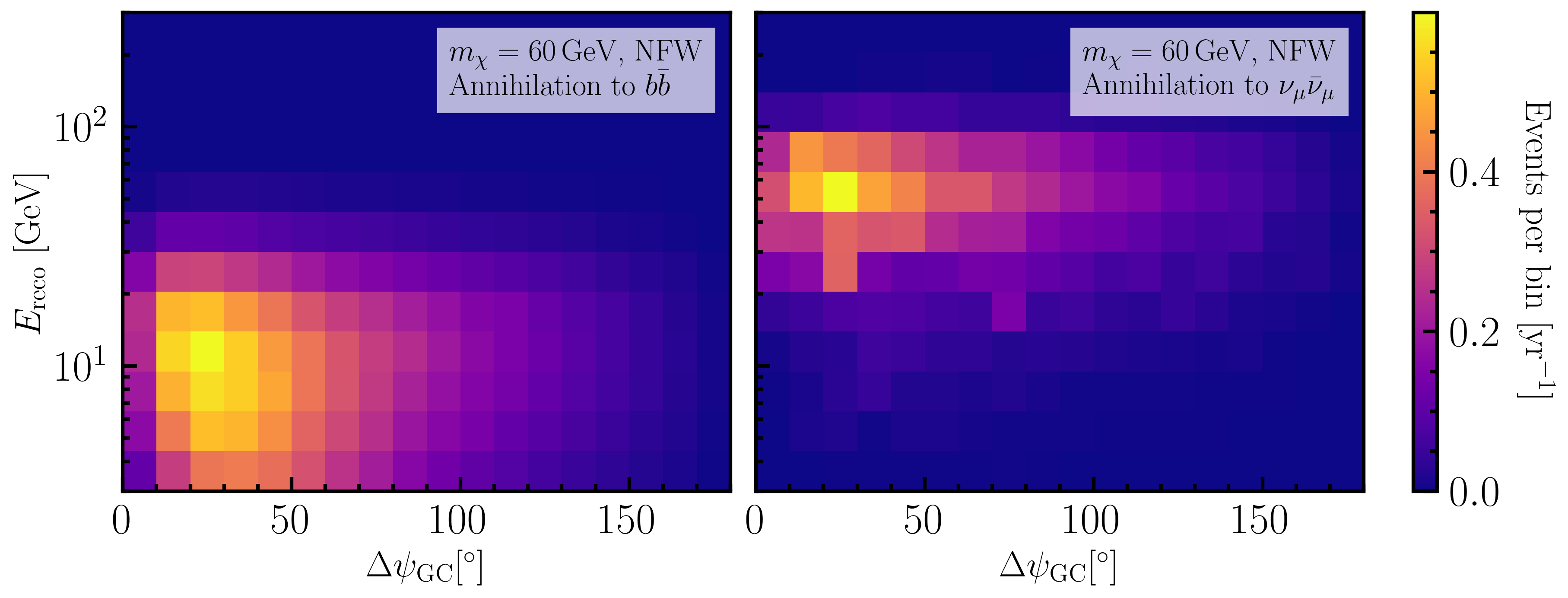
Fig 8 (page 15).
Limitations
- The entire analysis is based on simulation with no real IceCube Upgrade data; systematic uncertainties in ice properties, module calibration, and neutrino interaction cross sections are not fully characterized in the truncated text and may shift projected limits.
- Only three annihilation channels (bb̄, τ+τ−, νν̄) are considered; other phenomenologically important channels (e.g., W+W−, ZZ, hh, cc̄, gg) that are relevant in specific WIMP models are not projected.
- The solar analysis assumes perfect capture-annihilation equilibrium for all masses above 3.7 GeV; for very light WIMPs or specific interaction operators, equilibrium may not be fully established in the Sun, which would reduce the actual neutrino flux relative to projections.
- Systematic uncertainties on the background normalization are absorbed into a single free parameter αbg; shape uncertainties (e.g., spectral index of atmospheric neutrinos, angular distribution of muons) are not explicitly marginalized over in the described likelihood.
- The GC analysis relies on an assumed NFW halo profile; the J-factor uncertainty (which can span an order of magnitude depending on the inner slope and local DM density) is not explicitly propagated into the sensitivity bands shown.
- No adversarial or distribution-shift validation is reported for the ML classifiers (GNN noise cleaner, GNN+BDT background rejection); performance on real Upgrade data may differ from simulation if the ice model or module response is imperfectly modeled.
Open questions / follow-ons
- How robust are the projected sensitivities to uncertainties in the glacial ice optical properties and the new module (mDOM/D-Egg) calibration, particularly at sub-5 GeV where the ice model has the largest uncertainties and the signal-to-background ratio is most fragile?
- Can the sensitivity be extended below 3.7 GeV by explicitly modeling partial evaporation equilibrium, or by targeting annihilation channels where evaporation is less disruptive, given that next-generation detectors may probe the evaporation mass regime directly?
- How much improvement in spin-independent limits is achievable in the Galactic Center channel for light DM when NFW profile uncertainties are properly marginalized, and do projected limits remain competitive with direct detection experiments (e.g., LZ, XENONnT) in that case?
- What is the impact of including shape systematics (atmospheric neutrino flux normalization and spectral uncertainty, DOM efficiency variations) in the likelihood, and does the truncated chi-squared approximation remain valid under those extended nuisance parameter spaces?
Why it matters for bot defense
This paper is a particle astrophysics / neutrino telescope study with no direct relevance to CAPTCHA, bot defense, or online fraud detection. The subject matter — dark matter indirect detection via neutrino observatories — is entirely outside the domain of web security, behavioral biometrics, or adversarial ML in the context of bot mitigation. A bot-defense engineer would not find applicable techniques, threat models, datasets, or architectural patterns here.
The only tangentially transferable element is methodological: the paper's use of GNN-based anomaly/noise separation (DynEdge applied to graph-structured pulse data) and the profile likelihood ratio framework for signal-vs-background discrimination are general statistical and ML patterns. However, these are well-established techniques in the security/ML literature already, and the specific instantiation here (Cherenkov photon pulses in glacial ice) has no meaningful analogy to web traffic or user interaction data. This paper should not be prioritized for review by bot-defense practitioners.
Cite
@article{arxiv2605_06600,
  title={ Sensitivity Projections for Low-Mass Dark Matter Annihilation with the IceCube Upgrade },
  author={ R. Abbasi and M. Ackermann and J. Adams and J. A. Aguilar and M. Ahlers and J. M. Alameddine and S. Ali and N. M. Amin and K. Andeen and C. Argüelles and Y. Ashida and S. Athanasiadou and S. N. Axani and R. Babu and X. Bai and A. Balagopal V. and S. W. Barwick and V. Basu and R. Bay and J. J. Beatty and J. Becker Tjus and P. Behrens and J. Beise and C. Bellenghi and S. Benkel and S. BenZvi and D. Berley and E. Bernardini and D. Z. Besson and E. Blaufuss and L. Bloom and S. Blot and F. Bontempo and J. Y. Book Motzkin and C. Boscolo Meneguolo and S. Böser and O. Botner and J. Böttcher and J. Braun and B. Brinson and Z. Brisson-Tsavoussis and R. T. Burley and D. Butterfield and K. Carloni and J. Carpio and N. Chau and Y. C. Chen and Z. Chen and D. Chirkin and S. Choi and A. Chubarov and B. A. Clark and G. H. Collin and D. A. Coloma Borja and A. Connolly and J. M. Conrad and D. F. Cowen and C. De Clercq and J. J. DeLaunay and D. Delgado and T. Delmeulle and S. Deng and P. Desiati and K. D. de Vries and G. de Wasseige and T. DeYoung and J. C. Díaz-Vélez and S. DiKerby and T. Ding and M. Dittmer and A. Domi and L. Draper and L. Dueser and D. Durnford and K. Dutta and M. A. DuVernois and T. Ehrhardt and L. Eidenschink and A. Eimer and C. Eldridge and P. Eller and E. Ellinger and D. Elsässer and R. Engel and H. Erpenbeck and W. Esmail and S. Eulig and J. Evans and P. A. Evenson and K. L. Fan and K. Fang and K. Farrag and A. R. Fazely and A. Fedynitch and N. Feigl and C. Finley and D. Fox and A. Franckowiak and S. Fukami and P. Fürst and J. Gallagher and E. Ganster and A. Garcia and M. Garcia and E. Genton and L. Gerhardt and A. Ghadimi and C. Glaser and T. Glüsenkamp and J. G. Gonzalez and S. Goswami and A. Granados and D. Grant and S. J. Gray and S. Griffin and K. M. Groth and D. Guevel and C. Günther and P. Gutjahr and C. Ha and A. Hallgren and L. Halve and F. Halzen and L. Hamacher and M. Handt and K. Hanson and J. Hardin and A. A. Harnisch and P. Hatch and A. Haungs and J. Häußler and K. Helbing and J. Hellrung and B. Henke and L. Hennig and F. Henningsen and L. Heuermann and R. Hewett and N. Heyer and S. Hickford and A. Hidvegi and C. Hill and G. C. Hill and R. Hmaid and K. D. Hoffman and A. Hollnagel and D. Hooper and S. Hori and K. Hoshina and M. Hostert and W. Hou and M. Hrywniak and T. Huber and K. Hultqvist and K. Hymon and A. Ishihara and W. Iwakiri and M. Jacquart and S. Jain and O. Janik and M. Jansson and M. Jin and N. Kamp and D. Kang and W. Kang and A. Kappes and L. Kardum and T. Karg and A. Karle and A. Katil and M. Kauer and J. L. Kelley and M. Khanal and A. Khatee Zathul and A. Kheirandish and T. Kim and H. Kimku and F. Kirchner and J. Kiryluk and C. Klein and S. R. Klein and Y. Kobayashi and S. Koch and A. Kochocki and R. Koirala and H. Kolanoski and T. Kontrimas and L. Köpke and C. Kopper and D. J. Koskinen and P. Koundal and M. Kowalski and T. Kozynets and A. Kravka and N. Krieger and T. Krishnan and K. Kruiswijk and E. Krupczak and A. Kumar and E. Kun and N. Kurahashi and C. Lagunas Gualda and L. Lallement Arnaud and M. J. Larson and F. Lauber and J. P. Lazar and K. Leonard DeHolton and A. Leszczyńska and C. Li and J. Liao and C. Lin and Q. R. Liu and Y. T. Liu and M. Liubarska and C. Love and L. Lu and F. Lucarelli and W. Luszczak and Y. Lyu and M. Macdonald and E. Magnus and Y. Makino and E. Manao and S. Mancina and A. Mand and I. C. Mariş and S. Marka and Z. Marka and L. Marten and I. Martinez-Soler and R. Maruyama and J. Mauro and F. Mayhew and F. McNally and K. Meagher and A. Medina and M. Meier and Y. Merckx and L. Merten and J. Mitchell and L. Molchany and S. Mondal and T. Montaruli and R. W. Moore and Y. Morii and A. Mosbrugger and D. Mousadi and E. Moyaux and T. Mukherjee and M. Nakos and U. Naumann and L. Neste and M. Neumann and H. Niederhausen and M. U. Nisa and K. Noda and A. Noell and A. Novikov and A. Obertacke and V. O'Dell and A. Olivas and R. Orsoe and J. Osborn and E. O'Sullivan and B. Owens and V. Palusova and H. Pandya and A. Parenti and N. Park and V. Parrish and E. N. Paudel and L. Paul and C. Pérez de los Heros and T. Pernice and T. C. Petersen and J. Peterson and S. Pick and M. Plum and A. Pontén and V. Poojyam and B. Pries and R. Procter-Murphy and G. T. Przybylski and L. Pyras and C. Raab and J. Rack-Helleis and N. Rad and M. Ravn and K. Rawlins and Z. Rechav and A. Rehman and I. Reistroffer and E. Resconi and C. D. Rho and W. Rhode and L. Ricca and B. Riedel and A. Rifaie and E. J. Roberts and S. Rodan and M. Rongen and A. Rosted and C. Rott and T. Ruhe and L. Ruohan and D. Ryckbosch and J. Saffer and D. Salazar-Gallegos and P. Sampathkumar and A. Sandrock and G. Sanger-Johnson and M. Santander and S. Sarkar and M. Scarnera and M. Schaufel and H. Schieler and S. Schindler and L. Schlickmann and B. Schlüter and F. Schlüter and N. Schmeisser and T. Schmidt and A. Scholz and F. G. Schröder and S. Schwirn and S. Sclafani and D. Seckel and L. Seen and M. Seikh and S. Seunarine and P. A. Sevle Myhr and R. Shah and S. Shah and S. Shefali and N. Shimizu and B. Skrzypek and R. Snihur and J. Soedingrekso and D. Soldin and P. Soldin and G. Sommani and D. Song and C. Spannfellner and G. M. Spiczak and C. Spiering and J. Stachurska and M. Stamatikos and T. Stanev and T. Stezelberger and T. Stürwald and T. Stuttard and G. W. Sullivan and I. Taboada and S. Ter-Antonyan and A. Terliuk and A. Thakuri and M. Thiesmeyer and W. G. Thompson and J. Thwaites and S. Tilav and K. Tollefson and J. A. Torres and S. Toscano and D. Tosi and K. Upshaw and A. Vaidyanathan and N. Valtonen-Mattila and J. Valverde and J. Vandenbroucke and T. Van Eeden and N. van Eijndhoven and L. Van Rootselaar and J. van Santen and J. Vara and F. Varsi and M. Venugopal and M. Vereecken and S. Vergara Carrasco and S. Verpoest and D. Veske and A. Vijai and J. Villarreal and C. Walck and A. Wang and E. H. S. Warrick and C. Weaver and P. Weigel and A. Weindl and J. Weldert and A. Y. Wen and C. Wendt and J. Werthebach and M. Weyrauch and N. Whitehorn and C. H. Wiebusch and D. R. Williams and L. Witthaus and G. Wrede and X. W. Xu and J. P. Yanez and Y. Yao and E. Yildizci and S. Yoshida and R. Young and F. Yu and S. Yu and T. Yuan and S. Yun-Cárcamo and A. Zander Jurowitzki and A. Zegarelli and S. Zhang and Z. Zhang and P. Zhelnin and P. Zilberman and C. Zilleruelo Cañas },
  journal={arXiv preprint arXiv:2605.06600},
  year={ 2026 },
  url={https://arxiv.org/abs/2605.06600}
}