
A statistical look on kinematic planes of satellite galaxies II: The physics behind their early formation in TNG50 MW/M31-like galaxies
Source: arXiv:2605.05972 · Published 2026-05-07 · By Matías Gámez-Marín, Rosa Domínguez-Tenreiro, Isabel Santos-Santos, Diego Sotillo-Ramos, Alexander Knebe
TL;DR
This paper (Paper VI in a series) investigates why kinematically persistent planes (KPPs) of satellite galaxies form around Milky Way / M31-like hosts in the TNG50 cosmological simulation. The central question is not merely whether such planes exist — their existence at ~24% frequency in the eligible sample was established in the preceding Paper V — but what physical mechanism produces them. The authors connect KPP formation to the anisotropic collapse of the local Cosmic Web (CW) by tracking the deformation of Lagrangian Volumes (LVs), i.e., the comoving regions of initial matter that eventually collapse to form each host-satellite system, using a reduced tensor-of-inertia (TOI) analysis. The core claim is that the same directional compression that shapes the local large-scale structure also sets the orbital poles of future KPP satellite members, long before those satellites fall into the host halo.
The analysis is built on 46 KPP-hosting systems (out of 123 eligible, out of 190 total MW/M31-like systems in TNG50). For each, the authors decompose satellite kinetic energy into rotational, vertical, and radial components relative to the KPP plane, and track the comoving distances of proto-satellites to that plane from high redshift to z=0. Separately, they extract the three principal axes of the LV's reduced TOI over time and measure alignment angles between those axes and each satellite's orbital pole vector. The paper finds that ~67% of KPPs have their co-orbitation axis (J_stack) aligned with the LV's strongest-compression direction (e_3), ~20% align with the intermediate axis (e_2), and alignment with the major axis (e_1, expansion direction) is rare. These alignments are statistically distinct from random expectations.
A critical quantitative result is the quasi-simultaneity of three independent characteristic timescales — the time when satellites settle into a rotation-dominated ('disky') configuration (T^0.5_Krot), the time when orbital poles become clustered (T^cluster_Jstack), and the time when the LV shape stabilizes (T^shape_LV) — all peaking near a Universe age of T_uni ~ 4 Gyr, during the fast mass assembly phase of the host halo. This temporal convergence supports the authors' interpretation that early KPPs are fossil remnants of high-redshift anisotropic mass collapse within ΛCDM, requiring no late-time or exotic mechanisms.
Key findings
- KPPs are present in 46/123 eligible (≥9 satellite) MW/M31-like systems in TNG50, giving a frequency of ~37% among eligible systems and ~24% across all 190 P24-sample hosts.
- In ~67% of KPP-hosting systems, the KPP co-orbitation axis (J_stack) aligns with the LV's direction of strongest collapse (e_3); ~20% align with the intermediate axis (e_2); alignment with the major expansion axis (e_1) is rare — a distribution statistically distinct from random.
- Three independent characteristic timescales — T^0.5_Krot (transition to rotation-dominated kinematics), T^cluster_Jstack (orbital pole clustering), and T^shape_LV (LV shape stabilization) — are quasi-coeval, peaking at T_uni ~ 4 Gyr during the fast halo mass assembly phase.
- KPP satellites transition from velocity-dispersion-dominated configurations at high redshift to 'disky' rotation-dominated configurations (κ_rot > 0.5) from T^0.5_Krot onward, while vertical (κ_z) and radial (κ_rad) kinetic energy fractions decay early and remain low.
- Non-KPP satellites in KPP-hosting systems show no coherent pattern in the evolution of κ_rot, κ_z, and κ_rad; their kinetic energy remains roughly equally distributed among all components, in contrast to the ordered evolution seen in KPP satellites.
- The comoving distance of KPP proto-satellites to the J_stack-plane decreases systematically from high redshift onward, with the median distance curve showing a clear monotonic decline — whereas non-KPP satellites show no equivalent confinement signal.
- Paper V (preceding work) found that KPP satellites have statistically larger pericentric distances and higher specific orbital angular momenta than non-KPP satellites, making them more resilient to survive to z=0; the current paper's kinematic decomposition is consistent with this, showing that the disky configuration is established and maintained once the Keplerian regime is reached at T^eq_Krot.
Methodology — deep read
Threat model and framing: This is not a security paper; the 'adversary' here is the set of competing theoretical explanations for satellite planes (group infall, tidal debris, LMC-like companions, triaxial halo torques). The paper tests whether high-redshift anisotropic CW collapse alone can account for both the spatial and kinematic properties of KPPs, without invoking late-time mechanisms.
Data provenance and sample construction: The authors use TNG50-1 (the highest-resolution IllustrisTNG flagship; box size 51.7 cMpc, dark matter particle mass 4.6×10^5 M_sun, baryonic particle mass 8.5×10^4 M_sun, Planck 2015 cosmology). Host galaxies are drawn from the Pillepich et al. (2024) 'P24 sample': 198 MW/M31-like galaxies selected by stellar mass (M_* = 10^10.5–10^11.2 M_sun within 30 kpc), disk-like morphology, isolation (no neighbor ≥10^10.5 M_sun within 500 kpc at z=0), and halo mass M_200c < 10^13 M_sun. Eight FoF satellites of more massive hosts are removed, leaving 190 systems. Satellites are Subfind-identified subhalos gravitationally bound at z=0, with ≥10 stellar particles (M_*,cut = 8.5×10^5 M_sun), infall at least 500 Myr before z=0, and cosmological origin confirmed via SubhaloFlag. Average satellite count is 11+9/-4 per host. Of 190 systems, 123 have ≥9 satellites ('eligible'); of these, 46 host KPPs meeting significance thresholds (N_KPP ≥ 5, f_KPP ≥ 25%).
KPP identification (from Paper V / Santos-Santos et al. 2023): The 'J_stack method' scans for an axial direction J_stack around which the maximum number of satellite orbital poles cluster within a critical aperture angle α_crit = 36.87° over time. KPP membership requires poles to stay within α_crit of J_stack for at least 4 Gyr between T_uni ≃ 6 Gyr (approximate end of fast assembly, T_no-fast) and z=0. This is the kinematic persistence criterion; positional planarity is a derived, not required, property.
Kinematic decomposition (Sec. 4): For each KPP-hosting system, a cylindrical coordinate frame is defined with Z-axis along J_stack, centered on the host center of mass and velocity. Each satellite's kinetic energy is decomposed into three median fractions: κ_rot (azimuthal/rotational), κ_rad (radial toward/away from J_stack axis), and κ_z (vertical, parallel to J_stack). These are computed as squared velocity component ratios (e.g., κ_z,i = (v_z,i / v_i)^2) and then median-averaged over KPP members at each timestep. The threshold κ_rot = 0.5 (from Sales et al. 2012) defines the transition to a 'disky' configuration; the Universe age at this crossing is T^0.5_Krot. The authors also track individual satellite comoving distances to the J_stack-plane (d_j,Js(t)) and report the median d_Js(t) for KPP and non-KPP members separately. The time when d_Js first reaches a stable low value defines the timescale T_dJs.
Lagrangian Volume (LV) analysis (Sec. 5–6): For each host-satellite system, the LV is defined as the set of initial (high-redshift) comoving positions of all dark matter particles that end up gravitationally bound to the host halo at z=0 (following Robles et al. 2015, 2026). The reduced tensor of inertia of the LV is computed at each simulation snapshot from high redshift (z_high = 20.05) to z=0. Eigendecomposition of this tensor yields three principal directions: e_1 (major/slowest collapse or expansion), e_2 (intermediate), e_3 (minor/strongest collapse), with corresponding eigenvalues. The time evolution of these principal directions, and specifically the LV shape (axial ratios), is tracked. A characteristic timescale T^shape_LV is defined as the Universe age when the LV shape stabilizes. The alignment between J_stack (or individual satellite orbital poles J_orb) and each principal direction is measured as the angle between the vectors, and its distribution across the 46 KPP systems is compared against random (isotropic) expectations using statistical tests (the paper notes alignments are 'statistically distinct from random' but the specific test — e.g., Kuiper, Anderson-Darling — is not fully detailed in the truncated text).
Timescale comparison (Sec. 8): The three characteristic timescales T^0.5_Krot, T^cluster_Jstack, and T^shape_LV are computed for each KPP-hosting system and their distributions compared. The authors report that these peak quasi-simultaneously at T_uni ~ 4 Gyr. The paper also references T_no-fast (end of fast halo mass assembly) as a related timescale from Paper V, and compares all timescales to confirm co-evolution. Reproducibility and limitations of the truncated text: The analysis relies on TNG50, which is a public simulation (data available via the IllustrisTNG public data release). The authors provide a supplementary file extending per-system figures to 33 of the 46 KPP systems. No custom code release is mentioned in the available text. The LV methodology (Robles et al. 2015, 2026) is referenced but the 2026 paper is not yet publicly available at the time of writing (preprint dated May 2026), which is a reproducibility caveat. Concrete example: For KPP-HS system ID #488530, Fig. 1 shows κ_rot rising from ~0.3 at T_uni ~ 2 Gyr to above 0.5 at T^0.5_Krot, while κ_z declines from high values to near zero on roughly the same timescale. The lower panel shows satellite velocity-squared curves transitioning from a Hubble-flow-dominated regime to an oscillating Keplerian bound regime, with T^0.5_Krot coinciding with the onset of the stable orbital phase.
Technical innovations
- Extension of the Lagrangian Volume / reduced tensor-of-inertia framework (previously applied to two zoom-in systems in Paper IV) to a statistically significant sample of 46 KPP-hosting systems in TNG50, enabling population-level alignment statistics between LV principal axes and satellite orbital poles.
- Introduction of a three-component kinetic energy decomposition (κ_rot, κ_rad, κ_z) in a cylindrical frame aligned with J_stack, allowing the authors to distinguish four qualitatively distinct settling pathways by which KPP satellites transition from dispersion-dominated to disky configurations — a finer classification than the single κ_rot parameter used in prior Papers III–IV.
- Identification and mutual comparison of three independently defined characteristic timescales (T^0.5_Krot, T^cluster_Jstack, T^shape_LV) across 46 systems, demonstrating their quasi-coevality at T_uni ~ 4 Gyr and thereby linking kinematic, orbital-pole, and large-scale-structure evolution within a single observational framework.
- Demonstration that ~67% of KPPs align with the e_3 (strongest-collapse) LV axis and ~20% with e_2, with rare e_1 alignments, providing a statistically grounded mapping from Cosmic Web geometry to satellite plane orientation that extends and generalizes the single-system result of Paper IV.
Datasets
- TNG50-1 (IllustrisTNG) — 190 MW/M31-like host-satellite systems (P24 sample); full simulation box 51.7 cMpc — publicly available via IllustrisTNG data release (https://www.tng-project.org)
Baselines vs proposed
- Random (isotropic) distribution of J_stack–e_3 alignments: expected ~33% in strongest-collapse quadrant vs. observed ~67% in KPP systems (statistically distinct per paper's claim; exact p-value not given in truncated text)
- Random (isotropic) distribution of J_stack–e_2 alignments: expected ~33% vs. observed ~20% in KPP systems
- Non-KPP satellites in KPP-hosting systems: no coherent κ_rot / κ_z / κ_rad evolution pattern vs. KPP satellites: systematic early rise in κ_rot and decay of κ_z and κ_rad converging at T_uni ~ 4 Gyr
- KPP frequency in all eligible (≥9 satellite) systems: 46/123 = 37% (this paper / Paper V) vs. prior literature estimates of <1% for positional planes (Libeskind et al. 2005; Bahl & Baumgardt 2014; Cautun et al. 2015)
Figures from the paper
Figures are reproduced from the source paper for academic discussion. Original copyright: the paper authors. See arXiv:2605.05972.
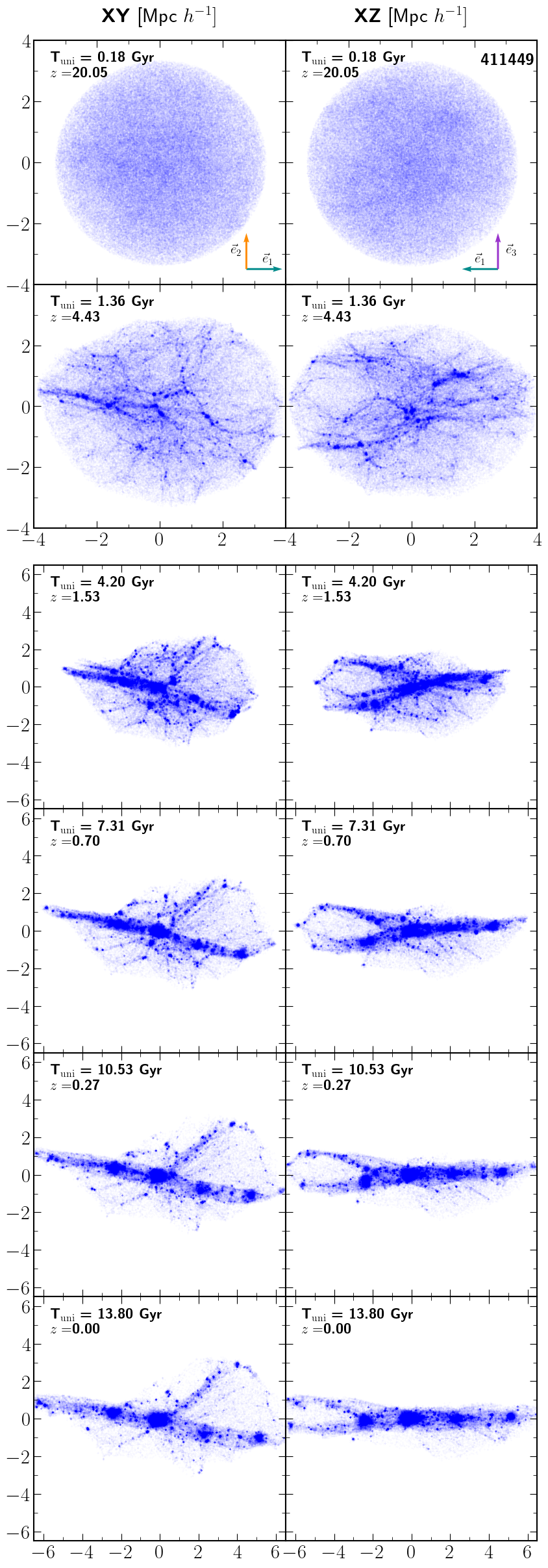
Fig 3: Projections of the LV around the ID # 411449 KPP-HS, from 𝑧high
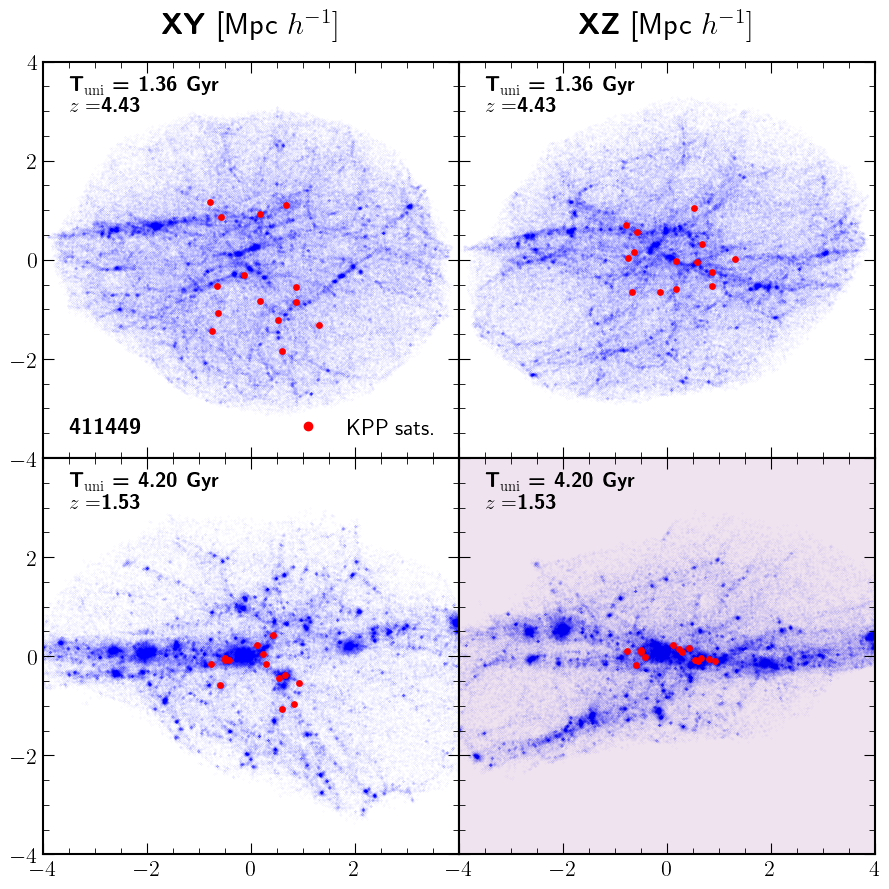
Fig 8: Projections along the ®𝑒3(𝑡) (left panels) and ®𝑒2(𝑡) (right panels) of the density field around the host galaxy formation site for 4 KPP-HS systems
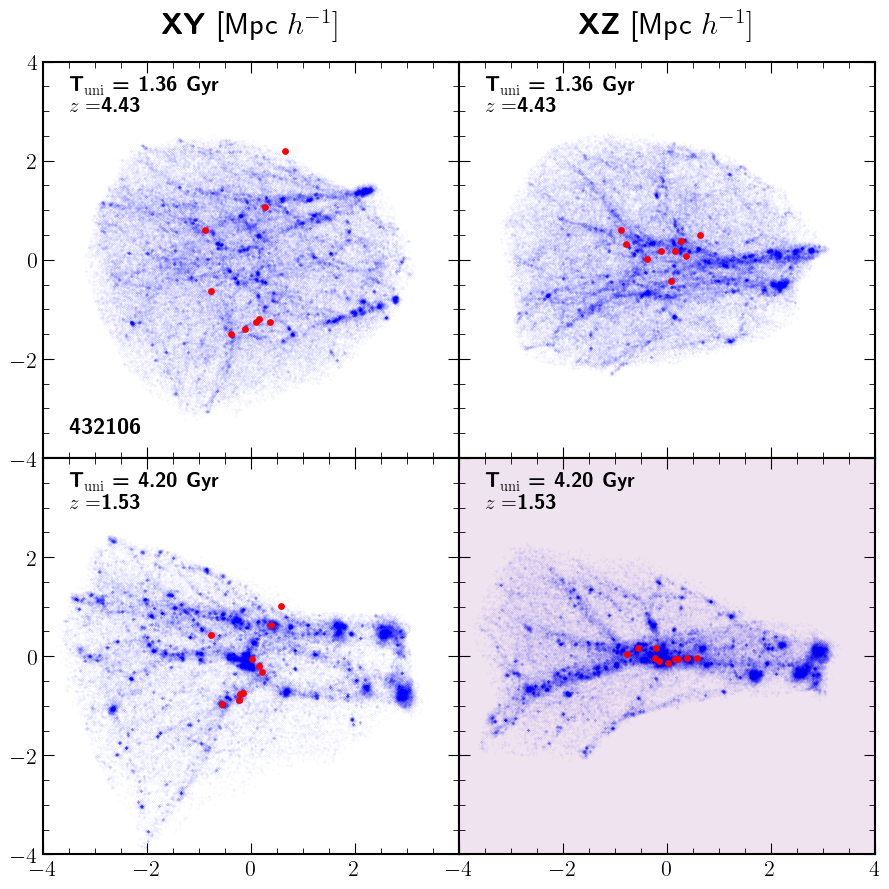
Fig 9: Alignment signals between the co-orbitation axis ®𝐽stack and the
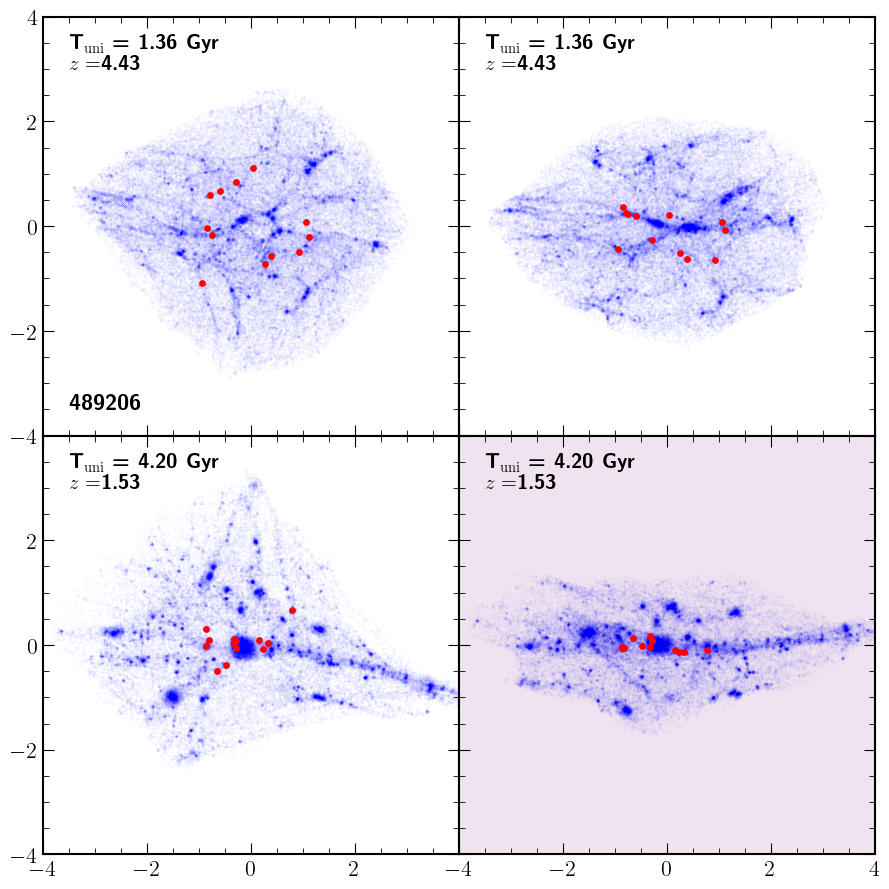
Fig 7: Time evolution of the angles between the ®𝐽orb of satellites with respect to the principal directions of the LVs, ®𝑒𝑖(𝑡), 𝑖= 1, 2, 3, for one KPP-HS
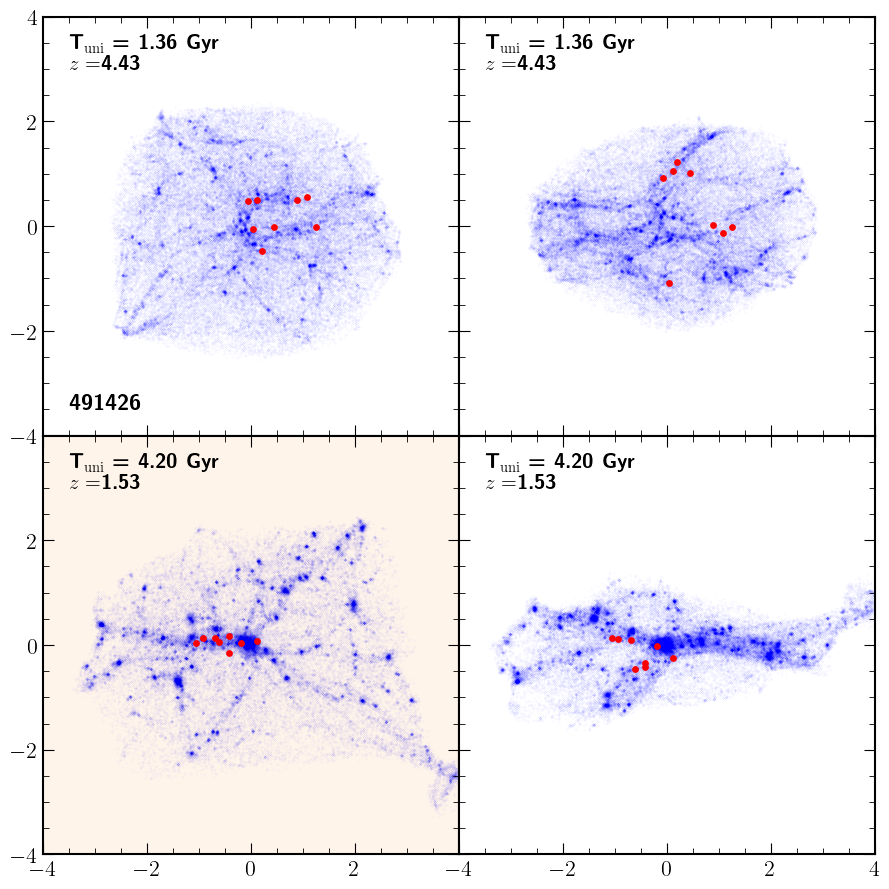
Fig 10: Left and middle panels: comoving distance of satellites to the ®𝑒3-plane as a function of time. Purple curves and shaded regions stand for the median
Limitations
- The analysis is restricted to TNG50, a single simulation with a specific sub-grid physics implementation (AREPO + IllustrisTNG feedback model); results may not generalize to simulations with different feedback prescriptions (e.g., EAGLE, FIRE, Illustris-1) or different cosmologies.
- The LV methodology depends on Robles et al. (2026), a paper cited but not yet publicly available at the time of this preprint, making full independent reproduction of the Lagrangian Volume extraction pipeline difficult.
- The sample of KPP-hosting systems is relatively small (46 systems), and the statistical tests comparing alignment distributions to random expectations are described qualitatively ('statistically distinct') without explicit p-values, confidence intervals, or test statistics reported in the available text.
- The κ_rot = 0.5 threshold for 'disky' classification is adopted from Sales et al. (2012), which was defined for stellar particles within galaxies, not for satellite galaxy ensembles treated as point masses; the applicability of this threshold to the satellite-plane context is not validated.
- The paper focuses exclusively on 'early KPPs' (those forming around T_uni ~ 4 Gyr); late-forming kinematic planes (potentially arising from LMC-like group infall or tidal debris) are explicitly excluded from the analysis, so the framework is not a complete explanation for all observed satellite planes including the present-day MW configuration.
- The analysis uses comoving distances, which is appropriate for tracking large-scale structure evolution but may introduce artifacts when comparing LV shape evolution timescales to satellite orbital dynamics (which are physical/proper-frame processes); this subtlety is noted in a footnote but not fully addressed.
- No observational validation is attempted against the actual MW or M31 satellite planes; the paper is entirely simulation-based, and the connection to observed systems remains inferential.
Open questions / follow-ons
- Does the ~67% e_3 / ~20% e_2 alignment split depend on the large-scale environment type (void, wall, filament, node) of the host system, and can the minority e_2-aligned KPPs be explained by hosts embedded in sheet-like (wall) environments where e_2 and e_3 collapse directions are comparably strong?
- The quasi-coevality of the three timescales at T_uni ~ 4 Gyr is demonstrated statistically but not mechanistically derived; what is the causal order — does LV shape stabilization drive orbital pole clustering, or do they co-emerge from the same tidal field, and can this be tested with a controlled perturbation experiment in the simulation?
- How do the results change in simulations with significantly different baryonic feedback (e.g., FIRE-2 or EAGLE), where the satellite mass function and orbital energy dissipation differ, given that effective viscosity / dissipation is invoked to explain the circularization of KPP orbits?
- The paper establishes that early KPPs are fossil remnants of high-redshift collapse, but does not address how often these early KPPs are detectable or masked at z=0 by late-time perturbations (LMC analogs, group infall), which is the observationally relevant question for comparing to MW/M31 data.
Why it matters for bot defense
This paper is a cosmological astrophysics study with no direct relevance to bot defense, CAPTCHA systems, or behavioral biometrics. It addresses the 'satellite plane problem' in galaxy formation theory using N-body / hydrodynamic simulations, and its methodological toolkit (tensor-of-inertia decomposition, kinetic energy fractionation, Lagrangian tracking) has no meaningful analog in web security or machine learning for bot detection.
A bot-defense engineer would have no actionable takeaway from this work. It is included here presumably in error or as a test of the system's domain-filtering behavior. The paper should be flagged as out-of-scope for a CAPTCHA / bot-defense research audience and routed to an astrophysics literature review pipeline instead.
Cite
@article{arxiv2605_05972,
  title={ A statistical look on kinematic planes of satellite galaxies II: The physics behind their early formation in TNG50 MW/M31-like galaxies },
  author={ Matías Gámez-Marín and Rosa Domínguez-Tenreiro and Isabel Santos-Santos and Diego Sotillo-Ramos and Alexander Knebe },
  journal={arXiv preprint arXiv:2605.05972},
  year={ 2026 },
  url={https://arxiv.org/abs/2605.05972}
}