
An extensive theory of nonlinearly intercoupled pseudomodes for noise model reduction in circuit QED
Source: arXiv:2605.03946 · Published 2026-05-05 · By M. Gabriela Boada G., Nicolas Dirnegger, Andrea Delgado, Prineha Narang
TL;DR
This paper tackles a real modeling bottleneck in superconducting cQED: once Josephson nonlinearities and structured dissipation both matter, the usual Born-Markov master-equation workflow either becomes too crude or accumulates ad hoc corrections. The authors’ main claim is that Garraway-style pseudomodes do not require the retained system to be linear; what matters is whether the eliminated sector’s influence can be written as a rational self-energy. If so, the eliminated sector can be replaced by a finite set of damped auxiliary modes even when the retained Hamiltonian has Kerr terms, cross-Kerr terms, and multi-photon mixing.
The paper’s core technical move is to formulate the reduction in the Heisenberg picture through a Dyson equation for the retained-mode Green’s function. They then work out explicit closed-form elimination for a two-mode Kerr-coupled prototype and extend the same template to three-mode three-wave mixing and four-mode bilinear exchange / pumped quartic parents. A second main result is an equivalence between a four-mode quartic parent with a displaced pump mode and an effective three-wave-mixing Hamiltonian: in the stiff-pump limit, the effective coupling is g3 = g4 β* and the retained frequencies acquire Kerr/Stark shifts from |β|^2. The text is largely theoretical; it presents analytic reductions and pole formulas rather than a numerical benchmark study.
Key findings
- The authors generalize Garraway pseudomodes to retained Hamiltonians with arbitrary nonlinear interactions, arguing that the reduction criterion is a rational self-energy rather than linearity of the principal system (Sec. III, Eq. 25–31).
- For a two-mode Kerr + cross-Kerr exchange prototype, the local self-energy takes the closed form Σn,m(z) = g^2 n(m+1)/(z − Ω_b), yielding dressed poles z± in Eq. (52) with occupation-conditioned frequency shifts from self-Kerr and cross-Kerr terms.
- In the three-mode three-wave-mixing case, the matrix element becomes g3√(nm(ℓ+1)) and the eliminated c-mode contributes a single occupation-conditioned pole shifted by Kc and cross-Kerr terms χac, χbc (Eq. 63–67).
- For the four-mode bilinear c–d exchange case, the reduced self-energy is Σ4(z) = g4^2 ℓ(k+1)/(z − ωd − χad n − χbd m − χcd(ℓ−1)) (Eq. 77), again a single-pole rational form conditioned on spectator occupations.
- The stiff-pump displacement d = β + δd converts the quartic parent g4(abc†d† + h.c.) into an effective three-wave mixing term g3(abc† + h.c.) with g3 = g4 β* and frequency renormalizations ˜ωμ = ωμ + χμd|β|^2 (Eq. 89–95).
- The paper asserts exact spectral collapse G(4)(z) → G(3)(z) in the stiff-pump limit, but the provided excerpt does not include a numerical error bound, simulation table, or explicit convergence plot.
- Within fixed-excitation sectors, the Hamiltonians reduce to tridiagonal matrices with jump amplitudes Jr+1 = g√((r+1)(N−r)) in the two-mode case and analogous sector-specific forms for the three- and four-mode cases (Eq. 53, 68, 78).
Threat model
The relevant adversary is the structured dissipative environment of a cQED device, especially when its spectrum is non-Markovian and interacts with nonlinear circuit modes. The paper assumes the environment may be represented by a finite rational pole structure after reduction, and that the retained subsystem can be arbitrarily nonlinear. What the method cannot do, by assumption, is exactly capture eliminated sectors whose influence is not representable by a finite rational self-energy or whose response functions are not matched by the chosen pseudomodes.
Methodology — deep read
The threat model is not cybersecurity in the usual sense but a modeling adversary: the practical enemy is an open cQED environment whose spectral response is structured, non-Markovian, and coupled to nonlinear circuit modes. The paper assumes the retained subsystem may be strongly nonlinear at the Hamiltonian level (Kerr, cross-Kerr, three-wave mixing), while the eliminated sector is representable through a response function with rational poles. The central assumption is that the reduced dynamics are governed by the eliminated sector’s self-energy; if that self-energy is rational, a finite auxiliary-mode model exists. The authors explicitly treat the eliminated sector as something whose measured response functions should be matched to hardware, but they do not develop a separate attacker model, since this is not a security paper.
On data: there is no empirical dataset in the machine-learning sense. The “data” are analytic Hamiltonians and spectral-response forms: a Lorentz–Drude background plus a coherent pump line and a Lorentzian pump-induced feature are written down in Eqs. (10)–(13), but these are model assumptions rather than measured datasets. The paper also refers to experimentally measured response functions as the target for the eliminated sector, yet the excerpt contains no hardware traces, no parameter tables, no train/test splits, and no finite-sample estimation pipeline. The worked examples are fully symbolic: two-mode Kerr + cross-Kerr exchange, three-mode three-wave mixing, and four-mode c–d exchange / quartic-parent displacement. The basis truncations are by excitation sector, not by dataset split.
Architecturally, the paper’s key formalism is a Heisenberg-picture reduction. The total Hamiltonian is partitioned as H = Hkeep + Helim + Hint (Eq. 14). The retained operators Sα obey equations of motion with a fluctuating force term Fα(t) (Eq. 15–17). Solving out the eliminated sector gives a nonlocal-in-time integro-differential equation with memory kernel Kαβ(t) (Eq. 18–20) and noise operator ξα(t) (Eq. 21–22). In frequency space, the kernel becomes a matrix self-energy Σαβ(ω) (Eq. 23), and the reduced dynamics follow a Dyson equation G−1(ω) = G0−1(ω) − Σ0(ω) (Eq. 24). The novel claim is that if Σαβ(ω) has a rational partial-fraction form with poles zℓ = ξℓ − iλℓ (Eq. 25), then each pole can be mapped to a damped pseudomode obeying local equations of motion (Eq. 28–29). The pseudomode is not required to be linear internally; if its own dressed propagator is GR(ω), then the back-action on the principal system is ΣeffR(ω) = g^2 GR(ω) (Eq. 30–31). That is the conceptual bridge from linear pseudomode theory to nonlinear cQED sectors.
Training regime is not applicable because there is no numerical training. The closest thing to a “procedure” is a sequence of analytic derivations: write the model in the bare Fock basis, identify conserved quantities (N, Q, D depending on the interaction), project into fixed sectors, derive local transition frequencies Ω that include Kerr and cross-Kerr shifts, solve the local two-level exchange exactly, and then read off the Green’s function and self-energy. In the two-mode prototype, the transition amplitude is E(g)n,m = gab√(n(m+1)) and the reduced Green’s function is Gn,m(z) = 1/[z − Ωa − Σn,m(z)] with Σn,m(z) = g^2 n(m+1)/(z − Ωb) (Eq. 50–52). The same substitution template is then reused for three-mode and four-mode cases. For coherent displacement, they explicitly replace d by β + δd, identify β = gEARF χd(ωRF), and neglect δd in the stiff-pump limit. No optimizer, epoch count, seed strategy, or hardware accelerator is reported.
Evaluation is analytic rather than statistical. The paper compares exact sector-wise elimination formulas against the pseudomode template and checks that the local self-energy has the expected rational form with a single occupation-conditioned pole. The main “results” are the dressed poles in Eq. (52), Eq. (79), and Eq. (80), plus the exact mapping from the displaced four-mode quartic parent to the effective three-wave-mixing model in Eq. (87)–(95). The excerpt does not show error bars, held-out comparisons, convergence plots, or ablations over pole count. The only explicit figure cited in the excerpt is Fig. 1, which adapts Garraway’s energy-level diagram to the nonlinear two-mode prototype. Reproducibility is partially constrained by the nature of the paper: the derivations are analytic, but the excerpt does not mention released code, notebooks, or a frozen numerical implementation.
A concrete end-to-end example is the two-mode exchange problem. Start with H = ωaa†a + Ka a†2a2/2 + ωbb†b + Kb b†2b2/2 + χab a†ab†b + gab(a†b + b†a). In the bare basis |n,m⟩, the local transition frequencies are shifted to Ωa = ωa + Ka(n−1) + χab m and Ωb = ωb + Kb m + χab(n−1). Projecting onto the two-state local exchange subspace {|n,m⟩, |n−1,m+1⟩}, the Schrödinger equation can be solved exactly with the initial condition that the exchanged state starts empty. Eliminating the second amplitude gives an integro-differential equation for the retained amplitude with kernel proportional to exp[−i(En,m−En−1,m+1)(t−t′)]. In frequency space this becomes a Green’s function with a self-energy Σn,m(z) = g^2 n(m+1)/(z − Ωb), and the dressed poles are the two roots in Eq. (52). The higher-mode cases are obtained by the same algebra after swapping in the appropriate conserved quantum numbers and occupation-conditioned couplings.
Technical innovations
- Extends Garraway pseudomodes from linear retained subsystems to nonlinear Kerr / cross-Kerr retained Hamiltonians by making rational self-energy, not linearity, the reduction criterion.
- Derives a Dyson-equation formulation of pseudomode elimination in the Heisenberg picture for matrix-valued memory kernels and nonlinear retained sectors.
- Provides closed-form occupation-conditioned self-energies and dressed poles for two-mode, three-mode three-wave-mixing, and four-mode bilinear exchange cQED models.
- Shows that a quartic four-mode parent with a displaced pump reduces to an effective three-wave-mixing Hamiltonian with g3 = g4β* and Kerr-induced Stark shifts.
- Connects coherent drive and pseudomode displacement through the same spectral-density / susceptibility language used for the eliminated sector.
Datasets
- None — n/a — analytic Hamiltonian models and spectral-density assumptions only
Baselines vs proposed
- Standard Markovian master equation: not quantified in the excerpt vs proposed pseudomode reduction: exact rational self-energy reproduction under the stated pole assumption
- Linear pseudomode reduction for linear retained systems: generalized from linear retained Hamiltonian vs proposed: same rational-pole mapping applied to nonlinear Kerr / cross-Kerr sectors
- Naive perturbative elimination: not quantified in the excerpt vs proposed: closed-form local self-energy Σ(z) with occupation-conditioned poles in Eqs. (52), (67), (77), (88)
Figures from the paper
Figures are reproduced from the source paper for academic discussion. Original copyright: the paper authors. See arXiv:2605.03946.
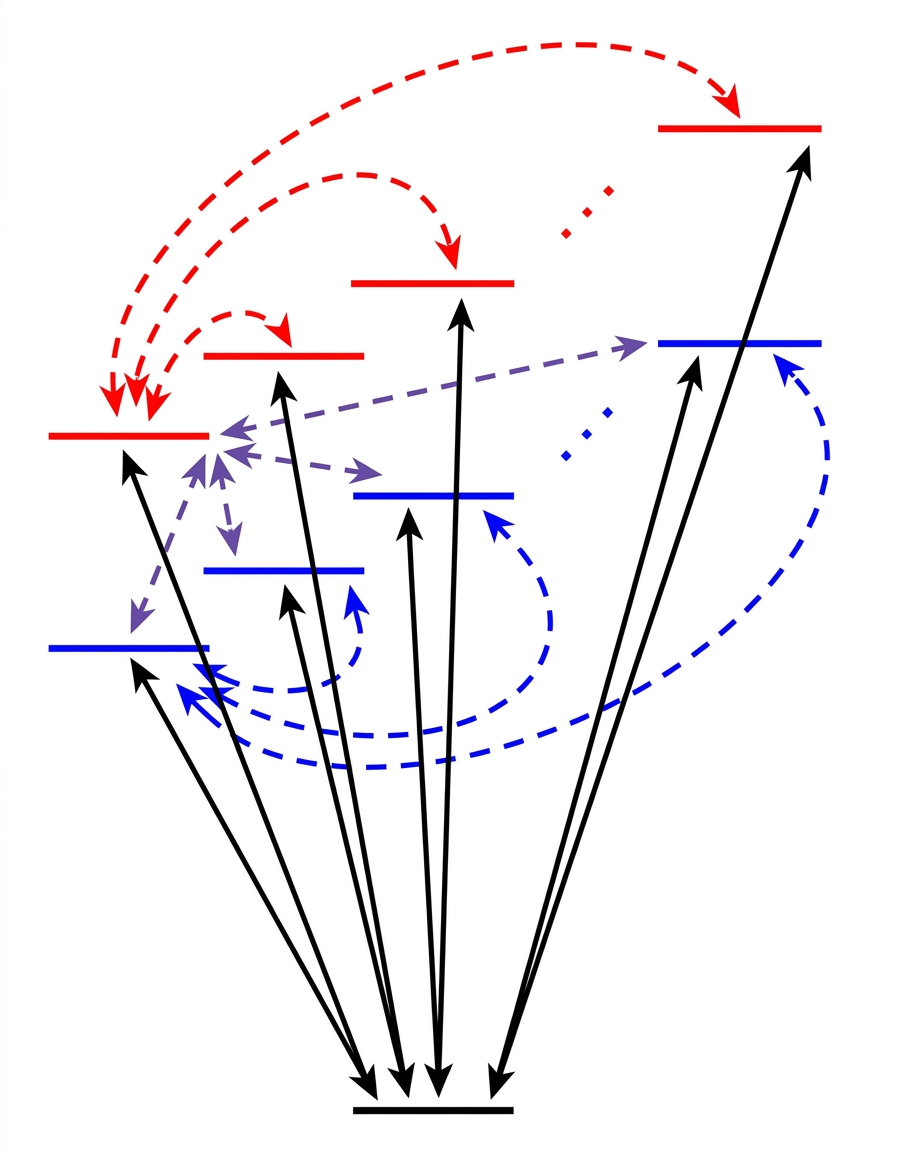
Fig 1: Our adaptation of Garraway’s energy level diagram
Limitations
- No numerical benchmark section is visible in the excerpt, so claims like “substantially reduces computational overhead” are not backed by reported timing or memory numbers here.
- The reduction is exact only when the eliminated sector’s response is well approximated by a rational self-energy; broad continua or branch-cut spectra are not treated in detail.
- The coherent-displacement argument relies on the stiff-pump limit δd → 0; the size of corrections from pump fluctuations is not quantified.
- The excerpt does not provide a concrete algorithm for fitting measured hardware response functions into pole expansions, despite emphasizing that requirement.
- No robustness analysis is shown for parameter mismatch, finite temperature, or drive-induced nonstationarity beyond the cited field-biased spectral-density formulas.
Open questions / follow-ons
- How many pseudomodes are needed in practice to approximate measured cQED noise spectra with acceptable error, and how does this scale with bandwidth and nonlinearity?
- Can the rational-self-energy approach be extended cleanly to branch-cut baths, strong finite-temperature effects, or explicitly time-dependent environments?
- What is the quantitative approximation error when the stiff-pump assumption is relaxed and the δd fluctuations are retained?
- How does this reduction behave under control pulses and gate sequences where the relevant spectral response is probed away from the calibration point?
Why it matters for bot defense
For a bot-defense engineer, the main relevance is conceptual rather than direct: it is a clean example of replacing a hard, high-dimensional, memoryful system with a smaller auxiliary representation when the observed input-output behavior has a compact spectral form. That same mindset appears in CAPTCHA and fraud settings when one tries to model a complicated interacting population with a tractable surrogate that preserves the channels that matter most.
The caution is equally useful: the reduction is only as faithful as the chosen response model. If you fit the wrong spectral structure, you can get a compact surrogate that is elegant but misleading. For bot-defense practitioners, that translates to being careful about whether a reduced detector or behavioral model actually preserves the attack surfaces and distribution shifts you care about, rather than just matching average behavior on a calibration set.
Cite
@article{arxiv2605_03946,
  title={ An extensive theory of nonlinearly intercoupled pseudomodes for noise model reduction in circuit QED },
  author={ M. Gabriela Boada G. and Nicolas Dirnegger and Andrea Delgado and Prineha Narang },
  journal={arXiv preprint arXiv:2605.03946},
  year={ 2026 },
  url={https://arxiv.org/abs/2605.03946}
}