
The Algebra of Iterative Constructions
Source: arXiv:2605.03176 · Published 2026-05-04 · By Kevin Batz, Benjamin Lucien Kaminski, Lucas Kehrer, Gerwin Klein, Henning Urbat, Todd Schmid
TL;DR
This paper develops an algebraic language, AIC, for reasoning about fixed-point constructions on complete lattices without doing the usual index-heavy manipulations over sequences. The central idea is to treat operations like tail, head, pointwise application, “take the supremum of all suffixes” and “take the infimum of all suffixes” as algebraic operators on sequences, so that classical fixed-point iterations can be proved by equational and quasi-equational reasoning. In the standard model, a term like ◇F*⊥ denotes the Kleene construction sup_n F^n(⊥), while □◇F*a captures a more general limit-inferior/limit-superior style construction from an arbitrary seed. The paper’s contribution is not a new fixed-point theorem alone, but a reusable proof calculus that can derive a range of theorems uniformly.
The authors use AIC to reprove several known results and derive a new theorem: the Tarski-Kantorovich principle, a fixed-point-theoretic generalization of k-induction, and a theorem showing that under suitable countable continuity and ω-cocontinuity conditions, both lim inf and lim sup of iterates from an arbitrary seed are fixed points. They mechanize the algebra and proofs in Isabelle/HOL and report that Isabelle’s sledgehammer can automatically find proofs of the showcased theorems in the stronger axiom system AIC1. They also study axiomatization limits: a finite finitary axiom set is sound but incomplete for sequence algebras, while an infinitary axiom set is complete, and no finite finitary axiomatization can be complete for standard sequence models.
Key findings
- AIC encodes classical fixed-point iteration as algebraic terms; in the standard sequence model, ◇F*⊥ denotes sup_n F^n(⊥), making Kleene-style constructions expressible without explicit index arithmetic.
- The paper proves the Tarski-Kantorovich principle algebraically: for ω-continuous F, ◇F*a is the least fixed point of F above the seed a.
- They derive a fixed-point-theoretic generalization of Park induction and a latticed k-induction principle, both within the same equational framework.
- A novel theorem shows that if F is countably continuous and ω-cocontinuous, then □◇F*a is a fixed point of F for arbitrary seed a.
- The Isabelle/HOL mechanization is strong enough that sledgehammer can automatically prove the showcased fixed-point theorems in AIC1, including high-level statements like Tarski-Kantorovich and Park induction.
- AIC0 is sound for sequence algebras but incomplete; the paper proves that no complete axiomatization of standard sequence models exists using finitely many finitary axioms.
- A different finite axiom set with infinitary axioms is complete for standard models, establishing that infinitary reasoning is unavoidable in this setting.
Methodology — deep read
The adversary/threat model is not a security adversary in the usual sense; the paper’s “threat” is mathematical complexity: proving fixed-point iteration theorems typically requires nested indices, continuity hypotheses, and delicate reasoning about lim sup/lim inf. The authors assume a complete lattice L (in fact, countably complete, with bottom and top) and monotone endomaps F : L → L. Their target theorems are about iteration on sequences in Lω, under standard continuity assumptions: ω-continuity for Kleene/Tarski-Kantorovich-style results, and stronger countable continuity plus ω-cocontinuity for the lim inf/lim sup theorem. They do not assume access to explicit counterexamples or dynamic adversaries; instead, they study what can be derived from algebraic axioms and what cannot.
The data here are mathematical structures rather than empirical datasets. The standard model is the sequence algebra over a countably complete lattice L. Terms denote sequences built from variables and operators. The paper uses concrete lattice examples only as intuition (for instance extended reals), but the formal development is abstract. There are no train/validation/test splits, labels, or preprocessing pipelines. The relevant “inputs” to the theorems are standard interpretations of variables as arbitrary sequences and interpretations of function symbols as monotone maps on L. The main semantic definition is that each term is evaluated homomorphically in a sequence algebra: join and meet are pointwise, ◇ takes suffix-wise suprema, □ takes suffix-wise infima, F applies elementwise, and F* applies F iteratively along the sequence index (nth position gets F^n of the nth element). A concrete example is the term F*⊥, whose nth component is F^n(⊥); applying ◇ to that sequence yields the pointwise suffix supremum, which corresponds to the usual Kleene construction sup_n F^n(⊥) at index 0.
The architecture is an equational/quasi-equational calculus rather than a neural architecture. AIC’s signature includes constants ⊥ and ⊤, lattice operations ⋎ and ⋏, unary operations ◇, □, ⊖ (head), and 𝒮/shift (written as a shift symbol in the paper), plus for each function symbol F two unary operators: F and F*. The novelty is semantic: these operators are interpreted over sequences so that fixed-point iteration becomes algebraic manipulation of terms. AIC0 is the base axiom system. It axiomatizes bounded lattice structure, monotonicity and distribution of shift over joins/meets, closure/hull behavior of ◇ and □ (inflation/deflation, idempotence, monotonicity, commutation with shift), and the interaction of F and F* (monotonicity, commutation F F* = F* F, shift/iteration law, and the induction/coinduction rules F a ⪯ a ⇒ F* a ⪯ a and a ⪯ F a ⇒ a ⪯ F* a). AIC1 extends AIC0 with additional redundant axioms chosen to help automated proof search in Isabelle/HOL; the paper explicitly notes that AIC1 is more usable even though it is not stronger in expressive power.
The training regime analogue is the formal proof workflow. There is no optimization loop, epochs, batch size, or random seed strategy. Instead, the authors construct derivations in quasiequational logic, then mechanize them in Isabelle/HOL. The paper states that the mechanized proofs follow the manual exposition closely and that intermediate steps are often solved automatically. The strongest automation result reported is that Isabelle’s sledgehammer can find proofs of the showcased fixed-point theorems fully automatically in AIC1, but not in the smaller AIC0. The completeness section is a separate meta-theoretic development: they prove soundness and incompleteness of AIC0 for standard models, prove completeness of a different infinitary axiomatization, and show a no-go theorem against any finite finitary complete axiomatization.
The evaluation protocol is theorem proving and model-theoretic analysis. For theorem proving, the paper demonstrates derivations of several named results: Kleene’s theorem as a special case, the Tarski-Kantorovich principle, a generalization of Park induction, a fixed-point-theoretic version of k-induction, and the new lim inf/lim sup theorem. For each, the paper contrasts manual algebraic proof sketches with Isabelle/HOL mechanization. For the completeness claims, the authors evaluate axiomatizations by whether they are sound, complete, and finitely axiomatizable for sequence algebras. They do not report statistical tests, benchmarks, or quantitative runtime tables in the provided text. A concrete end-to-end example is the Kleene-style construction: one starts with the flat bottom sequence ⊥, forms the orbit F*⊥ = ⊥, F(⊥), F^2(⊥), …, then applies ◇ to obtain the suffix-supremum sequence. Under ω-continuity, the paper derives algebraically that this sequence is a fixed point, i.e. F ◇F*⊥ = ◇F*⊥. Replacing ⊥ by an arbitrary seed a and combining ◇ with □ gives the limit-superior/limit-inferior construction □◇F*a used in the novel theorem.
Reproducibility is relatively strong for a theory paper: the authors state that the Isabelle/HOL formalization and formal proofs are available via the Isabelle Archive of Formal Proofs (isa-afp.org), and they mention supplementary material containing the formalization. What is not fully reproducible from the excerpt alone is the exact proof scripts and the details of the automation setup, beyond the statement that sledgehammer succeeds on the key results in AIC1. The paper also notes that some axioms in AIC1 are redundant and chosen for proof search convenience, which matters for anyone attempting to replay the automation or port it to another prover.
Technical innovations
- Introduces AIC, an algebraic calculus that internalizes fixed-point iteration on sequences via operators such as ◇, □, and F* instead of explicit index-based limit reasoning.
- Uses a quasi-equational axiomatization of sequence algebras to derive fixed-point theorems by equational logic, including continuity-dependent constructions from arbitrary seeds.
- Provides an algebraic proof of the Tarski-Kantorovich principle and a fixed-point-theoretic generalization of k-induction within the same framework.
- Proves a new lim inf / lim sup fixed-point theorem for countably continuous and ω-cocontinuous endomaps, extending Olszewski’s earlier result.
- Separates a usable but incomplete finitary axiom system (AIC0/AIC1) from a complete infinitary axiomatization, and proves finitary completeness is impossible for standard models.
Figures from the paper
Figures are reproduced from the source paper for academic discussion. Original copyright: the paper authors. See arXiv:2605.03176.
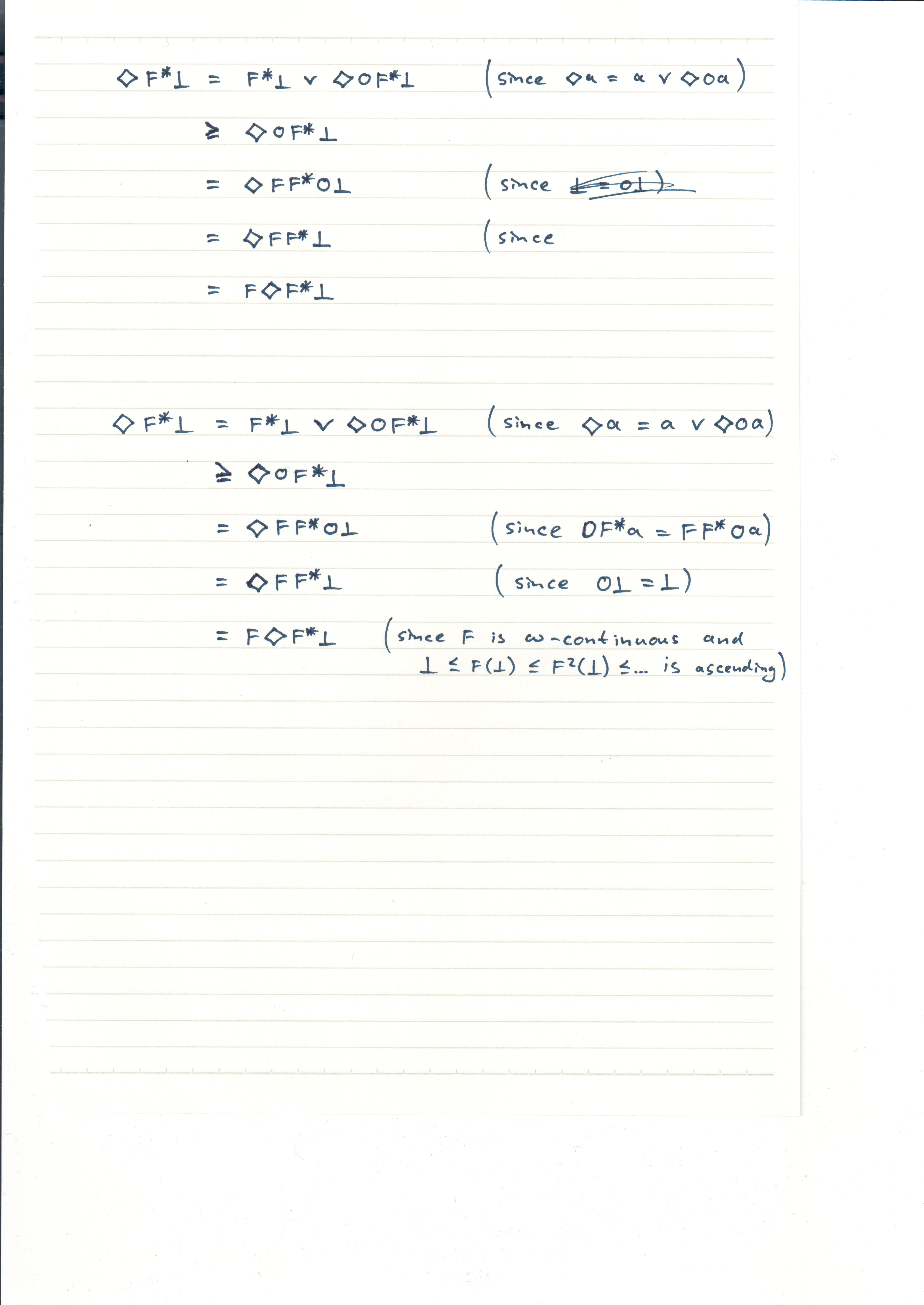
Fig 4: Proof of ol-post-fp (top tree) and ol-pre-fp (bottom tree).
Limitations
- The paper is entirely theoretical; there is no empirical evaluation, benchmark suite, or performance comparison in the machine-learning sense.
- The excerpt does not provide explicit Isabelle proof sizes, proof search times, or failure rates for AIC0 vs AIC1, so the automation gains are qualitative rather than quantified here.
- AIC0 is intentionally incomplete for standard sequence algebras, so the base axiom system cannot capture all valid identities.
- The completeness result relies on infinitary axioms, which may limit direct implementability in automated tools compared with purely finitary systems.
- The main theorems depend on continuity assumptions (ω-continuity, countable continuity, ω-cocontinuity), so the constructions do not apply to arbitrary monotone maps.
- The paper’s standard models are sequence algebras over countably complete lattices; behavior on weaker structures or nonstandard models is not the focus.
Open questions / follow-ons
- Can the AIC framework be extended to other semantic domains beyond complete lattices, such as metric spaces, domains with partial information, or probabilistic orders?
- Which fragments of AIC retain enough power for automation while avoiding infinitary axioms, and can those fragments be characterized syntactically?
- Can the algebraic approach be lifted to richer fixed-point logics, e.g. modal µ-calculus variants or higher-order fixed-point calculi?
- How far can the Isabelle automation be pushed on larger real verification examples, such as invariant generation or liveness proofs, rather than just named theorem statements?
Why it matters for bot defense
This paper is not about CAPTCHA or bot detection directly, but it is relevant as a proof-methodology paper for systems engineers who need to reason about iterative processes, invariants, and convergence. A bot-defense practitioner might care if they use fixed-point style definitions for policy stabilization, repeated scoring, iterative reputation updates, or monotone rule systems, because AIC gives a disciplined way to derive and mechanize convergence arguments without resorting to ad hoc index juggling.
More practically, the paper suggests a way to encode iterative security policies as algebraic objects and prove properties like “the process stabilizes,” “the computed state is a fixed point,” or “the limit from any seed is well-defined under stated continuity assumptions.” It would not directly help with model training or CAPTCHA generation, but it could help formalize and verify update loops in detection pipelines, especially where monotonicity and fixed-point semantics matter. The main caution is that the framework is abstract and proof-oriented; it is strongest when the system can genuinely be modeled as a monotone operator on a complete lattice.
Cite
@article{arxiv2605_03176,
  title={ The Algebra of Iterative Constructions },
  author={ Kevin Batz and Benjamin Lucien Kaminski and Lucas Kehrer and Gerwin Klein and Henning Urbat and Todd Schmid },
  journal={arXiv preprint arXiv:2605.03176},
  year={ 2026 },
  url={https://arxiv.org/abs/2605.03176}
}