
The DAMSA Experiment
Source: arXiv:2604.28133 · Published 2026-04-30 · By Prithak Bhattarai, Andrew Brandt, Alan Bross, Bradley Brown, Samriddha Chakraborty, Haohui Che et al.
TL;DR
DAMSA is a proposed very-short-baseline beam-dump experiment designed to search for short-lived particles that decay too early to be efficiently seen in conventional long-baseline beam-dump setups. The central physics idea is simple: if the signal particle is produced at the dump and decays within a meter or less, moving the detector extremely close to the source can recover sensitivity lost to the beam-dump “ceiling.” The paper frames this as a general short-lived-particle program covering axion-like particles, dark photons, light dark matter, and massive spin-2 states, with a compact detector optimized for displaced visible decays and scattering signals.
The main new element is the staged experimental strategy. The full DAMSA concept targets an 800 MeV proton beam at Fermilab PIP-II, where meson production dominates but neutron backgrounds are severe. To de-risk the idea, the authors propose DAMSA Path-Finder (DPF), a proof-of-concept experiment at SLAC LESA using an 8 GeV electron beam and the benchmark channel a→γγ. DPF is meant to validate the core technologies: short vacuum decay volume, tight vertexing, magnetic charge separation, and a fine-grained calorimeter capable of reconstructing displaced two-photon decays while suppressing beam-related neutrons. This paper is mainly a technical concept note rather than a results paper; it presents projected sensitivities, detector choices, and background logic, but does not report a completed measurement.
Key findings
- The core baseline is ultra-short: the target-to-ECal distance is about 1 m, with the active detector spanning z = 45 cm to z = 101 cm from the target face, designed specifically to beat the beam-dump ceiling for fast decays.
- The DPF vacuum decay chamber is 20 cm in diameter and 30 cm long, with a baseline pressure target of < 10^-3 mbar; the authors state the neutron nuclear scattering probability in residual gas is < 10^-8 per traversal.
- For the DPF target geometry, the tungsten block is 5 cm × 5 cm × 15 cm, corresponding to 42.9 X0, chosen to contain the 8 GeV EM shower core while minimizing neutron production.
- With the baseline magnet/yoke configuration, the field is quoted as 0.65 T over a 12 cm tracking region, giving a sagitta of about 3.5 mm for a 100 MeV/c track over 12 cm; the stated tracker goal is < 1 mm vertex resolution.
- The DPF background strategy for ALP→γγ relies on two explicit cuts: each photon must have Eγ > 500 MeV and the inter-photon angle must exceed 1°, which the authors say should make the search nearly background-free.
- The LESA sensitivity projections are shown for three cumulative exposures: 1.5×10^14, 1.5×10^16, and 1.5×10^18 electrons on target (EOT), with Fig. 1 comparing these curves against existing laboratory and astrophysical exclusions.
- For the full DAMSA proton-beam configuration, Fig. 3 states spallation yields about 13–15 neutrons per proton at 800 MeV, making beam-related neutron suppression the dominant experimental challenge.
- The authors claim the full-scale proton-beam setup can probe the intermediate long-lived regime between collider-stable particles and astrophysical-length-scale decays, especially for ALPs, dark photons, and spin-2 states; however, this is presented as a sensitivity estimate rather than a demonstrated measurement.
Threat model
The relevant adversary is the accelerator environment itself: prompt electromagnetic leakage, beam-related neutrons from photo-nuclear or spallation processes, delayed neutron-capture gamma cascades, cosmic neutrons, and decay-at-rest backgrounds that can fake rare displaced decays or low-energy recoils. The signal particles are assumed to be feebly coupled, short-lived, and produced in the target or dump; they can decay or scatter only within the compact downstream detector volume. What the detector cannot do, by design, is rely on long decay paths or large detector mass to compensate for poor vertexing, because the sought particles are expected to disappear quickly. The paper assumes no malicious tampering or intentional adversary beyond physics backgrounds, and no hidden-source interference other than beam timing structure and geometry.
Methodology — deep read
The threat model is the standard beam-dump one: new particles are created in a target or dump, travel some distance, and either decay visibly in a downstream fiducial volume or scatter in a detector. The adversarial/irrelevant-for-signal background is not a malicious actor but beam-related backgrounds, especially prompt electromagnetic leakage, beam-related neutrons from photo-nuclear or hadronic spallation processes, and delayed neutron-capture gamma cascades. The key assumption is that for the DPF pathfinder, an 8 GeV electron beam at SLAC LESA produces a much more controlled background environment than a proton dump, while the full DAMSA proton configuration at PIP-II must handle far higher neutron multiplicity. The paper assumes that very short source-to-detector distance is a feature, not a bug: by placing the detector on the order of a meter from the target, the experiment can retain sensitivity to short-lived dark-sector states that would decay before reaching longer-baseline detectors.
The data in this paper are not measured datasets but simulation- and design-driven inputs. The authors repeatedly reference GEANT4-based studies and sensitivity estimates, but the excerpt does not provide a released simulation package, event files, or a data split. The physics reach plots in Fig. 1 are generated for the DPF ALP→γγ benchmark at SLAC LESA using three cumulative EOT values: 1.5×10^14, 1.5×10^16, and 1.5×10^18. Background normalization differs between the electron-beam and proton-beam configurations: Fig. 2 normalizes rates to the EM shower photon flux escaping the target, while Fig. 3 normalizes to the spallation neutron flux. The paper also states that absolute rates per EOT or POT will come from dedicated GEANT4 simulations at the relevant beam energies, but those absolute numbers are not actually included in the excerpt. There is no labeled train/validation/test split because this is not a machine-learning study.
The architecture is a staged detector concept. The DPF stage consists of a tungsten target, a 20 cm diameter by 30 cm long vacuum decay chamber, a dipole magnetic field, a tracking detector, and a CsI electromagnetic calorimeter. The target is a 5×5×15 cm^3 tungsten block (42.9 radiation lengths) sized to contain the 8 GeV EM shower core while limiting target mass and neutron production; the authors mention optional design tweaks such as a 1 cm lead sheet at the downstream end to absorb X-rays and a rotating cylindrical target to spread heat, but the baseline remains full tungsten. The vacuum chamber is intended to keep neutron interactions in the decay volume negligible; the stated residual-gas nuclear scattering probability is <10^-8 per traversal at <10^-3 mbar. The magnet is a permanent NdFe or SmCo dipole, with the baseline yoke configuration giving 0.65 T across a 12 cm tracking region. Tracking is envisioned with either four LGAD layers in the baseline or a future six-plane configuration; the excerpt lists LGAD or μRWELL as candidate technologies. The calorimeter is a 12×12×44 cm^3 CsI total-absorption ECAL with SiPM readout, aimed at <6%/sqrt(E[GeV]) energy resolution and ~1 ns timing. The concrete signal mode worked through in the paper is ALP→γγ: the ALP is produced in the target (via Primakoff for photon-coupled ALPs), traverses O(cm)–1 m, and decays in the vacuum chamber; the two photons then hit the ECAL, where a displaced vertex is reconstructed using the shower geometry and timing.
The production and decay mechanisms are summarized separately for several models. For photon-coupled ALPs, production is via Primakoff processes γ+Z→a+Z, including photons from the EM cascade. For electron-coupled ALPs at LESA, production channels include e− bremsstrahlung, resonant and non-resonant e+e− annihilation, and Compton-like e−γ→ae−. Dark photons are produced by dark bremsstrahlung and photon mixing, then decay to e+e−, μ+μ−, or hadrons depending on mass. Large-extra-dimension scenarios are treated through massive spin-2 KK gravitons, produced mainly by Primakoff-like γN→GN and decaying mostly to γγ. Light dark matter is handled through two signal classes: elastic scattering of χ on electrons, nucleons, or nuclei, and inelastic scattering through an excited state χ* that de-excites to χe+e− or χγ. For the full PIP-II proton-beam version, the dominant production channel shifts to meson physics, especially π0→γA′/a and subsequent A′→χχ or visible decays; the paper emphasizes that this is a qualitatively different production environment from the electromagnetic-shower-dominated DPF.
The training regime is not applicable in the usual sense because there is no learned model reported. Instead, the paper’s workflow is an engineering and simulation program: detector design choices are motivated by GEANT4 studies, and the sensitivity curves are derived under stated cut assumptions. The only explicit selection criteria in the excerpt are the DPF ALP→γγ cuts of Eγ > 500 MeV for each photon and opening angle >1°. The authors also discuss timing-based rejection of delayed neutron backgrounds, vertex reconstruction to distinguish decays in the target from decays in the vacuum chamber or decay pipe, and the possibility of using a beam pulse structure to exploit timing information for LDM scattering searches. Hardware-wise, the proposal assumes a compact tabletop-scale detector, radiation-tolerant permanent magnets, and fast timing layers (LGADs). There is no mention of random seeds, optimizer settings, or epoch counts because no network is being trained.
Evaluation is presented as projected sensitivity and background-rate logic rather than a completed experimental analysis. Fig. 1 shows ALP→γγ reach at SLAC LESA for three exposures and compares against existing laboratory and astrophysical bounds, plus projected sensitivities for SHiP and the future CERN BDF DAMSA concept. Fig. 2 and Fig. 3 summarize relative background processes for the DPF and PIP-II configurations, respectively: prompt EM leakage, beam-induced neutrons, hadronic shower products, n-capture gamma cascades, cosmic neutrons, and negligible neutrino backgrounds. The performance claims in Table III are subsystem-level goals: >95% tracking efficiency above 30 MeV/c, <1 mm vertex resolution, ~50 ps LGAD timing, and ECAL energy resolution targeted at <6%/sqrt(E[GeV]). The paper does not report statistical tests, cross-validation, or blinded analyses. Reproducibility is limited in the excerpt: the authors reference prior simulation-based studies and design studies, but no code release, frozen weights, or public dataset is described.
One concrete end-to-end example is the DPF ALP→γγ benchmark. An 8 GeV electron beam strikes the tungsten target, producing a thick electromagnetic shower. Photons in that shower can convert to ALPs through the Primakoff process in the target material. A subset of ALPs with masses and couplings in the plotted region survive the short flight distance, enter the 30 cm vacuum chamber, and decay to two photons before leaving the chamber or just downstream of it. Those photons then enter the CsI calorimeter, where the event is reconstructed as a displaced diphoton vertex; the analysis is designed to reject background by requiring each photon above 500 MeV and an opening angle above 1°. The paper’s claim is that this topology, combined with the ultra-short baseline, yields near-background-free sensitivity over a broad region of ALP parameter space at the stated EOT levels, but the excerpt does not show the full cutflow or raw event counts behind that claim.
Technical innovations
- Introduces an ultra-short-baseline beam-dump geometry specifically to recover sensitivity to particles that decay before reaching conventional longer-baseline detectors.
- Proposes a staged validation strategy with DPF at SLAC LESA using 8 GeV electrons before scaling to the full PIP-II proton-beam experiment.
- Uses a compact decay volume plus displaced-vertex calorimetry and tracking to separate short-lived visible decays from beam-induced neutron activity.
- Extends the same experimental platform to multiple short-lived-physics targets: ALPs, dark photons, KK gravitons, and light dark matter scattering.
- Explicitly leverages different production regimes at electron- vs proton-beam facilities: electromagnetic shower production at LESA and meson-dominated production at PIP-II.
Datasets
- No public dataset reported — simulation/design study only — GEANT4 studies referenced in text
Baselines vs proposed
- Longer-baseline beam-dump experiments: sensitivity to fast decays limited by the beam-dump ceiling vs proposed DAMSA: improved reach for short-lived particles at ~1 m baseline (projected, not measured)
- Existing laboratory and astrophysical ALP constraints: shown as excluded gray/yellow regions in Fig. 1 vs DAMSA projected reach at LESA: broader previously unprobed (ma, g_aγγ) region for 1.5×10^14 to 1.5×10^18 EOT (projected)
- SH iP projected sensitivity: compared in Fig. 1 vs DAMSA at CERN BDF: DAMSA reach shown for 2×10^19 POT at BDF in brown, but no numerical ratio is tabulated
- Full tungsten target vs tungsten+lead target: photon production differs by at most 1% according to Fig. 5, while the paper concludes full tungsten is optimal when only these materials are considered
Figures from the paper
Figures are reproduced from the source paper for academic discussion. Original copyright: the paper authors. See arXiv:2604.28133.
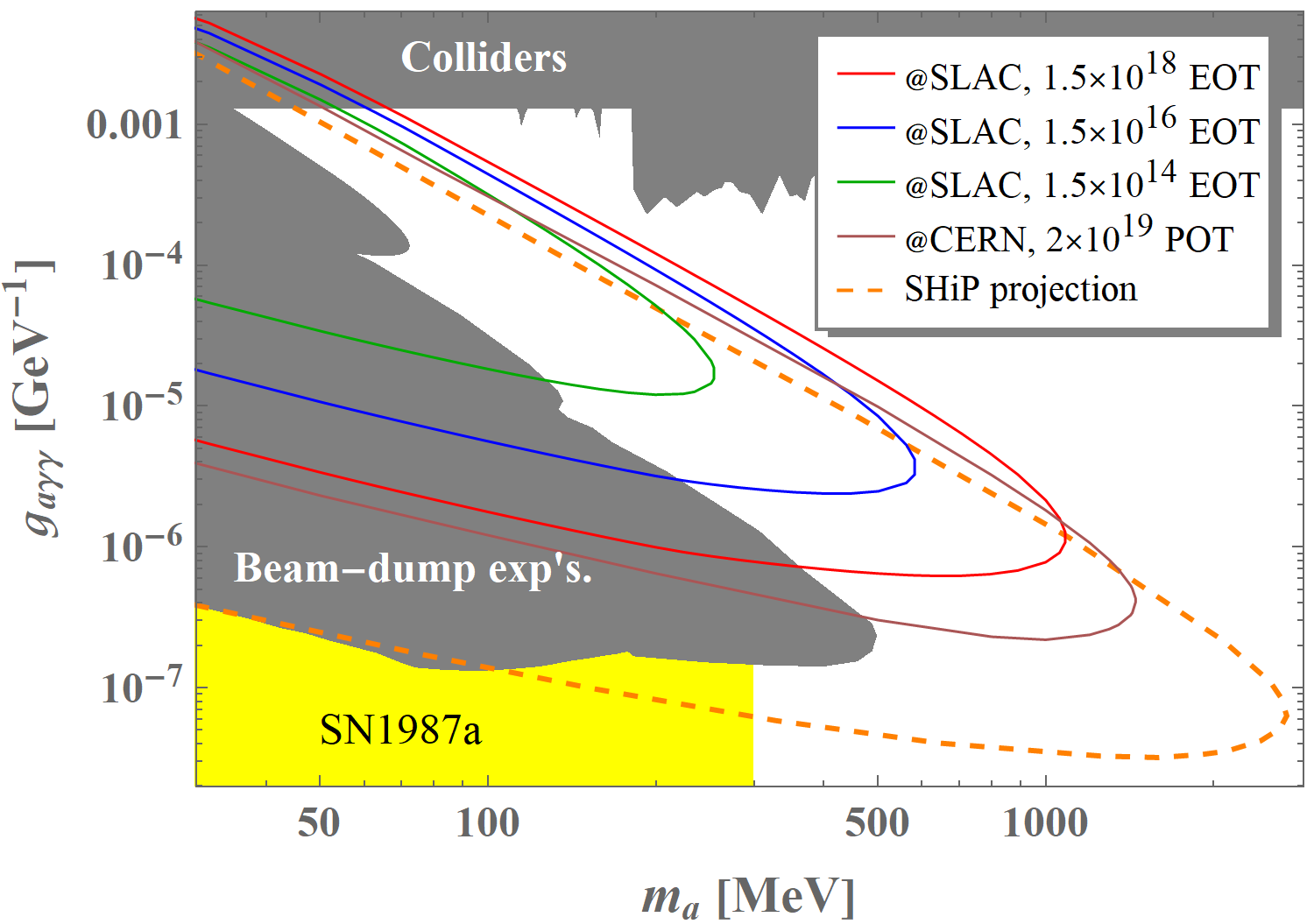
Fig 1: Sensitivity prospects for DAMSA to ALPs interacting with the SM photon at SLAC’s 8 GeV
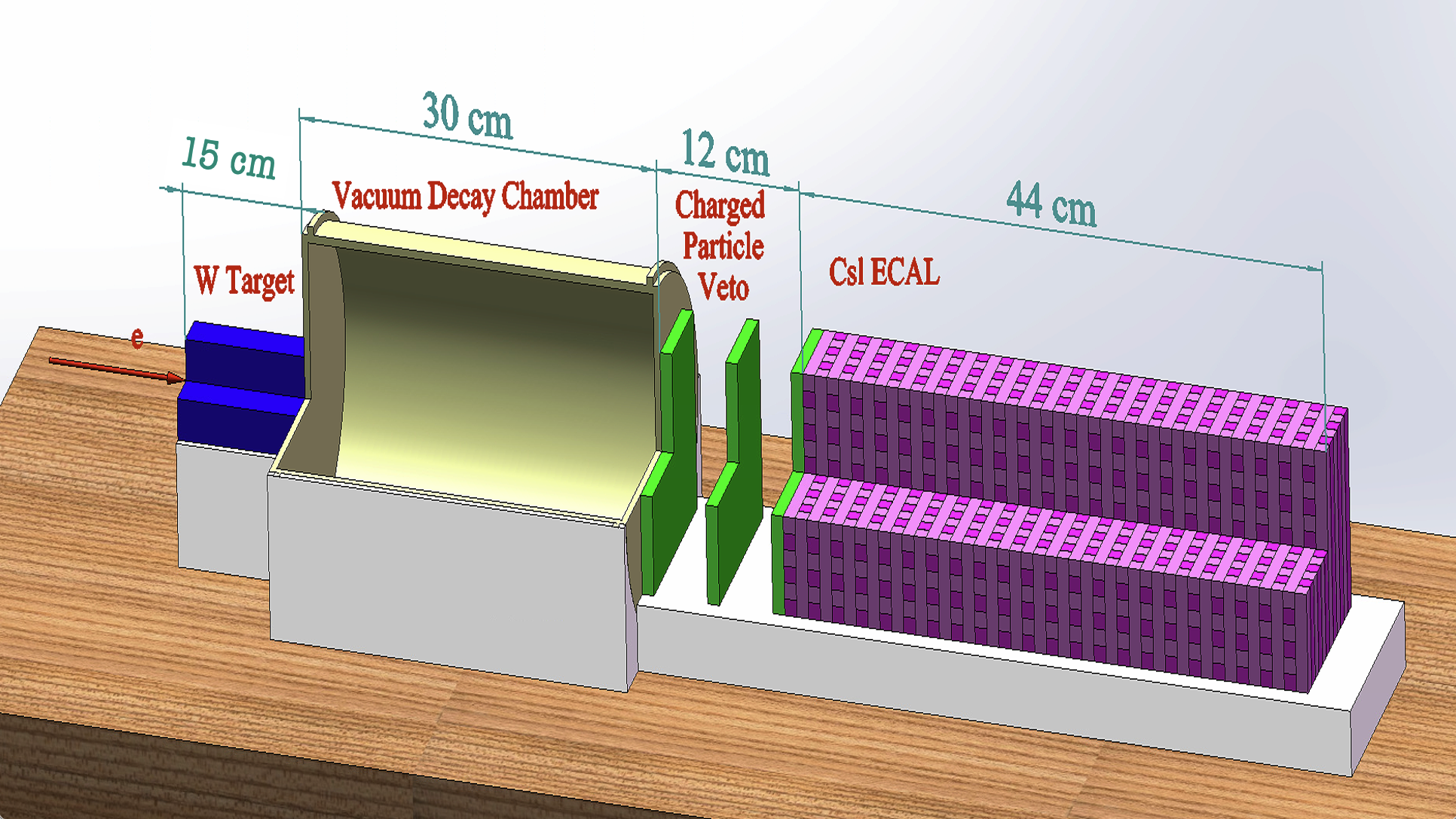
Fig 4: (Left) Stage 1 DAMSA experiment which consists of the 15 cm tungsten target, the vacuum decay
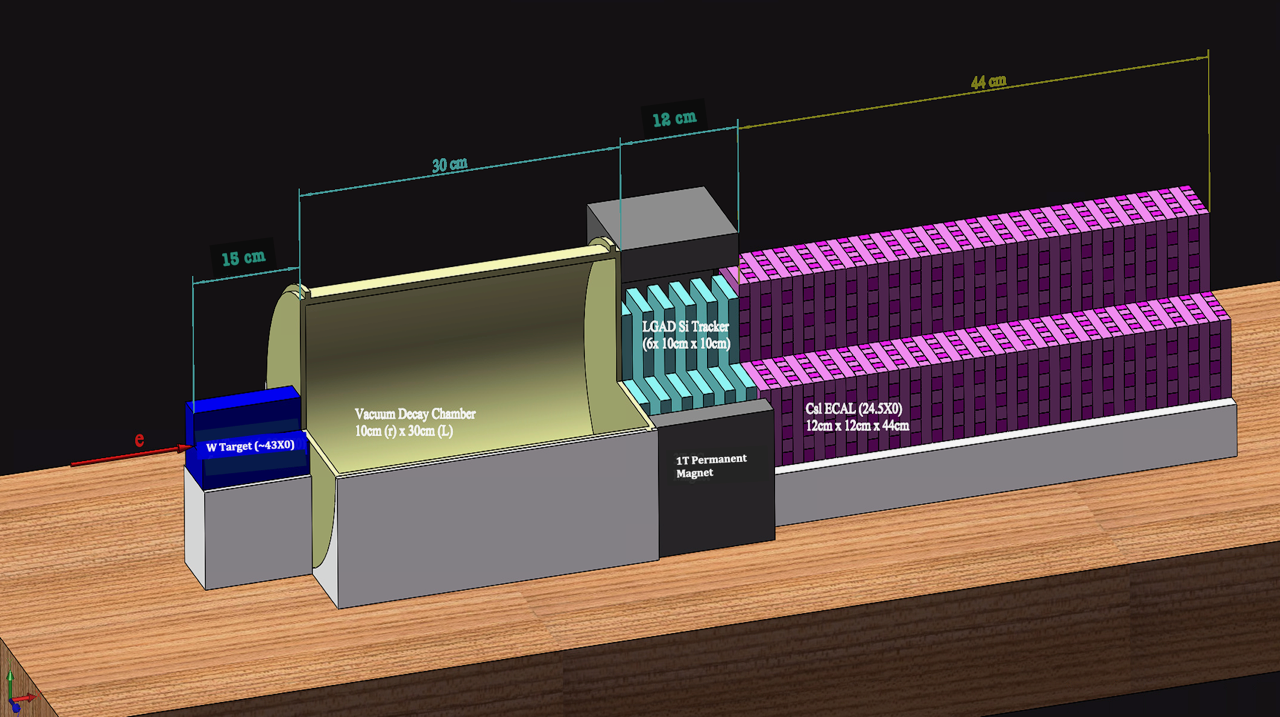
Fig 5: Photon production rate (left) and Background rate (right)
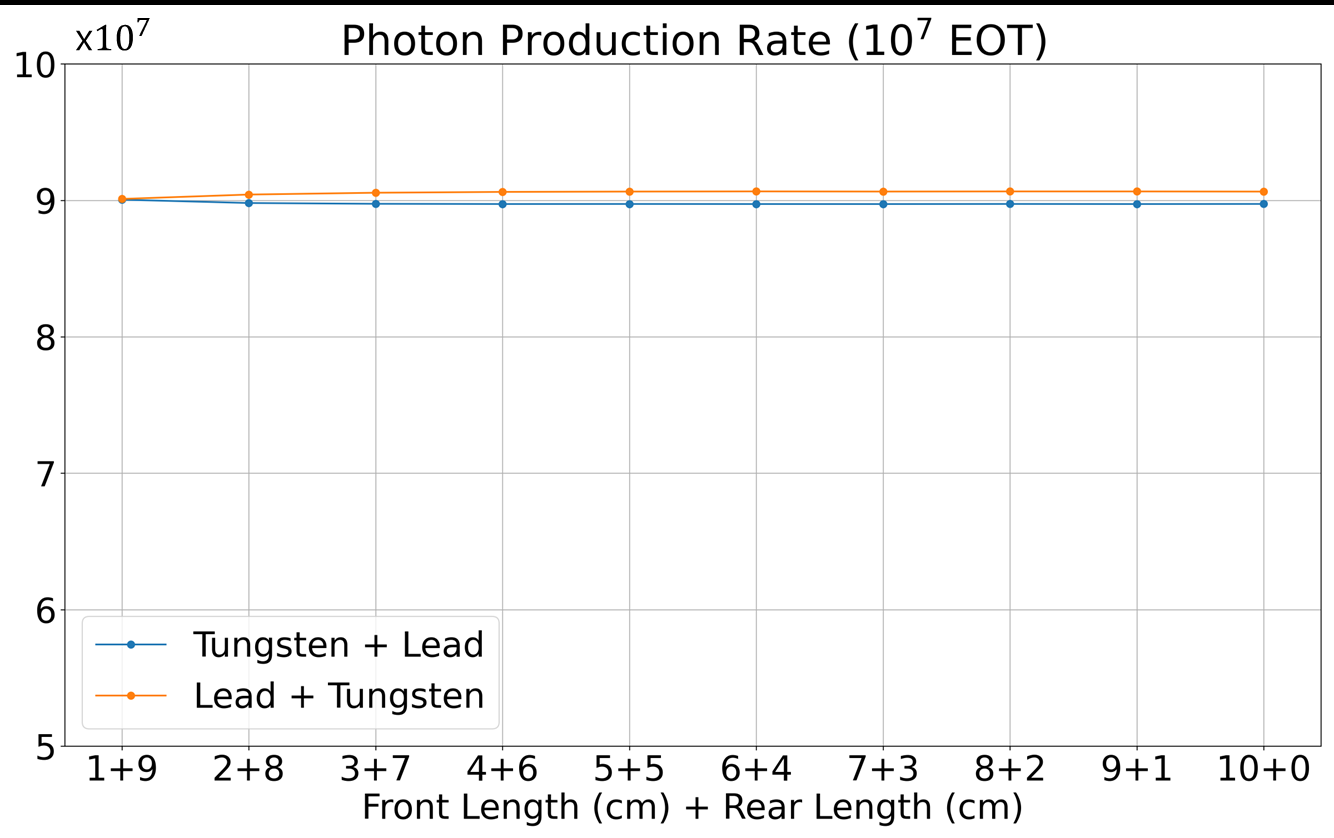
Fig 3: Relative rates of Standard Model background processes for the full-scale DAMSA experiment at
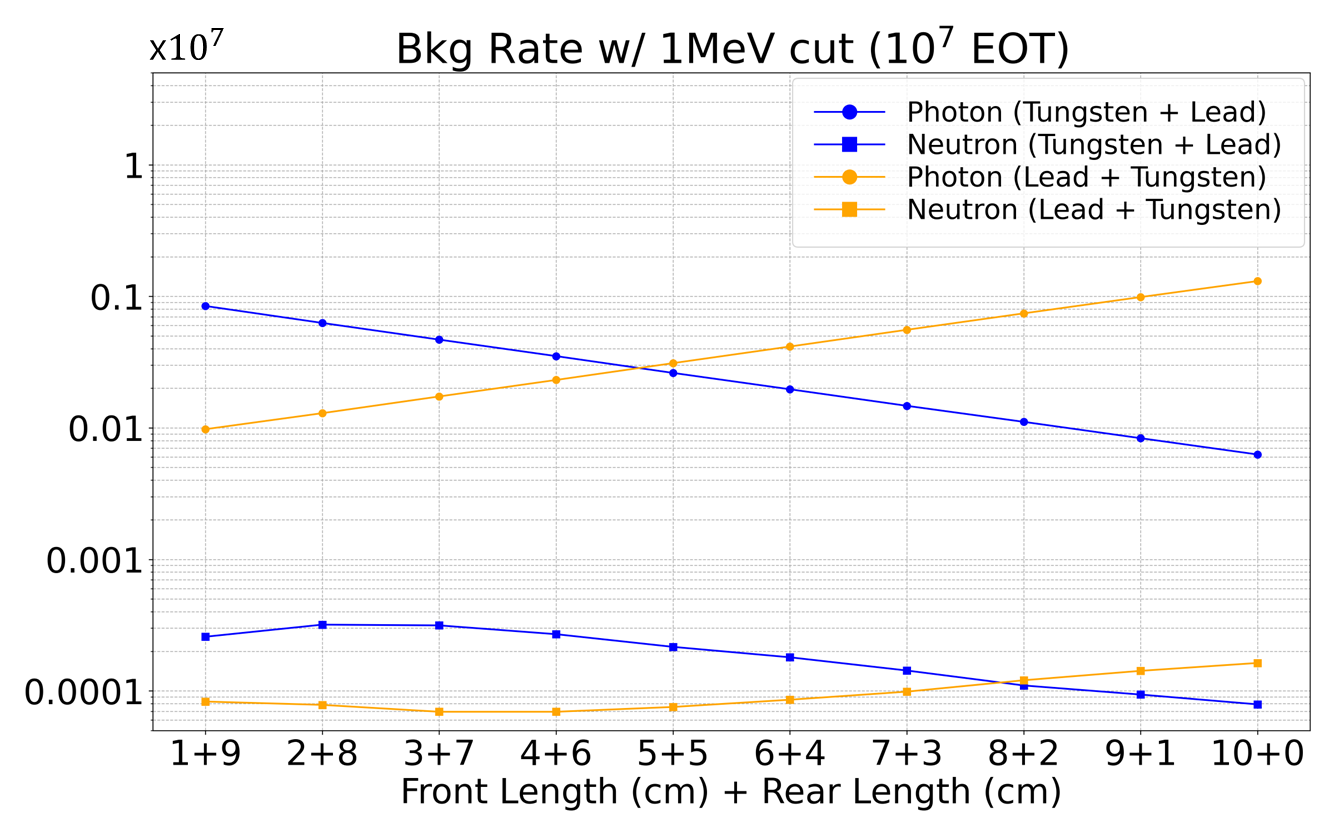
Fig 5 (page 12).
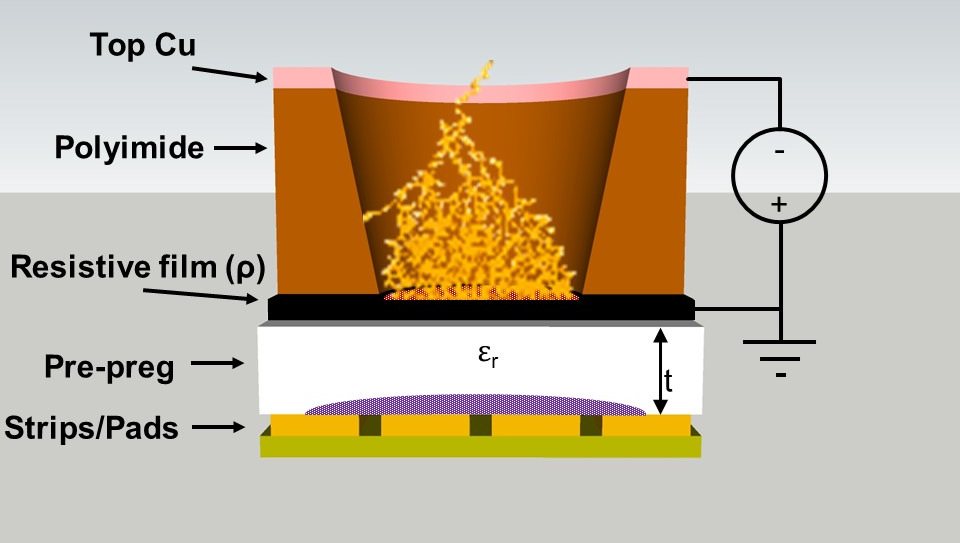
Fig 6: Structure of unit cell of µRWELL [52].
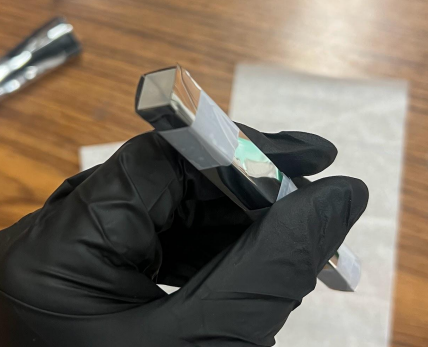
Fig 7: (Left) Photograph of a CsI crystal wrapped in aluminized mylar. (Right) 3D ECal layout. (Top) An

Fig 8: (Left) Illustration of the CsI crystal calibration measurements at UC Riverside, using a Hamamatsu
Limitations
- The paper is a proposal/concept note; it does not report an operating detector, real data, or a validated background measurement.
- Sensitivity plots are based on simulation assumptions and cuts; the excerpt does not include full cutflows, event yields, or systematic-uncertainty breakdowns.
- Absolute background rates are not given in the excerpt; Fig. 2 and Fig. 3 use different normalizations, making direct comparison only qualitative.
- The DPF background estimate depends heavily on very aggressive geometric and timing assumptions, including a small vacuum chamber and near-background-free diphoton selection.
- No public code, event samples, or reproducibility package is described in the excerpt.
- The proton-beam full DAMSA background environment is acknowledged to be substantially more difficult, but mitigation is still at the design stage rather than experimentally demonstrated.
Open questions / follow-ons
- What are the full GEANT4-predicted absolute background rates, including uncertainties, for the DPF and PIP-II geometries under realistic beam timing and shielding assumptions?
- How robust is the near-background-free ALP→γγ claim once detector nonidealities are included, especially split clusters, accidental overlaps, and imperfect neutron shielding?
- Can the same compact detector concept be adapted to measure scattering-based light dark matter signals with enough control of recoil systematics to compete with dedicated LDM experiments?
- What is the optimal tradeoff between target thickness, neutron production, and dark-sector yield for the proton-beam version at PIP-II?
Why it matters for bot defense
For a bot-defense engineer, this paper is not directly actionable as a CAPTCHA or LA benchmark, but it is relevant as an example of how short path length plus precise vertexing can recover rare-signal sensitivity in a hostile background environment. The transferable lesson is architectural: when the background is dominated by prompt clutter or secondary interactions, moving the observation point as close as physically possible to the source and adding discriminating geometry/timing can matter more than simply scaling detector size. In bot-defense terms, that maps to designing challenge/response systems that constrain the attacker’s time and action budget, then using high-resolution signals to separate genuine behavior from synthetic or delayed responses. The caveat is that the analogy is structural, not literal: this paper is about particle detection, so any application to CAPTCHA or LA should be limited to design intuition about latency, proximity, and background rejection rather than direct technical reuse.
Cite
@article{arxiv2604_28133,
  title={ The DAMSA Experiment },
  author={ Prithak Bhattarai and Andrew Brandt and Alan Bross and Bradley Brown and Samriddha Chakraborty and Haohui Che and Bhupal Dev and Bhaskar Dutta and Juan V. Estrada and Eric Garcia and Anthony Gomez and Gajendra Gurung and Brian Joshua Gomez Hernandez and Wooyoung Jang and Jay Hyun Jo and Krzysztof Jodłowski and Doojin Kim and Eunsu Kim and Hyunyong Kim and Shin Hyung Kim and Young-Kee Kim and Jing Liu and Chang-Seong Moon and Donna Naples and David Nygren and Minseok Oh and Vittorio Paolone and Hyangkyu Park and Jong-Chul Park and Nathaniel J. Pastika and Rohit Raut and Juergen Reichenbacher and Paul Rubinov and Eunsuk Seo and Veronika Shalamova and Seodong Shin and Melvin Shochet and Adrian Thompson and Yau Wah and Shawn Westerdale and Guang Yang and Un-Ki Yang and Inseok Yoon and Jaehoon Yu },
  journal={arXiv preprint arXiv:2604.28133},
  year={ 2026 },
  url={https://arxiv.org/abs/2604.28133}
}