
Rewiring Perceived Doability in VR: Hand Redirection as a Subtle Cross-Sensory Support for Sustained Practice
Source: arXiv:2604.25443 · Published 2026-04-28 · By Isidro Butaslac, Yota Nagaya, Almira Princess Redoble, Jordan Aiko Deja, Nicko Reginio Caluya, Maheshya Weerasinghe et al.
TL;DR
This position paper examines how subtle hand redirection (HR) in virtual reality (VR) can function as a form of cross-sensory support to enhance perceived doability—the moment-to-moment cognitive appraisal that an action is doable and within one’s capability. The authors propose that applying conservative visuo–proprioceptive remapping within known perceptual limits can create micro-success experiences, such as reaching a virtual target slightly earlier despite similar physical movement. Such experiences may increase users’ continuation intention and early re-engagement in low-intensity repetitive practices like stretching, addressing a key motivational bottleneck that often prevents sustained exercise adherence.
The work articulates two core research questions: (RQ1) whether and how HR shifts perceived doability to support sustained practice and positive behavior change, and (RQ2) under what redirection parameters HR remains acceptable without undermining users’ agency, authenticity, trust, or fostering dependence. The authors introduce a sit-and-reach VR prototype using Meta Quest 3S to explore these questions and outline a research plan focused on assessing cognitive appraisals, self-efficacy, fatigue, engagement, and acceptability indicators. Key tensions addressed include balancing assistance versus authenticity, subtlety versus agency/trust, and empowerment versus dependence. The paper situates HR-based support as a promising but ethically nuanced paradigm for autonomy-preserving cross-sensory behavior change interventions.
Key findings
- Perceived doability is a critical psychological bottleneck affecting sustained engagement in light exercise, often more than objective physical limitations.
- Subtle hand redirection (HR) within conservative psychophysical thresholds can create repeated micro-success experiences by visually advancing virtual hand position relative to real hand without increasing physical effort.
- Micro-successes generated by HR may increase continuation intention and early re-engagement without explicit coaching or overt motivational messaging.
- HR acceptability depends on avoiding detection; surpassing perceptual detection thresholds risks undermining agency, trust, and authenticity.
- Repeated unnoticed HR exposure can degrade proprioceptive accuracy and induce perceptual drift, raising safety and aftereffect concerns in sustained practice contexts.
- Designing HR support with complementary mechanisms (e.g., progress visualization, fading assistance) is key to preserving autonomy and preventing dependence.
- Psychophysical studies establish movement- and direction-dependent detection thresholds for HR, which must be respected for support to remain subtle and natural feeling.
- Contextual factors such as gaze behavior and environmental stimuli modulate the detectability and trustworthiness of HR interventions.
Threat model
The adversary in this context is the risk of perceptual detection of hand redirection by the user, which can undermine agency, trust, and authenticity. The system must operate within psychophysical detection thresholds to remain unnoticed. The user cannot detect overt manipulations that exceed detection limits or cause discomfort. There is no adversarial attacker per se; rather, the threat involves unintended negative psychological consequences if the subtle HR fails or users notice the manipulation.
Methodology — deep read
Threat Model & Assumptions: The adversary in this context is not an attacker but a concern about user perception—specifically, whether users notice the visuo–proprioceptive redirection applied by HR and how it affects feelings of agency, authenticity, and trust. The assumption is that HR operates subtly within psychophysically established detection thresholds to remain unnoticed, thereby safely influencing perceived doability. Risks involve perceptual drift, dependence, and agency loss if thresholds or contextual factors cause detection.
Data: There is no large dataset used; rather, the authors built a sit-and-reach VR prototype implemented on a Meta Quest 3S headset to test hand redirection effects. The target population includes individuals with low exercise routine adherence, emphasizing older adults as a key subgroup. The study design involves repeated sessions in VR with HR support ON (forward visual hand redirection) versus OFF (veridical alignment). Outcome measures include subjective self-reports of perceived doability, exercise self-efficacy, perceived effort, VR-induced fatigue (validated instruments), engagement (Hopkins Rehabilitation Engagement Rating Scale - Reablement Version), and acceptability metrics around agency, trust, and dependence.
Architecture/Algorithm: The technique involves applying conservative visuo–proprioceptive remapping by rendering the virtual hand slightly forward relative to the real hand along the reaching axis. This creates a controlled sensorimotor discrepancy below detection thresholds established in prior psychophysical work (e.g., gain-based redirection limits). The system inputs real hand and arm pose tracking data, applies the redirection transformation, and outputs the virtual hand pose in the VR scene. No novel machine learning models are introduced; the novelty lies in framing HR as cross-sensory support targeting perceived doability rather than reach extension or geometric constraints.
Training Regime: Not applicable as the position paper focuses on the system concept and research plan rather than completed empirical results. Future evaluations are planned with counterbalanced within-subject trials, short repeated VR sessions designed to test immediate changes in appraisal and intentions.
Evaluation Protocol: The outlined protocol plans to compare HR support ON versus OFF within individuals, measuring immediate shifts in perceived doability, self-efficacy, perceived effort, fatigue, and engagement using validated instruments. Post-session follow-up will assess continuation intention and actual re-engagement. Acceptability and boundary measures include perceived authenticity of success, attribution ambiguity, agency, trust, and willingness to practice without HR. The study will identify perceptual boundaries and psychological trade-offs by correlating detection sensitivity, behavioral outcomes, and subjective responses. This mixed-methods approach includes both quantitative scales and qualitative feedback.
Reproducibility: The authors have developed a prototype on Meta Quest 3S. No code release or dataset is mentioned, reflecting the position paper and early-stage research plan nature. Future releases or empirical studies are implied. The discussion emphasizes using existing psychophysical detection threshold data from prior published work to guide HR parameter tuning.
Example End-to-End: A participant dons the Meta Quest 3S headset and performs a sit-and-reach stretching task over multiple trials. In the HR support ON condition, the system subtly shifts the virtual hand forward relative to the tracked real hand so the virtual target is reached earlier in VR for essentially the same physical movement. The participant experiences repeated micro-success signals potentially increasing perceived capability. Self-report questionnaires assess changes in perceived doability and willingness to continue. Acceptability is evaluated by querying trust and authenticity perceptions. The experimental design is counterbalanced with HR OFF to isolate the effect of redirection.
Technical innovations
- Reframing hand redirection (HR) from a geometric/interaction technique into subtle cross-sensory support targeting perceived doability—the cognitive appraisal of capability and effort.
- Applying conservative visuo–proprioceptive remapping within psychophysically established detection thresholds to induce micro-success experiences that increase continuation intention without explicit feedback or coaching.
- Proposing a layered design approach combining in-the-moment subtle HR with complementary mechanisms (progress visualization, fading support) to preserve agency, authenticity, and prevent dependence.
- Highlighting the critical trade-offs and boundary conditions around subtlety, detectability, and ethical acceptability for cross-sensory interaction in sustained physical practice.
Figures from the paper
Figures are reproduced from the source paper for academic discussion. Original copyright: the paper authors. See arXiv:2604.25443.
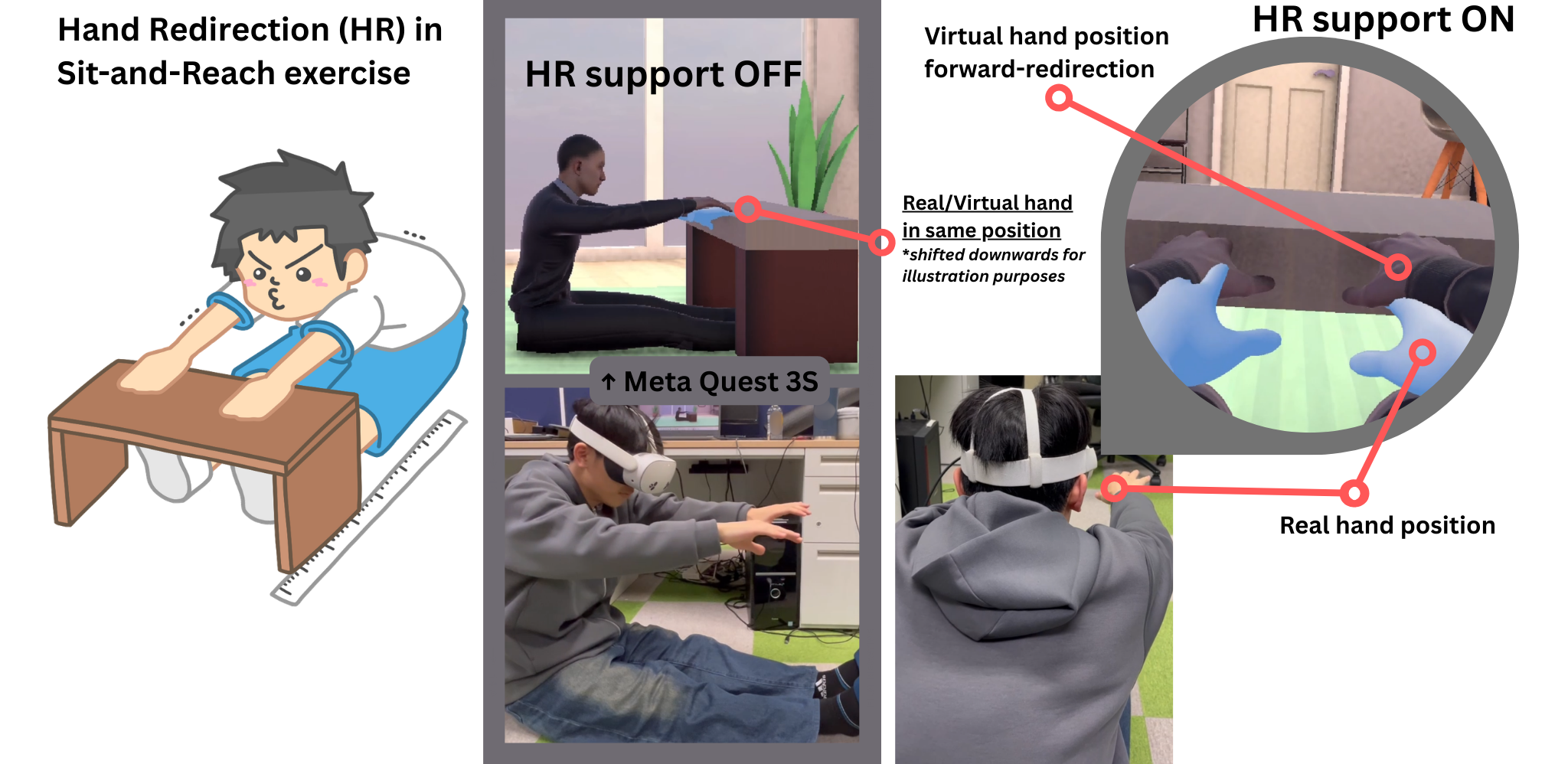
Fig 1: Our initial Meta Quest 3S prototype of HR as subtle cross-sensory support in a sit-and-reach stretching task. This
Limitations
- The work is currently a position paper with a prototype and conceptual research plan; no empirical results or controlled user studies have been reported yet.
- Potential perceptual drift and proprioceptive accuracy degradation with prolonged HR exposure remain unstudied in sustained practice contexts.
- Acceptability and ethical trade-offs around agency, trust, authenticity, and dependence need empirical validation and remain open questions.
- The study focuses on light stretching tasks and non-regular exercisers; effects may differ for other exercises, populations, or task complexities.
- No real-world transfer or long-term retention effects have been measured yet to confirm sustained behavior change.
- Unclear how individual differences in perceptual sensitivity, VR familiarity, or cognitive appraisal affect HR effectiveness and acceptability.
Open questions / follow-ons
- How does subtle HR impact long-term retention, transfer, and sustained autonomous exercise beyond immediate perceived doability?
- What are optimal fading schedules or adaptive strategies to balance early assistance with later autonomous capability?
- Which design cues best support users’ internal attribution of success to themselves rather than the system?
- How do individual differences in sensory sensitivity, VR experience, and motivation modulate the effectiveness and acceptability of HR?
Why it matters for bot defense
Although not directly related to CAPTCHAs or bot defense, this research provides insights into subtle cross-sensory manipulation of perception and cognitive appraisal in VR environments. For bot-defense and CAPTCHA practitioners, the concept of subtle sensory remapping to influence user states without overt cues may inspire novel defensive interaction designs that balance user experience and security requirements. Understanding the perceptual detection thresholds and psychological risks of manipulations is crucial for maintaining trust and authenticity in user interfaces—principles that apply broadly beyond exercise VR to any system aiming to shape human behavior or cognition subtly. Furthermore, the layered approach balancing automation with user awareness offers a useful conceptual framework for designing ethical, autonomy-preserving interactive systems.
Cite
@article{arxiv2604_25443,
  title={ Rewiring Perceived Doability in VR: Hand Redirection as a Subtle Cross-Sensory Support for Sustained Practice },
  author={ Isidro Butaslac and Yota Nagaya and Almira Princess Redoble and Jordan Aiko Deja and Nicko Reginio Caluya and Maheshya Weerasinghe and Taishi Sawabe and Hirokazu Kato and Eric Cesar Vidal },
  journal={arXiv preprint arXiv:2604.25443},
  year={ 2026 },
  url={https://arxiv.org/abs/2604.25443}
}