
Uncovering Relationships between Android Developers, User Privacy, and Developer Willingness to Reduce Fingerprinting Risks
Source: arXiv:2603.29063 · Published 2026-03-30 · By Alex Berke, Güliz Seray Tuncay, Michael Specter, Mihai Christodorescu
TL;DR
This paper investigates how Android developers perceive platform efforts to reduce user tracking via device fingerprinting, a stealthy method that circumvents user controls and privacy protections. Despite previous platform changes aimed at restricting fingerprinting, apps continue to exploit device-specific attributes to track users without consent. Through a survey of 246 professional Android developers, the study evaluates developers' awareness of fingerprinting, their willingness to adopt privacy-protecting changes, and their trade-offs between increased developer effort and enhanced user privacy.
The primary intervention studied is a hypothetical Android platform change called “API Usage Purposes,” requiring developers to declare their intentions for APIs susceptible to fingerprinting in the app manifest. Despite anticipating increased developer effort, 89% of developers supported the change, preferring an optional adoption model over a mandatory one. Surprisingly, developers who currently use fingerprinting were six times more likely to favor the change than those who do not, suggesting potential willingness among the most affected developers to collaborate on privacy improvements. Developers’ main concerns centered on compliance, enforcement, user experience, and engineering challenges. The study further finds that developers generally perceive iOS as more privacy-protective than Android, but this perception narrows among those highly familiar with fingerprinting. The authors highlight opportunities for platforms to engage developers more effectively in improving privacy protections through transparent, actionable policy designs.
Key findings
- 89% of surveyed Android developers supported the hypothetical API Usage Purposes change to reduce fingerprinting, despite anticipated increased effort.
- 41.5% favored a required implementation model and 48.0% favored an optional adoption model; only 10.6% opposed any change.
- Regression analysis shows perceived developer effort negatively correlates with support (OR=0.46, p<0.01), while perceived positive impact on privacy strongly increases support (OR=3.65, p<0.001).
- Developers whose apps or SDKs use fingerprinting were more than 6 times as likely to support the change (OR=6.48, p<0.05), contradicting the initial hypothesis.
- SDK developers have a higher reported fingerprinting rate (38.9%) than app developers (15.4%).
- 46.7% of respondents expressed specific concerns, primarily about compliance and enforcement (most frequent theme), engineering challenges, and user experience.
- Most developers rank iOS above Android for protecting user privacy, but this gap decreases significantly among developers very familiar with fingerprinting.
- Open-ended responses raised trust concerns that developers might falsely declare API usage or evade restrictions and doubts about Google Play Store's enforcement efficacy.
Threat model
The adversaries considered are app developers or SDK providers who knowingly or indirectly fingerprint users to track them without consent, using device-specific APIs that circumvent platform privacy controls. The model assumes these developers understand fingerprinting risks but may evade platform restrictions unless motivated to change. Developers may be rational agents balancing effort and benefit rather than outright malicious actors. The platform and users cannot directly prevent fingerprinting without developer cooperation.
Methodology — deep read
The paper employs a mixed-methods survey study targeting professional Android developers to explore perceptions of fingerprinting-related privacy risks and reactions to a proposed platform intervention. The threat model focuses on developers who use device fingerprinting APIs knowingly or through dependencies, potentially tracking users covertly without user consent or platform support.
Data was collected via an online survey administered by Qualtrics in June 2025, recruiting 498 participants via developer-focused websites and Google Play Store developer accounts. After screening for Android development experience and knowledge of the AndroidManifest.xml and permissions, 246 qualified respondents remained. Demographics skewed heavily male (87%) and primarily aged 35-54.
The survey instrument described a hypothetical Android platform feature “API Usage Purposes,” requiring declaration of fingerprinting-related API uses in the app manifest, inspired by Apple’s analogous “Required Reason API.” Participants rated Android and iOS user privacy protections pre- and post-explanation of the proposed change, indicated their familiarity with fingerprinting, reported whether their app or SDK used fingerprinting, and expressed support for optional vs. mandatory implementation models. Open-ended questions solicited concerns about the change.
Data analysis included logistic regression models to assess how perceived developer effort, perceived user privacy impact, and fingerprinting use predicted support for the change. Additional regressions controlled for demographics, team size, and whether participants worked on apps or SDKs. Qualitative thematic coding of 184 open responses identified concerns grouped into compliance, engineering challenges, user experience, documentation, and other themes. Inter-rater reliability of coding reached a Cohen’s kappa of 0.74 indicating substantial agreement.
As a concrete example, a participant familiar with fingerprinting who reports moderate developer effort and positive privacy impact is predicted to support the change with high odds (significant coefficients in regression). The participant’s concerns might center on potential enforcement loopholes by Google, as indicated in open comments.
No code or dataset is publicly released, but the anonymized survey data is available upon research request. While the survey captures attitudes at a single timepoint with hypothetical intervention, its use of quantitatively modeled predictors and qualitative analysis provides a multifaceted understanding of developer perceptions.
Technical innovations
- First quantitative measurement of Android developers’ trade-off decisions between developer effort and user privacy regarding fingerprinting.
- Novel survey-based modeling of developer willingness to adopt a platform-mandated API declaration approach to mitigate fingerprinting.
- Identification that developers who use fingerprinting themselves are disproportionately supportive of privacy-protecting platform changes, contrary to prior assumptions treating them as adversaries.
- Thematic analysis revealing spontaneous developer concerns about enforcement and compliance absent from formal survey prompts.
Datasets
- Android Developer Survey — 246 professional developers — proprietary, anonymized dataset available on request
Baselines vs proposed
- No prior platform intervention baseline reported; study compares support for hypothetical change under optional vs. required adoption:
- Support for required model: 41.5% vs optional model: 48.0% vs no change: 10.6%
- Developers using fingerprinting support change (OR=6.48) vs non-users (baseline)
- Perceived effort impact on support OR=0.46, perceived privacy impact OR=3.65
Figures from the paper
Figures are reproduced from the source paper for academic discussion. Original copyright: the paper authors. See arXiv:2603.29063.
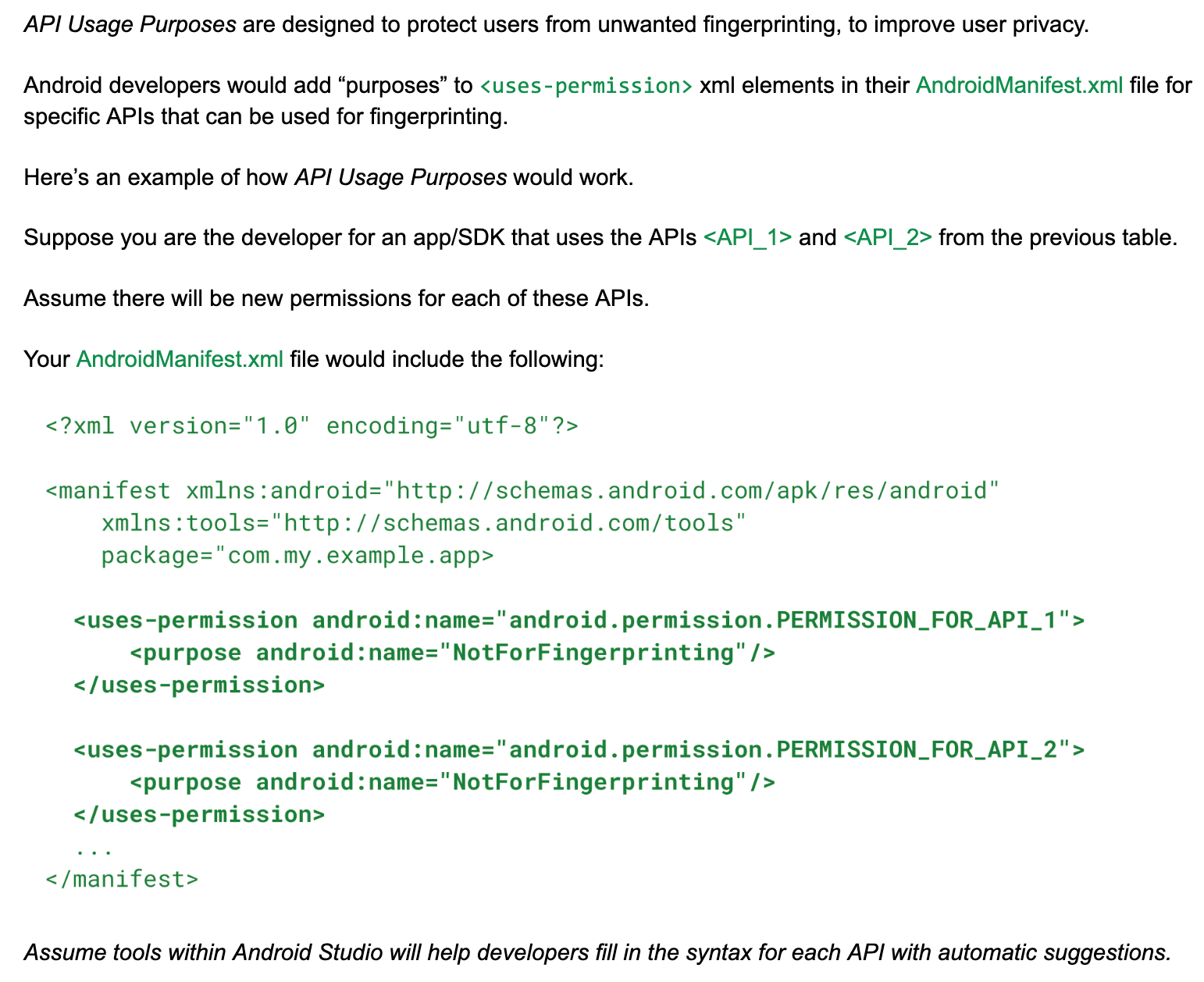
Fig 1: Screenshot from the developer survey (directly before Q16), which explains how developers would implement the
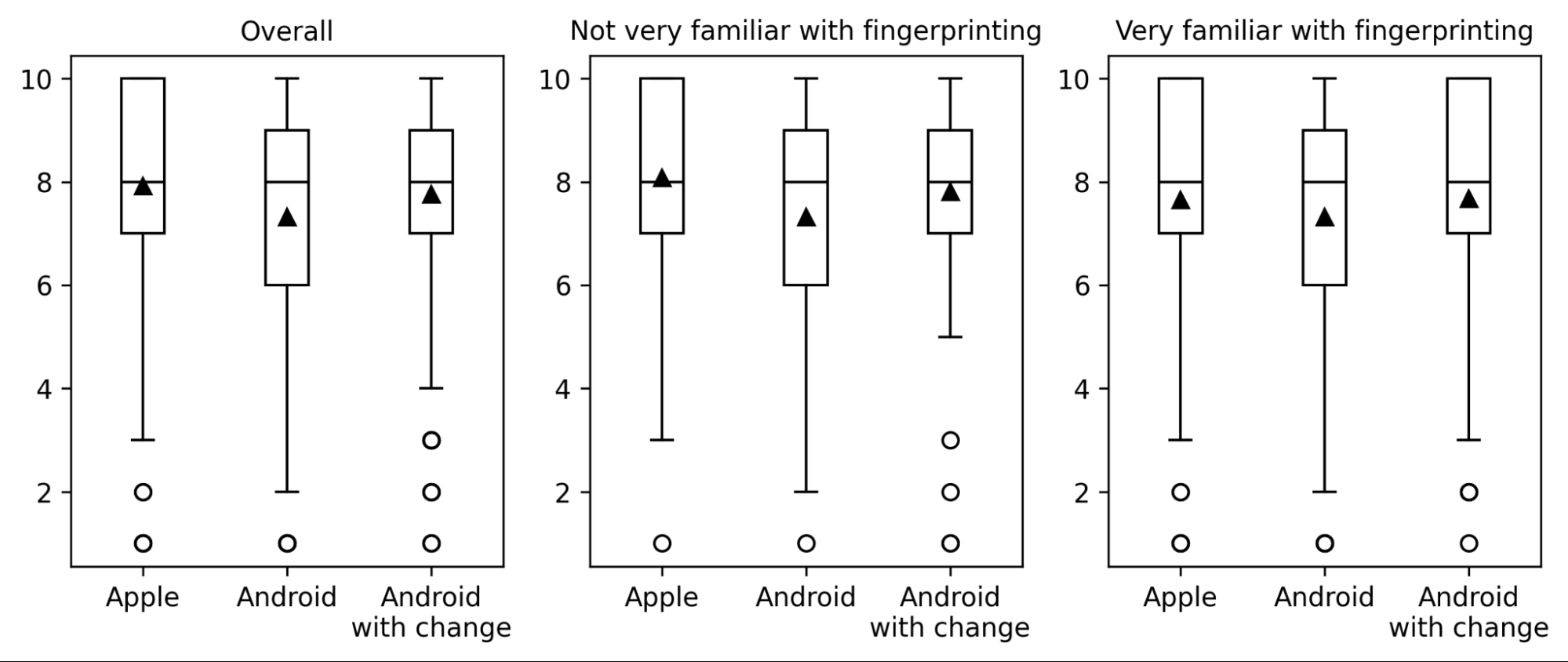
Fig 8: Distribution of levels of agreement for the statements “[Apple/Android] protects user privacy” from 1 (strongly
Limitations
- Survey participants predominantly male and English-speaking, potentially limiting generalizability.
- Self-reported data on fingerprinting use and perceptions may be biased or inaccurate.
- Hypothetical intervention not implemented; developer behavior under real conditions may differ.
- No direct empirical validation of the proposed platform change’s effectiveness or enforcement feasibility.
- Cross-sectional survey lacks longitudinal insights into changing developer attitudes over time.
- Lack of adversarial evaluation—developers who actively seek to circumvent policies not explicitly modeled.
Open questions / follow-ons
- How effective would actual implementation and enforcement of API usage declaration be in reducing fingerprinting in Android apps?
- What incentives beyond optional privacy badges and Play Store ranking could increase developer adoption of privacy-preserving practices?
- How do developer attitudes toward fingerprinting evolve longitudinally as platform policies and enforcement mechanisms mature?
- Can tooling automatically verify or validate declared API usage purposes to strengthen compliance and reduce developer evasion?
Why it matters for bot defense
This study illuminates the critical role app developers play in gatekeeping user privacy, particularly regarding fingerprinting as a covert tracking vector that can undermine user control. Bot-defense and CAPTCHA practitioners should note that developer willingness to adopt privacy-protective practices can be surprisingly high even among those currently using fingerprinting. Effective platform interventions requiring developer cooperation—such as mandatory API usage disclosures—can receive broad support if they balance effort and benefit and provide optional or incentive-based adoption pathways.
Moreover, developer concerns around enforcement and compliance suggest that technical bot-detection or CAPTCHA mechanisms relying on platform cooperation must address these real-world compliance and enforcement challenges to be effective. Insights about SDK vs. app developer roles may also inform how fingerprinting-related defenses are architected. Overall, this work encourages bot-defense teams to engage closely with developer communities and platform ecosystems to build collaborative privacy defenses rather than treating developers solely as adversaries.
Cite
@article{arxiv2603_29063,
  title={ Uncovering Relationships between Android Developers, User Privacy, and Developer Willingness to Reduce Fingerprinting Risks },
  author={ Alex Berke and Güliz Seray Tuncay and Michael Specter and Mihai Christodorescu },
  journal={arXiv preprint arXiv:2603.29063},
  year={ 2026 },
  url={https://arxiv.org/abs/2603.29063}
}