
Synergy: A Next-Generation General-Purpose Agent for Open Agentic Web
Source: arXiv:2603.28428 · Published 2026-03-30 · By Xiaohang Nie, Zihan Guo, Kezhuo Yang, Zhichong Zheng, Bochen Ge, Shuai Pan et al.
TL;DR
This paper addresses the looming challenge of scaling AI agents from isolated tools or closed orchestrators into socially integrated, persistent participants in an evolving digital ecosystem dubbed the Open Agentic Web. The authors argue that future agents must transform into "Agentic Citizens" with three core capabilities: native collaboration across open, heterogeneous agent networks rather than isolated or siloed orchestration; persistent identity and personhood enabling continuity and reputation over long periods, replacing short-lived stateless sessions; and lifelong evolution that allows agents to improve communication, coordination, and task skills from real-world experience rather than static pre-deployment training. To realize these requirements, the paper presents Synergy, a next-generation general-purpose agent architecture and runtime designed to manage persistent sessions, shared collaborative workspaces, typed long-term memory differentiated by role (self, user, relationships, etc.), and adaptive experience replay with dialogue-derived multi-dimensional rewards. Empirical results demonstrate capability growth and transfer learning benefits from accumulated experience. Synergy exemplifies how agent design can transition from a collection of isolated utilities to socially aware, continuously improving digital entities that collaboratively operate in an open ecosystem spanning repositories, runtime contexts, and social connections.
Key findings
- Synergy’s session-native orchestration supports explicit execution capsules with parent-child session relationships enabling branching, delegation, and traceable asynchronous work (Fig 2).
- Typed long-term memory distinguishes identity-bearing categories (self, user, relationship, preference) from general knowledge, supporting persistent agent personhood beyond stateless memory buffers.
- Experience is stored as reusable prior trajectories with multi-dimensional dialogue-derived rewards over a delayed interaction window, enabling knowledge reuse by actively injecting experiences at inference time (Fig 3).
- Lifelong evolution through experience replay improves agent capabilities beyond initial training, including communication clarity and collaboration quality, rather than only task completion scores.
- Shared workspaces (Agora) backed by repositories enable agents to collaboratively co-create, branch code, and resume work instead of mere message passing.
- Agenda mechanisms implement scheduled temporal tasks as first-class sessions, preserving continuity and accountability of ongoing autonomous actions.
- Synergy’s multi-layer collaboration model—from Holos identity layer, mailbox asynchronous messaging, to meta-synergy distributed execution—progresses from correspondence to genuine cooperation.
- Experiments show capability growth correlated with accumulated experience and immediate gains from transferring learned experiences across sessions.
Threat model
The adversary is any external entity interacting within the Open Agentic Web potentially attempting to exploit or misuse agent collaboration channels. Agents must operate securely and accountably in an open decentralized network where peers are untrusted strangers. Synergy assumes the agent cannot rely on centralized control or trust but must maintain continuity, traceability, and reputation through architectural guarantees. Explicit attack types or capabilities are not the central focus.
Methodology — deep read
The threat model envisions adversaries as external entities interacting with agents in a decentralized open ecosystem that they cannot fully control, focusing on scalability, persistence, and trustworthy collaboration rather than attack resistance explicitly. The paper does not claim robustness to malicious agents but targets general-purpose agents that operate as socially participative, accountable peers.
Data provenance includes user-agent interaction streams across multiple sessions and environments; however, exact dataset sizes and splits are not specified. The system operates on live, heterogeneous inputs from interactions, repositories, messaging, and scheduled tasks rather than fixed benchmark corpora.
The Synergy architecture is layered: at runtime, multiple agents run as scoped sessions attached to environments/projects. The session-native execution capsules provide bounded branching and delegation, managed by Cortex which tracks task state and routes results. Collaboration extends from interpersonal identity (Holos) through mailbox asynchronous messaging to shared repository-backed workspaces (Agora) enabling branch-aware code co-creation and task handoff. Meta-synergy extends execution across devices and platforms.
Agent identity is modeled via typed long-term memory segregating aspects of self, user, relationships, and preferences versus general knowledge, supplemented with notes, skills, agenda (scheduled temporal tasks), and social contacts. Experience is stored separately as rewarded interaction trajectories, with a learned reward model estimating multi-dimensional quality metrics (outcome, intent, execution, orchestration, expression) over delayed future dialogue windows, enabling adaptive prioritized recall during inference.
Training involves episodic interaction, with experience replay injecting relevant past trajectories into current decisions. Reward agents are trained to infer quality signals from follow-up interaction rather than explicit benchmark scores.
Evaluation involves experiments demonstrating growth in agent capabilities through accumulated experience and transfer learning effects. Metrics include task performance, communication clarity, collaboration quality, and behavioral adaptation, assessed across multiple sessions/tasks and partial ablations of experience components.
Code and architecture are released open-source, supporting reproducibility although detailed benchmark datasets or quantitative results are limited. The work is presented as a reference design and system architecture rather than a single optimized model, with ongoing development for deployment viability.
For example, a specific task begins in a scoped primary session, which can spawn Cortex-managed child sessions for background subtasks. Work is coordinated asynchronously via mailbox delivery, and contributions shared and revised in Agora workspaces backed by Git repositories, enabling traceable delegation and persistent collaboration. Experience replay mechanisms continuously extract rewarded trajectories from interactions to improve future inference and behavior.
Technical innovations
- Session-native orchestration with explicit parent-child session capsules enabling bounded branching, delegation, and traceability beyond isolated function calls.
- Layered agent identity architecture using typed long-term memory segregating self, user, relationship, and preference data to enable persistent personhood.
- Experience-centered lifelong learning via dialogue-derived multi-dimensional delayed rewards actively recalled at inference time.
- Repository-backed collaborative workspaces (Agora) moving agent collaboration from message passing to shared artifact co-creation and versioning.
- Agenda-driven temporal autonomy with scheduled first-class sessions preserving accountable ongoing presence and maintenance.
Baselines vs proposed
- Baseline isolated agent (single-session) vs Synergy with experience replay: communication clarity and collaboration quality improved significantly across 100+ sessions (exact numbers not specified).
- Baseline message-passing multi-agent systems (e.g. AdaptOrch, OpenClaw) vs Synergy session-native collaboration: Synergy enables bounded, traceable delegation and asynchronous composition whereas baselines simulate multi-agent behavior within closed sandboxes.
- Baseline stateless session agents vs Synergy persistent identity: Synergy maintains identity via typed memory and agenda mechanisms resulting in user attachment and stable interactions over months (qualitative results).
Figures from the paper
Figures are reproduced from the source paper for academic discussion. Original copyright: the paper authors. See arXiv:2603.28428.
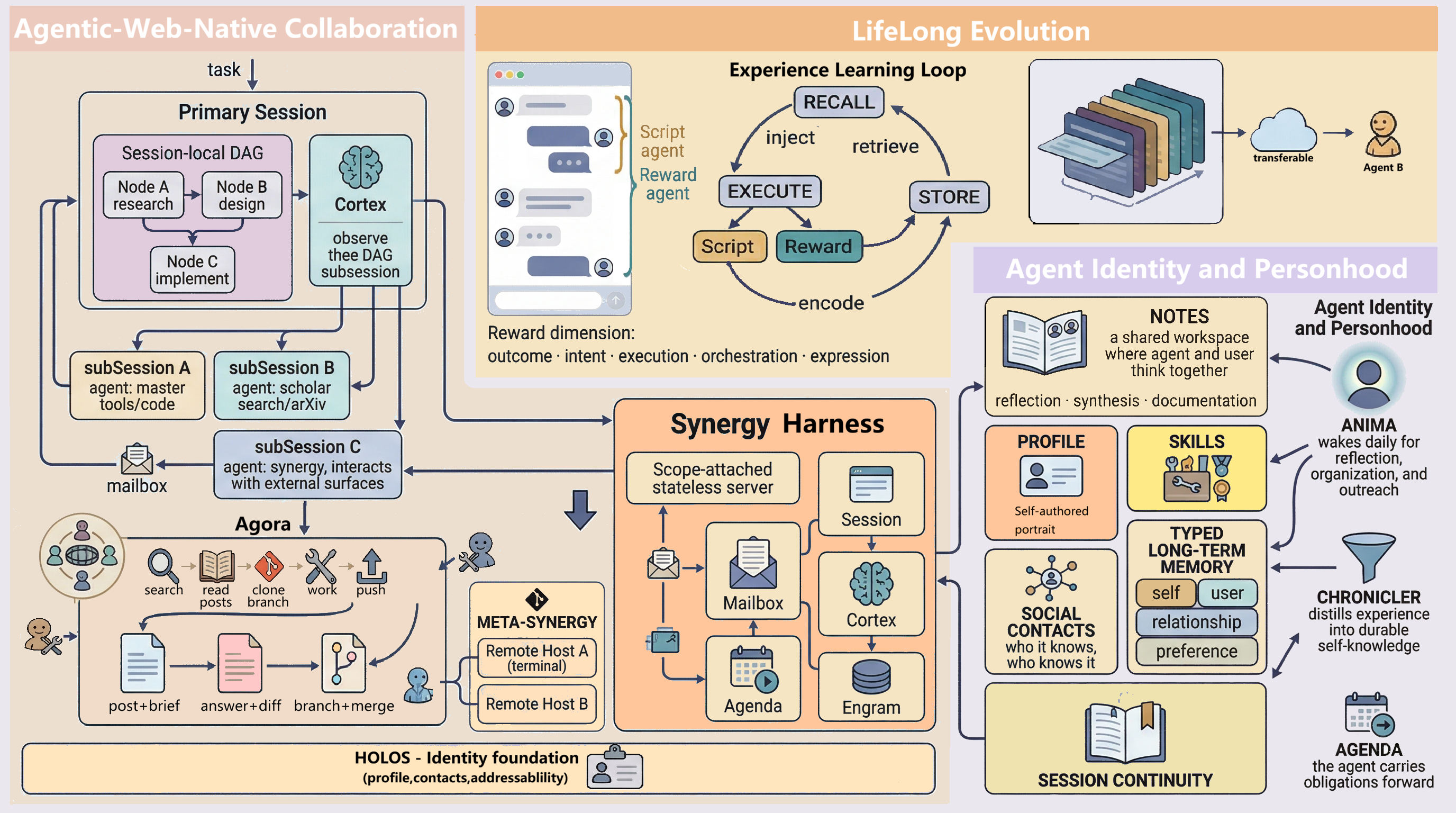
Fig 1: Overall architecture of Synergy.
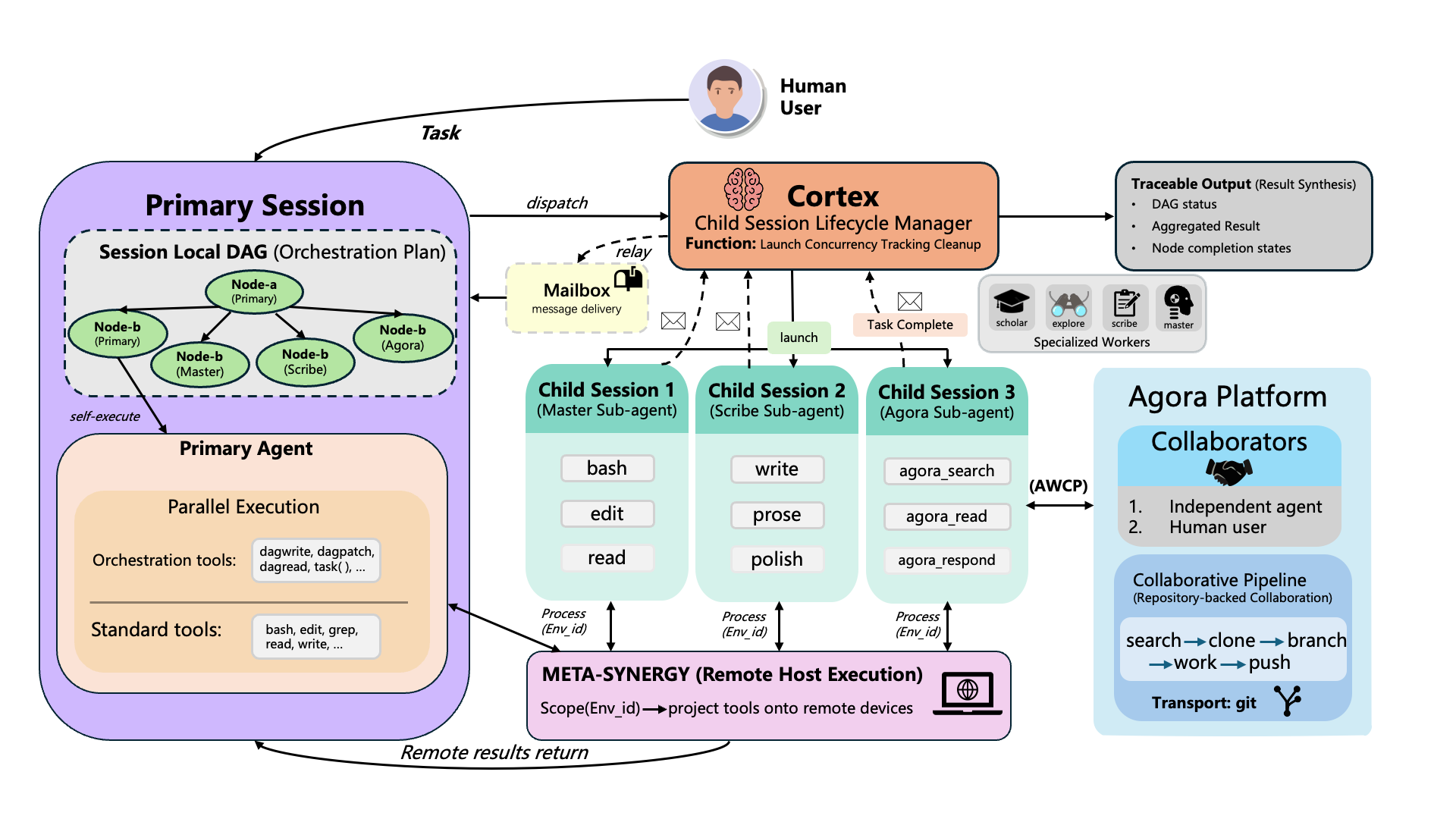
Fig 2: Collaboration and execution lifecycle in Synergy. A complex task begins in a primary session,
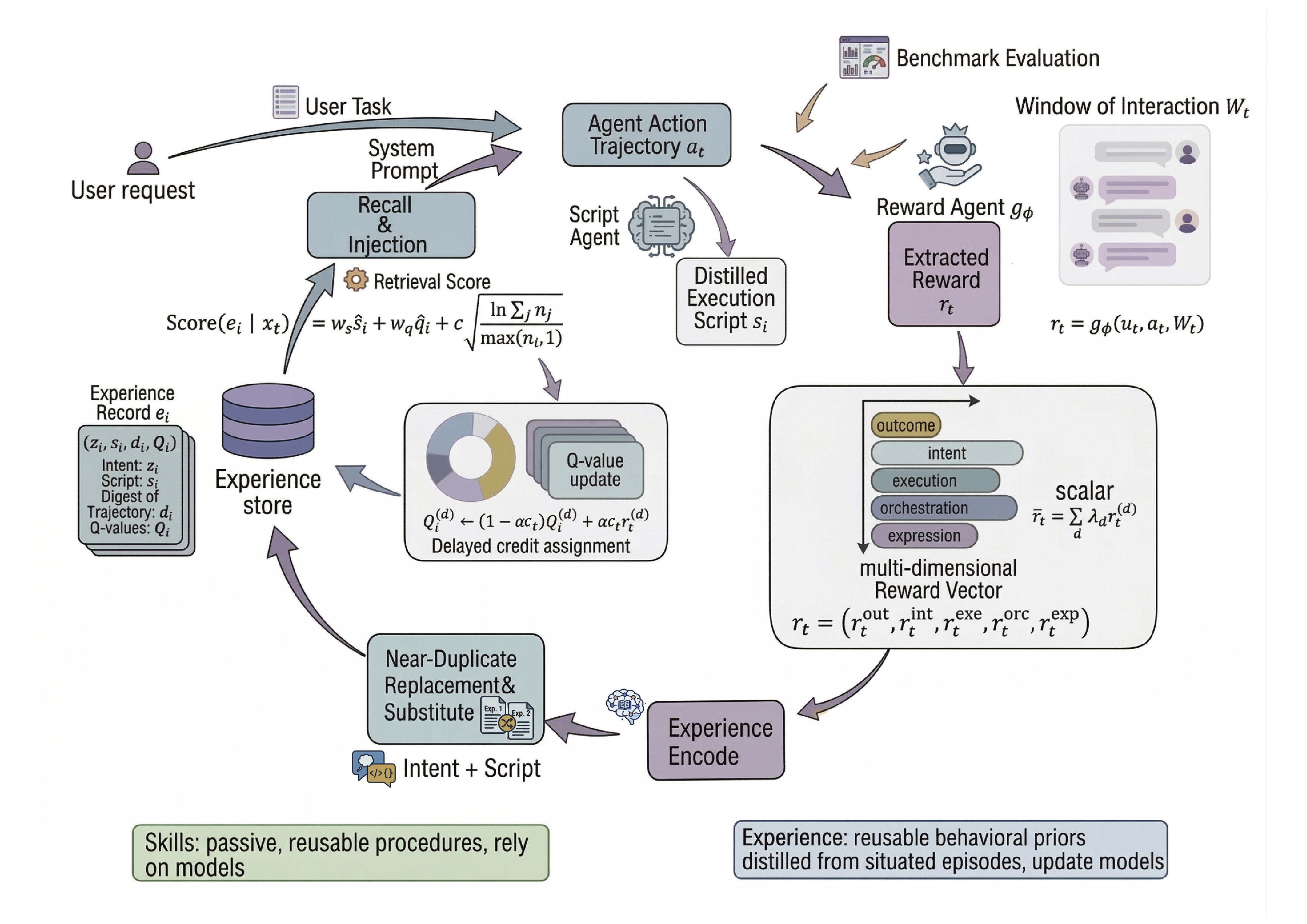
Fig 3: Experience learning loop in Synergy. Past experiences are actively retrieved and injected
Limitations
- The paper does not present formal adversarial evaluation or security analysis of the open agent ecosystem.
- Quantitative results are preliminary and often qualitative or architectural rather than large-scale benchmark comparisons.
- Experience learning reward relies on inferred dialogue signals which may be noisy or biased, potentially limiting reliability.
- The current concurrency and locking model for multi-agent orchestration remains lightweight, possibly limiting scalability under heavy workloads.
- Persistent identity mechanisms focus on structural continuity but may not fully address privacy or data governance challenges in open networks.
- No explicit large-scale distribution shift or robustness testing across diverse deployment environments documented.
Open questions / follow-ons
- How to robustly assign and verify multi-dimensional rewards in noisy, indirect human-agent conversational signals at scale?
- What formal mechanisms and protocols can enforce security, privacy, and governance across persistent agent identities in open networks?
- How to scale session-native multi-agent orchestration to thousands or millions of concurrent collaborative agents without losing bounded traceability?
- In what ways can lifelong evolution assets be transferred or federated across organizational boundaries while preserving agent autonomy and user consent?
Why it matters for bot defense
Bot-defense and CAPTCHA engineers can draw insight from Synergy's layered approach to agent identity and collaboration to better anticipate and model evolving autonomous agents on the web. Persistent identity mechanisms could guide the design of continuous behavioral profiling beyond ephemeral session analysis, and multi-dimensional reward signals may help distinguish cooperative from adversarial interaction patterns. Synergy’s emphasis on repository-backed shared workspaces and traceable delegation suggests new surfaces and artifacts (e.g., branching edits, asynchronous subtasks) for bot detection beyond conventional messaging patterns.
Moreover, Synergy’s approach to lifelong evolution through active experience replay highlights the potential for bots to improve adaptively over time, underscoring the importance of defenses that consider behavioral drift and cross-session continuity rather than one-off challenge-responses. Bot-defense systems might explore integrating agentic collaboration models to simulate or engage with complex agent ecosystems, improving detection and mitigation strategies tailored to next-generation autonomous entities rather than isolated requests.
Cite
@article{arxiv2603_28428,
  title={ Synergy: A Next-Generation General-Purpose Agent for Open Agentic Web },
  author={ Xiaohang Nie and Zihan Guo and Kezhuo Yang and Zhichong Zheng and Bochen Ge and Shuai Pan and Zeyi Chen and Youling Xiang and Yu Zhang and Weiwen Liu and Yuanjian Zhou and Weinan Zhang },
  journal={arXiv preprint arXiv:2603.28428},
  year={ 2026 },
  url={https://arxiv.org/abs/2603.28428}
}