
Is Crowdsourcing a Puppet Show? Detecting a New Type of Fraud in Online Platforms
Source: arXiv:2511.00195 · Published 2025-10-31 · By Shengqian Wang, Israt Jahan Jui, Julie Thorpe
TL;DR
This paper addresses an emerging integrity risk in crowdsourcing platforms like Amazon Mechanical Turk (MTurk): the presence of "puppeteers"—human workers who control multiple "puppet" accounts that bypass conventional attention checks and generate fraudulent data. Analyzing two separate MTurk studies with 558 and 698 participants respectively, the authors find that a strikingly high fraction of accounts—33% in the first study and 56.4% in the second—exhibit behavior indicative of puppetry. The analyses involve detecting identical passwords appearing improbably frequently in the dataset and leveraging browser local storage PIN collision to infer shared control of accounts. Importantly, the evidence suggests the puppets are largely manually operated humans rather than bots, as indicated by interaction patterns and variability in login attempts. The authors argue that single defense mechanisms like attention checks are insufficient to filter out such sophisticated fraud and propose a multi-layered detection framework combining bot and puppeteer detection techniques. This new fraud paradigm threatens the validity of crowdsourced research data, motivating novel countermeasures and reevaluation of prior study conclusions.
Key findings
- In Study 1 (N=558), 193 accounts (34.6%) were identified as puppets controlled by 31 distinct puppeteers, detected by improbable identical password reuse (P values as low as 4.5×10^−279).
- In Study 2 (N=698), 384 accounts (55%) were identified as puppets controlled by at least 38 puppeteers, detected by shared 4-digit PIN values stored in local browser storage across multiple MTurk IDs (chance probability 0.00016).
- Combined inattentive and puppet accounts in Study 1 totaled 57%, comparable to the 56.5% puppets in Study 2, indicating widespread fraud.
- Analysis of GUI interaction data from Study 1 showed no conclusive evidence of bots; variability in failed logins and unique behaviors indicate human operators behind puppets.
- Existing attention checks fail to filter puppets, as human puppeteers can identify and correctly answer them.
- Highly identical response patterns were rare, suggesting puppeteers do not simply replay sets of answers but manually engage with each account.
- Common bot-detection methods (time-based metrics, question pattern analysis, browser fingerprinting) remain relevant but require complementary capabilities to detect manually controlled puppets.
- Renting or trading of qualified MTurk worker accounts on social media is prevalent and undermines platform qualification filters, worsening the puppeteer problem.
Threat model
The adversary is a human crowdsourcing worker (puppeteer) who controls multiple MTurk worker accounts (puppets) manually to maximize financial benefits and evade detection. They may use VPNs or rented accounts to bypass geographical and eligibility filters. The puppeteer is assumed not to deploy fully automated bots for task completion but may employ partial automation. They know the presence of attention checks and standard bot detection features and adapt to bypass these. However, they do not have privileged access to internal platform data or the ability to compromise backend systems. Attacker capabilities exclude deploying large-scale AI-driven bots with perfect automation but include manual control of multiple accounts and reusing credentials across accounts.
Methodology — deep read
The study involves a detailed forensic analysis of two independent Amazon Mechanical Turk (MTurk) user studies conducted in 2022, each originally aimed at authentication system research and unexpectedly revealing puppeteer fraud. The threat model assumes an adversary (puppeteer) who controls multiple accounts (puppets) manually but without running full-fledged bots. These puppeteers evade typical automated detection and pass attention checks.
Data provenance includes two user studies: Study 1 (N=558) required US residents with ≥95% HIT approval and ≥500 prior tasks; participants created passwords and answered questionnaires over two sessions while mouse/keyboard interactions were recorded. Study 2 (N=698) also used US participants with similar qualifications, assigning unique 4-digit PINs stored in local browser storage across sessions and groups, allowing linkage of accounts sharing PINs.
For Study 1, the primary puppet detection method utilized improbable repeated password usage: leveraging the "Pwned Passwords" dataset with ~5.5 billion leaked credentials, the probability (p) of each password was computed; the binomial distribution was then applied to calculate P(X≥k) where k is the number of repeated instances. Passwords with extremely low probabilities (down to 10^-279) indicated multiple accounts controlled by the same puppeteer.
Study 2 employed a simpler but novel detection leveraging browser local storage: the same 4-digit PIN appearing on different MTurk IDs strongly suggested those accounts shared a browser profile and thus a puppeteer. The probability of random coincidence was calculated as 0.00016, deeming matches to be puppets.
To disambiguate human vs. bot control, Study 1’s GUI interaction logs were analyzed for "human-like" inefficiencies or variability, including diverse mouse scrolling, failed logins, and unique search usage. Bots tend to have rigid, uniform timings and repetitive patterns, but the puppets exhibited varied responses and repeated login failures consistent with manual human use.
Across both studies, attention check performance was quantified, showing puppeteers often pass these checks, indicating human cognition. Additional signals including identical multiple-choice patterns, free-form text answer similarity, and timing profiles were employed to evaluate bot likelihood, revealing minimal correlation.
Neither dataset nor frozen model weights were released. Some statistical analysis used binomial cumulative functions with exact computed probabilities for password repetition. The studies did not use cross-validation as they were investigative dataset analyses rather than predictive modeling.
A concrete example is given by Study 1, where, e.g., one puppeteer controlled 57 accounts sharing an extremely rare password with P(X≥57) ≈ 4.5×10^-279, with interactions showing varied login errors over sessions, strongly implying manual operation.
Limitations include potential underestimation of puppet numbers in Study 2 due to group assignment fragmentation and inability to fully exclude bot assistance in partial tasks.
Technical innovations
- Novel detection of puppeteers on crowdsourcing platforms via statistical improbability of repeated passwords leveraging a 5.5 billion leaked password corpus.
- Use of browser local storage PIN collisions across multiple MTurk IDs to infer multiple accounts controlled by the same human operator.
- Demonstration that puppeteers controlling multiple accounts can evade standard attention checks designed for bots or inattentive workers.
- Multi-faceted fraud detection framework combining bot detection techniques (timing, behavior, fingerprinting) with puppeteer-specific heuristics based on behavior variability and account linkage.
Datasets
- AMT Study 1 — 558 participants — internal crowdsourcing experiment with password selection and questionnaire data
- AMT Study 2 — 698 participants — internal crowdsourcing experiment involving PIN memorization with browser local storage
Baselines vs proposed
- Inattentive workers vs puppets in Study 1: Inattentive 22.7% vs Puppets 34.6%
- High eligibility filter impact (from referenced Dupuis et al.): 12.4% usable responses at lower HIT criteria vs 31.3% at higher eligibility, contrasted with 34.6% and 55% puppets detected here despite filters
- Attention check pass rates: Puppets largely pass attention checks, demonstrating evasion capability beyond standard baseline checks
Figures from the paper
Figures are reproduced from the source paper for academic discussion. Original copyright: the paper authors. See arXiv:2511.00195.

Fig 1: A screenshot for an advertisement related to rental Amazon MTurk accounts on Facebook, (captured on

Fig 2: Screenshots for Facebook posts related to Amazon MTurk trading in public groups, (captured on
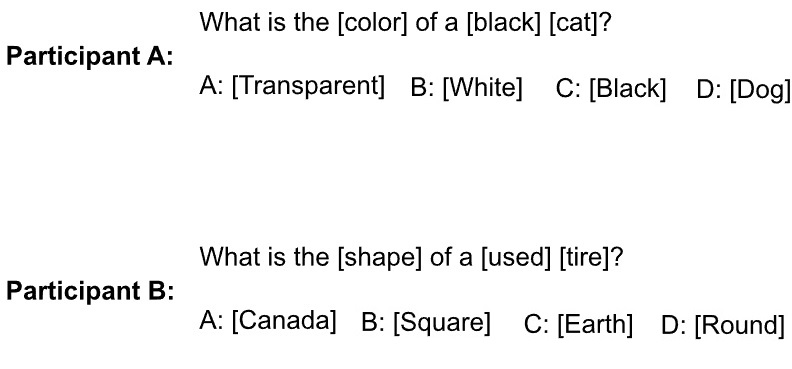
Fig 3: Simple example of a dynamic multiple choice question. Text in brackets are dynamic words inserted on the
Limitations
- No comprehensive adversarial evaluation against puppeteers actively trying to deceive detection heuristics; only observational analysis.
- Study 2’s puppet detection via PIN collisions may underestimate puppeteer prevalence if accounts are split across groups with different local storage.
- Lack of ground truth labels for puppets forces reliance on heuristic and probabilistic inferences.
- No deployment or real-time detection system implementation and evaluation; purely offline forensic analysis.
- Privacy constraints prevent collection of raw IP addresses or full browser fingerprints, limiting user linkage features.
- Potential for some overlap between inattentive and puppet categories, complicating clear categorization.
Open questions / follow-ons
- How can real-time detection systems effectively identify puppeteer-controlled multiple account fraud without excessive false positives?
- What advanced behavioral biomarkers beyond passwords and local storage can better disambiguate puppeteer actions from legitimate users?
- Can generative AI be leveraged both by puppeteers to evade detection and defenders to design adaptive detection algorithms?
- How prevalent is the puppeteer threat across other major crowdsourcing or gig economy platforms beyond MTurk?
Why it matters for bot defense
This work highlights a novel and subtle form of platform fraud involving manual control of multiple accounts rather than classic automated bot activity. For bot-defense and CAPTCHA practitioners, the findings imply that traditional automated bot detection methods and standard attention checks are insufficient to ensure data integrity when adversaries engage humans to operate multiple puppet accounts. Multi-layered and behaviorally informed detection mechanisms that consider probabilistic credential reuse, browser fingerprinting, and subtle user interaction traits will be critical countermeasures.
Importantly, CAPTCHA or bot defenses solely relying on automated interaction patterns or simplistic attention questions may be bypassed by human-operated puppets. Hence, integrating cross-account linkage analysis and anomaly detection becomes essential. Moreover, as generative AI bots become more prevalent, detection frameworks must evolve to address hybrid fraud involving both human puppeteers and automated components. This paper encourages revisiting verification design and data quality validation in crowdsourcing contexts, reinforcing the need for a diversified defense posture.
Cite
@article{arxiv2511_00195,
  title={ Is Crowdsourcing a Puppet Show? Detecting a New Type of Fraud in Online Platforms },
  author={ Shengqian Wang and Israt Jahan Jui and Julie Thorpe },
  journal={arXiv preprint arXiv:2511.00195},
  year={ 2025 },
  url={https://arxiv.org/abs/2511.00195}
}