
Magnetic Field Line Chaos, Cantori, and Turnstiles in Toroidal Plasmas
Source: arXiv:2510.25047 · Published 2025-10-29 · By Allen H Boozer
TL;DR
This paper provides a comprehensive review and synthesis of the mathematical concepts of chaos, cantori, and turnstiles as they apply to magnetic field lines in toroidal fusion plasmas, specifically tokamaks and stellarators. Though these concepts underpin key physical phenomena—such as magnetic reconnection, microinstabilities, and plasma-wall interactions—their explicit discussion in fusion plasma literature has been limited. The author clarifies the subtle properties of magnetic field line chaos, the breakup of magnetic surfaces into chains of islands, and the role of cantori surfaces with localized holes (turnstiles) in facilitating magnetic flux transport. These topological insights elucidate mechanisms behind non-resonant divertors in stellarators, disruptions in tokamaks, and runaway electron damage. The paper also introduces Fourier decomposition techniques to precisely analyze cantori and turnstiles, enabling finer characterization of field line behavior beyond standard Poincaré plots.
Key results include quantitative relationships connecting exponential separation of neighboring field lines to magnetic surface breakup, the identification of the last confining surface as a cantorus with paired turnstiles, and the recognition of the importance of non-ideal effects in triggering reconnection once surfaces become highly contorted. The work emphasizes that ideal magnetic evolution cannot maintain resonant island perturbations without producing singular current sheets and that real plasmas, with small resistivity, rapidly lead to chaotic magnetic volumes. Finally, practical implications on fusion device design, especially regarding stellarator divertors and tokamak disruption mitigation, are discussed through these topological and dynamical system lenses.
Key findings
- Magnetic field lines exhibit exponential separation of infinitesimally neighboring lines quantified by a maximum Lyapunov exponent σmax, causing flux tube distortion by factors up to ~10^7 during ideal evolution (Fig. 3).
- Breakup of magnetic surfaces occurs via resonant perturbations forming chains of magnetic islands at rational rotational transform surfaces ι = n/m, with island width scaling as the square root of the perturbation amplitude (Equations 3.2 and 3.3).
- The last surviving magnetic surface before large chaotic regions form is a cantorus—an irrational surface with holes (turnstiles) where ⃗B·ˆn ≠ 0 allows magnetic flux leakage; turnstiles come in inward-outward flux pairs due to divergence-free field (Section 5).
- Fourier decomposition of field-line coordinates with Gaussian-windowed FFTs provides a more precise and quantitative method to locate cantori and measure turnstile flux collimation than conventional Poincaré plots (Section 5.1).
- Non-resonant stellarator divertors rely on cantori and turnstiles to form helical flux tubes that channel plasma exhaust to specific wall regions; the width of these divertor flux tubes correlates with turnstile size, typically only a few percent of the cantorus area (Section 5.2).
- Ideal perturbations that resonate with rational surfaces produce singular delta-function current densities, causing explosive magnetic surface distortion and rapid surface breakup in realistic plasmas with small resistivity (Section 6.1).
- Overlap of island chains from nearby rational surfaces triggers large chaotic magnetic volumes, but the actual penetrations rely on turnstile flux tubes through cantori, a more subtle and precise mechanism than approximate island overlap (Section 4 and 5).
- Magnetic reconnection timescales are governed by a combination of ideal evolution and the exponential separation scale σr, setting when small non-ideal effects cause rapid topology change (Section 6.1.2).
Threat model
The conceptual adversary is the combination of small non-ideal plasma effects such as resistivity and perturbations that cause magnetic surface breaking, chaotic magnetic field line behavior, and reconnection. The ideal assumptions are broken by these real physical perturbations, which introduce singular current layers and localized magnetic flux transport through turnstile pairs. The plasma evolution is generally assumed to be ideal except where these small non-ideal effects trigger topology changes. No intentional malicious adversary is modeled.
Methodology — deep read
Threat model & assumptions: The paper treats the magnetic field lines in toroidal plasmas as Hamiltonian trajectories with coordinates (ψt, θ, φ), assuming a magnetostatic snapshot at fixed time first, then considering slow time variations. The assumption is that the magnetic field is divergence-free (∇·B=0), smooth except at resonant rational surfaces where ideal MHD breaks down producing singular current sheets. The adversary, in a conceptual sense, is the non-ideal plasma resistivity or perturbations that cause magnetic surface breaking and chaos.
Data: The investigation is theoretical and computational, using analytic models like the Standard Map to illustrate island chains and chaos, and employing Fourier analysis on numerically followed magnetic field lines to characterize cantori. The paper references numerical examples and previous simulations but does not provide new large-scale datasets or experimental data. Quantities like the rotational transform ι(ψt) and poloidal flux ψp(ψt, θ, φ, t) serve as the essential functions defining the magnetic field.
Architecture/algorithm: Magnetic field lines are modeled as Hamiltonian trajectories governed by ψp as the Hamiltonian. Resonant perturbations with mode numbers (m, n) introduce magnetic islands. Chaos arises when these island chains overlap or when surfaces break to form cantori. The novel analytical tool is applying Gaussian windowed Fourier transforms on spatial coordinates of field lines (R(φ), Z(φ)) to identify surfaces, quantify cantori presence, and measure the narrowness and flux content of turnstiles—improving upon traditional Poincaré plots.
Training regime: Not applicable as this is an analytical and theoretical study.
Evaluation protocol: The validity of the analysis is illustrated by comparing properties of numerical standard maps with calculated flux tube distortions. Theoretical scaling laws are derived for island widths, flux through turnstiles, and exponential separation (σmax). The approach also cross-references previous numerical and experimental plasma results from literature for support and context. No explicit statistical tests or machine learning metrics apply.
Reproducibility: The paper references previous foundational work by Boozer and collaborators, and the methods (mathematical derivations and Fourier decompositions) are described in sufficient detail to replicate given access to corresponding magnetic equilibria. No specific code or datasets are released; reliance is on published equations and prior data (e.g., Boozer 2004, Punjabi & Boozer 2025).
Example end-to-end: Starting from a magnetic equilibrium with known rotational transform profiles, the author describes how a resonant perturbation at rational surfaces introduces island chains of size proportional to perturbation amplitude. On increasing perturbation, these islands overlap forming chaotic regions bounded by cantori with turnstiles. Tracking magnetic field lines in (R, Z, φ) coordinates and Fourier decomposing their spatial trajectories permits identification of cantori as surfaces where field lines linger and precise localization and quantification of highly collimated turnstiles (flux leakage channels). This knowledge then connects to physical phenomena such as plasma transport through these turnstiles in a stellarator divertor or rapid disruption onset in a tokamak when ideal perturbations reach singular current densities.
Technical innovations
- Application of Gaussian-windowed Fourier transform analysis on magnetic field line coordinates to quantitatively resolve cantori and turnstiles, surpassing traditional Poincaré plots (Section 5.1).
- Demonstration that ideal resonant perturbations inherently induce singular, delta-function current densities on rational surfaces, requiring non-ideal effects to achieve magnetic reconnection and surface breakup (Section 6.1).
- Identification and characterization of turnstiles as paired, highly collimated magnetic flux tubes leaking through holes in cantori surfaces, fundamental for plasma-wall interaction and stellarator divertor physics (Section 5).
- Clarification that exponential separation of neighboring magnetic field lines (Lyapunov exponent σmax) causes extreme magnetic flux tube deformation, influencing reconnection timescales and runaway electron confinement (Sections 4 and 6).
Figures from the paper
Figures are reproduced from the source paper for academic discussion. Original copyright: the paper authors. See arXiv:2510.25047.
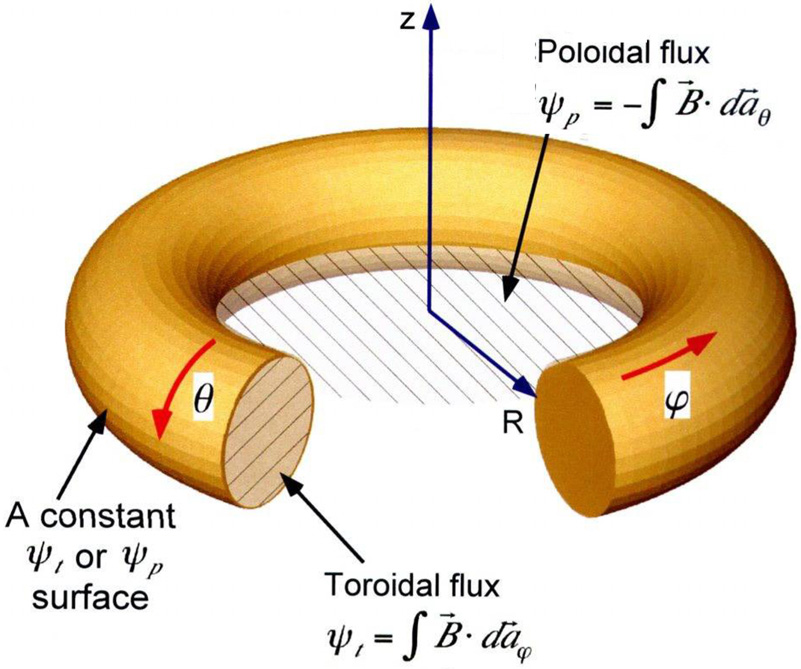
Fig 1: The poloidal flux ψp is defined by the magnetic flux penetrating the hole in the
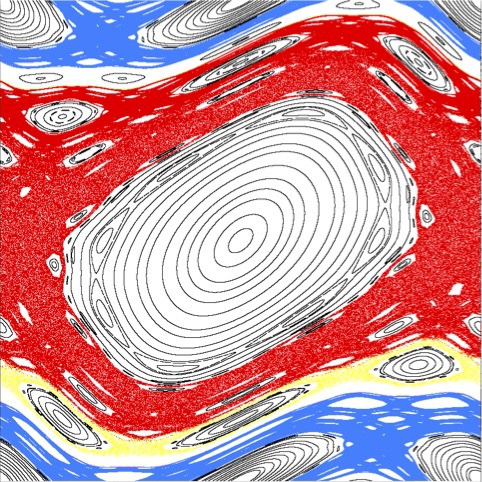
Fig 2: The Standard Map gives trajectories by iteration in a space of two periodic
Fig 3: A magnetic field ⃗B(⃗x, t) can be thought of as consisting of tubes of magnetic flux by
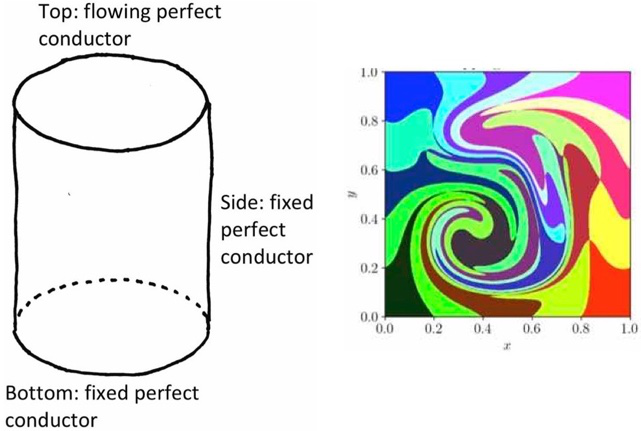
Fig 4 (page 8).
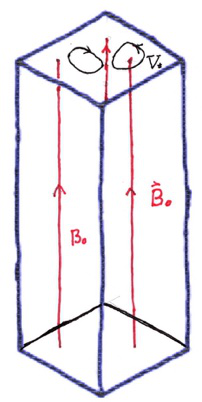
Fig 5 (page 8).
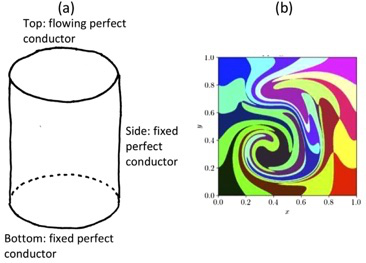
Fig 6 (page 8).
Limitations
- No large-scale numerical simulations or experimental validation of the quantitative Fourier-based cantori and turnstile identification technique are presented; method demonstrated on theoretical/analytic examples.
- The analysis focuses on magnetostatic snapshots or slowly evolving equilibria, leaving fast transient phenomena and full 3D nonlinear dynamics of disruption and reconnection for future work.
- Assumes smooth magnetic fields except at resonant surfaces; real plasmas with turbulent or stochastic perturbations may deviate.
- The approach requires sufficiently resolved magnetic field equilibria and precise field line tracing, which may be challenging for experimental magnetic measurements or highly noisy data.
- The impacts on plasma transport and impurity control from turnstiles are inferred qualitatively from field line topology rather than quantitatively modeled with full kinetic or fluid transport physics.
Open questions / follow-ons
- How do finite resistivity and turbulence quantitatively affect the evolution, formation, and dynamics of cantori and turnstiles in realistic 3D fusion plasmas?
- Can the Fourier-based cantori and turnstile identification method be adapted for experimental magnetic data with measurement uncertainty and incomplete field line tracing?
- What role do cantori and turnstiles play in impurity transport and radiation dynamics at the plasma edge, and how do these flux tubes interact with neutral gas and recycling?
- How can optimized stellarator designs leverage control of cantori and turnstile structures to improve divertor resilience and plasma confinement?
Why it matters for bot defense
Although not directly related to bot defense or CAPTCHA design, this paper contributes a deep analytical and topological framework for understanding chaotic trajectories and transport bottlenecks—concepts that may be abstractly analogous to dynamical systems and mixing processes in spatial domains. For CAPTCHA practitioners, the methods of decomposing complex trajectories in periodic coordinate spaces into harmonic components to identify subtle boundaries and flux channels could inspire novel approaches to analyzing spatial or graph-based bot behavior patterns. Moreover, the paper’s emphasis on detailed characterization of chaotic boundaries (cantori) and their narrow openings (turnstiles) parallels the challenge of detecting hidden or rare vulnerabilities (akin to turnstiles) in security systems. While the domain and detailed physics differ, the rigorous quantitative approach to delineating chaotic but structured regions may inform advanced anomaly detection or robustness evaluation techniques.
Cite
@article{arxiv2510_25047,
  title={ Magnetic Field Line Chaos, Cantori, and Turnstiles in Toroidal Plasmas },
  author={ Allen H Boozer },
  journal={arXiv preprint arXiv:2510.25047},
  year={ 2025 },
  url={https://arxiv.org/abs/2510.25047}
}