
Bot detection services are specialized tools designed to differentiate human users from automated bots on websites and applications. Their core function is to prevent malicious activities such as credential stuffing, fake account creation, scraping, and spam by verifying legitimate user behavior. Effective bot detection helps maintain security, protect user data, and ensure reliable site performance.
What Are Bot Detection Services and Why Do You Need Them?
Every website exposed to public access risks bot attacks—scripts designed to mine data, generate fake traffic, or exploit vulnerabilities. Bot detection services provide essential defense by verifying users through challenges, behavior analysis, or risk scoring mechanisms. Without them, websites face risks such as:
- Account takeover through automated logins
- Inflated traffic metrics harming analytics accuracy
- Skewed advertising performance from non-human traffic
- Abuse of registration or checkout processes
By weeding out bots, these services allow businesses to ensure a smoother experience for genuine users and reduce fraud and operational costs.
Key Technologies Behind Bot Detection Services
Bot detection approaches vary in methodology and complexity. Understanding the common techniques helps in choosing the right protection:
1. Challenge-Response Tests (CAPTCHAs)
These tests require users to complete a task difficult for bots but simple for humans—such as identifying objects in images, typing distorted text, or solving puzzles. They are the backbone of services like Google reCAPTCHA, hCaptcha, and CaptchaLa.
2. Behavioral Analysis
By monitoring mouse movements, typing speed, and interaction patterns, services generate risk profiles to flag suspicious activity without interrupting user flow. This method balances security and user experience, often seen in solutions like Cloudflare Turnstile.
3. Device and Network Fingerprinting
Advanced detection collects data on browser fingerprints, IP reputation, and device characteristics to recognize known bot signatures.
4. Machine Learning Models
Combining signals from multiple sources, machine learning models adapt over time, improving detection accuracy of evolving bots.

Comparing Popular Bot Detection Services
Here’s an objective overview of some widely used bot detection providers, including their support and features:
| Feature / Service | CaptchaLa | Google reCAPTCHA | hCaptcha | Cloudflare Turnstile |
|---|---|---|---|---|
| Core Tech | CAPTCHA challenges + token validation | CAPTCHA challenges + risk analysis | CAPTCHA challenges + privacy focus | Invisible challenges + behavioral |
| SDKs | Web (JS/Vue/React), iOS, Android, Flutter, Electron + server SDKs | Web, mobile SDKs | Web, mobile SDKs | Web SDK |
| Supported Languages | 8 UI languages | Multiple | Multiple | Limited |
| Pricing | Free 1000/mo; Pro 50K-200K; Business 1M | Mostly free, enterprise options | Free and pay-as-you-go | Free tier with limits |
| Privacy | First-party data only | Google data processing involved | Privacy-friendly alternative | Collects some user data |
| Integration | Simple loader and API validation | Token + backend verification | Token + backend verification | Invisible, low-friction |
Each of these services has strengths depending on your priorities—whether it's ease of integration, user experience, privacy, or scaling. CaptchaLa offers an alternative emphasizing first-party data use and multi-platform SDK support, which can be appealing for businesses looking for deeper control over bot defense.
Technical Insights: How to Validate a User with CaptchaLa
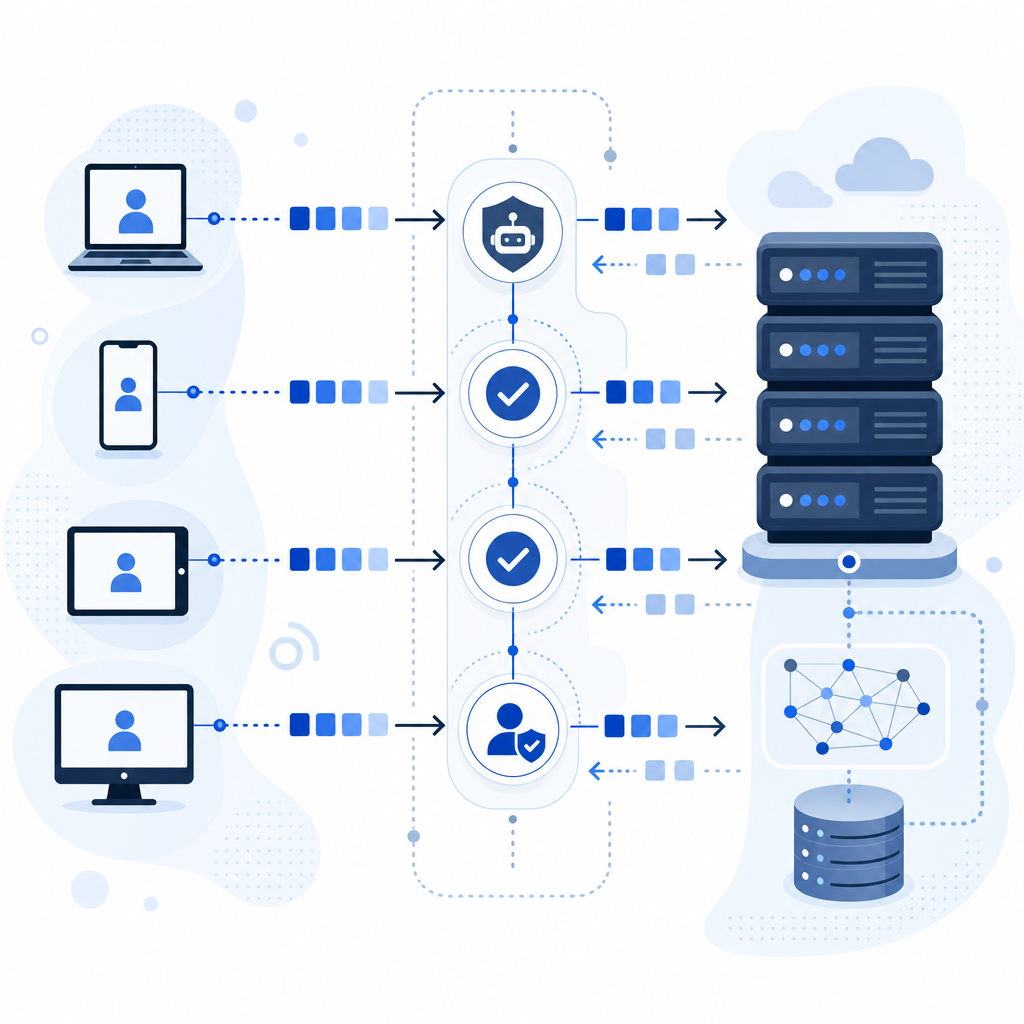
To implement bot detection, server-side verification is crucial. Here's a simplified step sequence for validating CAPTCHA completion using CaptchaLa:
Render the CAPTCHA widget on your site using CaptchaLa’s loader script:
html<script src="https://cdn.captcha-cdn.net/captchala-loader.js"></script>After user interaction, your frontend receives a
pass_token.Send the token and client IP to CaptchaLa's API for verification:
httpPOST https://apiv1.captcha.la/v1/validate Headers: X-App-Key: yourAppKey X-App-Secret: yourAppSecret Body: { "pass_token": "token-from-client", "client_ip": "user-ip-address" }Process the API response server-side to decide if the user passes or fails the bot check.
This approach ensures that only validated users proceed past sensitive actions like login or payment processing.
Tips for Choosing and Implementing Bot Detection Services
When selecting a bot detection solution, keep these technical and operational factors in mind:
User Experience: Opt for services that balance security with smooth usability. Invisible or low-friction tests reduce abandonment.
Integration Flexibility: Support for your tech stack (JS frameworks, mobile platforms) eases deployment. CaptchaLa supports many SDKs including React, Flutter, iOS, Android, and more.
Privacy Compliance: Consider solutions that minimize data sharing outside your environment if privacy regulations like GDPR or CCPA are concerns.
Scalability & Pricing: Estimate your traffic and bot challenge volume. CaptchaLa’s tiered pricing (free for 1000 monthly validations, scalable to millions) compares favorably for growing sites.
Backend Verification: Always complement frontend challenges with server-side validation to prevent token spoofing or bypass.
Multi-Layer Security: Combine CAPTCHA with IP reputation checks, rate limiting, or behavioral analysis for increased protection.
Conclusion
Effective bot detection services are a necessity for maintaining the integrity and usability of modern websites. While solutions like Google reCAPTCHA, hCaptcha, and Cloudflare Turnstile are popular choices, alternatives such as CaptchaLa offer robust features including multi-platform SDKs, first-party data validation, and competitive pricing tiers.
By understanding the technologies behind bot detection and carefully matching them to your needs, you can better protect your platform from fraud and abuse while providing seamless access to real users.
For a deeper dive into integration and capabilities, check out the CaptchaLa documentation or explore pricing plans to find the right fit for your site’s bot defense strategy.