
Bot detection online is the critical practice of identifying malicious or automated traffic that can harm your website’s performance, security, or user experience. It involves distinguishing legitimate human users from bots trying to scrape data, commit fraud, or launch attacks. Effective bot detection protects resources, preserves analytics integrity, and reduces operational risks in digital environments.
This post breaks down the key techniques powering modern bot detection, compares popular solutions, and explains how developers and site owners can integrate these defenses, including options like CaptchaLa.
What Is Bot Detection, and Why Does It Matter?
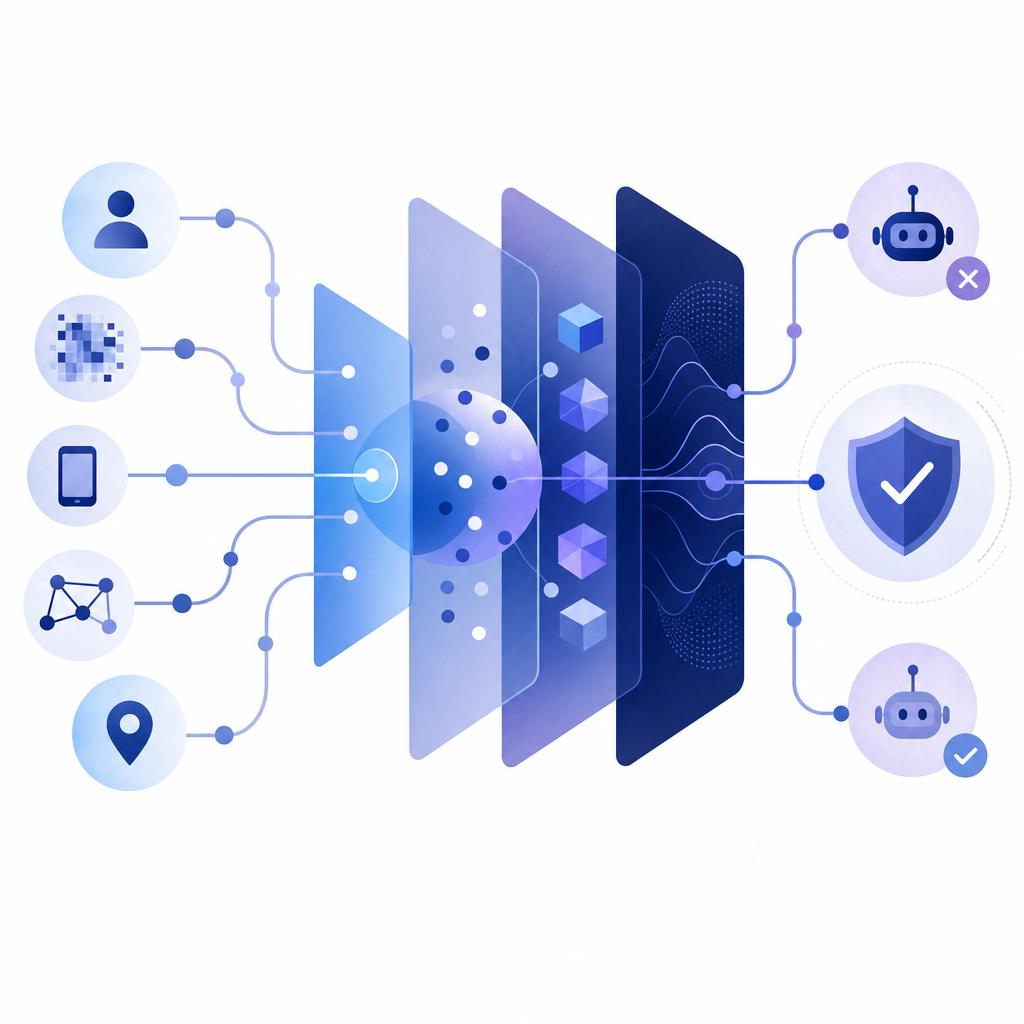
At its core, bot detection is the process of analyzing interactions with your website or application to determine if they originate from real people or automated scripts and programs. Unlike traditional CAPTCHAs that simply challenge users, sophisticated bot detection solutions operate transparently behind the scenes—tracking behavior, fingerprinting devices, or issuing subtle challenges.
Bot traffic accounts for an estimated 40%-50% of all web requests and can lead to:
- Data scraping that compromises intellectual property
- Automated form submissions causing spam or abuse
- Credential stuffing and account takeover attacks
- Distorted web analytics and business intelligence
- Increased bandwidth and hosting costs
Every website that accepts user input or exposes an API faces bot risks. Strong detection mechanisms allow for timely blocking or mitigation of suspicious traffic, improving security posture and user experience alike.
Common Bot Detection Techniques
Behavioral Analysis
Behavioral analysis observes how users interact with a page over time, looking for patterns unlike typical human activity—such as overly fast clicks, impossible mouse movements, or repeated request rates. This method leverages machine learning models that become more accurate over time as they build benchmarks for normal behavior.
Fingerprinting and Device Intelligence
Fingerprinting collects data points like browser type, screen resolution, fonts, installed plugins, and other subtle details to uniquely identify clients. Bots often lack the full complexity or consistency of real users’ devices, enabling detection.
Challenge-Response Systems (CAPTCHAs)
Traditional CAPTCHAs require users to solve puzzles that bots find difficult, such as image recognition or distorted text entry. Newer variants, like invisible CAPTCHA or CAPTCHA alternatives, minimize user friction by issuing challenges only to high-risk interactions.
IP Analysis and Reputation
Checking IP addresses against threat intelligence lists or detecting anomalies in geographic access patterns can help identify bot sources. Rate limiting or geo-blocking complements this method.
JavaScript and Proof-of-Work Checks
Many bots don’t execute or fully support JavaScript. Implementing checks that require JS execution or lightweight proof-of-work computations can filter out simple scripts.
Comparing Popular Bot Detection Solutions
Here’s a comparison of several well-known CAPTCHA and bot detection services, including CaptchaLa:
| Feature | CaptchaLa | reCAPTCHA (Google) | hCaptcha | Cloudflare Turnstile |
|---|---|---|---|---|
| Core Functionality | CAPTCHA + bot detection | CAPTCHA + risk analysis | CAPTCHA + privacy focus | Invisible CAPTCHA & bot detection |
| Privacy | First-party data only | Google ecosystem | Privacy-oriented | Cloudflare network data |
| SDKs | JS/Vue/React, iOS, Android, Flutter, Electron + server SDKs | JS API & Mobile SDKs | JS API & Mobile SDKs | JS API |
| Multi-language UI | 8 languages | Multiple languages | Multiple languages | Limited UI |
| Free Tier Limits | 1000/month | High usage free | Based on impressions | Free with Cloudflare plans |
| Pricing Transparency | Clear tiers (Pro, Business) | Varies, Google Terms | Usage-based pricing | Included with Cloudflare |
| Integration | Easy, documented docs | Widely adopted | Easy with privacy compliance | Integrated with Cloudflare services |
While Google reCAPTCHA is widely used, some organizations seek alternatives for privacy or integration reasons. CaptchaLa offers broad SDK coverage and a straightforward API, making it a flexible choice for developers wanting control without big provider dependencies.
Best Practices for Implementing Bot Detection Online
Deploying effective bot detection requires more than just adding a CAPTCHA widget. Here are technical specifics to follow:
Multi-Layered Defense
Use a combination of behavioral analytics, fingerprinting, and challenge-response for better accuracy. Don’t rely solely on CAPTCHAs as they can frustrate users.Server-Side Validation
Always verify tokens or challenge passes on your backend. For example, with CaptchaLa, POST validation requests tohttps://apiv1.captcha.la/v1/validateusing your app key and secret ensure authenticity.Adaptive Challenges
Configure systems to issue CAPTCHAs only for suspicious sessions, reducing friction for regular users.Monitor and Tune
Continuously monitor traffic data and false positive rates. Fine-tune thresholds and update device fingerprint profiles to keep up with evolving bot tactics.Secure SDK and API Usage
Utilize official SDKs like CaptchaLa’s Maven (la.captcha:captchala:1.0.2) or CocoaPods (Captchala 1.0.2) packages for stability and security.
Here’s an example of server-side token validation with CaptchaLa in pseudocode:
# Pseudocode for validating CaptchaLa token on server
import requests

def validate_captcha(pass_token, client_ip):
    url = "https://apiv1.captcha.la/v1/validate"
    headers = {
        "X-App-Key": "YOUR_APP_KEY",
        "X-App-Secret": "YOUR_APP_SECRET",
        "Content-Type": "application/json"
    }
    payload = {
        "pass_token": pass_token,
        "client_ip": client_ip
    }
    response = requests.post(url, headers=headers, json=payload)
    result = response.json()
    return result.get("success", False)

# Usage example:
if validate_captcha(token, user_ip):
    proceed_with_request()
else:
    reject_request()
This approach ensures your backend confirms the legitimacy of client interactions instead of blindly trusting frontend signals.

Conclusion
Bot detection online is an evolving challenge requiring a multi-faceted approach that balances user experience with security needs. Solutions like CaptchaLa provide flexible, developer-friendly options to incorporate CAPTCHAs, behavioral analytics, and server verification into your application stack.
Other popular vendors like Google reCAPTCHA, hCaptcha, and Cloudflare Turnstile offer viable alternatives depending on your priorities like privacy, ecosystem fit, or cost structure. Ultimately, combining diverse techniques and continuously tuning your defenses will best protect your digital assets from automated abuse.
For developers interested in implementing or upgrading bot detection, check out CaptchaLa’s documentation for integration details and the pricing page to explore plans matching your usage requirements.