
Bot detection methods are crucial strategies and technologies designed to differentiate between human users and automated software (bots) attempting to interact with websites or applications. These methods help prevent automated abuse such as spam, credential stuffing, scalping, and scraping, ensuring the integrity and security of online services.
Understanding these bot detection techniques enables developers and security teams to implement defenses that minimize false positives, protect user experience, and reduce risk effectively.
Common Bot Detection Methods Overview
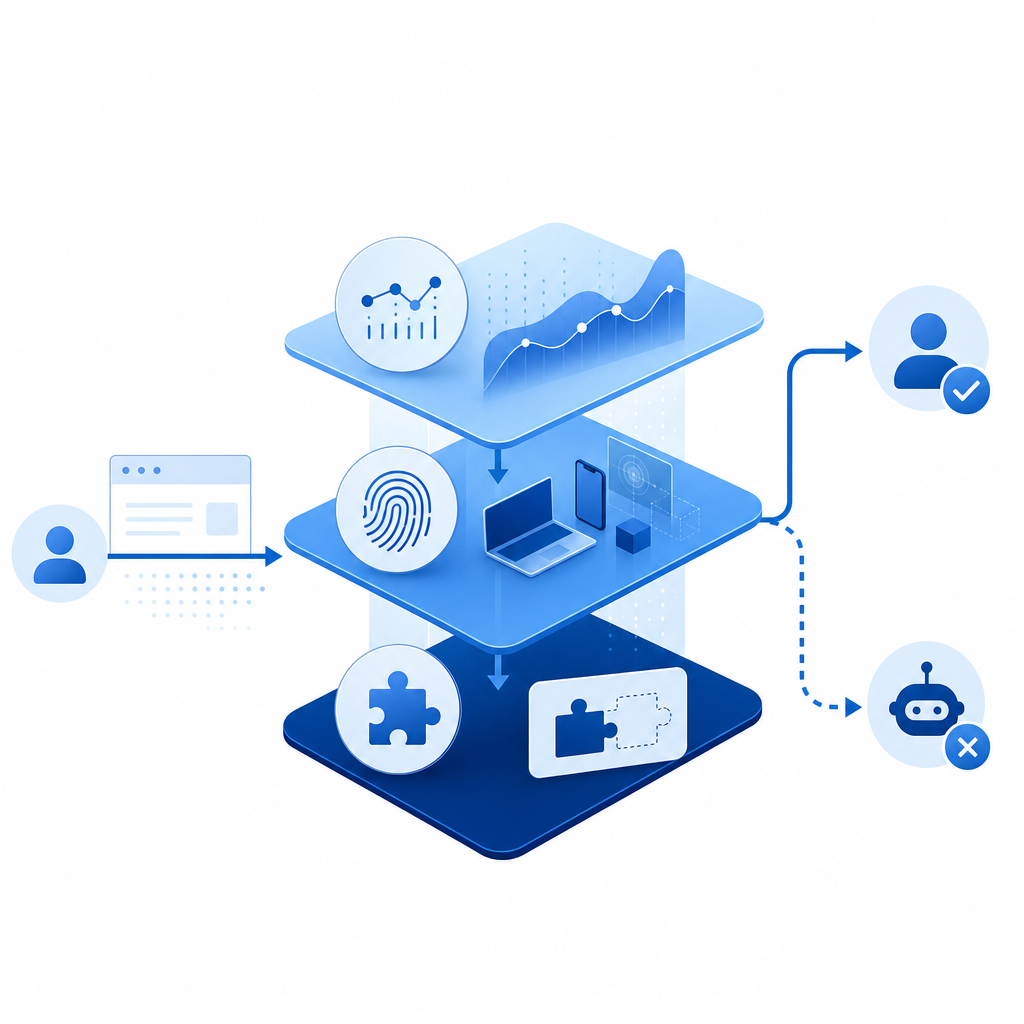
Bot detection deploys a combination of behavioral analytics, challenge-response tests, risk scoring, and device fingerprinting. No single method is foolproof; combining multiple approaches often yields the best protection.
Some widely used methods include:
- Behavioral Analysis: Monitoring interaction patterns such as mouse movement, keystroke dynamics, and navigation speed to identify atypical automation.
- Challenge-Response Tests: Presenting tasks like CAPTCHAs that are easy for humans but difficult for bots.
- Device Fingerprinting: Collecting browser and device data to create a unique profile that helps spot anomalies or known bot signatures.
- IP and Network Analysis: Examining IP reputation, geolocation, and traffic patterns to identify suspicious sources.
Challenge-Response Tests: CAPTCHAs and Alternatives
Among bot detection tools, CAPTCHAs remain the most familiar. They pose tests — image recognition, puzzles, or checkbox challenges — that humans solve quickly but challenge automated scripts.
CaptchaLa provides a variety of CAPTCHA options supporting multiple UI languages and native SDKs for web frameworks like React, Vue, and mobile platforms including iOS, Android, and Flutter. Unlike some competitors such as Google's reCAPTCHA, CaptchaLa offers first-party data control and flexible integration options with server SDKs in PHP and Go.
Cloudflare Turnstile, by contrast, offers a non-interactive, privacy-focused challenge that relies heavily on risk scoring without explicit user tests, which can deliver smoother UX but may lack direct interaction feedback.
Behavioral Analysis: Detecting Suspicious Patterns
Behavioral analytics measure fine-grained user actions like:
- Mouse movement trajectories — bots tend to move in linear or scripted paths.
- Keystroke dynamics — irregular or robotic typing cadence indicates automation.
- Click timing and frequency — rapid or repetitive clicks diverge from human behavior.
This method often integrates with machine learning models to establish a baseline of normal user behavior and flag deviations that may suggest bots.
Device Fingerprinting: Unique Identification Without User Input
This approach collects detailed info about a user’s browser environment, including:
- User agent details
- Screen resolution and color depth
- Installed fonts and plugins
- Time zone and language settings
- Canvas fingerprinting or WebGL data
When combined, these elements create a digital fingerprint used to recognize repeat visitors or bots attempting to mask identities.
Comparative Summary of Bot Detection Solutions
| Feature | CaptchaLa | reCAPTCHA | hCaptcha | Cloudflare Turnstile |
|---|---|---|---|---|
| Challenge Types | Image, text, slider, audio | Image recognition, checkbox | Image recognition, checkbox | Invisible, challenge-free |
| SDK Platforms | Web, iOS, Android, Flutter | Web, limited mobile support | Web, mobile SDKs | Primarily web |
| Data Control | First-party only | Google’s platform | Third-party platform | Cloudflare infrastructure |
| Privacy | High (no user tracking beyond) | Moderate (Google account data) | Moderate | Focus on anonymity |
| Pricing | Free tier + scalable paid plans | Free, embedded in Google Ads | Pay per usage | Included with Cloudflare plan |

Implementing Bot Detection with CaptchaLa
Integrating CaptchaLa into your security stack can be straightforward thanks to native SDK support and REST APIs. For example, a basic server-side token validation request looks like this:
// Example: Validate CAPTCHA token server-side (Node.js pseudocode)
// Receive pass_token and client IP from frontend
const response = await fetch("https://apiv1.captcha.la/v1/validate", {
  method: "POST",
  headers: {
    "X-App-Key": "your_app_key",
    "X-App-Secret": "your_app_secret",
    "Content-Type": "application/json"
  },
  body: JSON.stringify({ pass_token: tokenFromClient, client_ip: userIp })
});
const result = await response.json();
if (result.success) {
  // Proceed with authenticated action
} else {
  // Block or challenge user further
}
CaptchaLa supports issuing server tokens for more advanced workflows, and offers a loader script to simplify frontend integration. Its free tier allows 1000 monthly validations, with paid plans scaling to millions of checks suitable for enterprises.
Best Practices for Combining Bot Detection Methods
Relying solely on CAPTCHAs may disrupt user experience, while behavioral and fingerprinting systems alone risk false positives. Combining methods strategically can optimize protection:
- Use invisible behavioral analysis as a first line to identify low-risk traffic.
- Present CAPTCHAs conditionally to suspicious sessions or new visitors.
- Maintain updated IP reputation lists and watch for unusual spikes.
- Regularly analyze false positive rates to fine-tune detection thresholds.
- Integrate logging and monitoring to quickly respond to emerging bot tactics.
Conclusion
Bot detection methods encompass a variety of technologies—from user behavior monitoring and device fingerprinting to challenge-response tests—to distinguish legitimate users from automated threats. Each approach has strengths and trade-offs regarding user friction, privacy, and accuracy.
Solutions like CaptchaLa enable flexible, multilingual CAPTCHA integration combined with server validation and SDKs covering web and mobile platforms. Pairing these techniques with behavioral analytics and IP analysis creates a robust defense against automated abuse.
Where to go next? Explore CaptchaLa pricing or dive into our documentation for implementation details and API references. Strengthening your bot defenses today can preserve both user experience and security for tomorrow.