
A bot detection algorithm is an essential technology designed to distinguish human users from automated bots on websites and applications. By analyzing patterns of interaction, network data, and behavioral signals, these algorithms help prevent fraudulent activities such as credential stuffing, scraping, spam, and denial-of-service attacks. Effective bot detection algorithms work continuously in real time to identify suspicious traffic while minimizing friction for legitimate users.
What Is a Bot Detection Algorithm?
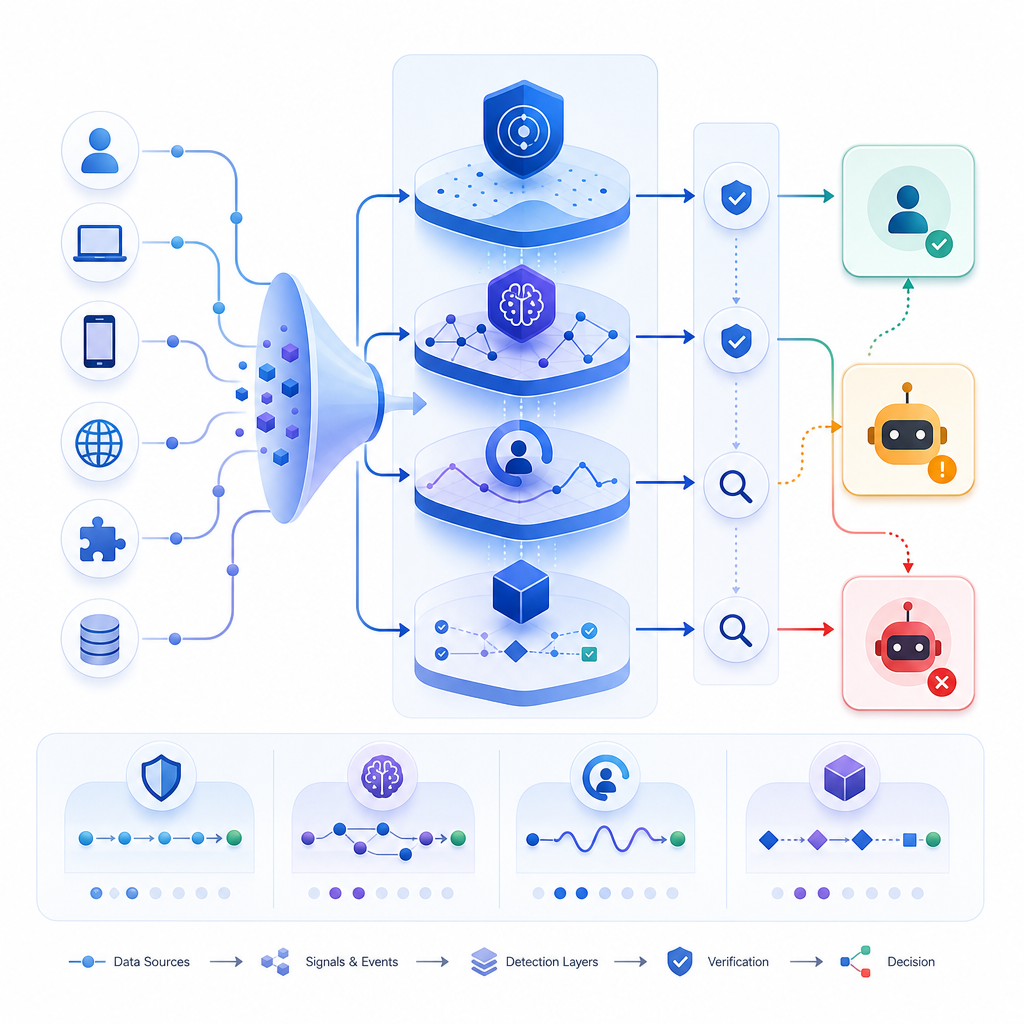
At its core, a bot detection algorithm applies a combination of signal gathering and pattern recognition techniques to evaluate whether a visitor is a human or an automated script. These algorithms ingest inputs like mouse movement, typing patterns, IP reputation, device fingerprinting, and network anomalies. Using statistical models or machine learning, they compare observed behavior against known bot characteristics.
The result is a risk score or a binary classification that decides whether to challenge the visitor—often via CAPTCHAs—or allow access uninterrupted. Traditional detection methods relied heavily on simple rules (e.g., request frequency thresholds), but modern algorithms incorporate richer signals and adapt over time.
Key Techniques Used in Bot Detection Algorithms
Several technical approaches combine to form a resilient bot detection system.
Behavioral Analysis
- Mouse and touch gestures: Humans exhibit nuanced, natural movement patterns, whereas bots often generate linear or mechanical cursor paths.
- Timing and rhythm: The speed and intervals between clicks or keystrokes can expose automated scripts.
- Page interaction depth: Bots may skip interactive steps or behave unrealistically fast.
Device and Network Fingerprinting
- Browser and OS metadata: Collecting detailed header and environment info helps identify anomalies or known bots.
- IP reputation and geolocation: Accessing external threat intelligence databases to flag suspicious IPs.
- Proxy and VPN detection: Bots often hide behind proxies which can be identified based on network patterns.
Challenge-Response Tests
When the algorithm’s certainty is low, it can trigger challenges like CAPTCHAs. These tests require tasks easily solved by humans but hard for bots—such as solving puzzles, image recognition, or typing distorted text.
Comparing Bot Detection Solutions: CaptchaLa vs. Competitors
| Feature | CaptchaLa | reCAPTCHA | hCaptcha | Cloudflare Turnstile |
|---|---|---|---|---|
| Challenge types | Image, puzzle, badge-less | Image, badge, audio | Image, badge | Invisible, badge-less |
| Native SDKs support | Web (JS/Vue/React), iOS, Android, Flutter, Electron | Web primarily | Web primarily | Web primarily |
| Server SDKs | PHP, Go | Limited | Limited | Limited |
| UI languages | 8 | Multiple | Multiple | Multiple |
| Pricing | Free tier 1K/mo, Pro & Business tiers | Free and paid enterprise tiers | Free with fees on enterprise | Included with Cloudflare plans |
| First-party data usage | Yes | Limited | Limited | Limited |
CaptchaLa’s approach emphasizes native SDKs across platforms and first-party data processing, supporting custom integrations and privacy-conscious deployments. Competitors like reCAPTCHA provide broad recognition but may rely on third-party data sharing, which might concern privacy-minded users.
How CaptchaLa Implements Bot Detection Algorithms
CaptchaLa leverages multi-layered bot detection combining client-side and server-side signals.
- Client SDKs collect behavioral metrics using native JavaScript and mobile components optimized for minimal user impact.
- Behavior data and tokens are securely transmitted to CaptchaLa’s validation API endpoint (
POST https://apiv1.captcha.la/v1/validate) including parameters likepass_tokenandclient_ip. - Server SDKs (
captchala-php,captchala-go) facilitate token issuing and validation within backend infrastructure. - When risk is detected beyond acceptable thresholds, interactive challenges prompt users, leveraging CaptchaLa’s customizable UI supporting 8 languages.
This workflow balances protection and user experience, crucial for sites with high legitimate user traffic but significant bot risk.
Example: Validation API Interaction (Pseudocode)
# Pseudocode for validating user token with CaptchaLa

def validate_captcha(pass_token, client_ip):
    endpoint = "https://apiv1.captcha.la/v1/validate"
    headers = {
        "X-App-Key": "your_app_key",
        "X-App-Secret": "your_app_secret"
    }
    payload = {
        "pass_token": pass_token,
        "client_ip": client_ip
    }
    response = http_post(endpoint, headers, payload)
    result = response.json()
    return result.get("success", False)
Best Practices for Bot Detection Algorithm Deployment
To maximize effectiveness and reduce false positives:
- Layered Defense: Combine bot detection algorithms with other security controls, including rate limiting and firewall rules.
- Continuous Monitoring: Analyze traffic trends and update risk thresholds dynamically.
- User Experience Optimization: Only challenge users when risk is significant to avoid frustration.
- Privacy Compliance: Use first-party data where possible and disclose data practices transparently.
- Regular Updates: Keep SDKs and algorithms current with evolving bot tactics.
Sites under heavy bot attack often complement detection algorithms with managed services like CaptchaLa, which invests in research and updates to stay ahead of advanced bots.

Conclusion
A bot detection algorithm is vital for maintaining the integrity and usability of online services. By analyzing behavioral patterns, device fingerprints, and network signals—and supplementing with challenge-response mechanisms—these algorithms act as gatekeepers against automated abuse. Platforms like CaptchaLa provide flexible, multilingual SDKs and backend APIs that enable developers to incorporate effective bot detection tailored to their needs.
For organizations evaluating solutions, it’s helpful to consider factors such as integration ease, SDK support, pricing tiers, and data privacy commitments. CaptchaLa’s documentation (docs) offers comprehensive guides for implementation, while their pricing page details usage plans suited for diverse traffic scales.
Whether protecting a small website or an enterprise platform, understanding the mechanics behind these algorithms helps optimize security without compromising the user experience.
Ready to explore how bot detection algorithms can safeguard your site? Visit CaptchaLa’s pricing and jumpstart your bot defense journey.