
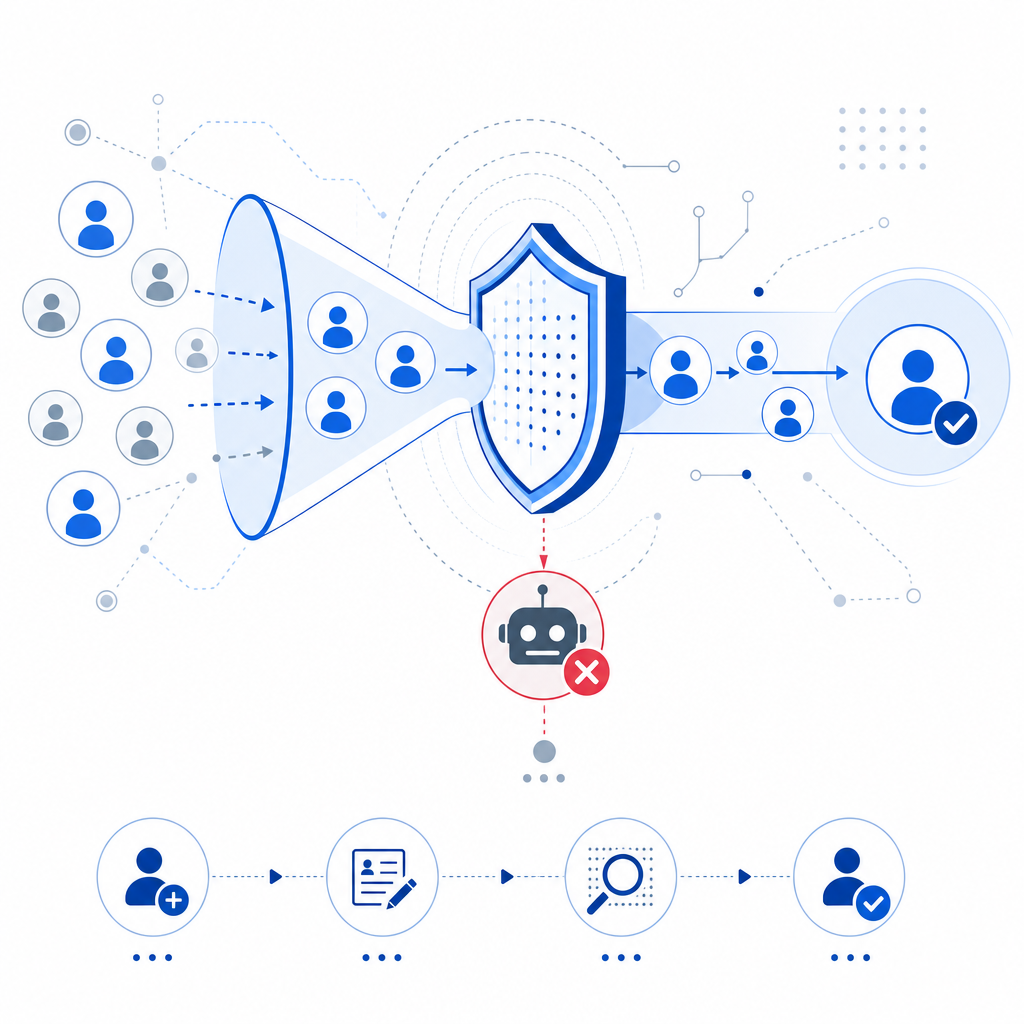
A bot email detector is a tool designed to identify and block automated or fraudulent email signups generated by bots rather than real people. Its purpose is to protect websites and applications from spam, abuse, fake accounts, and malicious activity by verifying the authenticity of the email user during registration or form submission. Instead of relying solely on traditional CAPTCHAs, these detectors analyze user behavior, form data, and other signals to distinguish bots from humans efficiently.
How Does a Bot Email Detector Work?
At its core, a bot email detector combines several techniques to assess whether an email registration is originating from a human or a bot. These include:
- Behavioral analysis: Tracking mouse movements, typing speed, and interaction patterns that deviate from normal human behavior.
- Email pattern detection: Spotting suspicious domains, disposable or temporary email providers, and unusual email formatting.
- IP reputation and rate limiting: Checking IP addresses against threat databases and controlling the volume of signup attempts from a single source.
- Challenge-response tests: Presenting CAPTCHAs or interactive challenges to verify the user is human when the risk score is high.
Each of these layers adds confidence to the bot detection process without unnecessarily disrupting legitimate users.
Core Features to Look For in a Bot Email Detector
When evaluating bot email detectors, consider the following key technical aspects:
- Integration flexibility: Support for multiple platforms and languages (e.g., web SDKs, mobile SDKs).
- Real-time verification: Instant feedback on the legitimacy of a signup attempt during form submission.
- Accuracy and false positives: Effectiveness in correctly identifying bots while minimizing disruption to real users.
- Data privacy: Compliance with regulations and policies regarding user data and first-party tracking.
- Scalability: Ability to handle growing traffic volumes with tiered pricing plans.
CaptchaLa, for example, offers native SDKs for popular web frameworks (JS, React, Vue) and mobile platforms (iOS, Android, Flutter, Electron). It also provides server SDKs for PHP and Go, enabling real-time backend validation via secure API endpoints.
Comparing Popular Bot Defenses for Email Signup
| Feature | CaptchaLa | reCAPTCHA | hCaptcha | Cloudflare Turnstile |
|---|---|---|---|---|
| SDK Languages | JS, React, Vue, iOS, Android, Flutter, Electron | JS-based; mobile limited | JS-based; growing mobile support | JS-based; integrated with Cloudflare services |
| Server SDKs | PHP, Go | None official | Limited | None official |
| Validation API | Yes (POST with tokens) | Yes (siteverify API) | Yes | Yes |
| Pricing Model | Free + Pro + Business tiers | Free with usage limits | Pay-per-use | Included with Cloudflare account |
| Privacy Focus | First-party data only | Google ecosystem dependent | Privacy-focused | Requires Cloudflare proxied traffic |
| Challenge Types | CAPTCHA & behavior analysis | Primarily CAPTCHA | CAPTCHA & visual puzzles | Invisible & interactive challenges |
| Customizability | High (custom tokens, UI) | Moderate | Moderate | Moderate |
This table highlights that CaptchaLa uniquely combines multi-platform support, server SDKs, and a clear pricing structure focused on bot email detection use cases. It also emphasizes user privacy by relying solely on first-party data.

Implementing a Bot Email Detector: Technical Overview
A typical bot email detection workflow might look like this:
- Client-side initialization: Load the bot detection JavaScript SDK on your signup page to analyze user behavior immediately.
- User submission: When the form is submitted, the SDK generates a
pass_tokenrepresenting the challenge result or behavioral score. - Server-side validation: Your backend sends a POST request to
https://apiv1.captcha.la/v1/validateincluding thepass_tokenand client IP with API credentials (X-App-KeyandX-App-Secret). - Response interpretation: The API returns a validation verdict. On success, allow signup; on failure, prompt additional verification or block.
Here is a simplified pseudocode example outlining server-side validation:
# Pseudocode for server-side bot email detection validation

def validate_signup(pass_token, client_ip):
    api_url = "https://apiv1.captcha.la/v1/validate"
    headers = {
        "X-App-Key": "your_app_key",
        "X-App-Secret": "your_app_secret",
        "Content-Type": "application/json"
    }
    payload = {
        "pass_token": pass_token,
        "client_ip": client_ip
    }

    response = http_post(api_url, payload, headers)
    if response.status_code == 200 and response.json()['success']:
        # User is verified as not a bot
        return True
    else:
        # Bot suspected, block or challenge further
        return False
This process ensures that bots attempting to create fake accounts with disposable or generated emails are filtered out efficiently.
Challenges in Bot Email Detection
No detection system is perfect. Some common obstacles include:
- Advanced bots mimicking human behavior through sophisticated scripting or AI.
- False positives that frustrate real users and increase drop-off rates.
- Balancing usability and security — aggressive detection can alienate genuine users.
- Privacy regulations limiting data collection, requiring careful first-party data handling.
Providers like CaptchaLa support customization of challenge difficulty and scriptable behavior thresholds to fine-tune protection aligned with your user base.
Choosing the Right Bot Email Detector for Your Needs
Selecting a bot email detector depends on your specific requirements:
- If you want easy multi-platform integration with native SDKs and server APIs, solutions like CaptchaLa offer solid options.
- For websites heavily embedded in the Google ecosystem, reCAPTCHA is ubiquitous but may raise privacy concerns.
- hCaptcha provides privacy-focused alternatives with pay-per-use pricing but less server-side support.
- Cloudflare Turnstile integrates well for sites already using Cloudflare but is less customizable outside that environment.
Consider where your users come from, how much friction you can add during signup, and your data privacy stance. Testing different solutions with A/B experiments often reveals the best approach to balance protection and user experience.
If you're interested in more details on how to implement or customize a bot email detector with CaptchaLa, explore our documentation or review the pricing plans suitable for various traffic volumes. Protecting your user registration from bots has never been easier with robust, multi-layered defenses integrated at every stage.