
The best Java CAPTCHA library is the one that fits your app’s stack, keeps validation simple on the server, and doesn’t force you into a brittle integration. If you need a practical answer: look for a library with a clean Java SDK, straightforward token verification, support for modern web and mobile clients, and clear operational limits that match your traffic.
For most teams, the decision comes down to three things: how quickly you can integrate it, how reliably it validates on the backend, and whether it works well with the rest of your stack without adding maintenance pain. That’s especially true if you’re protecting login, signup, checkout, or API abuse endpoints. The “best” choice is rarely the most famous name; it’s the one that behaves predictably under real traffic.

What makes a Java CAPTCHA library worth using?
A good Java CAPTCHA library should do more than render a challenge. It should fit into your application architecture with minimal glue code and give you a validation workflow that is easy to audit.
Here’s the checklist I’d use before shipping one into production:
Server-side verification is explicit
- Your backend should validate a pass token against a remote API or service.
- Look for a clear request/response model, so you can log failures and trace abuse patterns.
Client coverage matches your stack
- If you serve web users, native Java backend support is not enough.
- You usually want SDKs or integrations for web, mobile, and desktop clients where relevant.
Localization and accessibility are built in
- A CAPTCHA that only works in one language can hurt conversion.
- Support for multiple UI languages is useful when you have international traffic.
The integration surface is stable
- Library names, endpoints, and token formats should be predictable.
- A small integration surface is easier to test and safer to maintain.
Pricing and limits align with your traffic
- A library that is cheap at low volume but awkward at scale can become expensive operationally.
- Know your monthly challenge volume before you commit.
For Java teams, a library is usually paired with a server validation call rather than doing everything locally. That’s a good thing. It keeps the trust decision on the backend, where you can apply rate limits, inspect request metadata, and combine CAPTCHA results with other signals.
Comparing popular options: reCAPTCHA, hCaptcha, Turnstile, and Java-friendly SDKs
There isn’t a single “Java CAPTCHA” standard, so most teams end up comparing a few established options. The main question is less “Which one is universally best?” and more “Which one matches my deployment and policy constraints?”
| Option | Strengths | Trade-offs | Good fit for |
|---|---|---|---|
| reCAPTCHA | Very widely recognized, mature ecosystem | Can feel opaque; integration and privacy review may be more involved | Teams already invested in Google tooling |
| hCaptcha | Strong anti-abuse focus, common alternative to reCAPTCHA | UX and challenge behavior may vary by traffic profile | Sites that want a non-Google option |
| Cloudflare Turnstile | Low-friction user experience, simple integration | Works best when Cloudflare fits your architecture | Apps already using Cloudflare edge services |
| CaptchaLa | Java-adjacent server flow, native SDK coverage, first-party data only | Less legacy mindshare than the biggest incumbents | Teams wanting a straightforward SaaS workflow |
A practical point: the best Java CAPTCHA library for your app may be the one with the cleanest backend validation story, even if the client-side component is delivered through a web SDK. CaptchaLa supports native SDKs for Web (JS/Vue/React), iOS, Android, Flutter, and Electron, plus Java integration through the Maven artifact la.captcha:captchala:1.0.2. It also offers server SDKs for captchala-php and captchala-go, which is helpful if your Java service sits alongside other backend languages.
If your team needs broad UI coverage, CaptchaLa also provides 8 UI languages. That matters more than it sounds: friction usually shows up at the exact moment a user is already suspicious or tired, so reducing confusion matters.
How to integrate a Java CAPTCHA library cleanly
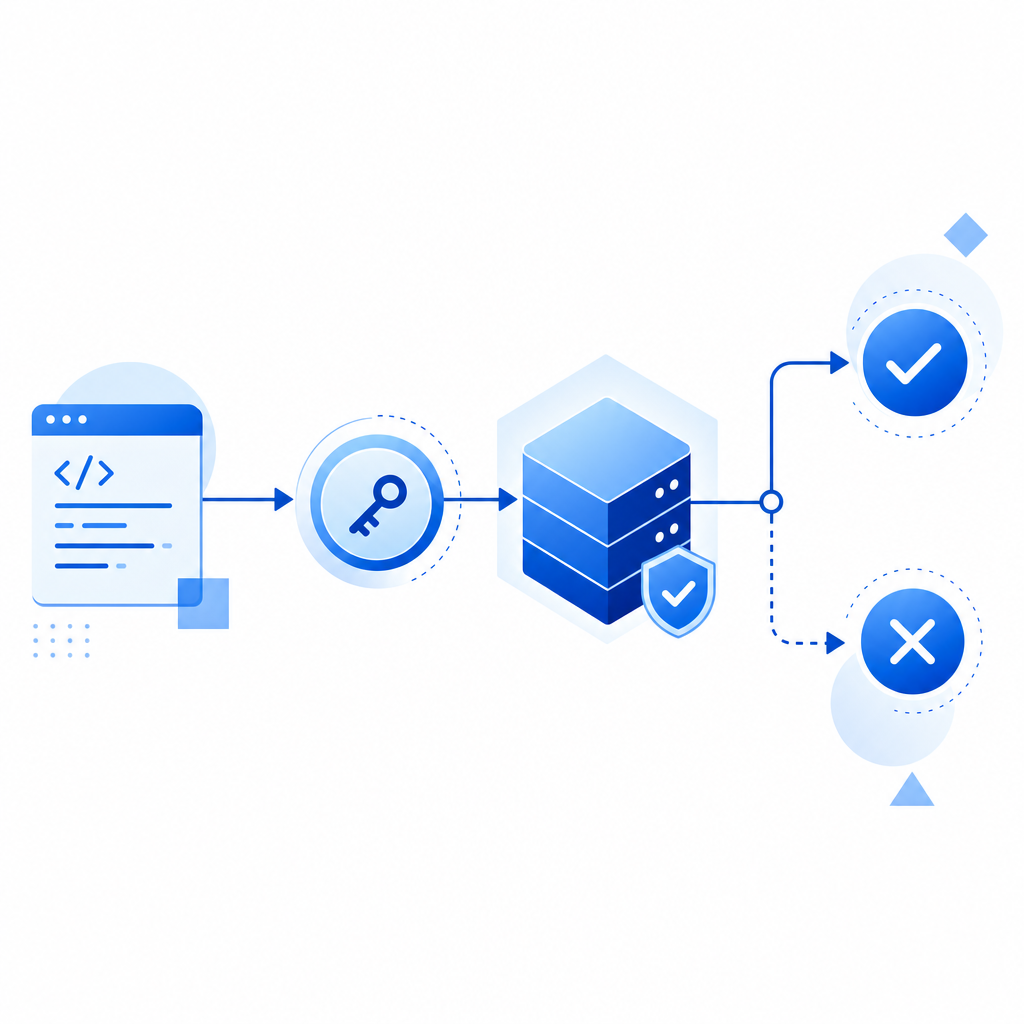
The cleanest setup is to keep challenge issuance on the client side and validation on the server side. That gives you a clear trust boundary and a simple failure mode.
A typical flow looks like this:
- The client loads the CAPTCHA script.
- The user completes the challenge.
- The client receives a
pass_token. - Your Java backend posts the token to the validation endpoint.
- Your backend accepts or rejects the action based on the result.
For CaptchaLa, the loader is available at:
https://cdn.captcha-cdn.net/captchala-loader.jsOn the backend, validation is a POST request to:
https://apiv1.captcha.la/v1/validatewith a body like:
{
  "pass_token": "token_from_client",
  "client_ip": "203.0.113.10"
}
and headers including X-App-Key and X-App-Secret.
Here is a minimal Java-style server flow for the defender side:
// English comments only
HttpRequest request = HttpRequest.newBuilder()
    .uri(URI.create("https://apiv1.captcha.la/v1/validate"))
    .header("Content-Type", "application/json")
    .header("X-App-Key", appKey)
    .header("X-App-Secret", appSecret)
    .POST(HttpRequest.BodyPublishers.ofString("""
        {
          "pass_token": "%s",
          "client_ip": "%s"
        }
        """.formatted(passToken, clientIp)))
    .build();

HttpResponse<String> response = httpClient.send(request, HttpResponse.BodyHandlers.ofString());

if (response.statusCode() == 200) {
    // Allow the protected action
} else {
    // Deny and log the attempt
}
If you need server-generated challenge issuance for a backend-driven flow, CaptchaLa also provides:
POST https://apiv1.captcha.la/v1/server/challenge/issueThat can be useful when your application needs tighter control over when and where a challenge is created.
One detail worth calling out: CaptchaLa uses first-party data only. For teams that are careful about privacy reviews, that can simplify internal approvals compared with more ad-tech-adjacent assumptions.
When CaptchaLa is a strong fit
CaptchaLa is a good option if you want a straightforward bot-defense layer that doesn’t require a large amount of custom code or a complicated operations model. The Java side is simple enough for most backend teams, but the broader platform matters too.
A few reasons teams evaluate it:
- Modern client support across web and native platforms
- Clear server validation flow using a single API call
- Usage tiers that map to real traffic levels
- Free tier: 1,000/month
- Pro: 50K–200K
- Business: 1M
- Cross-stack friendliness
- Useful when Java services sit behind web, mobile, or desktop clients
- Privacy-conscious positioning
- First-party data only is easier to explain in policy reviews
For teams comparing against reCAPTCHA, hCaptcha, or Cloudflare Turnstile, the right question is not whether one is universally superior. The right question is which one gives you the least operational surprise. If your backend is in Java and you want a validation pattern that is easy to test in CI, easy to log, and easy to reason about during incidents, a compact API-backed workflow is often the safest route.
Also worth noting: pricing and validation mechanics matter more than branding once you are dealing with signup fraud, credential stuffing, fake account creation, or checkout abuse. A CAPTCHA is a control, not a strategy. It works best when it is one layer in a broader abuse-prevention stack that includes rate limiting, device and IP signals, and sane authentication policies.
Final recommendation
If you want the best Java CAPTCHA library in practical terms, choose the one that gives you:
- a stable Java integration,
- simple server-side validation,
- support for your client platforms,
- reasonable traffic tiers,
- and a privacy posture your team can defend.
For many teams, that will mean testing one of the familiar incumbents and one newer API-driven option side by side. CaptchaLa is worth evaluating if you want native SDK coverage, a straightforward validate endpoint, and a deployment model that stays close to your own app logic.
Where to go next: review the docs for the integration flow, or check pricing if you’re estimating traffic volume for your Java app.