
Behavioural CAPTCHA is a type of bot defense technology that analyzes user behavior to distinguish humans from automated bots without relying solely on explicit challenges. By monitoring how users interact with a page—such as mouse movements, typing patterns, or touch gestures—behavioural CAPTCHA systems create a frictionless verification experience that improves security and usability simultaneously.
This approach reduces the frustrating experience of deciphering distorted text, clicking images, or solving puzzles. Instead of asking users to prove their humanity through a visible challenge, behavioural CAPTCHA invisibly collects interaction data to make an informed risk decision. This shift helps websites and applications better combat increasingly sophisticated bot attacks while maintaining user satisfaction.
How Does Behavioural CAPTCHA Work?
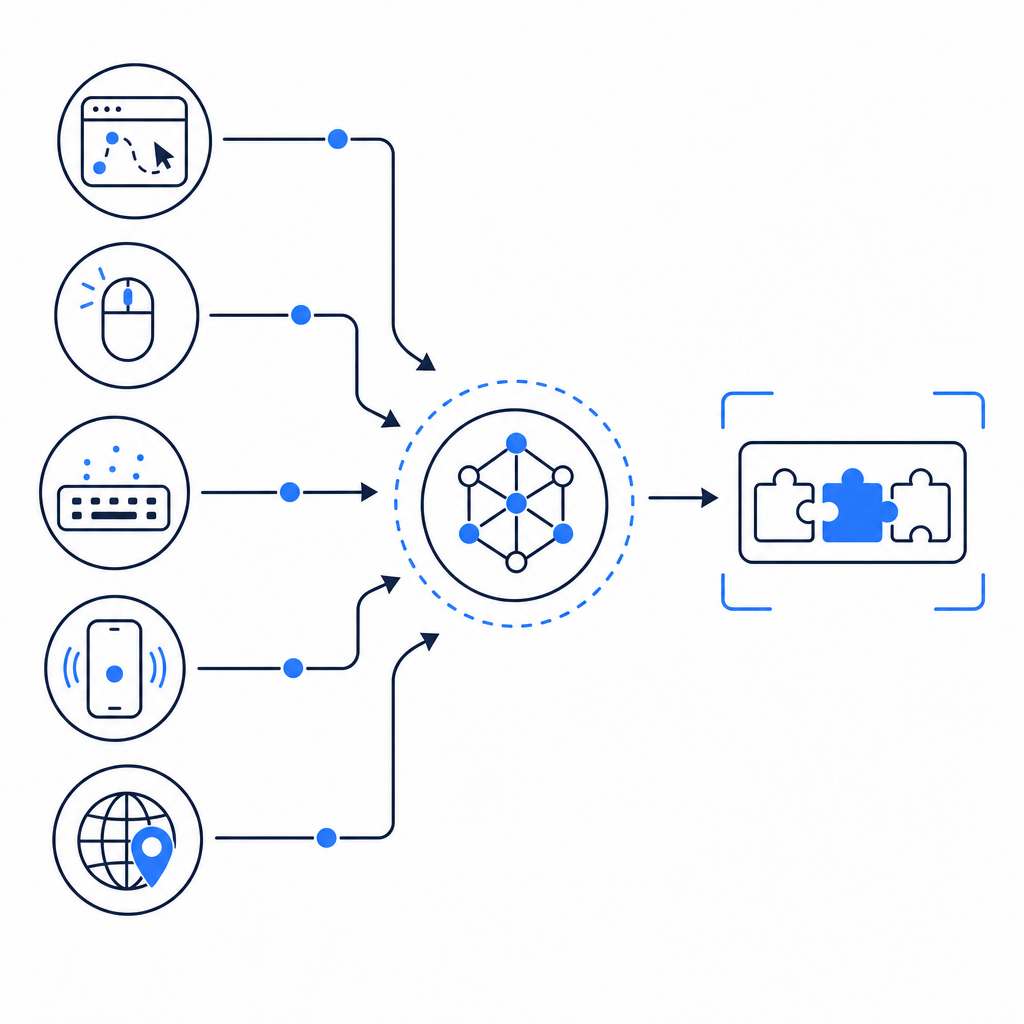
Behavioural CAPTCHA works by collecting and analyzing subtle user interaction data during the session, often before the user even completes a form or clicks a submit button. Key behavioral signals include:
- Cursor movement velocity and acceleration
- Click timing and patterns
- Typing rhythm and error corrections
- Scrolling behavior
- Touchscreen gestures on mobile devices
Machine learning models interpret these signals to generate a risk score that estimates how likely the user is a human versus an automated bot. The verification can be completely invisible if the risk score is low (trusted user) or trigger a fallback challenge only for suspicious activity. This multi-layered approach enables a smoother user experience without compromising security.
Behavioural CAPTCHA vs Traditional CAPTCHA
| Feature | Behavioural CAPTCHA | Traditional CAPTCHA |
|---|---|---|
| User Interaction | Mostly invisible, analyzes natural behavior | Requires explicit user challenge (text, image, puzzle) |
| User Experience | Minimal disruption | Often interrupts and can frustrate |
| Accessibility | High - works with screen readers and adaptive tech | Can be difficult for some disabilities |
| Bot Detection Accuracy | Sophisticated, evolving with ML models | Limited to challenge-solving ability, vulnerable to solvers |
| Easy Integration | Available via SDKs and APIs | Varies by provider, sometimes complex |
| Examples | CaptchaLa behavioural mode, Cloudflare Turnstile | Google reCAPTCHA v2/v3, hCaptcha |
Most major CAPTCHA providers now offer behavioural options to improve security and UX. For example, Cloudflare Turnstile uses passive checks combined with optional user challenges, while CaptchaLa provides dedicated behavioural CAPTCHA SDKs and APIs designed to assess first-party data with privacy in mind.
Technical Specifics of Implementing Behavioural CAPTCHA
For developers integrating behavioural CAPTCHA, understanding key technical aspects helps set realistic expectations and optimize performance. Here are critical elements to consider:
Data Collection and Privacy
Behavioural CAPTCHA collects first-party interaction data only; this safeguards user privacy compared to third-party tracking often seen in other CAPTCHA services.SDK Availability
CaptchaLa offers native SDKs for Web (JavaScript, Vue, React), mobile platforms (iOS, Android, Flutter), and desktop environments (Electron). This allows tailored integration for diverse applications.Server-Side Validation
Verification involves a POST request to CaptchaLa’s API endpoint with a token generated on the client and user IP for validation. This server-side step confirms the authenticity of the interaction data.
// Example: verifying CaptchaLa behavioural CAPTCHA on server-side (Node.js)
// Comments explain each step

const fetch = require('node-fetch');

async function verifyCaptcha(passToken, clientIp) {
  const response = await fetch('https://apiv1.captcha.la/v1/validate', {
    method: 'POST',
    headers: {
      'X-App-Key': process.env.CAPTCHA_APP_KEY,
      'X-App-Secret': process.env.CAPTCHA_APP_SECRET,
      'Content-Type': 'application/json'
    },
    body: JSON.stringify({ pass_token: passToken, client_ip: clientIp })
  });
  const result = await response.json();
  return result.success;  // Boolean indicating valid human verification
}
Fallback Challenges
In cases where behavioural analysis suggests potential bot activity, automated fallback to traditional CAPTCHA challenges can reduce false negatives and further deter bots.Localization & Accessibility
CaptchaLa supports 8 languages for UI components and complies with accessibility standards, ensuring broad usability across regions and user abilities.
Comparing Popular Behavioural CAPTCHA Providers
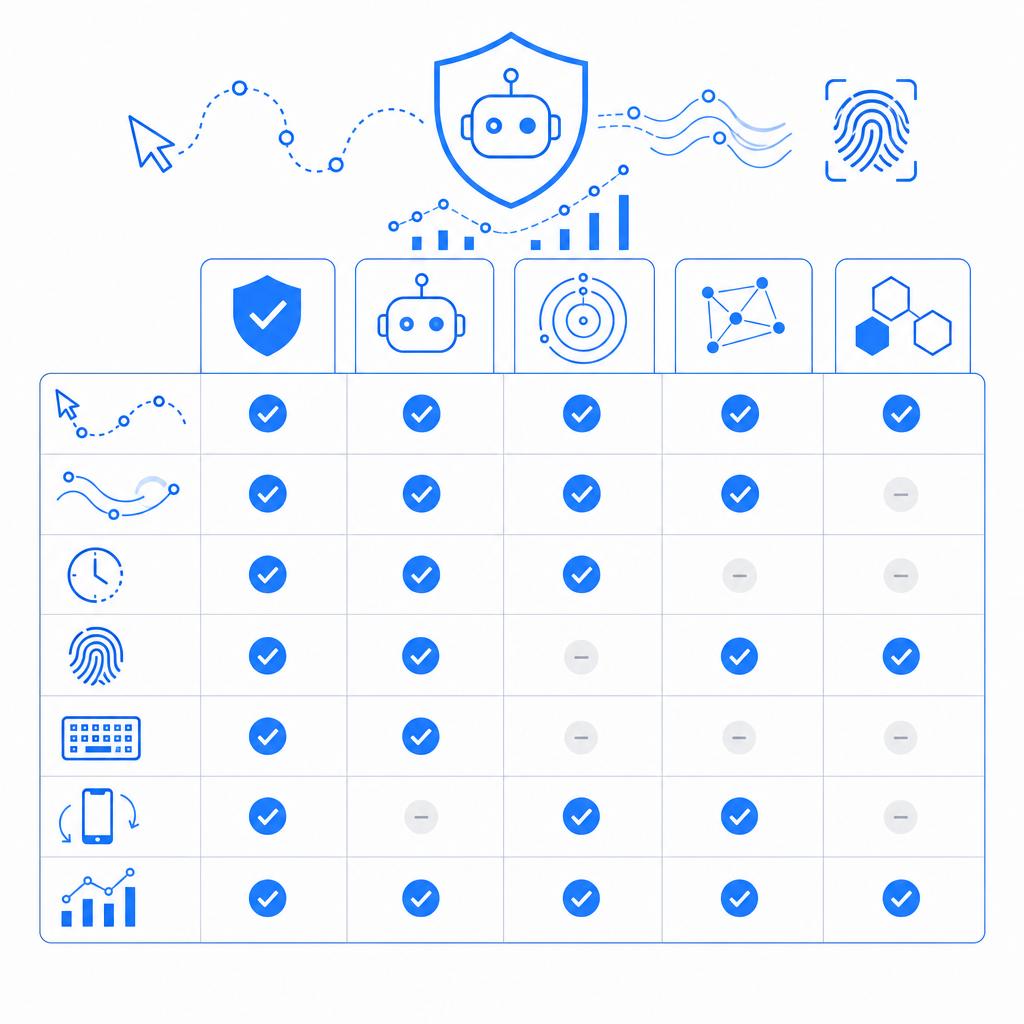
Besides CaptchaLa, other well-known players in the behavioural CAPTCHA space include Google reCAPTCHA v3, hCaptcha, and Cloudflare Turnstile. Here is an objective comparison focusing on behavioural features:
| Provider | Behavioural Analysis | SDKs & APIs | Privacy Focus | Free Tier / Limits |
|---|---|---|---|---|
| CaptchaLa | Advanced, first-party only | Web (JS/Vue/React), iOS, Android, Flutter, Electron, PHP, Go SDKs | Strong, no 3rd-party tracking | Free tier: 1000/mo |
| Google reCAPTCHA v3 | Yes, scored badges | Web-focused, some native SDKs | Data sent to Google servers | Free but usage limits vary |
| hCaptcha | Behavioural + challenge | Mostly Web, enterprise native SDKs | Focus on privacy but uses some tracking | Free & paid tiers |
| Cloudflare Turnstile | Passive + user challenges | Web only via CDN loader | Privacy-focused, no tracking cookies | Free & enterprise options |
While Google’s reCAPTCHA is widely adopted, it raises privacy concerns for some users and site operators due to data sharing with Google. CaptchaLa aims to strike a balance with strong behavioural analysis leveraging only first-party data, customizable SDKs, and generous free tiers that facilitate privacy-conscious implementation.
Why Choose Behavioural CAPTCHA for Your Website or App?
Bot attacks today are highly automated and sophisticated, capable of bypassing static challenges by using advanced solving techniques or human farms. Behavioural CAPTCHA adds an important defensive layer by detecting subtle anomalies, automated scripts, or scripted event timings that no challenge alone can fully prevent.
Additionally, behavioural CAPTCHA helps:
- Reduce user friction by minimizing explicit CAPTCHA interactions
- Increase completion rates on forms, purchases, and signups
- Provide deeper analytics on user authenticity trends
- Support a more seamless, modern user experience in line with mobile-first design
Organizations looking to improve bot defense while maintaining visitor satisfaction should consider behavioural CAPTCHA solutions like those offered by CaptchaLa. Whether deploying on a website, a mobile app, or a desktop client, behavioural data-driven bot detection allows stronger security with less annoyance.
Where to go next? Explore CaptchaLa’s flexible pricing plans to find your fit, or dive deeper by visiting the detailed docs. Implement smarter CAPTCHA solutions that protect your service without compromising your users’ experience.