
Anti scraping refers to techniques and tools designed to prevent unauthorized automated bots from extracting data from websites. Web scraping can be a legitimate method for gathering publicly available data, but it becomes problematic when malicious bots harvest content, overload servers, or gain competitive advantage through automated data theft. Anti scraping solutions detect and block these harmful activities, protecting website content, user privacy, and server resources.
What Exactly Does Anti Scraping Mean?
At its core, anti scraping is the practice of identifying and stopping bots that crawl websites to extract data without permission. This may involve analyzing visitor behavior, IP reputation, request patterns, and leveraging challenges such as CAPTCHAs to prove visitor authenticity. While web scraping itself is not illegal or inherently bad, uncontrolled scraping by automated programs can cause:
- Data theft or unauthorized republishing
- Price scraping by competitors
- Account takeovers via credential stuffing
- Server overloads from rapid-fire requests
An anti scraping system aims to maintain fair use by detecting bots and slowing down or blocking these suspicious requests.
Common Anti Scraping Techniques
Behavioral Analysis and Rate Limiting
One of the foundational methods involves monitoring traffic patterns. Legitimate users browse pages at human speeds, rarely making hundreds of requests per minute from the same IP address. Bots, however, often generate repeated, high-frequency calls. Anti scraping solutions analyze timing, navigation paths, mouse movements, and request headers to differentiate humans from scripts. When thresholds are exceeded, the system can throttle or block traffic.
IP Reputation and Blacklisting
Many anti scraping tools use IP reputation databases to block known sources of malicious bots or proxies. If a suspicious IP address is identified, its access can be limited. However, attackers often rotate IPs or use residential proxies, reducing this method’s effectiveness alone.
CAPTCHA Challenges
Challenging visitors with CAPTCHAs, such as those provided by platforms like CaptchaLa, Google reCAPTCHA, hCaptcha, or Cloudflare Turnstile, requires users to prove they are human by solving puzzles. CAPTCHAs act as gatekeepers for suspicious or high-risk traffic, stopping automated bots from proceeding further. The choice between CAPTCHAs varies based on usability, accessibility, and integration options.
Honeypots and Hidden Fields
Some sites place invisible form fields or links that humans won't interact with but bots tend to fill or click, flagging them as automation. This technique is lightweight and works well combined with other defenses.
Device Fingerprinting and Browser Validation
Advanced anti scraping solutions build detailed profiles of visitors by analyzing browser characteristics (user agent, plugins, fonts, canvas rendering). Bots often have unusual or default fingerprints that can reveal automation.
How Anti Scraping Solutions Differ: A Comparison
| Feature | CaptchaLa | Google reCAPTCHA | hCaptcha | Cloudflare Turnstile |
|---|---|---|---|---|
| UI Languages | 8 | Multiple | Multiple | Multiple |
| Platform SDKs | Web, iOS, Android, Flutter, Electron | Web only | Web only | Web only |
| Server SDKs | PHP, Go | None officially | None officially | None officially |
| Validation API | POST with token + IP + keys | POST with token | POST with token | POST with token |
| Ease of Integration | Native SDKs + CDN loader | Script embeds | Script embeds | Script embeds |
| Privacy Focus | First-party data only | Uses Google services | Data shared with hCaptcha | Runs on Cloudflare network |
| Free Tier Usage | 1000/month | Free tier available | Free tier available | Free tier available |
This table highlights that CaptchaLa offers multiple native SDKs including backend server integrations (PHP, Go) and frontend libraries for native apps, providing flexibility beyond web-only options. CaptchaLa also emphasizes privacy with first-party data processing, which can matter for compliance.
Implementation: How to Add Anti Scraping with CaptchaLa
Below is a simplified example of integrating CaptchaLa’s JavaScript loader and server-side token validation:
// Load CaptchaLa widget in your web app
<script src="https://cdn.captcha-cdn.net/captchala-loader.js"></script>

<script>
  Captchala.render('captcha-container', {
    siteKey: 'your-site-key',
    language: 'en'
  });

  async function verifyCaptcha(token) {
    // Send token and client IP to backend for validation
    const response = await fetch('https://apiv1.captcha.la/v1/validate', {
      method: 'POST',
      headers: {
        'X-App-Key': 'YOUR_APP_KEY',
        'X-App-Secret': 'YOUR_APP_SECRET',
        'Content-Type': 'application/json'
      },
      body: JSON.stringify({ pass_token: token, client_ip: 'user_ip_here' })
    });
    const result = await response.json();
    return result.success;
  }
</script>
This example shows how CaptchaLa’s loader injects a CAPTCHA widget, while your backend securely verifies responses to prevent automated abuse.
Best Practices for Anti Scraping Strategy
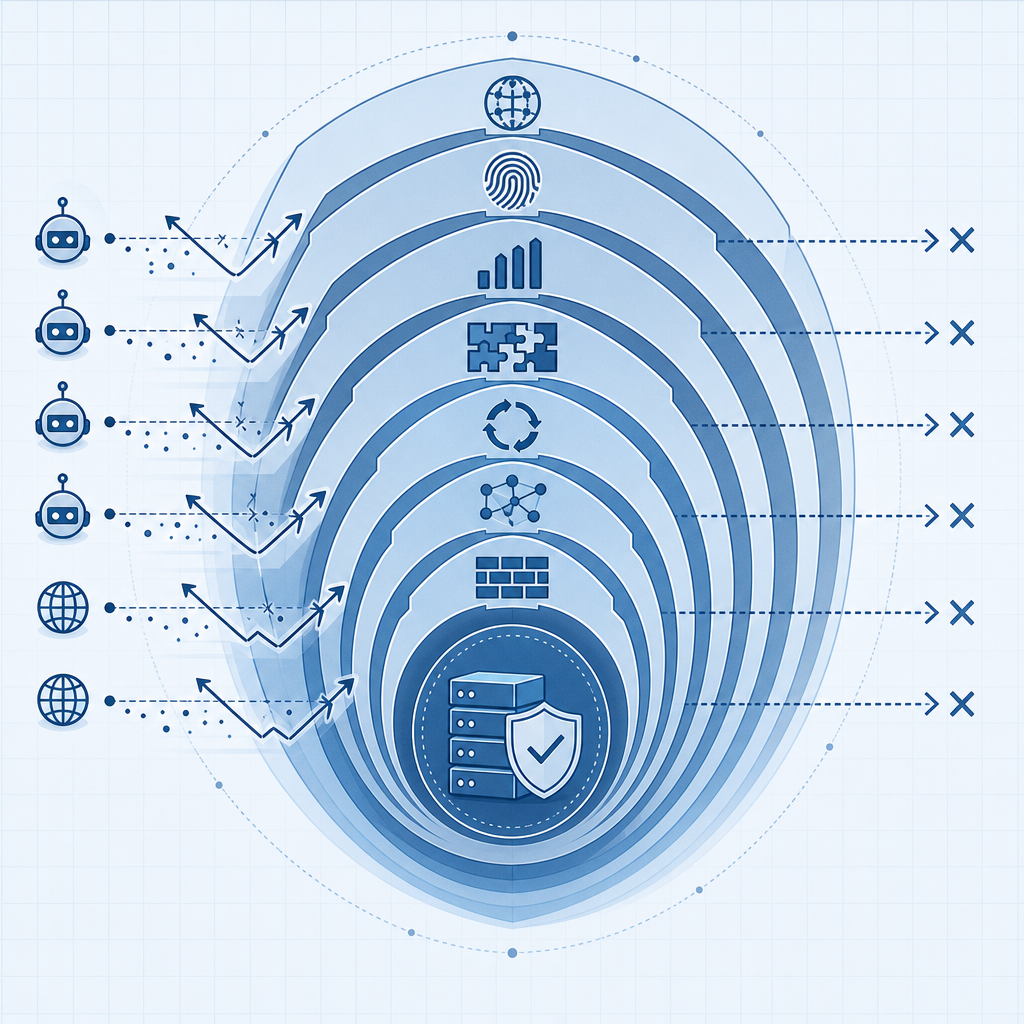
- Layer Your Defenses: Combine rate limiting, IP reputation checks, behavioral analysis, and CAPTCHAs for robust protection. No single method is foolproof.
- Prioritize User Experience: Ensure CAPTCHAs are only triggered when necessary to avoid friction for genuine users. CaptchaLa’s customizable challenges help balance security and usability.
- Monitor and Adapt: Attackers evolve their methods often. Regularly review analytics and tune detection thresholds.
- Leverage First-Party Data: Where privacy is important, avoid third-party CAPTCHA providers that share user data externally. CaptchaLa processes data in-house to help maintain compliance.
- Integrate Seamlessly: Use SDKs and APIs that fit your tech stack. CaptchaLa supports multiple frontend and backend platforms, facilitating smooth implementation.

Conclusion
Anti scraping is an essential component of modern bot defense, protecting websites from automated data theft and abuse. It utilizes multiple detection methods including CAPTCHAs, behavioral analysis, and IP monitoring. Solutions like CaptchaLa provide flexible, privacy-conscious tools with native SDKs for web and mobile platforms, supporting developers in implementing effective anti scraping measures.
If you want to explore how anti scraping fits your security setup or try integrating CaptchaLa, check out their detailed documentation or explore pricing options at captcha.la/pricing. Protect your data while maintaining a smooth experience for real users.