
When building PHP applications exposed to the web, preventing automated bots from abusing your services is crucial. Anti bot PHP strategies combine server-side validation, client interaction, and third-party tools to distinguish human users from scripts effectively. Unlike simply blocking IP addresses, proper anti bot PHP methods must balance security with usability — allowing legitimate users while deterring spambots, scrapers, and credential stuffing attacks.
Whether integrating simple token checks or sophisticated CAPTCHA challenges, using PHP for bot defense requires an understanding of common threats, available tools, and practical implementation patterns. Below, we explore key approaches, technologies, and considerations for anti bot PHP protection in modern web applications.
Why Anti Bot Measures Matter in PHP Applications
Automated bots impact PHP apps in multiple ways: generating fake signups, scraping content, launching brute force login attacks, or overwhelming resources. Because PHP often powers user-facing frontends and APIs, defenses must be capable of verifying real human interaction in real time.
Key benefits of anti bot PHP solutions include:
- Reducing fraudulent activity: Bots can waste bandwidth and taint user data.
- Preserving server resources: Prevent overloads caused by relentless automated requests.
- Improving user experience: Block spam or abusive actions without inconveniencing genuine visitors.
- Protecting backend systems: Stop bots from gaining unauthorized access or scraping confidential data.
Effective bot defense often integrates client-side challenges with server-side validation, making PHP well-suited for handling the latter in your stack.
Core Techniques for Anti Bot PHP Integration
1. Client-Side Interaction & Challenge
The frontline against bots is usually a challenge that requires human interaction — such as checking a box, solving puzzles, or behavioral analysis. Popular services provide embeddable JavaScript widgets or SDKs, which can be included in PHP-generated pages.
Examples include CaptchaLa, Google’s reCAPTCHA, hCaptcha, and Cloudflare Turnstile. These tools deliver challenges and provide tokens that your PHP server can verify.
2. Server-Side Token Validation
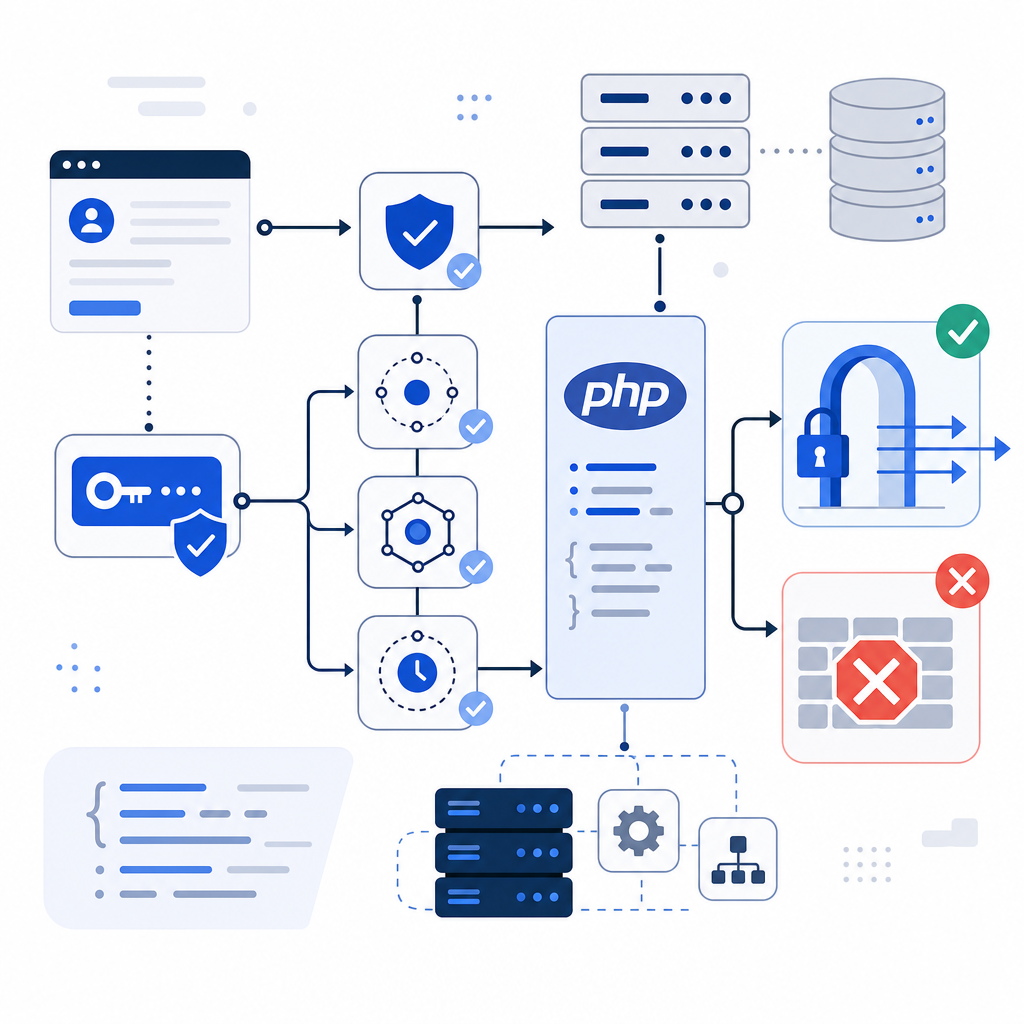
After the client-side challenge issues a token, your PHP backend must verify it through API calls. This ensures the token is valid, unexpired, and tied to the originating client IP.
Here’s a typical validation flow with PHP pseudocode using CaptchaLa:
// Example: Validating CaptchaLa token server-side (PHP)
// Client sends POST request with 'pass_token' and 'client_ip'
$passToken = $_POST['pass_token'];
$clientIP = $_SERVER['REMOTE_ADDR'];

$validationPayload = [
    'pass_token' => $passToken,
    'client_ip' => $clientIP
];

// Set your CaptchaLa credentials here
$appKey = "YOUR_APP_KEY";
$appSecret = "YOUR_APP_SECRET";

$ch = curl_init("https://apiv1.captcha.la/v1/validate");
curl_setopt($ch, CURLOPT_POST, true);
curl_setopt($ch, CURLOPT_POSTFIELDS, json_encode($validationPayload));
curl_setopt($ch, CURLOPT_HTTPHEADER, [
    "X-App-Key: $appKey",
    "X-App-Secret: $appSecret",
    "Content-Type: application/json"
]);
curl_setopt($ch, CURLOPT_RETURNTRANSFER, true);

$response = curl_exec($ch);
curl_close($ch);

$responseData = json_decode($response, true);

if ($responseData['success'] === true) {
    // Token is valid — proceed with user request
} else {
    // Token invalid or missing — block or challenge again
}
3. Behavioral & Rate-Limiting Analysis
Besides challenges, PHP backend code can enforce IP-based rate limits, monitor unusual request patterns, or require additional verification for suspicious behavior. This complements CAPTCHA-style approaches and catches non-interactive bots.
Comparing Popular CAPTCHA & Anti Bot Solutions for PHP
| Feature | CaptchaLa | Google reCAPTCHA | hCaptcha | Cloudflare Turnstile |
|---|---|---|---|---|
| Server SDK (PHP) | Yes (captchala-php) | Limited (Official API calls) | No official PHP SDK | No official PHP SDK |
| Client SDKs supporting PHP frontends | Web JS + multiple frameworks | Web JS + mobile SDKs | Web JS + mobile SDKs | Web JS only |
| Supported UI languages | 8 | Multiple | Multiple | Multiple |
| Free tier limits | 1,000/mo | Varies; generous | Generous | Generous |
| Data handling privacy | First-party data only | Google data | Unknown | Cloudflare network data |
| Pricing transparency | Clear tiers (pricing) | Usage-based, less transparent | Varies | Included with Cloudflare services |
| Challenge types | Multiple, configurable | Checkbox, invisible, audio | Checkbox, puzzles | Invisible, checkbox |
Each has pros and cons — for example, reCAPTCHA is well-known but involves Google data-sharing, while CaptchaLa emphasizes privacy with first-party data only and native PHP SDKs that ease backend validation.
Implementing Anti Bot PHP: Checklist & Best Practices
- Select a CAPTCHA provider with PHP support: Ensure SDKs or simple REST APIs cover your stack.
- Integrate client-side challenge on critical user actions: Login, signups, forms, API endpoints.
- Implement server-side verification in PHP: Use secure API calls to validate challenge tokens before processing requests.
- Log and monitor validation failures: Detect potential attack trends.
- Combine with rate limiting and IP reputation checks: Add layers of protection beyond CAPTCHAs.
- Respect usability: Avoid excessive challenges to minimize user friction, potentially adjusting thresholds dynamically.
- Update keys and dependencies regularly: Maintain security and access to new features.
Using CaptchaLa’s PHP SDK makes implementation straightforward with native PHP tools designed for this purpose.

Summary
Anti bot PHP solutions rely on a mix of client engagement and backend verification to keep automated scripts at bay without harming genuine users. Picking the right provider depends on your needs around privacy, SDK support, and pricing. Services like CaptchaLa offer PHP-native tools and privacy-conscious handling with flexible usage tiers.
Combining token validation with behavioral analysis and rate limiting, PHP developers can build resilient defenses that fit seamlessly into their web architecture.
Where to go next? Explore CaptchaLa’s documentation for integration details or check out their pricing plans to find a fit for your project’s scale.