
A bot detector kick is a proactive action that triggers once suspicious automated behavior is detected, effectively "kicking" or blocking bots before they can cause damage. By quickly identifying and responding to patterns of non-human traffic, websites can prevent fake account creation, scraping, fraud, and other malicious activities. Put simply, a bot detector kick is your website’s early warning system combined with an automatic defense move—crucial in today’s environment where bots are increasingly sophisticated.
In this post, we’ll explore what comprises a bot detector kick, how it works under the hood, comparisons with other defensive tools, and technical approaches for implementation. If you want to strengthen your bot defenses or understand this essential mechanism better, read on.
What Exactly Is a Bot Detector Kick?
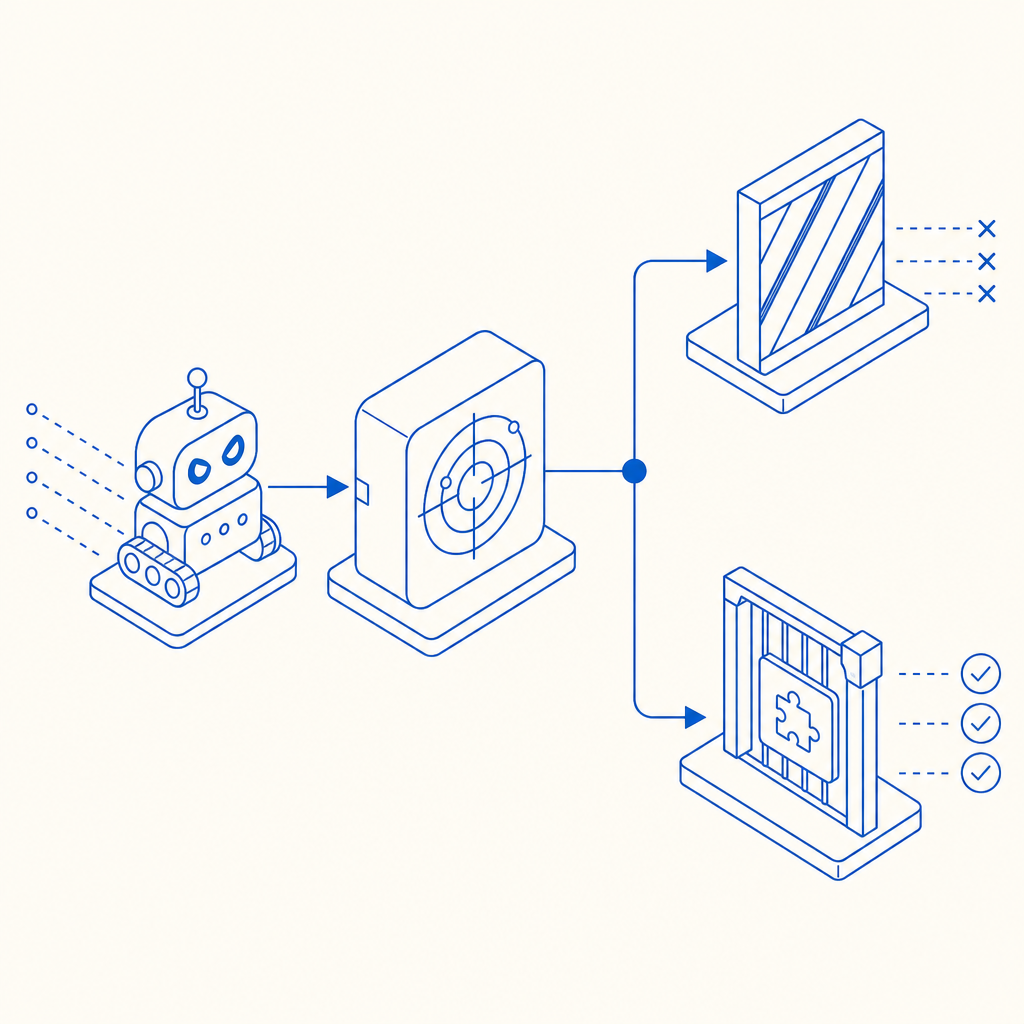
A “bot detector kick” is not a single technology but rather a response triggered by bot detection algorithms. Once behavior is flagged as anomalous or automated, the bot detector kick initiates one or more of the following:
- Serve a CAPTCHA challenge to prove humanness
- Block the IP address or user agent
- Rate-limit requests from the source
- Redirect suspicious traffic to a honeypot or challenge page
The goal is swift action that disrupts the automated script’s workflow before it can complete its intended task like spamming or data scraping. This response is vital because detecting bots alone isn’t enough — taking the right follow-up measures prevents damage.
For instance, CaptchaLa uses a combination of heuristic analysis and challenge issuance to perform a bot detector kick. When a request fails risk analysis, a CAPTCHA challenge is issued immediately, preventing further actions by likely bots. This process helps reduce false positives while maintaining user convenience.
Distinguishing Bot Detector Kick from Passive Detection
It’s important to differentiate between passive bot detection — where suspicious traffic is simply monitored — and an active bot detector kick which intervenes. Passive detection might log IPs or usernames to analyze later, but kicks block or challenge suspicious traffic in real-time.
How Bot Detector Kicks Work Technically
Behind the scenes, a bot detector kick relies on several technical components working together:
- Behavioral Analysis: Algorithms analyze mouse movements, keystroke patterns, request frequency, HTTP headers, and other signals to identify bots.
- Risk Scoring: Each interaction is assigned a risk score based on observed behavior and history.
- Threshold Triggers: Once a score crosses a defined threshold, the system triggers a kick.
- Challenge or Block: The kick action issues a CAPTCHA, blocks traffic, or employs another mitigation tactic.
- Feedback Loop: User responses (e.g., solving CAPTCHA) update model confidence to refine detection accuracy.
Example Bot Detector Kick Workflow (Pseudocode)
// pseudocode illustrating a bot detector kick logic

function onRequest(request) {
    let riskScore = analyzeBehavior(request);
    if (riskScore > RISK_THRESHOLD) {
        issueBotDetectorKick(request);
    } else {
        allowAccess(request);
    }
}

function issueBotDetectorKick(request) {
    // Send CAPTCHA challenge or block IP
    if (request.isHumanVerified()) {
        allowAccess(request);
    } else {
        sendCaptchaChallenge(request);
        logSuspiciousRequest(request);
    }
}
The threshold can be tuned for each use case, balancing user friction and security.
Comparing Bot Detector Kick Approaches: CaptchaLa, reCAPTCHA, hCaptcha, Turnstile
Several popular bot defense solutions incorporate mechanisms akin to a bot detector kick. Here’s a broad comparison:
| Feature | CaptchaLa | reCAPTCHA v3/Invisible | hCaptcha | Cloudflare Turnstile |
|---|---|---|---|---|
| Bot Detection + Challenge | Yes | Yes | Yes | Yes |
| Behavioral Analysis | Yes | Yes | Yes | Yes |
| Risk Scoring | Customizable | Google Proprietary | Configurable Risk Scores | Adaptive Model |
| Challenge Types | CAPTCHA + Invisible | Checkbox, Invisible, Score | CAPTCHA + Invisible | Invisible + Checkbox |
| SDKs Available | JS, React, Vue, iOS, Android | JS only | JS, Mobile SDKs | JS only |
| Self-hosting Option | No (SaaS) | No | No | No |
| Open Data Policy | First-party data only | Shared data with Google | Shared data with hCaptcha | Shared with Cloudflare |
Each solution issues a bot detector kick when suspicious activity crosses a threshold, but the customization and data handling differ. CaptchaLa emphasizes first-party data privacy and multi-platform SDKs, while Google’s reCAPTCHA relies heavily on global data signals.
Implementing Bot Detector Kicks with CaptchaLa
Integrating a bot detector kick into your app with CaptchaLa is streamlined through its native SDKs and APIs. Here are some core components:
On the client side:
Load the CaptchaLa challenge widget or invisible script usinghtml<script src="https://cdn.captcha-cdn.net/captchala-loader.js"></script>Your frontend triggers CaptchaLa to challenge users when needed.
Server-side validation:
Verify CAPTCHA tokens by POSTing to the validation endpoint with your app keys:bashPOST https://apiv1.captcha.la/v1/validate Headers: X-App-Key, X-App-Secret Body: { pass_token, client_ip }Server-issued challenges:
If you want to issue tokens from the backend for riskier flows:bashPOST https://apiv1.captcha.la/v1/server/challenge/issueSDK options: Use the server SDKs for PHP or Go to simplify integration.
Best Practice Tips
- Adjust risk thresholds dynamically based on traffic volume and sensitivity.
- Combine CaptchaLa’s behavioral analysis with IP reputation data.
- Use progressive challenges: start invisible and escalate only if suspicion grows.
- Monitor analytics regularly to refine rules and improve user experience.
Advantages of Active Bot Detector Kicks
An active kick system reduces bot impact more effectively than passive monitoring by:
- Cutting off automated attacks quickly: Prevents bots from proceeding instead of merely logging them.
- Improving user experience: Legitimate users face challenges only when truly suspicious.
- Reducing backend load: Stops scripted traffic early, reducing unnecessary resource consumption.
- Enabling customization: Different kick types (CAPTCHA, block, rate-limit) can target various bot profiles.
Bot detector kicks are critical tools for websites processing sensitive data, e-commerce platforms, gaming apps, and content publishers seeking to safeguard their resources from automation abuse.

Conclusion: Strengthen Your Defenses with Effective Bot Detector Kicks
A bot detector kick is essential for preventing automated attacks and maintaining site integrity. Using solutions like CaptchaLa, developers have access to flexible detection algorithms, multi-platform SDKs, and clear APIs that make implementing real-time bot defenses straightforward. By focusing on risk scoring and immediate response actions like challenge issuance, you can reduce fraud and abuse while minimizing user friction.
For more details on integration options, SDKs, and starting plans, check out CaptchaLa’s documentation and pricing. Taking a proactive stance with a bot detector kick can be a vital part of your security strategy moving forward.