
When selecting the best captcha service for your website or app, the key is finding a solution that effectively stops bots while maintaining a smooth user experience. CAPTCHA tools are essential to prevent spam, abuse, and fraudulent activity, but they vary widely in their approach, usability, and technical integration demands. The ideal service provides strong bot defense without frustrating or alienating legitimate users, offers robust developer support, and adapts to your platform’s needs.
Below, we’ll break down crucial factors to consider, compare popular options including CaptchaLa, and provide guidance on how to implement a CAPTCHA solution that fits your security strategy and user expectations.
What Defines the Best CAPTCHA Service?
Before diving into specific options, it’s important to identify core qualities of an effective CAPTCHA service:
- Security: Reliable detection of automated bots and automated abuse prevention. Advanced risk analysis can minimize false positives.
- User Experience: Minimal friction for humans, ideally invisible or with simple challenges that don’t degrade usability.
- Integration: Support for multiple platforms and programming environments, with straightforward SDKs and APIs.
- Customization: Adjustable difficulty, language options, and appearance to fit brand needs.
- Privacy: Transparent handling of user data, preferably with first-party data collection without third-party trackers.
- Scalability and Cost: Ability to handle traffic at various scales without prohibitive pricing.
Balancing these factors ensures a CAPTCHA solution that truly protects and enhances your application rather than becoming a nuisance or a weak link.
Popular CAPTCHA Services Compared
| Feature | reCAPTCHA (Google) | hCaptcha | Cloudflare Turnstile | CaptchaLa |
|---|---|---|---|---|
| Type | Checkbox/image challenges, Invisible, v3 risk score | Image/audio challenges, invisible | Invisible challenges | Image/interactive, invisible options |
| Supported Platforms | Web only | Web only | Web only | Web + Mobile (iOS, Android, Flutter, Electron) |
| Languages | ~40 languages | ~30 languages | Multilanguage support | 8 UI languages |
| SDKs | JavaScript only | JavaScript | JavaScript | Native SDKs for Web (JS/Vue/React), iOS, Android, Flutter, Electron, Server SDKs (PHP, Go) |
| Privacy | Google tracking involved | Privacy-focused, but external | Privacy-respecting, no tracking | First-party data only, minimal external dependencies |
| Free Tier | Yes | Yes | Yes | Yes (1000/mo free), Pro and Business tiers available |
| Complexity of integration | Moderate | Moderate | Easy | Easy, with comprehensive SDKs and API documentation |
Each service has strengths: Google reCAPTCHA is widely used and trusted but may include more intrusive tracking; hCaptcha emphasizes privacy; Cloudflare Turnstile is lightweight and invisible; CaptchaLa shines with under-the-hood flexibility and multi-platform support.
Key Integration and Developer Considerations
From a developer’s perspective, ease and flexibility of integration matter. CaptchaLa’s support for a broad spectrum of SDKs and platforms stands out. Here are some technical specifics:
Multi-platform SDKs: CaptchaLa offers native SDKs for Web frameworks (JavaScript, Vue, React), mobile platforms (iOS, Android, Flutter), and desktop apps (Electron), plus server SDKs for PHP and Go. This broad support reduces development friction.
API for validation: Bot defense validation involves a simple POST request to CaptchaLa’s validation API endpoint (
https://apiv1.captcha.la/v1/validate). The request body expectspass_tokenand the client IP, with secure headers (X-App-KeyandX-App-Secret) for authentication.Easy front-end integration: The loader script (
https://cdn.captcha-cdn.net/captchala-loader.js) handles CAPTCHA challenge rendering with minimal code changes needed in your existing UI.Internationalization: Supporting 8 UI languages allows good localization, crucial for global applications.
Challenge issuance: Server-side token issuance can be done via the server token API (
/server/challenge/issue), enabling advanced workflows for generating CAPTCHAs as needed.
Here’s a simplified example of a server-side validation call in pseudocode:
# Example validation call - pseudocode
def validate_captcha(pass_token, client_ip):
    headers = {
        "X-App-Key": "your_app_key",
        "X-App-Secret": "your_app_secret"
    }
    body = {
        "pass_token": pass_token,
        "client_ip": client_ip
    }
    response = http_post("https://apiv1.captcha.la/v1/validate", headers, body)
    return response.success
These developer-friendly options mean teams can deploy solid bot defenses on various frontend/backend stacks without significant overhead.
Balancing Security with User Experience
One of the biggest challenges in CAPTCHA implementation is maintaining high security while avoiding user frustration. Traditional CAPTCHAs with distorted text or difficult puzzles deter bots but also increase bounce rates due to poor usability.
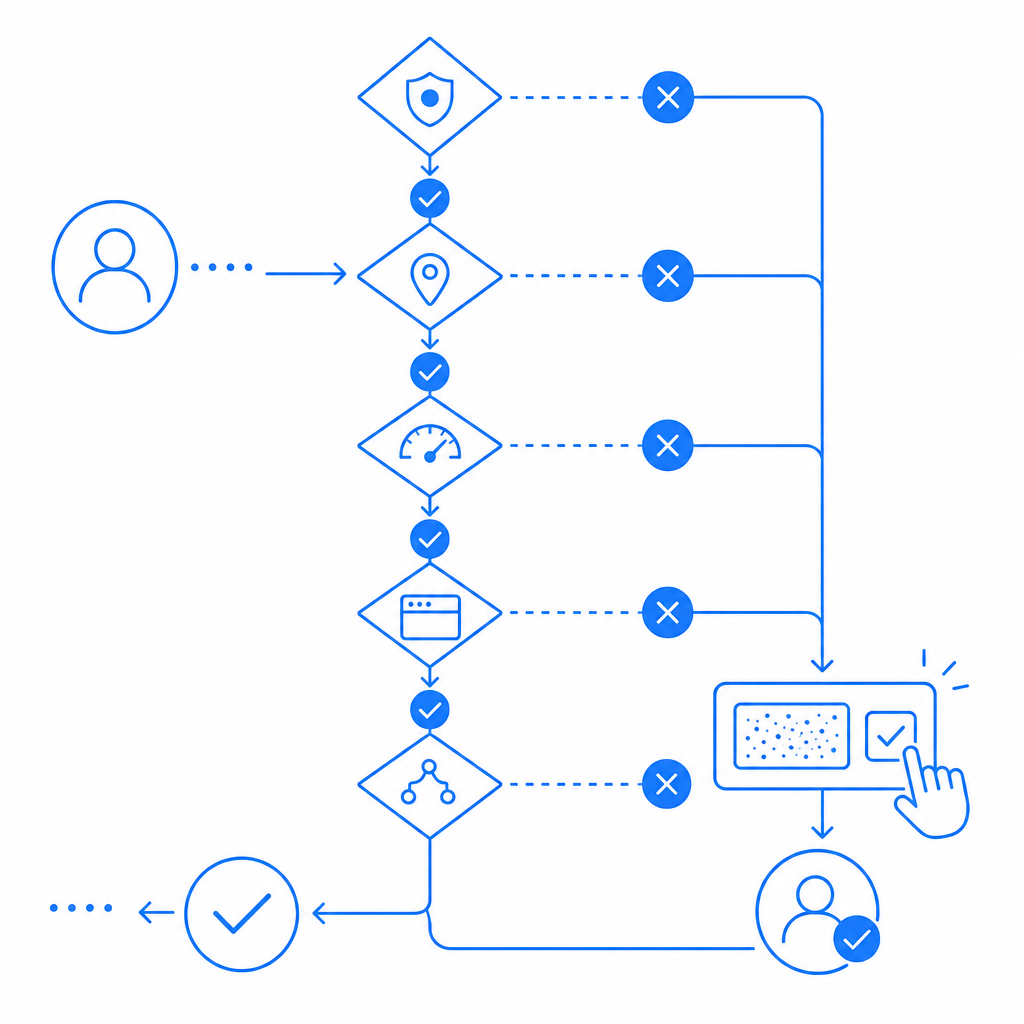
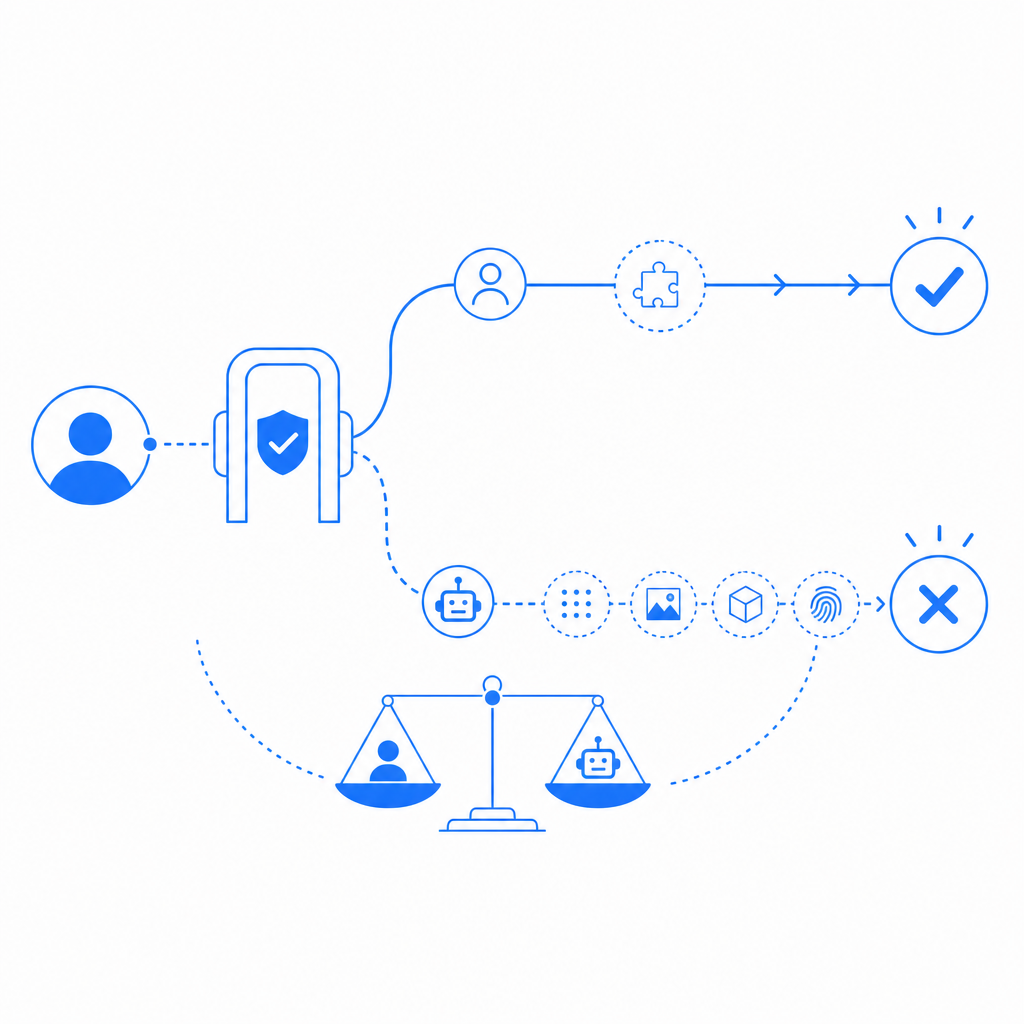
Modern services like CaptchaLa, Cloudflare Turnstile, and reCAPTCHA’s invisible mode aim to minimize visible challenges by using underlying risk analysis and behavioral signals to only present CAPTCHAs when suspicious activity is detected. This “adaptive challenge” approach lets most users pass through seamlessly.
Additionally, multilingual UI and accessible design are crucial for worldwide audience retention—a focus area for CaptchaLa’s 8 UI languages and clean challenge design.
While hCaptcha provides privacy advantages, some users find its challenges more complex than Google’s. Therefore, testing and monitoring human success rates and fallback scenarios is important post-deployment.
Cost and Privacy Considerations
Free CAPTCHA options exist, but businesses with moderate to high traffic volumes will need scalable paid tiers. CaptchaLa offers a free tier up to 1000 monthly solves, Pro plans accommodating 50K-200K solves, and Business plans handling 1 million solves, with transparent pricing.
Privacy is another deciding factor. CaptchaLa emphasizes first-party data collection, avoiding third-party analytics scripts that can track users across the web, unlike some other popular alternatives. This can better align with GDPR and CCPA compliance goals.
If privacy and data control are priorities, favoring CAPTCHA tools like CaptchaLa or Cloudflare Turnstile makes sense. For maximum traffic volumes, evaluate pricing carefully against your expected usage.
Conclusion: Selecting the Right CAPTCHA
The best captcha service for your site balances robust bot defense, minimal user friction, developer-friendly integration, privacy, and scalability. While Google reCAPTCHA remains popular, its tracking and limited platform support may not fit all needs. hCaptcha provides privacy but can affect user ease. Cloudflare Turnstile is lightweight and invisible but web-only.
CaptchaLa offers an appealing middle ground with:
- Native SDKs across web, mobile, and desktop
- Simple, secure APIs for challenge issuance and validation
- Multilingual UI and adaptable challenges
- Transparent, scalable pricing with a useful free tier
- Privacy-first data handling with first-party-only data collection
This versatility makes it a compelling choice for teams seeking customizable, user-friendly bot defense.
Where to go next? Check out CaptchaLa’s pricing plans or dive into the comprehensive documentation to explore integrating advanced CAPTCHA protection on your platform.