
Amazon anti scraping is not about one magic filter; it is a layered defense program that combines rate limiting, bot detection, challenge flows, device and session signals, and careful server-side validation. If you run a marketplace, reseller portal, price-monitoring-sensitive catalog, or any workflow that resembles Amazon’s risk profile, the goal is to slow automation without punishing legitimate users.
The hard part is that scraping traffic rarely looks obviously malicious at first glance. It often borrows real browsers, residential IPs, and human-like pacing. That means the right answer is not “block everything suspicious,” but “collect enough high-signal context to score requests accurately, then challenge or throttle only when needed.”
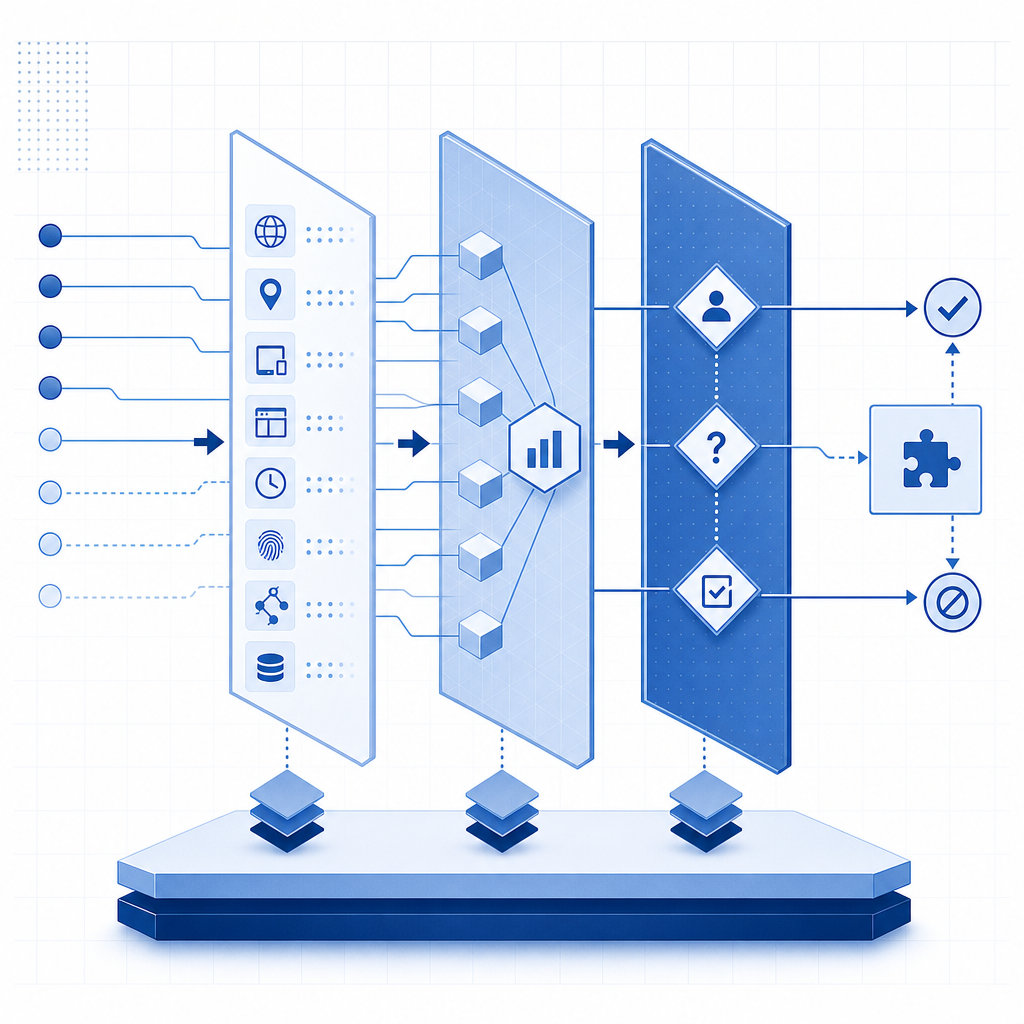
What amazon anti scraping actually needs to stop
The phrase “amazon anti scraping” usually refers to protecting pages, APIs, and workflows that are valuable to bots because they expose pricing, inventory, reviews, rank data, or account actions. The defenses need to handle more than simple crawlers. They also need to handle distributed automation, replay attempts, token reuse, and scripts that behave just enough like browsers to avoid naive rules.
A practical defense model starts with a few clear objectives:
- Preserve access for real users and internal services.
- Detect automated request patterns early, before data is extracted at scale.
- Make replayed sessions or forged client state useless.
- Keep friction low for low-risk traffic and only escalate when confidence drops.
- Maintain server-side control so client-side scripts cannot be trusted on their own.
The mistake many teams make is treating anti-scraping as a frontend problem. It is not. A bot can mimic DOM interaction, but it cannot easily fake a server-verified challenge result, a coherent session lifecycle, and clean request timing across many endpoints.
The signals that matter
You do not need every signal under the sun. You need the ones that are difficult to fake together:
- Request velocity per IP, per account, and per device fingerprint
- Session continuity and token reuse patterns
- Header consistency across requests
- Timing gaps between page load, challenge, and submit
- ASN, geo, and network reputation
- Endpoint sensitivity, such as search, pricing, login, and checkout-adjacent flows
The goal is to combine them into a risk score that decides whether to allow, challenge, or deny. For that reason, many teams use a bot-defense layer in front of sensitive routes and keep the final decision on the server.
A layered control plan for high-value traffic
For “amazon anti scraping” use cases, a good pattern is to use lightweight friction first and stronger challenges only when the risk score justifies it. That avoids turning your site into a maze for normal shoppers.
Here is a simple comparison of common approaches:
| Control | What it catches well | Limits |
|---|---|---|
| Static IP blocks | Repeat offenders, obvious abuse | Easy to rotate around |
| Rate limiting | Bursts and high-volume scraping | Can hurt shared NAT users |
| Fingerprinting | Reused clients and scripted stacks | Must be maintained carefully |
| CAPTCHA challenge | Uncertain or suspicious traffic | Adds user friction |
| Server-token validation | Replay and forged client state | Needs backend integration |
A challenge is only useful if the server can verify it. That is why client-only “proof” is not enough. When a user or bot completes a challenge, your backend should validate the result before granting access to the protected action.
For example, CaptchaLa supports native SDKs for Web (JS, Vue, React), iOS, Android, Flutter, and Electron, plus server SDKs for captchala-php and captchala-go. That matters because anti-scraping defenses often need to work across browser and app surfaces, not just a single page.
If you want a simple implementation sequence, use this:
- Place the challenge on the most sensitive entry point, not everywhere.
- Send the challenge result to your backend.
- Validate server-side with
POST https://apiv1.captcha.la/v1/validate. - Include
pass_tokenandclient_ipin the body. - Authenticate with
X-App-KeyandX-App-Secret. - Accept the request only after validation succeeds.
- Log the outcome with risk metadata for tuning later.
# Example validation flow
# 1. User completes challenge in the client
# 2. Client sends pass_token to the server
# 3. Server verifies with CaptchaLa
POST /v1/validate
Body:
  pass_token: "..."
  client_ip: "203.0.113.10"
Headers:
  X-App-Key: "your_app_key"
  X-App-Secret: "your_app_secret"

# 4. Only then allow the protected request
CaptchaLa also provides a server-token endpoint at POST https://apiv1.captcha.la/v1/server/challenge/issue, which is useful when your backend needs to initiate a challenge-driven flow for a trusted client path.
Where existing tools fit, and where they do not
Teams often compare reCAPTCHA, hCaptcha, and Cloudflare Turnstile when planning anti-scraping controls. That comparison is reasonable, but the right choice depends on the problem you are solving.
- reCAPTCHA is widely recognized and has broad ecosystem support.
- hCaptcha is often chosen for a stronger privacy posture in some deployments.
- Cloudflare Turnstile is attractive when you already use Cloudflare edge services and want low-friction verification.
- A dedicated bot-defense layer like CaptchaLa can be a better fit when you want explicit control over challenge flows, server validation, and product integration across apps and web.
The key distinction is not brand preference; it is control surface. If your concern is amazon anti scraping, you want tools that help you make request-level decisions based on your own first-party data. That means the system should work from the signals you already own: session behavior, client integrity, server logs, and challenge outcomes.
CaptchaLa’s deployment model is straightforward enough for teams that need quick rollout without giving up backend control. It supports 8 UI languages, ships a loader at https://cdn.captcha-cdn.net/captchala-loader.js, and has package options that fit common stacks, including Maven la.captcha:captchala:1.0.2, CocoaPods Captchala 1.0.2, and pub.dev captchala 1.3.2.
Choosing a friction level
A good rule: if the endpoint is informational, use soft controls. If it is valuable, authenticated, or inventory-sensitive, increase friction.
- Search and browse: rate limit plus passive scoring
- Login and account creation: challenge on suspicious patterns
- Price checks and catalog exports: stricter validation and quotas
- Checkout and fulfillment-adjacent actions: strongest verification, shortest-lived tokens
That keeps the business impact aligned with the risk. It also avoids teaching attackers exactly where the hard wall is.
Operational details that make the defense hold up
Anti-scraping fails when it is deployed once and never tuned again. The most effective programs treat bot defense as an operations loop.
First, log decisions with enough detail to explain them later. A request that was challenged should carry the reason code, the endpoint, the session age, and the validation outcome. Second, review false positives regularly. Shared networks, mobile carriers, and enterprise proxies can make traffic look weird without being abusive. Third, use first-party data only. That gives you cleaner signal ownership and reduces dependency on brittle third-party heuristics.
It also helps to separate the policy from the implementation. Your policy might say, “challenge when a request exceeds a per-session threshold and shows inconsistent client metadata.” Your implementation can then enforce that policy in one place, across web and app clients.
A small example of how that policy might read in pseudo-logic:
if endpoint in sensitive_endpoints:
  risk = score(ip, session, device, timing, reputation)

  if risk >= 80:
    deny()
  else if risk >= 50:
    require_challenge()
  else:
    allow()
This kind of structure is easier to maintain than a pile of one-off WAF rules. It also scales better when your product grows into more surfaces or when automated traffic changes shape.

Conclusion: build for attackers that adapt
Amazon anti scraping works best when it assumes attackers will adapt. That means your defense must be layered, server-verified, and tuned using the traffic you actually see. If you start with clear risk thresholds, validate challenge results on the backend, and keep friction proportional to sensitivity, you can protect valuable flows without turning real users away.
Where to go next: review the implementation details in the docs or compare plans on pricing.