
If you're building an app that integrates with Bluesky — whether that's a third-party client, a feed generator, a registration flow, or an AT Protocol-based service — you already know bots are a real problem. Automated account creation, spam replies, and credential-stuffing attacks hit Bluesky-connected surfaces just like any other open platform. A bot detector for Bluesky isn't a single magic API; it's a layered approach that combines behavioral signals, challenge-response verification, and server-side validation.
Why Bluesky Attracts Bot Traffic
Bluesky's AT Protocol is open by design. That openness is great for interoperability, but it also means that anyone can script account interactions, crawl public data aggressively, or spin up fake identities at scale. Common abuse patterns on Bluesky-adjacent apps include:
- Bulk account registration — bots filling sign-up forms faster than humans can
- Automated follow/like/repost loops — inflating engagement metrics
- Credential stuffing — replaying leaked username/password pairs against login endpoints
- Feed spam — posting promotional or harmful content through automated clients
Because many Bluesky clients are open-source or expose public API endpoints, attackers have plenty of surface area to target. The defender's job is to add friction at the right points without punishing legitimate users.
What a Bot Detector Actually Checks
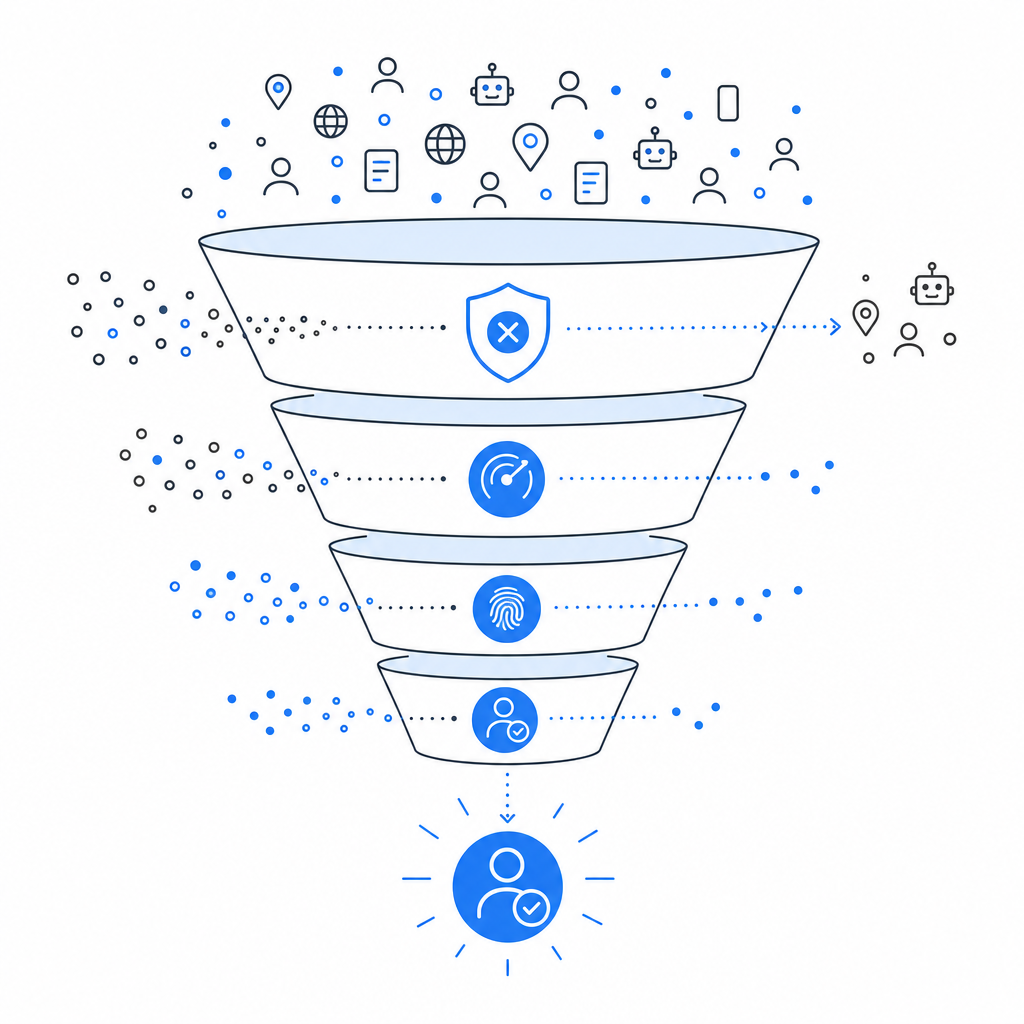
A useful bot detector combines several signal types. No single signal is enough on its own.
Behavioral signals
Mouse movement patterns, touch event sequences, scroll behavior, and time-on-page are hard to fake at scale. Real users exhibit micro-inconsistencies that headless browsers and simple scripts tend to smooth out. These signals feed into a client-side risk score before any challenge is issued.
Device and environment fingerprinting
Detecting headless Chromium, mismatched browser APIs, WebGL anomalies, or suspiciously clean browser environments helps identify automated agents. This is a passive check that runs silently on page load.
Challenge-response verification
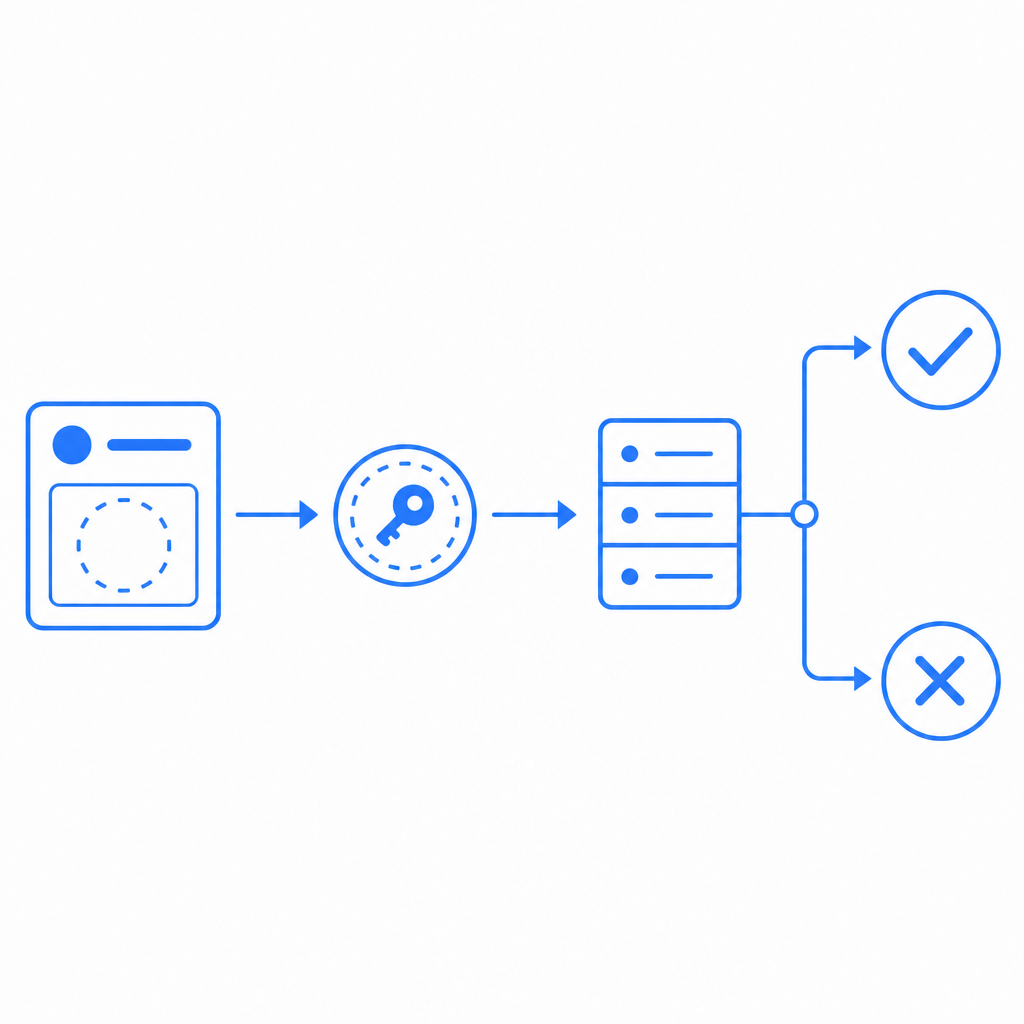
When passive signals flag a session as risky, an explicit challenge (visual puzzle, invisible proof-of-work, etc.) is issued. The user solves it; the client receives a short-lived pass_token; your server validates that token before completing the action.
IP and rate signals
High request rates from a single IP, known datacenter ranges, and Tor exit nodes are strong bot indicators. These are best combined with behavioral signals rather than used as hard blocks, since shared IPs and VPNs can affect real users.
Comparing Bot Detection Options for Bluesky Apps
| Tool | Primary model | First-party data | Free tier | Notes |
|---|---|---|---|---|
| reCAPTCHA v3 | Score-based, no challenge | No (Google) | Yes | Data shared with Google |
| hCaptcha | Challenge-based, privacy-focused | No (hCaptcha) | Yes | Reasonable friction |
| Cloudflare Turnstile | Invisible / managed challenge | Partially | Yes | Tied to Cloudflare network |
| CaptchaLa | Challenge + behavioral scoring | Yes | 1,000/mo free | Self-contained, no third-party data sharing |
The "first-party data" column matters more than it used to. Bluesky developers often care about user privacy and decentralization as values — sending behavioral telemetry to a third-party ad network can conflict with that. CaptchaLa processes verification data without sharing it with third parties, which tends to fit AT Protocol project values reasonably well.
Implementing Token Validation in Your Bluesky App
Here's a practical example of server-side validation after a user completes a challenge. The pattern works for any registration or login endpoint your Bluesky client calls.
// server.js (Node.js example)
// After the client solves the CAPTCHA, it sends pass_token with the request.
// Your server validates it before creating the Bluesky account or session.

async function validateCaptchaToken(passToken, clientIp) {
  const response = await fetch('https://apiv1.captcha.la/v1/validate', {
    method: 'POST',
    headers: {
      'Content-Type': 'application/json',
      'X-App-Key': process.env.CAPTCHALA_APP_KEY,
      'X-App-Secret': process.env.CAPTCHALA_APP_SECRET,
    },
    body: JSON.stringify({
      pass_token: passToken,  // token received from the client widget
      client_ip: clientIp,    // forward the end-user's IP for scoring
    }),
  });

  const result = await response.json();
  // result.success === true means the challenge was genuinely solved
  return result.success === true;
}

// Usage inside your registration handler:
// if (!(await validateCaptchaToken(req.body.passToken, req.ip))) {
//   return res.status(403).json({ error: 'Bot verification failed' });
// }
Load the client-side widget by adding the loader to your page:
<!-- Add this to your registration or login page -->
<script src="https://cdn.captcha-cdn.net/captchala-loader.js" async></script>
For Flutter-based Bluesky clients (a growing category), the captchala 1.3.2 package on pub.dev provides a native widget that handles the challenge flow and returns a pass_token you can send to your AT Protocol PDS or relay server for validation.
Tuning Your Bot Defense for Bluesky Workflows
Bluesky apps have some quirks that affect how you should configure bot detection:
- AT Protocol DID resolution is slow — don't gate DID creation or resolution behind a hard CAPTCHA wall; target the account registration step that precedes it.
- Feed generators receive automated requests legitimately — crawlers from the Bluesky infrastructure itself are not bots. Use the server-token endpoint (
POST https://apiv1.captcha.la/v1/server/challenge/issue) to pre-issue challenges only for human-facing flows, not feed API calls. - Mobile clients dominate — the iOS (CocoaPods
Captchala 1.0.2) and Android (Mavenla.captcha:captchala:1.0.2) SDKs use native interaction signals that are more reliable than mobile web fingerprinting. If you're building a native Bluesky client, prefer the native SDK over a WebView-embedded widget. - Rate limiting is complementary, not a replacement — challenge-response verification stops low-volume, targeted attacks that rate limiting misses entirely.
The CaptchaLa docs include an AT Protocol integration guide that covers these edge cases in more detail.
Where to Go Next
Bot detection on Bluesky-connected apps is genuinely solvable without adding heavy friction for real users. The key is combining passive behavioral scoring with an explicit challenge only when risk is elevated, then validating server-side before any irreversible action (account creation, posting, following) completes.
If you want to try this in your own project, CaptchaLa's free tier covers 1,000 verifications per month — enough to test across a full staging environment and early production traffic before committing to a plan. The docs have quickstart guides for JS, React, Vue, Flutter, iOS, and Android.