
Bot detection using mouse movements works by recording how a pointer moves across a screen and comparing that trajectory against known patterns of human behavior. Bots either produce no mouse events at all, generate perfectly linear paths, or replay scripted gestures — all of which diverge statistically from the irregular, slightly jittery motion real users produce. These deviations are measurable and form the basis of behavioral bot detection.
Why Mouse Data Is Useful for Bot Detection
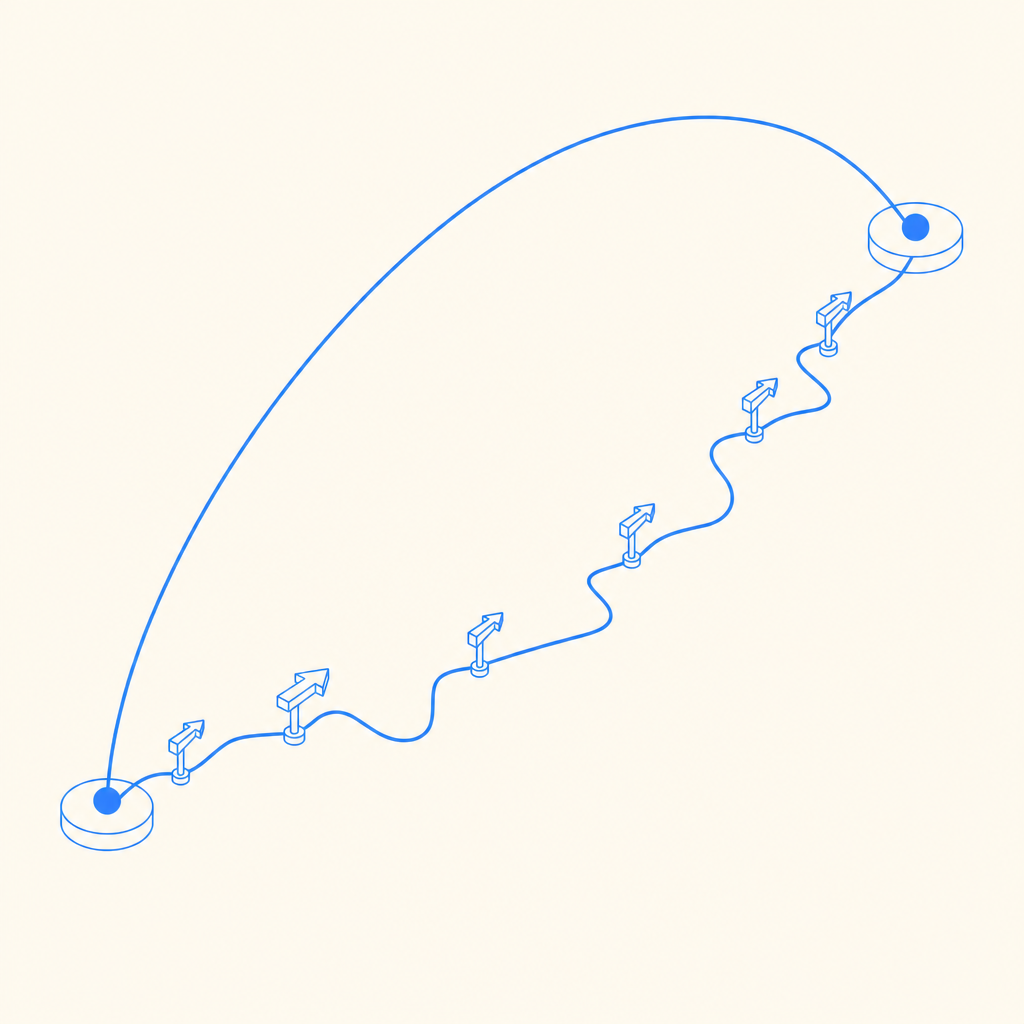
Keyboards can be scripted exactly. Form fields can be filled programmatically. But mouse movement is harder to fake convincingly at scale because authentic human motion is the product of the neuromuscular system — continuous micro-corrections, varying acceleration, and subtle overshoot patterns when approaching a click target.
When you capture mousemove events in a browser, you get a time-stamped sequence of (x, y) coordinates. From that sequence, defenders derive features like:
- Velocity profile — does speed ramp up and slow down naturally, or is it constant?
- Angular jitter — small random fluctuations in direction that appear in human movement but not in linear interpolation
- Fitts's law compliance — human movement toward a target slows as it approaches; automated movement often doesn't
- Pause/resume patterns — humans pause before clicking; bots often transition directly from movement to click event
- Event rate — browsers fire
mousemoveat ~60 Hz under normal conditions; scripted injection often shows unnaturally even intervals or suspiciously high rates
These features are not definitive on their own. A low-quality mouse, a trackpad, or a user with a motor impairment will each produce atypical patterns. That's why mouse signal is almost always combined with other behavioral signals — keystroke timing, scroll events, touch pressure on mobile, and passive device fingerprinting — rather than used as the sole gate.
Signal Extraction: What Defenders Actually Collect
Here's a minimal example of what a client-side signal collector might look like before the data is sent to a scoring endpoint:
// Collect mouse movement samples for behavioral analysis
const samples = [];

document.addEventListener('mousemove', (e) => {
  samples.push({
    x: e.clientX,
    y: e.clientY,
    t: performance.now(), // high-resolution timestamp
    buttons: e.buttons,   // which buttons are held
  });
});

// Compute average velocity between consecutive samples
function computeVelocities(pts) {
  return pts.slice(1).map((pt, i) => {
    const prev = pts[i];
    const dx = pt.x - prev.x;
    const dy = pt.y - prev.y;
    const dt = pt.t - prev.t; // milliseconds
    return Math.sqrt(dx * dx + dy * dy) / (dt || 1); // pixels per ms
  });
}

// Compute angular change between consecutive movement vectors
function computeAngularDeltas(pts) {
  return pts.slice(2).map((pt, i) => {
    const a = pts[i], b = pts[i + 1];
    const v1 = { x: b.x - a.x, y: b.y - a.y };
    const v2 = { x: pt.x - b.x, y: pt.y - b.y };
    const dot = v1.x * v2.x + v1.y * v2.y;
    const mag = Math.hypot(v1.x, v1.y) * Math.hypot(v2.x, v2.y);
    return mag > 0 ? Math.acos(Math.min(1, dot / mag)) : 0; // radians
  });
}
This raw feature data is typically compressed and hashed before being transmitted to avoid exposing the exact signals to adversaries. The server-side model then scores it.
How Different CAPTCHA Systems Use Behavioral Signals
Mouse movement analysis is not unique to one vendor — it appears across the major bot-defense services, though implementation depth varies.
| System | Mouse/Behavioral Signals | Friction for User | Notes |
|---|---|---|---|
| reCAPTCHA v3 | Yes — passive, score-based | None (invisible) | Score returned to server; no challenge |
| hCaptcha | Yes — used during image challenge | Medium | Also offers passive mode |
| Cloudflare Turnstile | Yes — behavioral + device signals | Low (mostly invisible) | Focuses on passive detection |
| CaptchaLa | Yes — behavioral signals behind token flow | Low | First-party data, no cross-site tracking |
Each system must balance detection accuracy against false-positive rate. Making behavioral thresholds too strict will fail legitimate users with unusual input devices or accessibility needs.

Mobile and Non-Mouse Environments
On touchscreen devices, there is no mousemove stream. Defenders shift to equivalent signals:
- Touch trajectory — finger path from
touchstarttotouchend - Pressure and radius —
Touch.forceandTouch.radiusX/Yvary naturally with a real finger - Swipe velocity curves — similar Fitts's law expectations apply
- Gyroscope micro-motion — very slight device tilt during interaction that bots running in emulators cannot reproduce
CaptchaLa ships native SDKs for iOS (CocoaPods Captchala 1.0.2), Android (Maven la.captcha:captchala:1.0.2), and Flutter (pub.dev captchala 1.3.2) so that behavioral collection is consistent across platforms rather than being bolted on per-app. The pass_token produced on-device gets validated server-side the same way as on web:
// Server-side token validation (Go)
// POST https://apiv1.captcha.la/v1/validate
// Headers: X-App-Key, X-App-Secret
// Body: { pass_token, client_ip }
resp, err := validateToken(passToken, clientIP, appKey, appSecret)
if err != nil || !resp.Success {
    // Reject the request or require additional verification
}
Limitations and Attack Resistance
Sophisticated bots do attempt to defeat mouse-based detection. Common techniques include replaying recorded human sessions, adding Gaussian noise to linear paths, or using browser automation patches that suppress automation flags. Defenders counter this through:
- Session uniqueness checks — replayed sessions are flagged if challenge tokens match previously used values
- Consistency scoring — if mouse data looks human but device fingerprint or timing data looks automated, the combined score drops
- Entropy thresholds — genuine human paths have measurable unpredictability; purely noised linear paths often fall outside the expected entropy range for real cursors
- Short validity windows — tokens expire quickly, making replay less useful
No single signal wins permanently. The cat-and-mouse dynamic between bot operators and defenders is ongoing, which is why scoring models need regular retraining on fresh traffic.
Where to go next: If you want to see how these behavioral signals fit into a full token validation flow, the docs walk through integration for Web, mobile, and server SDKs. The free tier covers 1,000 verifications per month — enough to evaluate signal quality on real traffic. Check pricing to see what fits your volume.